


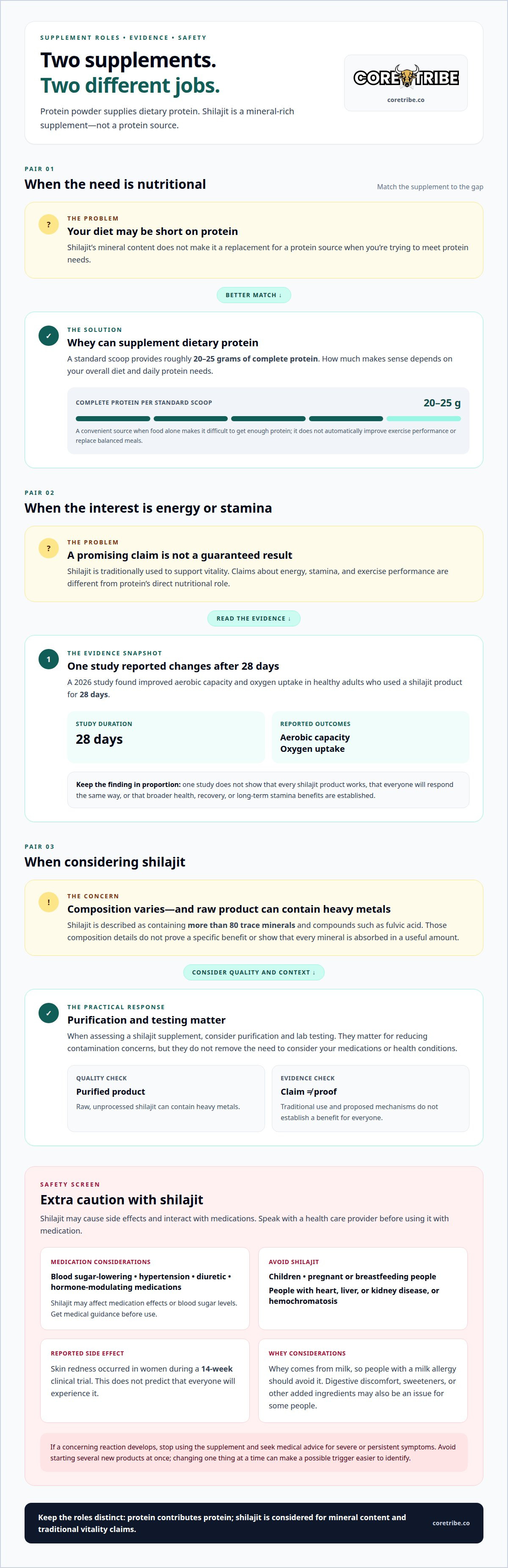
The more exotic supplement isn’t a substitute for the one that supplies protein. In the shilajit vs protein powder comparison, the key difference is their role: a standard scoop of whey provides roughly 20-25 grams of complete protein, while shilajit is a mineral-rich supplement, not a protein source.
If you train regularly, it’s natural to wonder whether shilajit can support the same goals as protein powder, or whether both could fit your routine. The shilajit vs protein powder choice comes down to what you want each supplement to contribute. They may sit alongside each other, but they aren’t interchangeable.
This guide explains potential benefits, risks, and ways to fit both into your routine. Comparing shilajit vs protein powder can help you weigh the evidence, consider timing, and choose based on your nutritional needs.
Key Takeaways
- Protein powder supplies dietary protein; shilajit serves a different role and shouldn’t replace a protein source when you’re trying to meet your protein needs.
- Explore the potential benefits of shilajit with a clear view of the limits: promising claims aren’t the same as well-established results.
- Learn why product purity matters and which health conditions or medications make extra caution important.
- Consider timing supplements around your routine and nutrition goals, rather than assuming a particular schedule is essential.
- See how shilajit and whey protein may fit together while keeping their distinct purposes in mind.
What are the claimed benefits of shilajit?
Shilajit is promoted for energy and stamina, while protein powder supplies dietary protein. A 2026 study reported improved aerobic capacity and oxygen uptake after healthy adults used a shilajit product for 28 days.
Claimed Energy and Stamina Effects
Shilajit is traditionally used to support vitality, and some supplement claims link it with energy, stamina, and exercise performance. This may interest people hoping to feel more resilient during training, but these claims differ from protein’s direct nutritional role.
The 2026 study offers a specific example: healthy adults using a shilajit product for 28 days had improved aerobic capacity and oxygen uptake. That finding is promising, but it describes one study and period. It doesn’t establish that every shilajit product improves exercise performance, or that the same effect applies to every person.
Energy also depends on practical factors such as sleep, food, hydration, and training load. Shilajit shouldn’t replace these foundations. If your stamina dips during exercise, a study is a reason to understand the evidence, not proof of a predictable boost.
Potential Benefits and Evidence Limits
Potential benefits describe effects shilajit may have beyond basic nutrition, including support for vitality and physical performance. The distinction matters: traditional use and proposed mechanisms don’t establish a treatment or prove a benefit for everyone.
Shilajit is described as containing more than 80 trace minerals, alongside compounds such as fulvic acid. That composition helps explain its appeal as a mineral-rich supplement. It doesn’t show that the body absorbs every mineral in a useful amount, or that a product delivers a specific outcome.
Product quality matters, too. Raw, unprocessed shilajit can contain heavy metals, so purification and testing are important when assessing a supplement. Composition and processing vary, which makes broad claims about “shilajit” difficult to apply to every product.
Keep benefit claims in proportion to the evidence. One result involving aerobic capacity doesn’t prove wider effects on health, recovery, or long-term stamina. Ask whether a claim relates to an outcome that has actually been studied, rather than whether it simply sounds plausible.
Nutritional Benefits and Evidence-Based Uses
Shilajit offers mineral compounds, but it isn’t a substitute for protein. Protein powder has a clearer nutritional use: a standard scoop of whey provides roughly 20-25 grams of complete protein, which can help supplement dietary protein.
For example, someone who struggles to get enough protein from food may use whey as a convenient source. The amount that makes sense depends on their overall diet and daily protein needs. Powder adds protein, but it doesn’t automatically improve exercise performance or replace balanced meals.
Shilajit’s evidence-based uses are narrower. The 28-day study reported changes in aerobic capacity and oxygen uptake, but that single finding doesn’t make shilajit a protein source or establish a broad health benefit. Its mineral content and fulvic acid are composition details, not proof of a specific result.
In practice, the two supplements address different needs. Protein powder contributes protein; shilajit is considered for its traditional vitality claims and mineral content. Keeping these roles separate makes it easier to judge whether either addresses a real gap in your routine.
What Are the Side Effects?
Shilajit may cause side effects and interact with certain medications. Protein powder can also cause problems, depending on its ingredients and the person using it. Taking them together isn’t automatically unsafe, but shilajit may interact with blood sugar-lowering, hypertension, diuretic, and hormone-modulating medications. Consult a health care provider before combining supplements with medication.
Medication Interactions and Higher-Risk Situations
Shilajit may affect medication effects or blood sugar levels, so medication use is an important safety consideration. If you take blood sugar-lowering, diuretic, or hypertension medication, speak with a health care provider before using it. The same caution applies to antidiabetic, antihypertensive, and hormone-modulating medications.
Children, pregnant people, and breastfeeding people should avoid shilajit, as should people with heart, liver, or kidney disease or hemochromatosis. These conditions can affect how the body handles a supplement or its mineral content. For example, someone with hemochromatosis has a specific reason to be cautious about supplements that may contain minerals.
Raw, unprocessed shilajit can contain heavy metals. Purification and lab testing matter when reducing contamination concerns, but they don’t remove the need to consider personal health conditions or medication interactions.
Potential Side Effects
Side effects can vary with product composition and individual sensitivity. Skin redness occurred in women during a 14-week clinical trial of shilajit. That finding is a specific reported effect, not a complete account of every possible reaction or a prediction that everyone will experience redness.
Protein powder has different practical considerations. Whey comes from milk, so people with a milk allergy should avoid whey products. Some people may also experience digestive discomfort, and sweeteners or other added ingredients may not suit individual sensitivities. Read the ingredient list to spot an obvious mismatch.
Stop using a supplement if a concerning reaction develops, and seek medical advice for severe or persistent symptoms. Avoid starting several new products at once. Changing one thing at a time makes it easier to identify a possible trigger.
Cognitive and Neuroprotective Claims
Some discussions describe shilajit as supporting cognitive function or protecting brain health. These claims shouldn’t be treated as established uses based on the evidence described here, which does not establish a neuroprotective effect.
For example, a claim about focus or memory needs direct evidence for that outcome. Mineral content or a proposed biological mechanism alone can’t show that a supplement improves cognition. Keep brain-health claims separate from observed effects such as skin redness or medication interactions.
If you’re considering shilajit, explore shilajit supplement options with these safety factors in mind.
Limited clinical evidence
Research on shilajit has examined specific outcomes, doses, and groups, rather than proving broad benefits for everyone. Study design matters: a finding about collagen or bone markers doesn’t establish that shilajit prevents disease, improves every workout, or replaces a proven nutrition strategy.
What the studies have examined
A study in the Journal of Ethnopharmacology examined purified Himalayan shilajit supplementation in healthy male volunteers. Other research assessed daily doses of 500 milligrams and 1,000 milligrams over eight weeks for their effects on type 1 collagen synthesis. These details identify the ingredient, population, and outcome studied, not a general result for all users.
Researchers also studied 60 postmenopausal women, aged 45 to 65 years, with osteopenia. The trial compared 250-milligram and 500-milligram shilajit doses with a placebo. It examined bone loss, inflammation, and oxidative stress. Those measures can help researchers explore biological effects, but they don’t by themselves show that shilajit treats osteoporosis or prevents fractures.
Separate studies examined men: one compared daily doses of 250 milligrams and 500 milligrams with a placebo, while another evaluated muscle strength in 63 men. The presence of a placebo comparison helps frame what researchers measured. It doesn’t mean every study reached the same conclusion or that results apply to different populations.
How to interpret the findings
Look closely at the endpoint. A study about type 1 collagen synthesis asks a narrower question than one about strength or everyday function. Likewise, research involving postmenopausal women with osteopenia cannot automatically establish effects in healthy younger adults. Each population and outcome sets limits on interpretation.
Duration matters, too. The collagen study ran for eight weeks, so it can’t settle questions about long-term use. A change in a measured marker may guide further research, but it doesn’t demonstrate a lasting health benefit. The study’s dose and formulation also matter when comparing it with another product.
“Purified” describes processing, not clinical effectiveness. A purified ingredient may differ from raw material, but purity alone can’t prove that a supplement reduces inflammation, increases strength, or prevents disease. Evidence for one preparation shouldn’t automatically be applied to every shilajit supplement.
Use these studies as early evidence about defined questions, not as a universal promise. For example, someone considering shilajit for muscle strength should distinguish a trial measuring strength in 63 men from evidence about protein intake, recovery, or long-term training outcomes. Those are separate questions requiring their own evidence.
Supplement timing and use
Timing works best when it serves a clear purpose. Protein powder can help fill a dietary gap, while shilajit is used for a different reason. Before adding either, identify what you want it to contribute, then fit it around meals, exercise, and any medication schedule. Taking both at the same time isn’t essential to their distinct roles.
Fit whey protein around food and exercise
Use whey at a time that makes it easier to meet your daily protein target. For example, someone finishing exercise without an easy meal option might mix a serving as a convenient snack. Someone else may prefer it with breakfast or between meals. The useful timing is whatever complements food rather than displacing balanced meals.
Typical whey intake is 1-2 scoops, depending on a person’s total daily targets. That describes a common pattern, not a personal prescription. Your food choices, training, and overall nutrition needs shape whether a scoop is useful. If you already get enough protein from meals, adding powder simply because it’s a workout day may not serve a clear purpose.
Use shilajit consistently and cautiously
For shilajit, follow the directions for the specific supplement instead of borrowing a dose from a study or another product. Research has examined processed shilajit at 100-2,000 mg/day, but those study amounts aren’t a universal daily recommendation. Products can differ in formulation, so a dose from one trial cannot automatically guide another product’s use.
Choose a practical time you can remember, such as including it in an established morning routine. Pairing a supplement with a familiar daily habit can support consistency, but it doesn’t make the supplement more effective. Indian traditional use is part of shilajit’s history, but tradition alone doesn’t determine a modern product’s directions or suitability.
Keep a simple record when introducing supplements: note the product, serving, timing, and any noticeable effects. For example, if you start shilajit while also changing your whey powder, it’s harder to tell which change may relate to a new symptom. Introducing one change at a time gives you a clearer picture of your routine.
Take particular care with medication schedules. Shilajit can interact with blood sugar-lowering, hypertension, diuretic, and hormone-modulating medications. Consult a health care provider before using it if you take these medicines or have a relevant health condition. Don’t change a prescribed medication schedule to accommodate supplements without professional guidance.
Finally, taking more supplements doesn’t necessarily lead to better results. Focus on each product’s purpose, its label directions, and the role of food and exercise. A steady routine built around meals, training, and rest is more useful than treating timing as a shortcut.
Taking shilajit with whey protein
Shilajit and whey can fit into the same routine because they serve different purposes. The practical difference in shilajit vs protein powder is whether you want a source of dietary protein or are considering a separate supplement.
Muscle Growth and Recovery Comparison
Whey protein supplies protein that supports muscle growth and repair, while shilajit isn’t a protein replacement. That distinction matters after exercise: someone whose meals don’t provide enough protein may use whey to help fill the gap. Shilajit’s traditional use and performance claims don’t make it equivalent to protein for muscle recovery.
Using both means pursuing separate aims, not relying on a proven synergy. For example, someone could have whey with a post-workout snack and take shilajit at another time, following its product directions. The choice depends on what their routine needs. If protein intake is already sufficient, adding whey may not fill a meaningful gap.
Protein and Essential Amino Acid Content
Shilajit isn’t a meaningful source of dietary protein or essential amino acids. Its mineral and fulvic acid content describes a different kind of ingredient, so it can’t replace whey when the goal is to add protein to meals.
Whey supplies complete protein, including essential amino acids. For example, someone comparing a whey shake with a shilajit extract should count the shake toward dietary protein, not the shilajit. Shilajit vs protein powder is a comparison of distinct roles, not of which contains more of the same nutrient.
Taking both doesn’t mean mixing them into the same drink. If that makes the taste or texture unpleasant, keep them separate. Follow each product’s directions and introduce one change at a time. This makes it easier to notice whether a new product coincides with a reaction or digestive discomfort.
In the United States, supplement costs vary based on factors such as product format, serving count, formulation, and ingredients. Compare the amount per serving and intended use rather than treating shilajit and whey as interchangeable purchases. Compare products that serve the same need, not simply their package prices.
For muscle growth and recovery, whey is the direct choice when you need more dietary protein; shilajit has a different purpose. If you’re considering adding shilajit, explore shilajit supplement options and consider how they fit your routine.
A case study involved a 29-year-old man with toxic exposure to agricultural chemicals, a context distinct from routine decisions about combining supplements.
Coretribe
Coretribe offers shilajit options for readers considering how to incorporate it into a routine, while keeping its role distinct from protein powder. Options include Shilajit Supplements, Coretribe ® Pure Shilajit Capsules - Mixed Sea Moss & Ashwagandha, and Coretribe®Shilajit Honey Sticks.
Choose based on your priorities and the product directions, rather than expecting shilajit to replace dietary protein. Explore Coretribe’s shilajit offerings to find an option that suits your routine.
Make your next supplement choice intentional
Let your routine’s actual needs guide what you add next. If you’re deciding between shilajit and protein powder, focus on the role you want a supplement to play rather than expecting one product to cover every goal. A thoughtful choice can keep your plan simple and help you notice whether a new addition fits.
As you refine your routine, consider which product format and directions suit your habits. Coretribe offers shilajit options, including capsules and honey sticks, for readers exploring this supplement as part of their wellness approach.
Contact Coretribe with your supplement questions and take your next step with care and confidence.
Frequently Asked Questions
What Is Shilajit and Why Are Gym-Goers Obsessed With It?
Shilajit is a mineral-rich resin traditionally used to support vitality, and gym-goers may be drawn to claims about stamina and exercise performance. That interest doesn’t make it a substitute for training, food, or protein. For example, someone choosing a post-workout supplement should distinguish shilajit’s traditional role from whey’s direct contribution of dietary protein, then decide which need their routine actually has.
Are there safety concerns?
Yes. Raw, unprocessed shilajit can contain heavy metals, and it may interact with blood sugar-lowering, hypertension, diuretic, or hormone-modulating medications. Skin redness was reported during a clinical trial. Purity and personal health history matter, so anyone taking medication should discuss shilajit with a health care provider before use. Protein powder also requires attention to its ingredients and fit with individual dietary needs.
How Much Should I Take?
There isn’t one universal amount for every shilajit product. Follow the directions for the specific product rather than copying a dose from a research study. For whey, intake depends on how much protein you already get from meals and your daily target; a standard scoop provides roughly 20-25 grams of complete protein. For example, someone whose meals already meet their needs may not need an extra serving.
What Does the Science Say?
Studies have investigated specific outcomes, including aerobic capacity, collagen synthesis, muscle strength, and bone-related measures. For example, one study examined purified shilajit for type 1 collagen synthesis over eight weeks. These findings address defined outcomes and study groups; they don’t establish that shilajit treats disease or delivers the same effects for everyone. Whey’s clearer role is supplying protein, rather than proving a particular training result.
Who should avoid shilajit or protein powder, including people with kidney disease or pregnancy?
Children, pregnant or breastfeeding people, and people with heart, liver, or kidney disease or hemochromatosis should avoid shilajit. Anyone with kidney disease should discuss protein targets and powder use with a health care provider, since dietary needs can depend on their health situation. During pregnancy, don’t assume a supplement is suitable because it’s natural; review protein powder ingredients and use with a qualified provider.

