


The fastest path to recovery may begin with recognizing when post-workout pain isn’t ordinary soreness. Natural supplements for muscle soreness, including BCAAs, may support recovery, but they can’t tell you whether pain is a sign of injury. Delayed-onset muscle soreness usually starts a day or two after exercise, peaks 2-3 days later, and resolves within 5-7 days; injury pain is often felt immediately and can last from a week to months.
It’s understandable to want a clear way to ease stiffness and get back to training. This guide explains what to consider when choosing natural supplements for muscle soreness, how BCAAs and boswellia may fit into your options, and how to distinguish typical soreness from pain that deserves attention. You’ll also find practical ways to assess supplement quality and set realistic expectations, so you can make an informed choice about recovery.
Key Takeaways
- Learn how BCAAs may support muscle recovery and why dose, timing, and consistent use matter.
- Build recovery around the essentials: enough sleep, balanced nutrition, and hydration.
- Understand what to consider when evaluating boswellia and its potential role in pain and physical function.
- Recognize clues that may help distinguish ordinary post-workout soreness from a possible injury.
- Compare supplement options and look for quality indicators before deciding what may fit your recovery routine.
1. Branched-chain amino acids and muscle recovery
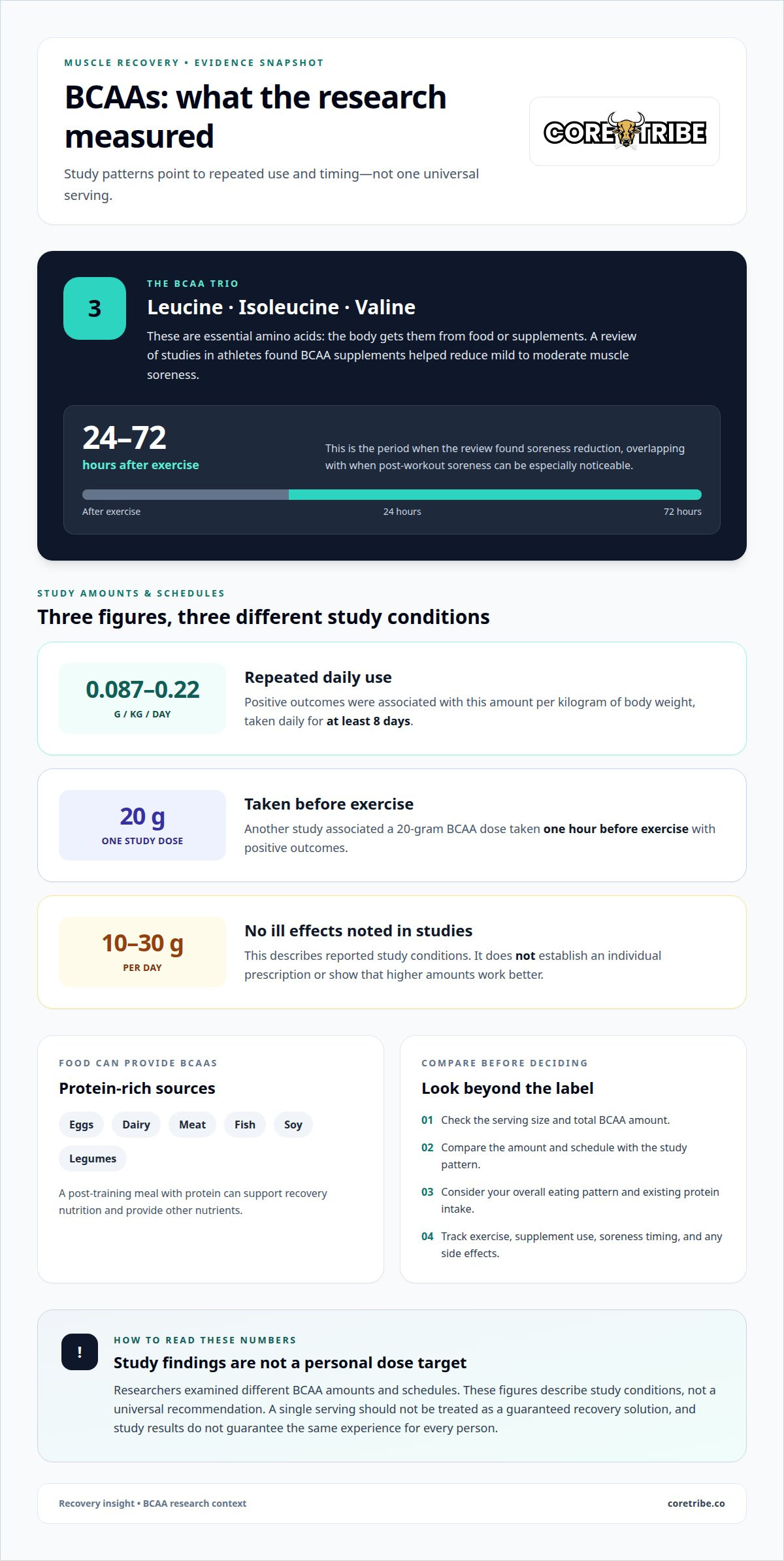
Branched-chain amino acids, or BCAAs, are leucine, isoleucine, and valine. They’re essential amino acids, meaning the body gets them from food or supplements. A review of studies in athletes found BCAA supplements helped reduce mild to moderate muscle soreness, especially 24 to 72 hours after exercise. That timing overlaps with the period when post-workout soreness can be most noticeable.
Research has examined different BCAA amounts and schedules, so a single dose shouldn’t be treated as a universal target. Positive outcomes were associated with 0.087-0.22 grams per kilogram of body weight per day for at least eight days. The studied duration also matters: these findings relate to repeated use, not just one serving after training.
Another study associated a 20-gram BCAA dose taken one hour before exercise with positive outcomes. Separately, studies reported no noted ill effects from doses of 10-30 grams per day. These figures describe study conditions, not an individual prescription. They also don’t establish that a higher amount works better. When comparing products, check the serving size and total BCAA amount, then consider how it fits with your overall eating pattern.
You can get BCAAs from food without taking a dedicated supplement. Eggs, dairy, meat, fish, soy, and legumes all provide protein containing amino acids. A post-training meal with a protein source can support recovery nutrition and provide other nutrients. If your usual meals already include protein-rich foods, a BCAA product may add less than expected. Compare your overall intake, not just the supplement label.
Omega-3 fatty acids are another recovery option, with research examining inflammation and muscle recovery. A systematic review of 13 studies suggested omega-3s may improve muscle recovery when taken for over 4 weeks. They may be more effective when already present in the body before exercise, making consistent intake more relevant than a single post-workout serving. Food sources include oily fish, while supplements offer another way to consume omega-3s.
Joint symptoms deserve separate attention from muscle soreness. Omega-3s are studied in relation to joint symptoms and inflammation, but the reviewed recovery findings don’t establish them as a treatment for every source of joint pain. Note whether discomfort feels centered in a joint or in the muscles used during exercise. That distinction helps you judge whether a supplement aimed at general recovery matches the problem.
For either BCAAs or omega-3s, compare the ingredient amount with the study pattern, then track your training and symptoms. A simple record of exercise, eating, supplement use, and soreness timing can reveal whether a routine aligns with your recovery needs. Also note side effects if they occur, since an ingredient’s study results don’t guarantee the same experience for every person.
2. Choosing the right muscle recovery supplements
Start with recovery habits, not a supplement label. Sleep gives your body time to repair tissue, while meals provide protein and energy for training. Hydration matters too: replace fluids lost during exercise and drink regularly with meals rather than relying on a supplement to make up for inadequate fluids. A recovery product can complement these basics, but it cannot replace them.
Evidence varies by ingredient and outcome. Rest, sleep, and active recovery are practical foundations. Supplements have been studied for specific effects, but no universal ranking shows they work better than those basics. Treat a supplement as a targeted addition, not a substitute for your recovery routine.
Protein supplies amino acids used to build and repair muscle. The recommended daily protein intake for adults is 0.8 g per kg of body weight. Physically active people may aim for 1.4 g/kg to 2 g/kg per day to help provide enough for muscle repair. Spreading intake evenly over four meals may stimulate muscle growth more than an uneven pattern. Eggs, beans, yogurt, and fish are examples of foods that contain protein.
Vitamin D and calcium have different roles in bone health, so muscle soreness and fracture recovery shouldn’t be treated as the same problem. A review found that 2,000 IU of vitamin D taken for at least a week decreased muscle damage and inflammation after exercise. Calcium is a nutrient involved in bone structure, but these findings don’t establish a supplement dose or fracture-healing plan. A suspected fracture needs medical assessment rather than a muscle-recovery supplement.
Ashwagandha has also been studied in exercise recovery. The reviewed guidance identifies 600 mg daily as a potentially helpful amount. That figure is a study reference, not a direction for everyone; a product’s serving and other ingredients affect what a person consumes. Check the full label, especially when combining products.
For turmeric, daily extract doses of 1.5-5 grams have been considered for exercise recovery. Trying turmeric through daily food for three to six months is another approach described for assessing potential benefits. Ginger supplements have no dose or effectiveness finding in the facts available for this article, so don’t assume they reduce exercise-related soreness.
Studied amounts vary: examples include 2,000 IU of vitamin D for at least a week and 600 mg of ashwagandha daily. Supplement costs also vary with ingredient, serving size, and format, so there’s no single typical US cost. For a broader wellness routine, explore natural supplement options, while keeping recovery basics at the center.
3. Boswellia extract for pain and physical function
Boswellia is a plant-derived ingredient discussed in relation to pain and movement, but those outcomes need to be evaluated separately. Pain describes what someone feels; physical function describes what they can do. For example, an exercise-related assessment might record discomfort as well as whether someone can climb stairs, squat, or lift an arm. These measures answer different questions, so a change in one doesn’t automatically indicate a change in the other.
Studies of Boswellia are useful only when the tested extract and outcome match the question. The words “Boswellia extract” on a label don’t identify the preparation researchers evaluated. Look for the plant name, extract details, serving information, and other ingredients, then compare them with the study in question. A result for one preparation shouldn’t be assumed to apply to every product bearing the Boswellia name.
For post-exercise soreness, timing matters too. Note when discomfort starts, where it occurs, and how it changes during ordinary movement. For example, record soreness after a leg workout alongside how easily you walk downstairs. If a study measures pain in another setting or tracks a different outcome, its findings may not answer whether Boswellia helps with workout recovery.
Physical function is practical because it links a supplement claim to everyday activity. Choose a repeatable task, such as standing from a chair or reaching overhead, and note whether movement feels restricted. Keep exercise, rest, and other recovery habits consistent while observing changes. Otherwise, shifts in training load or sleep can make a supplement’s effects harder to interpret.
When reviewing studies, focus on four details: the participants, the exact Boswellia preparation, the comparison group, and the outcome measured. A study of people with ongoing joint symptoms doesn’t necessarily establish an effect on temporary muscle soreness after exercise. Likewise, a reported change in pain doesn’t prove improved strength or function. The population and measured result determine what a finding can reasonably support.
Safety matters in this decision too. Read the full supplement label, including additional ingredients and serving directions, rather than judging a product by its front-panel claims. Keep a record of the product, timing, exercise, and any side effects. Avoid starting several new supplements at once, since that makes it harder to identify what may relate to an unexpected reaction or change in symptoms.
Consider Boswellia based on evidence that directly examines the outcome you care about. For muscle soreness, look for studies involving exercise and soreness measures. For movement, look for a clear function measure, such as completing a familiar task. These distinctions help separate a promising claim from evidence that matches your recovery question, without confusing pain relief with restored strength.
4. Delayed-onset muscle soreness versus injury pain
Delayed-onset muscle soreness, or DOMS, often follows unfamiliar or demanding exercise. It typically begins a day or two after a workout, rather than during the activity. For example, thigh stiffness may appear the morning after a challenging strength session. DOMS usually peaks 2-3 days after exercise and resolves within 5-7 days. That gradual pattern can help distinguish it from pain that starts suddenly.
Injury pain often starts during exercise or just afterward. A sudden, sharp sensation while lifting, sprinting, or changing direction differs from soreness that develops later. Pain from a muscle injury can last from a week to months. Timing is a useful clue, but it cannot confirm the cause on its own. Note when the discomfort began and whether it followed a specific movement.
Location and movement offer more context. DOMS often affects muscles worked during a session, such as both calves after hill running. Injury pain may be concentrated in one area after a particular lift or awkward step. Compare how the area feels at rest and during a familiar movement, such as walking upstairs. Changes in symptoms over several days can provide useful context.
A simple record can make the pattern easier to understand. Write down the workout, when discomfort first appeared, where it is felt, and how it changes. For instance, note whether soreness started the day after squats or began immediately during a repetition. Track the next few days against the usual DOMS window of 5-7 days. A pattern that differs from typical delayed soreness deserves attention.
Tart cherry juice is another option studied for post-exercise recovery. The available findings report that most patients who find cherry juice helpful drink about one glass a day. This doesn’t establish that it works for everyone or treats an injury. Consider it a possible recovery aid, not a way to identify why pain started.
Supplements can affect how someone experiences soreness, but they don’t establish whether pain comes from DOMS or injury. For example, reduced discomfort after a supplement wouldn’t prove that a muscle has healed. Keep the onset, location, and duration in view, even if you’re using a recovery product. DOMS commonly peaks 2-3 days after exercise, while immediate pain suggests a different pattern worth assessing.
Use the timeline as a guide, not a diagnosis. DOMS usually eases within 5-7 days; muscle-injury pain may persist from a week to months. If pain began during a single movement, is unusually intense, or isn’t following the expected course, don’t rely on supplements alone. A clear record of the exercise and symptoms can help explain what changed and when.
5. Which natural supplements may help reduce muscle soreness after exercise?
Research has examined several ingredients for exercise recovery, but findings depend on the dose, schedule, and outcome measured. Natural supplements for muscle soreness may include BCAAs, omega-3 fatty acids, N-acetylcysteine, creatine, turmeric, or tart cherry juice. These options aren’t interchangeable. Consider what each study measured and whether its participants and use pattern resemble your situation before drawing conclusions.
N-acetylcysteine, or NAC, has been studied for athletic recovery at 1200-1800 mg per day. The reviewed information cautions that doses exceeding 70 mg per kg of body weight may cause negative side effects. These amounts describe study conditions, not an individual dosing plan. Compare a product’s labeled amount with the research context, and don’t assume a larger serving will provide greater benefit.
Creatine studies have also explored muscle outcomes during restricted movement. In two studies with positive results, participants took 5 grams per dose in four doses each day. That schedule belongs to those specific study conditions, so it shouldn’t be treated as a universal recovery routine. Consider the measured outcome and how it fits with your training and nutrition habits.
Turmeric has been examined both as a food and as an extract. One approach is including turmeric in daily eating for three to six months while assessing potential benefits. The reviewed information also identifies daily turmeric extract doses of 1.5-5 grams as a possible exercise-recovery approach. Food use and extract supplementation are different, so compare like with like.
Tart cherry juice is another food-based option. The reviewed information reports that most patients who find it helpful drink about one glass a day. That observation doesn’t show that every juice product has the same effect. If you try it, note the product, timing, workout, and soreness pattern to see how it fits your routine.
Before combining products, read each full label and compare ingredients and serving information. The guidance discussed here advises against combining supplements with one another or with anti-inflammatory drugs. It also states that the FDA has not approved any over-the-counter CBD products for pain. Keep these details in mind when assessing product claims. Trying one new supplement at a time can also make changes easier to track.
When comparing natural supplements for muscle soreness, focus on the exact ingredient, amount, schedule, and outcome studied. For example, NAC research evaluated 1200-1800 mg per day, while turmeric guidance distinguishes food use from extract. These comparisons can help you choose what to investigate further without treating a study result as a guarantee. To explore wellness options, browse natural supplement choices and consider how each product fits your recovery priorities.
Coretribe: Shilajit Supplements
Coretribe’s Shilajit Supplements are a natural option to consider as part of a broader wellness routine. Keep the evidence in perspective: these supplements are not established here as a treatment for muscle soreness or injury pain. Coretribe ® Pure Shilajit Capsules - Mixed Sea Moss & Ashwagandha combine shilajit with the named ingredients, while Coretribe®Shilajit Honey Sticks offer another format. Review each product’s ingredient information and serving directions to decide whether it suits your routine. Supplements are only one part of recovery, alongside sleep, nutrition, and appropriate movement. If pain starts during exercise or persists beyond the usual soreness pattern, focus on understanding its cause rather than relying on a supplement. Contact Coretribe with questions about its Shilajit Supplements.
Build a recovery routine that fits your next step
Use your next training cycle to notice what supports your recovery. Make one change at a time, keep your usual routine steady, and record how your body responds. This approach can help you make thoughtful decisions about natural supplements for muscle soreness without treating a product as a replacement for rest, balanced meals, or attention to unusual pain.
For a wellness routine that includes shilajit, Coretribe offers Coretribe ® Pure Shilajit Capsules - Mixed Sea Moss & Ashwagandha and Coretribe®Shilajit Honey Sticks. Revive Dress is another Coretribe offering. These products have different forms and purposes, so consider their product information in the context of your needs rather than assuming they address exercise soreness. If you’d like to explore your options, contact Coretribe to discuss your needs. Take your next step with care and choose a routine you can sustain.
Frequently Asked Questions
What helps muscles recover the fastest?
No single supplement is established as the fastest way to recover. A reliable starting point is to match training with enough sleep, regular meals containing protein, and fluids throughout the day. After a demanding session, gentle movement, such as an easy walk, can keep you active without repeating intense work on sore muscles. Supplements are optional additions, not substitutes for these recovery habits.
What should you look for in supplements for muscle recovery?
Look for a clear ingredient list, the amount of each ingredient per serving, and directions that explain daily intake. A certification seal from NSF International or U.S. Pharmacopeia (USP) can be another quality indicator on packaging. Read the full label, including blends, rather than relying on a front-label claim. Choose a product whose ingredients and studied use match your goal.
Why are muscles sore after working out?
Muscles can feel sore after exercise that is unfamiliar or more demanding than usual. For example, slowly lowering a weight or walking downhill loads muscles as they lengthen. The resulting soreness can make everyday actions, such as sitting down or taking the stairs, feel tender. That differs from sudden, sharp pain during a specific repetition, which can suggest an injury rather than delayed soreness.
What are the side effects and medication interactions of supplements for muscle soreness?
Side effects and interactions depend on the ingredients and amounts, so review the complete label before use. The guidance discussed here advises against combining supplements with one another or with anti-inflammatory drugs. For example, adding a second recovery formula can make total ingredient intake harder to track. Note what you take and any unexpected effects, and discuss possible interactions with a pharmacist or healthcare professional.
When should muscle soreness prompt medical care rather than supplement use?
Seek medical care if pain is severe, starts suddenly during exercise, limits normal movement, or keeps worsening instead of easing. For example, sharp pain during a lift is a reason not to treat the problem as routine post-workout soreness. Supplements don’t identify or repair an injury. If symptoms interfere with everyday activities or don’t follow the expected recovery pattern, having the cause assessed is more useful than adding another product.
What are the typical doses and costs of supplements studied for muscle soreness in the US?
Studied amounts include BCAAs at 0.087-0.22 grams per kg of body weight daily for at least eight days, vitamin D at 2,000 IU for at least a week, ashwagandha at 600 mg daily, and turmeric extract at 1.5-5 grams daily. Supplement costs in the US vary by ingredient, serving size, and format, so there is no single typical cost.

