


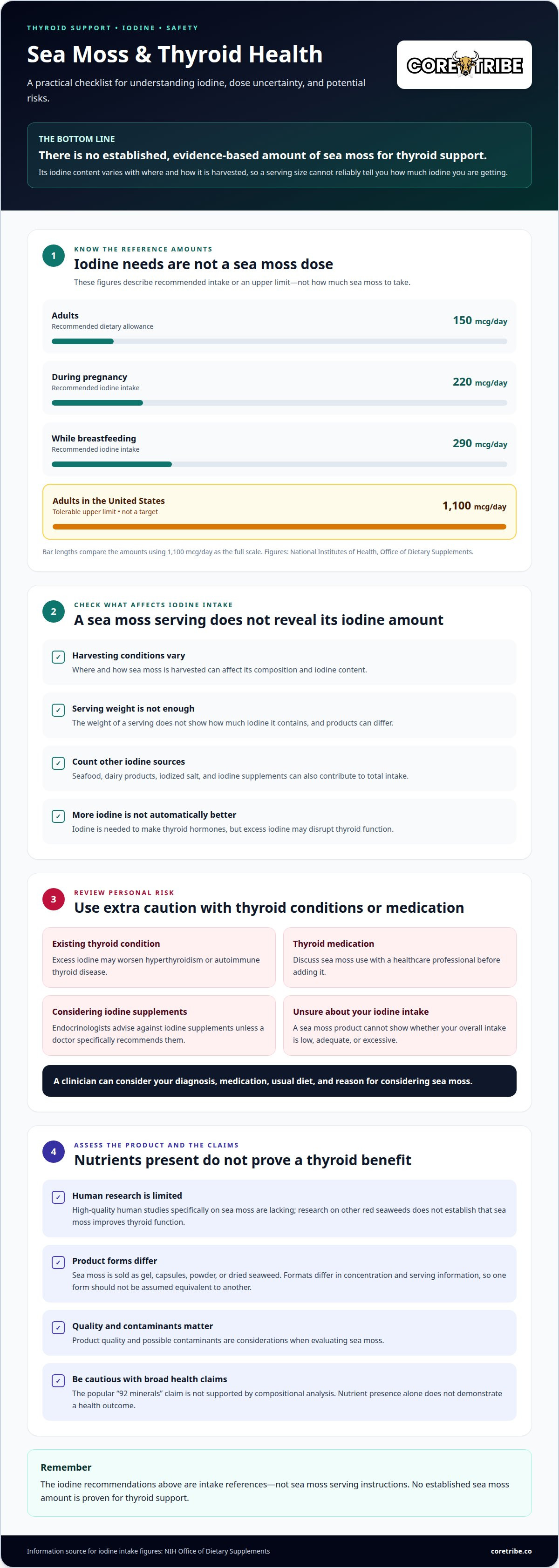
There’s no established amount of sea moss for thyroid function. Sea moss contains iodine, which the body needs to make thyroid hormones, but iodine levels can vary depending on where and how it’s harvested. More isn’t necessarily better: excess iodine may affect thyroid health.
It’s understandable to look for a natural way to support your well-being. But sea moss has no reliable, one-size-fits-all dose for thyroid support, and its variable iodine content makes it difficult to recommend a specific amount.
Here, you’ll learn how iodine relates to thyroid hormone production, why sea moss may pose risks for people with thyroid conditions or medication, and what to consider before using it. We’ll also explain why there’s no established amount to take for thyroid function.
Key Takeaways
- There’s no standardized, evidence-based daily dose of sea moss for thyroid support, so don’t treat a suggested serving as a proven thyroid dose.
- Sea moss iodine content varies with where and how it’s harvested, making its contribution difficult to estimate consistently.
- The tolerable upper limit for iodine intake is 1,100 mcg per day, according to the National Institutes of Health, Office of Dietary Supplements; this is a limit, not a target.
- If you have a thyroid condition or take thyroid medication, discuss sea moss use with a healthcare professional before adding it.
- Look beyond potential benefits: sea moss claims have limited human research, and product quality and possible contaminants are also relevant considerations.
Iodine and thyroid hormone production
Your thyroid uses iodine to make hormones, and sea moss can provide this mineral. However, iodine content varies with where and how it’s harvested, so a serving may not provide a consistent amount.
Sea Moss as an Iodine Source
Sea moss is a seaweed source of iodine, a dietary mineral the body needs to produce thyroid hormones. Because the body doesn’t make iodine, it must come from food or supplements. For someone with iodine deficiency, adequate iodine intake can support normal thyroid function.
The key uncertainty is how much iodine a product actually contains. Harvesting conditions affect sea moss composition, and products can differ. Serving weight alone doesn’t reveal iodine content. For people considering sea moss for thyroid function, this makes it difficult to estimate how much iodine a product contributes.
Other iodine sources include dairy products, seafood, and iodized salt. Sea moss may add to these dietary sources, but it can’t show whether someone’s overall intake is low, adequate, or excessive. That distinction matters because iodine is necessary, but too much can also affect thyroid health.
Iodine Intake Limits
The recommended dietary allowance is the daily intake intended to meet the needs of most healthy people in a group. According to the National Institutes of Health, Office of Dietary Supplements, the recommended dietary allowance for iodine for adults is 150 mcg per day.
During pregnancy, iodine needs rise to support the pregnant person and fetal development. According to the National Institutes of Health, Office of Dietary Supplements, the recommended iodine intake during pregnancy is 220 mcg per day. While breastfeeding, the recommended iodine intake is 290 mcg per day, according to the National Institutes of Health, Office of Dietary Supplements.
For adults in the United States, the recommended dietary allowance is 150 mcg per day, and the tolerable upper limit is 1,100 mcg per day, according to the National Institutes of Health, Office of Dietary Supplements. The upper limit isn’t a target. Pregnancy and breastfeeding have separate recommended amounts, and none of these figures establishes a sea moss serving size.
Risks of Excess Iodine
Excess iodine from sea moss foods or supplements can disrupt thyroid function. It may worsen hyperthyroidism or autoimmune thyroid disease, so adding a concentrated iodine source can be risky for people with existing thyroid concerns.
Consider all iodine sources, not just sea moss. Seafood, dairy, iodized salt, and iodine supplements can all contribute to total intake. Since sea moss content varies, serving weight alone may not be enough to estimate the total.
Considering sea moss for thyroid function means weighing both the need for iodine and the risks of excess. Endocrinologists advise against iodine supplements unless a doctor specifically recommends them, because they may negatively affect thyroid function. If you have a thyroid condition, discuss sea moss with your doctor before adding it to your routine.
Why is sea moss extract gaining popularity?
Sea moss extract attracts interest as a nutrient-containing seaweed used in supplements and foods. Its health claims deserve a closer look, especially if you’re considering it for thyroid support.
Evidence for Sea Moss Health Claims
Evidence for sea moss health claims remains limited because high-quality human studies specifically on sea moss are lacking. This matters when deciding whether a supplement can support a particular condition.
Some research examines red seaweeds or their compounds, rather than sea moss itself. Findings about sulfated polysaccharides, polyphenols, vitamins, minerals, and fiber therefore don’t establish that sea moss supplements improve thyroid function. There’s also no conclusive evidence that these supplements treat specific conditions or cause significant weight loss. Hyperthyroidism, for example, requires medical care, not an unproven seaweed remedy.
Sea Moss Nutrients and Potential Benefits
Sea moss contains nutrients including potassium, calcium, magnesium, iron, iodine, and trace elements. Its soluble fiber and mucilage may support digestion and fullness, which helps explain interest in its potential health benefits.
Those properties are not proof of a treatment effect. Sea moss iodine levels can vary, and the actual nutrient profile depends on the product. The popular “92 minerals” claim isn’t supported by compositional analysis. Consider the difference between a nutrient’s presence and evidence that eating it changes a health outcome.
Sea moss is also popular because it can be added to everyday foods. It’s sold as gel, capsules, powder, or dried seaweed. Gel can be stirred into a smoothie or soup as a thickener. These formats differ in concentration and serving information, so one form shouldn’t be assumed equivalent to another.
For thyroid concerns, a healthcare provider can consider your diagnosis, medication, usual diet, and reason for considering sea moss. If you have low iodine levels, discuss appropriate supplementation and dosing with a healthcare provider. For persistent or worsening symptoms, medical assessment is more useful than relying on broad wellness claims.
For a gentler route to gut support, increase fiber through familiar foods such as fruit, vegetables, whole grains, and legumes. Fermented foods such as yogurt, kefir, sauerkraut, and kimchi provide probiotics that may help maintain a healthy balance of gut bacteria. Adding fiber gradually can help reduce bloating from a sudden dietary change.
If you’re exploring supplements for general wellness, rather than treating a thyroid condition, you can browse Shilajit supplements as a separate option. They aren’t a substitute for thyroid care or evidence-based treatment.
Heavy-metal contamination risks
Sea moss can absorb substances from its surroundings, so growing and harvesting conditions affect what ends up in a product. This matters for supplements as well as dried seaweed: minerals such as potassium may attract attention, but possible heavy metals deserve consideration too.
To assess iodine content, contaminants, and quality, look for a batch-specific certificate of analysis reporting heavy metals and standardized iodine. Also look for details about where the sea moss was sourced and how it was processed. These provide more useful evidence than a general claim about purity.
Sea moss from polluted waters may contain heavy metals, including arsenic, lead, cadmium, and mercury. These elements can enter seaweed from its environment, so a product’s natural origin alone doesn’t establish its quality. Sourcing and processing details help explain what was tested and which batch the results describe.
A certificate of analysis is useful when it identifies the tested batch and includes results for heavy metals and iodine. The iodine information matters because sea moss iodine levels vary, while contaminant results address a separate safety concern. A general statement that a product is “tested” provides less specific evidence if it doesn’t identify the batch or substances covered.
Consider sourcing and processing information alongside test results. A certificate for one batch doesn’t automatically describe another, and iodine standardization doesn’t by itself show that heavy metals were tested. Likewise, mineral content such as potassium says nothing about possible arsenic, lead, cadmium, or mercury contamination. Each detail answers a different question about the product.
A practical review can focus on these points:
- Batch: Does the certificate of analysis identify the same batch as the product?
- Contaminants: Does it include results for arsenic, lead, cadmium, and mercury?
- Iodine: Does it report standardized iodine content?
- Origin and processing: Does the supplier provide information about where the sea moss came from and how it was processed?
These checks help distinguish a clear, batch-linked report from broad marketing language. They don’t establish that sea moss improves thyroid hormone production: contaminant testing addresses product quality, while evidence for health effects is a separate issue. Keep those questions distinct when weighing sea moss for thyroid-related use.
Sea moss and thyroid medication interactions
Sea moss can affect medication decisions because its iodine content varies, while some medicines depend on stable thyroid hormone levels. If you take thyroid medication, discuss sea moss with your doctor before adding it, rather than treating it as a routine food supplement.
For people taking levothyroxine for hypothyroidism, sea moss may make thyroid hormone levels unpredictable. The concern is especially relevant when iodine intake changes, since the thyroid uses iodine to produce hormones. Sea moss contains other nutrients, including calcium, but a nutrient list doesn’t establish that a product is compatible with your medication. Vitamins and minerals also don’t make it a treatment for thyroid disease.
Sea moss may also interact with blood thinners and certain blood pressure medications. People taking blood thinners may face adverse effects if sea moss changes how their blood clots. That’s separate from thyroid hormone regulation, so include all prescription medicines when discussing sea moss with a doctor. A supplement considered for general wellness or gut health can still matter to a medication plan.
For thyroid medication users who decide to start sea moss, a practical monitoring plan includes a baseline thyroid lab test before use and repeat testing six to eight weeks after starting. This timing gives a healthcare professional a way to compare thyroid levels before and after the change. Don’t adjust or stop prescribed thyroid medication on your own based on a supplement or lab result.
Sea moss can also affect interpretation of thyroid blood tests. Pause its use for at least 2 weeks before a TSH or thyroid panel, as advised in the available guidance. Tell the clinician arranging the test about sea moss use and the date it stopped. That context helps distinguish a change in supplement use from other influences on test results.
Before starting, share the product name, form, and label with your doctor, along with your medications and any planned thyroid testing. Discuss whether a baseline test is appropriate, when follow-up testing should take place, and what to do before a scheduled TSH panel. These details matter because sea moss products can differ in iodine content, and the same amount of gel, powder, or capsules may not provide the same iodine exposure.
People with hypothyroidism who take levothyroxine should be particularly cautious. Anyone taking blood thinners or certain blood pressure medicines should also raise sea moss during a medication review. The aim is to ground treatment decisions in the actual medication list, thyroid tests, and sea moss use, not assumptions based on its natural source.
Sea moss and thyroid conditions
Sea moss can provide iodine, but thyroid conditions change how carefully that source should be considered. Its variable iodine content makes self-treatment especially difficult to assess for people with diagnosed thyroid disease.
Yes, excess iodine from sea moss may worsen hyperthyroidism or autoimmune thyroid disease, including Hashimoto’s. People with thyroid disease should use caution with iodine-containing foods and supplements, and shouldn’t use sea moss to self-treat or replace prescribed medication.
For someone with hyperthyroidism, adding seaweed supplements may increase iodine exposure when the thyroid is already overactive. People with a history of hyperthyroidism are advised to avoid seaweed-based supplements. The issue isn’t that every amount has the same effect: sea moss iodine varies with where and how it’s harvested, so actual intake can be hard to estimate.
Hashimoto’s is an autoimmune thyroid condition, so the broader concern about autoimmune thyroid disease applies. Excess iodine may worsen autoimmune thyroid disease, making a supplement an unsuitable substitute for monitoring or treatment. A product’s natural origin doesn’t tell you how it will affect thyroid hormone levels or immune activity.
People with hypothyroidism shouldn’t assume sea moss will correct low thyroid levels. Iodine may support normal thyroid function in people who are iodine-deficient, but sea moss cannot cure thyroid disease or replace prescribed medication. Hypothyroidism can have different causes, and adding iodine without knowing the cause may complicate care rather than address it.
Keep these practical distinctions in mind:
- Known thyroid disease: Don’t self-treat with sea moss or replace prescribed medicine.
- Hyperthyroidism history: Avoid seaweed-based supplements.
- Multiple products: Don’t combine sea moss with several iodine-containing supplements.
- Unclear iodine status: Discuss appropriate assessment and supplementation with a healthcare professional.
For someone with a thyroid diagnosis, relevant factors include the specific condition, current treatment, iodine intake from food and supplements, and thyroid test results. A healthcare professional can consider these factors before any change in intake. This is especially important during pregnancy or breastfeeding, when recommended iodine intake differs from the adult recommendation.
Sea moss is sometimes called Irish moss, but that name doesn’t indicate a specific iodine amount or thyroid effect. Whether a person has Hashimoto’s, hypothyroidism, or hyperthyroidism, the central takeaway is the same: don’t treat a variable seaweed supplement as thyroid therapy. For general wellness beyond thyroid treatment, explore wellness products separately from decisions about prescribed care.
Coretribe: Coretribe ® Pure Shilajit Capsules - Mixed Sea Moss & Ashwagandha
Coretribe ® Pure Shilajit Capsules - Mixed Sea Moss & Ashwagandha combine sea moss with shilajit and ashwagandha in one supplement. They may suit readers considering these ingredients as part of a general wellness routine, but the product isn’t a treatment for thyroid disease or a proven way to regulate thyroid hormone levels.
If you have a thyroid condition, take medication, or are pregnant or breastfeeding, discuss sea moss use with a healthcare professional before adding the capsules. Sea moss iodine content can vary, so this product shouldn’t be treated as a predictable iodine dose or a substitute for prescribed care.
For questions about the product, contact Coretribe.
Choose a thoughtful next step
Let your next decision be guided by what you want to support, not the appeal of a trending ingredient. For sea moss for thyroid function, that means keeping supplement choices separate from decisions about diagnosis, medication, and thyroid care. A wellness product can be part of a broader routine, but it shouldn’t stand in for treatment.
If you’re exploring botanical products for general wellness, consider how each fits your routine and any guidance you already follow. Coretribe’s range includes supplements and wellness apparel, offering options beyond a single ingredient or format.
Explore Coretribe’s wellness offerings and choose your next step with care. A balanced approach leaves room for curiosity while keeping your health priorities at the center.
Frequently Asked Questions
How Much Sea Moss Should You Take?
There’s no established, evidence-based daily amount of sea moss for thyroid support. Products differ in form and iodine content, so a serving size on a label isn’t a proven thyroid dose. If you’re considering a product, read its directions and account for other iodine sources in your diet. A known thyroid condition or medication makes professional guidance especially important before starting.
Is it safe to consume sea moss daily?
Daily use isn’t proven safe for everyone, and there’s no standardized sea moss dose. In the United States, dietary supplements, including sea moss supplements, aren’t FDA-approved. That doesn’t mean every product causes harm, but safety and effectiveness can’t be assumed. For example, taking sea moss alongside an iodine supplement can increase total iodine intake. Consider your health conditions, medications, diet, and product directions before making daily use a habit.
What nutrients in sea moss may affect thyroid function, especially iodine?
Iodine is the key nutrient for thyroid hormone production. Sea moss also contains minerals such as potassium, calcium, magnesium, and iron, but their presence doesn’t prove a thyroid benefit. The relevant question is how much iodine you get from all sources, including food and supplements. For example, someone eating seafood and using iodized salt already has dietary iodine sources to consider alongside sea moss.
How much iodine is in sea moss, and how much does it vary by species and product?
Iodine amounts vary with sea moss species, growing conditions, harvesting location, and processing, so there isn’t one reliable amount for every product. Supplements from different companies can also contain different iodine levels. Don’t infer iodine content from a capsule’s weight or a gel’s serving size. A product with standardized iodine information offers a clearer basis for estimating intake than a label that lists sea moss alone.
Can sea moss help hypothyroidism or improve thyroid hormone levels?
Sea moss isn’t a treatment for hypothyroidism and shouldn’t replace prescribed medication. Adequate iodine can support normal thyroid function in people who are iodine-deficient, but that doesn’t show that sea moss raises thyroid hormone levels or treats hypothyroidism. Low energy alone, for example, doesn’t establish iodine deficiency. Thyroid tests and the condition’s underlying cause matter more than adding an unverified supplement.
Can sea moss interact with levothyroxine or antithyroid medications?
Sea moss can interact with thyroid medications, and people taking levothyroxine should speak with their doctor before using it. Variable iodine intake can make thyroid hormone levels less predictable. If you take antithyroid medication, disclose sea moss use to the prescribing clinician before starting it; don’t change medication timing or dosage on your own. Sharing the product label and planned start date helps make medication and test reviews more specific.
Is sea moss safe during pregnancy or breastfeeding for thyroid health?
Pregnancy and breastfeeding call for particular care with iodine-containing supplements. The recommended intake is 220 mcg per day during pregnancy and 290 mcg per day while breastfeeding, according to the National Institutes of Health, Office of Dietary Supplements. Those recommendations describe iodine intake, not a sea moss serving. Because product iodine varies, discuss sea moss use with your healthcare professional before adding it to prenatal or nursing routines.
What do clinical studies and medical guidelines say about sea moss and thyroid function?
High-quality human studies on sea moss are lacking, so evidence doesn’t establish that it improves thyroid conditions. Research on related red seaweeds doesn’t automatically prove effects from sea moss itself. Medical intake recommendations address iodine needs, not a sea moss dose for thyroid treatment. For a practical discussion, bring the product label, your medication list, and any recent thyroid test results to your healthcare appointment.

