


Honey doesn’t turn shilajit’s claimed effects into a proven treatment. Shilajit honey combines honey with shilajit, a mineral-rich substance traditionally used in Ayurvedic medicine. People often seek shilajit honey benefits such as support for energy, exercise recovery, and hormone levels, but evidence varies by claim, and no dose is established as safe and effective.
Before adding a supplement to your routine, it’s worth looking at the evidence and risks. Research on shilajit’s possible benefits is mixed, while contamination, digestive discomfort, and medication interactions are also important considerations.
This guide explains what shilajit honey is, which benefits are claimed, and what the evidence can and can’t tell us. It also covers safety, including who should avoid it and why product purity matters, to help you weigh traditional use against practical health information.
Key Takeaways
- Shilajit honey combines shilajit with honey, but the combination itself does not establish health benefits.
- Learn which benefits have early research behind them and why claims about energy, hormones, and other outcomes need careful interpretation.
- Understand how raw or unpurified shilajit may carry contamination risks, and what quality markers to look for.
- Review potential side effects and medication interactions before deciding whether a supplement fits your routine.
- Know why certain people should avoid shilajit honey and when discussing supplement use with a healthcare provider matters.
Are There Any Side Effects of Shilajit?
Shilajit contains minerals, vitamins, essential fatty acids, and organic fulvic and humic acids. Honey contributes natural sugars, while shilajit provides most of the mixture’s distinctive compounds. Combining them doesn’t establish a proven health effect. Shilajit has a long history in Ayurvedic medicine, but traditional use is different from modern evidence of safety. Its active compounds can also vary between preparations, so one product’s composition may not represent another.
What are the risks and side effects of taking shilajit with honey? Some users report nausea, an upset stomach, or mild digestive discomfort. People sensitive to honey or bee products may experience itching, swelling, or difficulty breathing. Stop using the product if a reaction occurs, and seek urgent attention for breathing difficulty. The FDA does not regulate shilajit, and no dose is established as safe and effective. Product quality and individual sensitivity are therefore important considerations.
Medication interactions also deserve attention. Shilajit may interfere with blood sugar-lowering drugs, thyroid medications, and other prescriptions. Animal studies suggest possible effects on chemotherapy drugs, aspirin, and hormonal medications. These findings don’t establish the same effects in people, but they point to combinations that warrant caution. Shilajit may also lower cholesterol and triglyceride levels. For someone taking medication to manage these measures, an added effect could complicate treatment decisions.
Some shilajit claims relate to exercise and muscle function. Research suggests it may reduce post-exercise fatigue, and shilajit may also increase collagen production. Collagen is found in muscles, bones, tendons, cartilage, and skin. That biological role doesn’t prove that a supplement builds muscle or improves athletic performance. The findings point to possible effects, not a substitute for training, rest, or a balanced diet. Pay attention to your body’s response rather than assuming more is better.
Researchers have also studied fulvic acid for possible cognitive effects. It may help prevent protein buildup and neurofibrillary tangles involved in Alzheimer’s disease, potentially slowing disease progression. These proposed effects don’t establish shilajit as a way to prevent or treat Alzheimer’s. Possible effects on hormones, including testosterone, are another reason for caution. If you take prescriptions, particularly thyroid or blood sugar medication, discuss supplement use with a healthcare provider before combining them. Stop use if unusual digestive symptoms or an allergic reaction occurs.
Claimed health benefits and limits of the evidence
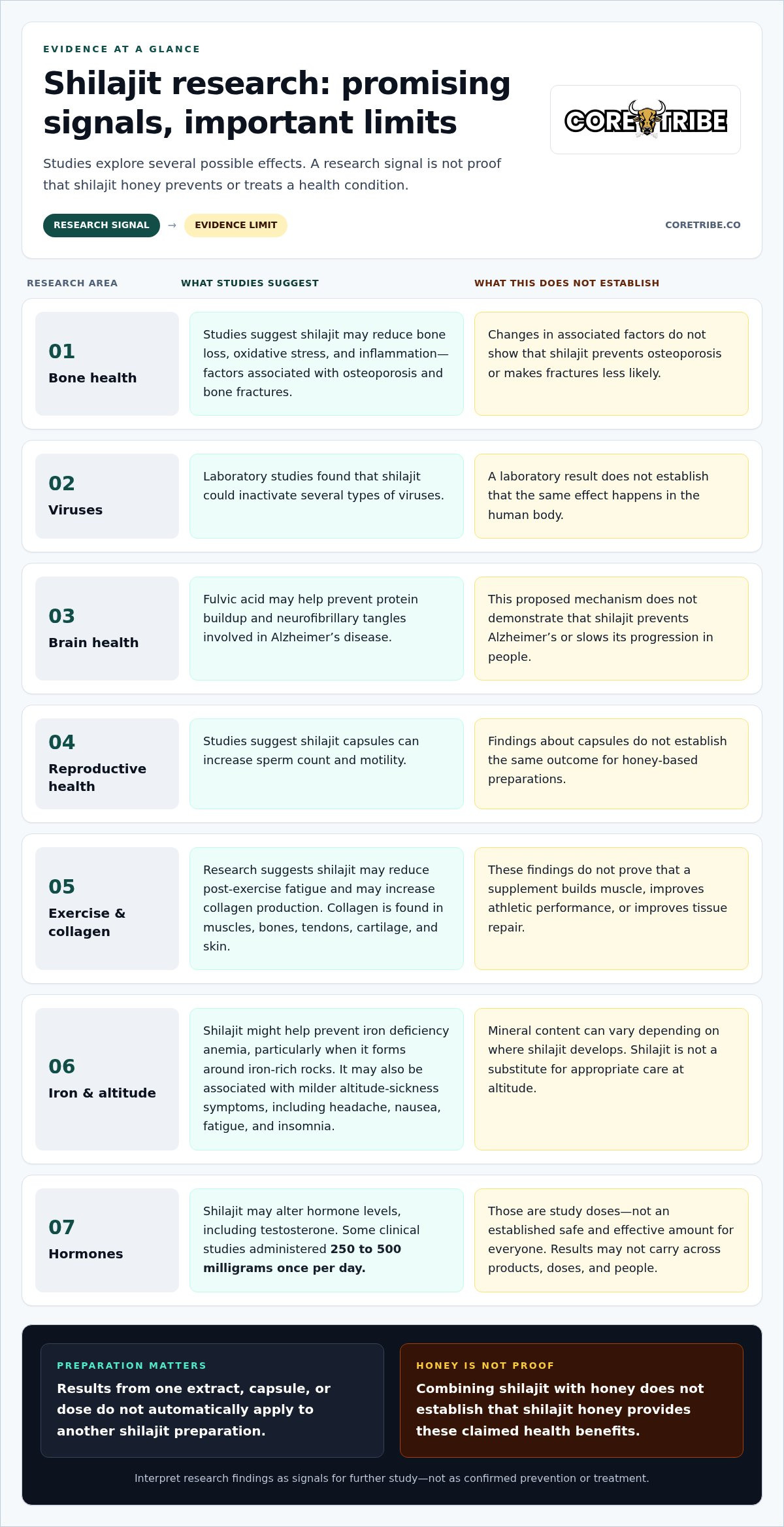
Shilajit research examines several distinct health questions. Studies suggest it may reduce bone loss, oxidative stress, and inflammation, factors associated with osteoporosis and bone fractures. That connection gives researchers reasons to investigate shilajit, but it doesn’t show that taking it prevents fractures. Results also depend on the preparation studied. Findings about one extract or dose don’t automatically apply to shilajit honey.
Other claims concern viruses and brain health. Laboratory studies found that shilajit could inactivate several types of viruses, but a laboratory result doesn’t establish the same effect in the human body. Fulvic acid has also attracted interest in Alzheimer’s research. It may help prevent protein buildup and neurofibrillary tangles involved in the disease. This proposed mechanism doesn’t demonstrate that shilajit prevents Alzheimer’s or slows its progression in people.
Reproductive research is another area of interest. Studies suggest shilajit capsules can increase sperm count and motility, but capsule findings don’t establish the same outcome for honey-based preparations. Shilajit may also influence collagen production. Collagen forms part of skin, muscles, bones, tendons, and cartilage. Its role in these tissues explains the research interest, but it doesn’t prove that taking a supplement improves strength or tissue repair.
Some claims concern iron and physical performance. Shilajit might help prevent iron deficiency anemia, particularly when it forms around iron-rich rocks. Its mineral content can vary depending on where it develops. Shilajit may also reduce post-exercise fatigue. People taking it might experience milder symptoms of altitude sickness, including headache, nausea, fatigue, and insomnia. Shilajit is not a substitute for appropriate care at altitude.
Hormone findings need similar care. Shilajit may alter hormone levels, including testosterone. Some clinical studies have administered 250 to 500 milligrams once per day. That describes study doses, not an established safe and effective amount for everyone. The main evidence gap is whether specific results carry across products, doses, and people. For readers comparing supplement formats, shilajit supplement options offer a starting point for understanding how products are presented.
Research suggests shilajit may reduce bone loss, oxidative stress, and inflammation, which are risk factors for osteoporosis and bone fractures. This points to a possible area of research, not a demonstrated health outcome. A change in factors associated with a condition doesn’t by itself establish that the condition is prevented or that fractures become less likely.
These findings are best understood as signals for further study, not proof of protection. They don’t establish whether taking shilajit changes the likelihood of osteoporosis or bone fractures.
Heavy metal and contamination risks
Shilajit develops over centuries from minerals and decomposed plants and animals. It is found mainly between rocks in the Himalayas. Raw material from this natural environment may contain heavy metals, fungi, or other substances that can cause illness. Natural origin doesn’t guarantee purity. Both the source material and how it is processed matter.
Unpurified shilajit can contain lead, arsenic, mercury, and other metals. Honey doesn’t remove these contaminants. Mixing ingredients changes the form, not the need to assess shilajit’s purity. A product’s color, texture, or traditional use also can’t establish that it is free from unwanted substances. The concern is the material itself, not whether it looks clean or blends smoothly.
Contamination can make a supplement a health risk rather than a wellness aid. The substances and amounts can vary, and raw or unprocessed products should be avoided. Quality and safety can differ between supplements, so consider the source material and available testing information. A honey mixture still contains shilajit, so the same concerns apply to that format.
- Look for the word “purified” on the shilajit label.
- Avoid raw or unprocessed shilajit products.
- Look for a third-party testing seal and a certificate of analysis.
- Check whether the testing information identifies the product being sold.
A certificate of analysis, or COA, reports a product’s testing results. A third-party seal can indicate independent testing, while a COA provides more product-specific detail. These are useful quality signals, but they don’t mean every batch is identical. If a label says “purified” but provides no testing information, that word alone doesn’t show which contaminants were assessed.
NSF International, USP, and ConsumerLab are examples of independent testing organizations whose seals buyers can look for. A seal or COA can help distinguish tested products from raw material with unknown contaminants. Read the label and testing details together. For shilajit honey, consider both the shilajit purity information and the honey ingredient: testing claims about one ingredient don’t automatically describe the other.
Supplement safety and healthcare provider advice
Shilajit safety depends on the person, product, and medications they take. Talk with a healthcare provider before using shilajit honey or any dietary supplement. Share the product label and your medication list, including prescriptions for blood sugar or blood pressure. This gives the provider practical information to consider possible interactions and personal health conditions.
Some adults tolerate shilajit at daily doses up to 2,000 mg. That figure does not establish a safe, effective dose for every person or product. If a healthcare provider approves use, start with the lowest recommended dose. Avoid increasing the amount simply because a lower amount produces no immediate sensation. Product strength and preparation can differ.
Some people should avoid shilajit, including children, pregnant people, and breastfeeding people. People with heart, liver, or kidney disease should also avoid it, as should people with hemochromatosis. Shilajit can increase blood iron levels, which may be dangerous for someone with this iron-overload disorder. These are specific risk groups, not just general reasons for caution.
Medication lists matter, too. People taking blood sugar-lowering medicines, diuretics, or hypertension medications should consult a healthcare provider before use. Shilajit may affect blood sugar or interact with treatment, so combining it with medication without guidance is a concern. Mention over-the-counter medicines and other supplements as well. A complete list helps identify combinations that could otherwise be overlooked.
Pay attention to how your body responds after taking a supplement. Stop use if unusual stomach symptoms or an allergic reaction occurs. Product safety instructions advise stopping use and contacting a healthcare provider immediately if an adverse reaction occurs. Itching, swelling, or difficulty breathing after honey exposure can signal an allergic response. Difficulty breathing requires urgent attention.
- Review your health conditions, medicines, and supplement labels with a healthcare provider.
- Avoid shilajit if you belong to one of the listed risk groups.
- If use is approved, begin with the lowest recommended dose.
- Stop use and seek advice if unusual symptoms develop.
Independent testing matters because supplement quality and safety can vary. Look for testing information, such as a certificate of analysis, alongside the product label. Shilajit combined with honey is described as generally safe when taken correctly, but it cannot replace healthy food, physical activity, or sufficient sleep. Those daily habits remain the foundation of a balanced wellness routine.
Shilajit mixed with honey
Shilajit honey pairs a traditional resin with a familiar sweetener. The combination changes the taste and format, but not the need to consider evidence, dose, and product quality.
Claimed Benefits of the Combination
Combining shilajit and honey is claimed to make the resin easier to take while retaining shilajit’s possible wellness effects. Honey adds sweetness, but there’s no established evidence that it amplifies shilajit’s effects. This distinction helps separate convenience and flavor from claims about energy, exercise recovery, or hormone support.
How do shilajit honey products compare with taking purified shilajit alone? Honey adds a sweet food ingredient and changes the delivery format; purified shilajit alone avoids that added ingredient. Shilajit itself remains the source of the proposed supplement effects, so compare ingredient and purity details rather than assuming the blend works better.
The claimed benefits of combining shilajit and honey largely reflect claims about shilajit itself. Honey may make its earthy taste more pleasant, which can influence whether someone prefers the format. Taste, however, isn’t evidence of improved absorption or stronger results. Assess a combination product by its labeled ingredients and testing, not by the word “natural.”
What is the typical price of shilajit honey, and how can buyers evaluate product quality? Prices vary by format, ingredients, and quality controls, so compare labels rather than relying on a single typical figure. Look for “purified” shilajit, independent testing, and a certificate of analysis. These details matter more than flavor claims alone.
Taking Shilajit With Honey
Shilajit with honey can be taken directly or mixed into a beverage, depending on the product directions. One set of directions says to take one stick directly or mix it into a beverage. Another recommends dissolving one teaspoon in water, tea, or milk once a day, preferably on an empty stomach.
These directions describe different product formats, not a universal dose. Follow the instructions for the specific product and don’t treat a teaspoon as interchangeable with a stick. Clinical studies have used shilajit doses between 250 and 500 milligrams once per day, but those study amounts don’t establish a standard dose for honey mixtures.
How should shilajit with honey be taken, and what is a typical dose? Follow the specific product’s directions: one stick directly or in a beverage, or one teaspoon dissolved in water, tea, or milk once daily, preferably on an empty stomach. These measures apply to their respective directions, not to every product.
For a format designed around honey, explore shilajit honey options and review the ingredient and testing details before choosing.
Coretribe: Coretribe ® Pure Shilajit Capsules - Mixed Sea Moss & Ashwagandha
Coretribe ® Pure Shilajit Capsules - Mixed Sea Moss & Ashwagandha offer a capsule-format option for readers exploring shilajit supplements. The named ingredients distinguish this blend from shilajit honey, so consider which format and ingredient combination suits your preferences. Coretribe®Shilajit Honey Sticks offer another format, pairing shilajit with honey. Neither option is a proven treatment or a substitute for medical care. If you’re considering a supplement, use this guide’s safety information to inform your decision, including discussing use with a healthcare provider when appropriate. Visit coretribe.co to explore Coretribe’s offerings.
Choose a Thoughtful Next Step
When weighing the potential shilajit honey benefits, let your priorities guide what you explore next. A supplement should fit comfortably into your wider routine, not replace the habits and care that support your well-being. Your health circumstances and the specific product both matter when deciding whether it suits you.
Coretribe offers Coretribe ® Pure Shilajit Capsules - Mixed Sea Moss & Ashwagandha and Coretribe®Shilajit Honey Sticks for those exploring different shilajit formats. Its offerings also include Revive Dress. Take time to consider which option aligns with your interests and the information you’ve learned. If you’re ready to explore, browse Coretribe’s offerings and choose your next step with care.
Frequently Asked Questions
What Is Shilajit Honey?
Shilajit honey is a blend of shilajit and honey, sold in formats such as single-use sticks or containers. Shilajit is a sticky substance formed from minerals and decomposed organic matter, while honey provides the mixture’s sweetness. Product labels can differ: some identify organic honey and fulvic acid. Read the ingredient list to understand what a particular blend contains rather than assuming every product uses the same formula.
Are there safety concerns?
Yes. Safety concerns include digestive discomfort, allergic reactions to honey, contaminants, and medication interactions. For example, someone taking blood sugar-lowering medication should consider that shilajit may affect blood sugar. Raw shilajit can contain lead, arsenic, mercury, fungi, or other harmful substances. Stop using a product if unusual stomach symptoms or an allergic reaction occurs, and seek medical help for signs such as difficulty breathing.
Can You Take Too Much?
There’s no established shilajit dose considered safe and effective for everyone, so taking more than product directions advise isn’t a sound way to pursue results. Shilajit is described as well tolerated by most adults at daily doses up to 2,000 mg, but that doesn’t make the amount appropriate for every person or preparation. If use is approved, begin with the lowest recommended dose and stop if unusual symptoms develop.
Is Shilajit Safe for Everyone?
No. Children, pregnant people, and breastfeeding people should avoid shilajit. People with heart, liver, or kidney disease, or hemochromatosis, should avoid it as well. Honey-based products bring an additional concern for people sensitive to honey or bee products, who may develop itching, swelling, or difficulty breathing. Anyone managing a chronic condition should treat supplement use as a health decision, not assume a natural ingredient is automatically suitable.
What are the claimed benefits of shilajit?
Claims include support for exercise recovery, collagen production, sperm count and motility, and hormone levels such as testosterone. Researchers have also studied possible effects related to bone loss, oxidative stress, inflammation, and fulvic acid’s role in Alzheimer’s-related protein buildup. These are distinct research questions, not interchangeable proof of a broad health effect. Claimed shilajit honey benefits largely reflect claims about shilajit; adding honey doesn’t establish those outcomes.
Who should and shouldn’t take shilajit?
People in the higher-risk groups described above should avoid shilajit. Those taking blood sugar-lowering medicines, diuretics, hypertension drugs, thyroid medication, or other prescriptions should discuss use with a healthcare provider. This is especially relevant when someone takes several medicines, since an interaction may be difficult to recognize from symptoms alone. A medication list and the supplement label provide useful details for that conversation.
Is there scientific evidence that shilajit or honey improves energy, stamina, or fertility?
Some studies suggest shilajit may reduce post-exercise fatigue, and studies of shilajit capsules suggest possible increases in sperm count and motility. Clinical studies have used doses between 250 and 500 milligrams once per day. These findings don’t establish that honey improves energy, stamina, or fertility, or that every shilajit preparation produces the same effects. The type of preparation and the outcome measured matter.
Can honey improve the taste or absorption of shilajit?
Honey adds sweetness, which can make shilajit’s earthy taste easier for some people to tolerate. That practical benefit is different from improved absorption: combining the ingredients doesn’t establish that the body absorbs shilajit more effectively. Product forms and directions also vary, so a stick and a measured amount of a separate mixture aren’t automatically equivalent. Follow the directions for the specific product rather than substituting one format for another.

