


A small study offers a reason for interest in ashwagandha for thyroid support: among 50 people with hypothyroidism, those who took 600 mg of ashwagandha root extract daily for 8 weeks had a 17.5% decrease in thyroid-stimulating hormone (TSH). That finding is promising, but it doesn’t make ashwagandha a substitute for thyroid medication or prove it’s suitable for everyone. The same potential to affect thyroid hormones matters especially if you have hyperthyroidism or take thyroid medicine.
It’s understandable to look for natural support for energy and well-being when thyroid symptoms affect daily life. This guide explains what evidence suggests about ashwagandha for thyroid support, including the possible effects in hypothyroidism and concerns for people with hyperthyroidism or taking medication. It also covers supplement forms and safety considerations to help you weigh potential benefits against risks.
Key Takeaways
- A small study found changes in thyroid markers among people with hypothyroidism, but the findings don’t make ashwagandha a replacement for prescribed treatment.
- Iron and calcium can reduce the absorption of thyroid medication, so timing supplements appropriately matters.
- Ashwagandha can raise thyroid hormone levels, making it unsuitable for people with hyperthyroidism.
- Supplement forms and directions vary; understand the product’s form and serving instructions before use.
- Pregnancy, breastfeeding, autoimmune conditions, and certain medications are important safety considerations to understand before taking ashwagandha.
Does Ashwagandha Improve Thyroid Health?
A small study suggests ashwagandha may raise thyroid hormone levels in adults with hypothyroidism. That possibility may be relevant to thyroid symptoms, but a change in hormone levels does not mean ashwagandha is a proven treatment.
Ashwagandha and Thyroid Hormone Levels
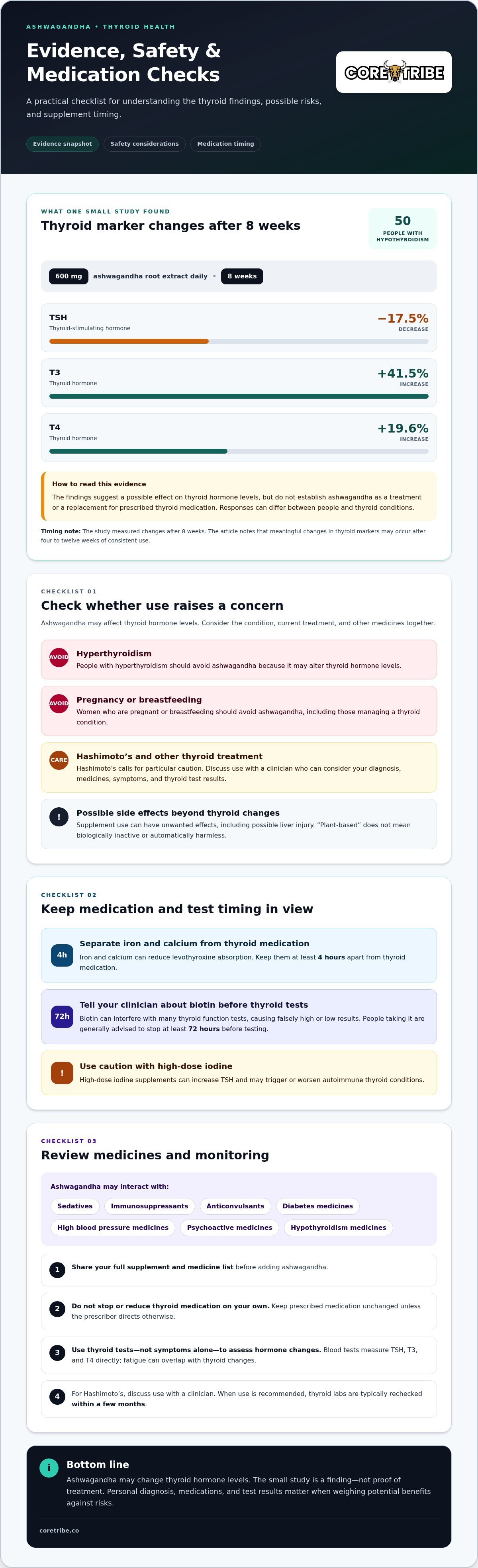
Thyroid hormones help regulate processes such as energy use, and ashwagandha may affect their levels. In an 8-week study of 50 people with hypothyroidism, participants taking 600 mg of ashwagandha root extract daily had a 17.5% decrease in TSH. Their T3 increased by 41.5%, while T4 increased by 19.6%. These results suggest a possible effect, but don’t establish ashwagandha as treatment for thyroid disorders.
How quickly can ashwagandha affect TSH, T3, and T4 levels? The study measured changes after 8 weeks, while meaningful changes in thyroid markers may occur after four to twelve weeks of consistent use. The response can differ between people and thyroid conditions.
Another 8-week study involved adults with bipolar disorder, and three participants experienced increases in T4. That finding is relevant because hormone changes can occur outside studies focused on hypothyroidism, too. A higher thyroid hormone level may be unwanted for someone whose levels are already elevated.
Risks and Side Effects
Risks and side effects are unwanted effects that can accompany supplement use, including possible liver injury. This matters because a botanical supplement can affect the body beyond the thyroid, and an existing thyroid condition may make hormone changes especially consequential. Treating ashwagandha as biologically active, rather than automatically harmless because it is plant-based, supports more careful decisions.
Is ashwagandha safe during pregnancy or breastfeeding for people with thyroid conditions? Women who are pregnant or breastfeeding should avoid ashwagandha, including those managing a thyroid condition. According to EFSA, the upper limit for selenium is 255 mcg/day for adults, including women who are pregnant or lactating, with lower age-dependent amounts for children and teens.
Symptoms such as fatigue can overlap with changes in thyroid function, so symptoms alone can’t show whether hormone levels have shifted. Thyroid blood tests measure markers such as TSH, T3, and T4 directly. For people with Hashimoto’s, ashwagandha calls for particular caution because it may affect thyroid hormones; the condition and current treatment both matter when weighing its use.
Can ashwagandha replace my thyroid medication?
No. Ashwagandha should complement, not replace, medical care. Don’t stop or reduce thyroid medication on your own. If you have a thyroid disorder, discuss use with a clinician who can consider your diagnosis, medicines, symptoms, and thyroid test results.
Effects on the Thyroid Axis
The hypothalamic-pituitary-thyroid axis is the signaling system that helps regulate thyroid hormone production. Ashwagandha may affect this system, which means it could influence hormone levels rather than simply support general wellness.
In hypothyroidism, a change in TSH, T3, or T4 can affect how a person’s existing treatment is working. An effect that seems helpful in one context could cause unwanted hormone shifts in another. For someone with Hashimoto’s, an autoimmune cause of hypothyroidism, extra care matters because the condition and current treatment both shape the decision. Ashwagandha is not a replacement for prescribed thyroid hormone.
Use in Subclinical Hypothyroidism
Subclinical hypothyroidism refers to a mild thyroid test pattern that may not cause obvious symptoms. It is different from an established diagnosis with a clear treatment plan. Ashwagandha’s possible effects on thyroid hormones make it relevant to consider, but do not establish it as a treatment.
Research on ashwagandha and hypothyroidism does not show that everyone with a mild change in test results should take it. TSH and thyroid hormone results, symptoms such as fatigue, and a history of Hashimoto’s all matter when assessing a possible response. Adding a supplement while monitoring results can make changes harder to interpret. Medical guidance and follow-up testing help distinguish a supplement effect from a change in the thyroid condition.
Medication, Supplements, and Medical Guidance
Medication and supplement timing can change how well thyroid treatment is absorbed. Iron and calcium supplements can bind to thyroid hormone in the digestive tract and reduce absorption of levothyroxine. Keep iron and calcium at least 4 hours apart from thyroid medication.
Biotin can interfere with many thyroid function tests, producing falsely high or low results. People taking biotin are generally advised to stop it at least 72 hours before thyroid tests. High-dose iodine supplements can increase TSH and may trigger or worsen autoimmune thyroid conditions, so they call for caution with Hashimoto’s.
Ashwagandha may interact with sedatives, immunosuppressants, anticonvulsants, and medicines for diabetes, high blood pressure, psychoactive disorders, or hypothyroidism. Share these medicines and supplements before adding it. For Hashimoto’s, discuss ashwagandha with a clinician; when its use is recommended, thyroid labs are typically rechecked within a few months. A general supplement range can be explored separately from decisions about thyroid treatment. Keep prescribed medication unchanged unless the prescriber directs otherwise.
Ashwagandha and hyperthyroidism
People with hyperthyroidism should avoid ashwagandha because it may alter thyroid hormone levels. Its possible effect on T3 and T4 makes an “adaptogen” label no guarantee of suitability.
Why thyroid hormone changes matter
Hyperthyroidism involves excess thyroid hormone activity, so a supplement that shifts T3 or T4 deserves caution. Ashwagandha may increase thyroid hormone levels and could worsen hyperthyroidism symptoms. In some cases, excess hormone activity may contribute to thyrotoxicosis, a potentially serious state associated with too much thyroid hormone in the body.
The concern is not limited to a supplement being taken as a treatment. Ashwagandha may affect thyroid hormone levels even when someone uses it for another reason, such as general wellness. A person with diagnosed hyperthyroidism therefore shouldn’t assume that a small serving or a product marketed as natural avoids the concern. The safest practical choice is to avoid it and include supplements in discussions about thyroid care.
Graves’ disease and immune concerns
Graves’ disease is a thyroid condition where hormone changes are especially relevant. Ashwagandha may affect T3 and T4, while its potential immune effects raise an additional consideration for people with autoimmune conditions. A product described as stimulating or balancing doesn’t establish that it is appropriate for Graves’ disease.
Changes in symptoms after starting a supplement can be difficult to interpret. Hyperthyroidism can cause symptoms, and ashwagandha may further influence hormone levels. If you have Graves’ disease, don’t start ashwagandha without discussing its possible effects as part of your care. This applies even if you’re considering it for stress or sleep rather than thyroid support.
Iodine supplements and practical precautions
Ashwagandha is not the only supplement that may affect thyroid health. High supplemental doses of iodine may trigger or worsen autoimmune thyroid conditions. For someone with Graves’ disease, combining products that may influence thyroid function can make changes harder to interpret. Review ingredients, including iodine, and avoid adding supplements casually.
Keep a clear record of supplements and symptom changes to discuss during thyroid care. Include ashwagandha, iodine products, and combination formulas, not only products taken specifically for thyroid health. This gives your care team a fuller picture when interpreting tests or symptoms. Don’t use ashwagandha to manage hyperthyroidism or assume an “adaptogen” label means it is safe for Graves’ disease.
Ashwagandha supplement forms and use
Ashwagandha comes in several supplement forms, and the form affects how you interpret serving directions. Tablets, capsules, powders, and liquids may contain root powder or concentrated extract, so similar-looking amounts are not necessarily equivalent. Check the ingredient form and amount on the label instead of comparing products by capsule size alone.
Compare the form and serving instructions
A common tablet format is 300 mg, taken twice per day after eating. That pattern describes a commonly used supplement format, not a personal thyroid dose or a requirement for every product. Extract strength, serving size, and additional ingredients differ, so follow the specific label and don’t assume one form can be substituted milligram for milligram for another.
Powders can be mixed into food or drinks, while tablets and capsules provide a measured serving. Liquid products have their own directions. In each case, check whether the label identifies root powder or root extract. Review blends ingredient by ingredient: iodine, for example, can affect thyroid function at high supplemental doses.
Timing, consistency, and thyroid tests
Follow the product directions consistently rather than changing the amount in response to a single symptom. Meaningful changes in stress, sleep, and thyroid markers may occur after four to twelve weeks of consistent use. This timeframe does not predict when an individual’s thyroid levels will change, so don’t use how you feel as a substitute for thyroid testing.
Biotin is a useful example of why supplement timing matters beyond meals. It can interfere with many thyroid function lab tests, producing falsely high or low results. People taking biotin are generally advised to stop it at least 72 hours before thyroid tests. Keep a written list of supplements and their serving directions to share when discussing test results or medicine use.
When extra care is needed
People with thyroid conditions should consider the full formula alongside their medicine. Ashwagandha may interact with medicines for hypothyroidism, diabetes, high blood pressure, and other conditions. Iron and calcium can also reduce absorption of levothyroxine; keep those supplements at least 4 hours apart from thyroid medication. Don’t change prescribed medicine to accommodate a supplement.
If you have Hashimoto’s or another autoimmune thyroid condition, consult a clinician before using ashwagandha. People with hyperthyroidism should avoid it because it may increase thyroid hormones. Pregnancy and breastfeeding are also reasons to avoid ashwagandha. These cautions apply to powders and combination supplements as well as tablets, because the ingredient’s effects do not depend on its form.
What are the risks and side effects of ashwagandha, including liver injury?
Ashwagandha can affect more than thyroid hormones, so safety decisions should account for pregnancy, autoimmune disease, and other medicines. Liver injury is also a possible concern. A natural origin or supplement label does not mean a product protects the liver or treats an injury.
Pregnancy, breastfeeding, and autoimmune conditions
Women who are pregnant or breastfeeding should avoid ashwagandha, whether they are considering it for thyroid support, stress, sleep, or another wellness goal. A thyroid diagnosis does not remove this concern, and describing a supplement as plant-based does not change the caution.
Ashwagandha may stimulate the immune system and potentially worsen autoimmune diseases, including rheumatoid arthritis, multiple sclerosis, and lupus. For example, someone managing lupus should consider this possible immune effect even if the product is intended for general wellness. The same caution applies to other autoimmune conditions, where the immune system is part of the underlying disease.
Hormone-sensitive conditions and medicine interactions
Ashwagandha may increase testosterone levels, so people with hormone-sensitive prostate cancer should avoid it. This is separate from its possible effects on thyroid hormones: the concern here is the potential effect on sex hormones. Anyone considering ashwagandha should account for a diagnosis of hormone-sensitive cancer, not focus only on thyroid symptoms.
Medicines matter, too. Ashwagandha may interact with sedatives, immunosuppressants, anticonvulsants, and medicines for diabetes, high blood pressure, psychoactive disorders, or hypothyroidism. Someone taking an immunosuppressant for lupus, for example, has both an autoimmune condition and a potential medicine interaction to consider. Keep a complete list of medicines and supplements available when discussing use.
Liver injury and careful decisions
Liver injury is a possible safety concern, not a condition to self-treat with supplements. A product marketed for liver wellness cannot be assumed to prevent or reverse injury. If liver health is already a concern, adding ashwagandha or combining supplements may make it harder to identify what is contributing to a change.
Before use, consider the full context: pregnancy or breastfeeding, autoimmune disease such as multiple sclerosis, hormone-sensitive prostate cancer, and medicines such as levothyroxine or sedatives. Avoid ashwagandha in the situations noted above, and don’t use it to replace prescribed treatment. For general wellness browsing, explore supplement options separately from decisions about managing liver injury or thyroid disease.
Coretribe: Coretribe ® Pure Shilajit Capsules - Mixed Sea Moss & Ashwagandha
Coretribe ® Pure Shilajit Capsules - Mixed Sea Moss & Ashwagandha combine shilajit, sea moss, and ashwagandha in one supplement. If you’re considering ashwagandha as part of a wider wellness routine, this is one option to explore. Its ingredients do not make it a treatment for hypothyroidism or a substitute for thyroid medication.
Because ashwagandha may affect thyroid hormone levels, people with thyroid conditions should consider it alongside their medicines and other supplements. People with hyperthyroidism should avoid it, while those with Hashimoto’s should discuss its use with a clinician. Keep thyroid care decisions separate from choosing a general wellness supplement.
For product details, visit Coretribe online.
Make your next step a thoughtful one
Let your next decision reflect your priorities, not pressure to add another supplement. If you’re considering ashwagandha for thyroid support, clarify what you hope to address and how you’ll assess whether it fits your broader care. Writing down your goals and questions can make your next conversation more focused and help you make wellness choices intentionally.
Natural products can be part of a considered routine, but thyroid health calls for attention to the full picture. Keep your choices aligned with your existing care and reassess as your needs or circumstances change. Informed decisions provide a steadier foundation than chasing quick fixes.
When you’re ready to explore wellness products for your routine, browse Coretribe’s offerings. Choose at your own pace, with your health priorities at the center. A thoughtful approach can help you move forward with greater clarity and confidence.
Frequently Asked Questions
Does ashwagandha help with hypothyroidism?
A small clinical study suggests ashwagandha may affect thyroid markers in people with hypothyroidism, but it is not an established replacement for treatment. If you’re considering ashwagandha for thyroid support, the key question is how it fits with your diagnosis, medicines, and ongoing care. Keep prescribed medication unchanged unless your prescriber directs otherwise, and note symptom changes to discuss at follow-up.
How long until ashwagandha actually helps?
Changes in stress, sleep, and thyroid markers may take four to twelve weeks of consistent use, though effects vary. Don’t judge the result from one good or difficult day. Keep a simple log of the start date, product form, serving directions, and symptom changes. If thyroid tests are part of your monitoring, record their dates too, so results can be considered alongside supplement use.
Is ashwagandha safe if I have Hashimoto’s?
Ashwagandha calls for caution with Hashimoto’s, an autoimmune thyroid condition, because it may affect thyroid hormone levels. Don’t assume a supplement is suitable just because it is botanical or marketed for balance. Before use, list your thyroid medicines, other supplements, and recent test results. This gives your clinician useful context for discussing whether it fits your care.
What supplements should people with Hashimoto’s or hypothyroidism be cautious about?
Pay particular attention to iodine, iron, calcium, and biotin. High supplemental iodine can increase TSH and may aggravate autoimmune thyroid conditions. Iron and calcium can reduce levothyroxine absorption, so separate them from thyroid medication by at least four hours. Biotin can distort thyroid test results; people taking it are generally advised to stop at least 72 hours before testing. Review combination formulas for these ingredients.
Does ashwagandha affect thyroid hormone levels or thyroid function?
Yes, ashwagandha may affect thyroid hormone levels, including T3 and T4, and can influence TSH results. That matters because the same change may have different implications depending on whether someone has hypothyroidism or hyperthyroidism. If you take thyroid medicine, keep its dose consistent and include supplement use in your health notes. A lab result is more useful when interpreted with your diagnosis and treatment history.
What does research say about ashwagandha for hypothyroidism?
In one 8-week study of 50 people with hypothyroidism, participants taking 600 mg of root extract daily had a 17.5% decrease in TSH. Their T3 increased by 41.5% and T4 by 19.6%. These findings describe changes measured in that study, not a recommended personal dose or proof that the supplement can replace thyroid care. Study results should be considered alongside an individual’s diagnosis and treatment.
Can ashwagandha worsen hyperthyroidism or Graves’ disease?
Yes. Ashwagandha may raise thyroid hormone levels and worsen hyperthyroidism symptoms, so people with hyperthyroidism should avoid it. Graves’ disease is an autoimmune cause of hyperthyroidism, making hormone-altering supplements a particular concern. Check combination products as well as standalone capsules, since ashwagandha may be part of a broader formula. Don’t use it to manage excess thyroid activity or replace prescribed care.
Can ashwagandha interact with levothyroxine or antithyroid medications?
Ashwagandha may interact with medicines for hypothyroidism, including levothyroxine, and may also affect thyroid hormone levels. Iron and calcium raise a separate timing concern because they can reduce levothyroxine absorption; take them at least four hours apart from the medicine. Before adding ashwagandha for thyroid support, include it and all other supplements in a medication review. Never adjust thyroid medicine to accommodate a supplement.

