


Can shilajit genuinely support hormone balance in women, or are the claims running ahead of the evidence? If you’ve searched “shilajit for hormone balance women,” you’ve likely found confident promises alongside unanswered questions. It’s understandable to want clarity, especially when much of the research may not reflect women’s health.
Current evidence doesn’t establish shilajit as a hormone-balancing treatment. Most clinical research has involved men, while women-specific benefits are supported by limited human research. That doesn’t erase shilajit’s traditional use, but it does make careful interpretation important. A wellness supplement and a proven treatment aren’t the same thing.
This article separates what research suggests from what remains uncertain, including claims about PMS, menopause, and PCOS. It also covers product quality and safety considerations, such as possible contaminants, side effects, and medication interactions. You’ll find practical questions to help assess women-focused hormone claims and decide whether shilajit fits your wellness routine.
Key Takeaways
- Learn why “hormone balance” is a broad wellness phrase, not a specific diagnosis or guaranteed outcome.
- Use a women-focused lens to assess claims about shilajit for hormone balance women, including whether studies measured the outcome being advertised.
- Compare claims about menstrual cycles, fertility, PCOS, and menopause as separate questions rather than assuming evidence for one applies to all.
- Apply a practical checklist to review ingredient labels, quality information, and the strength of supplement claims.
- See how Coretribe ® Pure Shilajit Capsules - Mixed Sea Moss & Ashwagandha can be considered as a supplement option without treating it as a hormone solution.
What Does Hormone Balance Mean, and Where Does Shilajit Fit?
Hormone-related supplement claims can feel compelling when you’re dealing with changes in energy, mood, cycles, or sleep. They can also be confusing: “balance” sounds precise, yet it’s often used without naming a hormone, a measurable outcome, or the evidence behind the promise. That distinction matters when assessing claims about shilajit for hormone balance women.
Hormone balance is a broad wellness phrase, not a diagnosis or a guarantee that a supplement can correct hormone levels. Hormonal disorders are specific health conditions that need proper assessment. Traditional use or a proposed biological mechanism cannot, by itself, establish that a supplement treats one.
A useful starting point is to ask what a claim means, what evidence supports it, and whether that evidence applies to the person and outcome being discussed. This article offers general education, not a diagnosis or a substitute for medical care. If changes are persistent, severe, or affecting daily life, a qualified healthcare professional can help assess possible causes rather than assuming hormones are responsible.
What does hormone balance mean for women?
Hormones naturally shift across the menstrual cycle and through life stages such as pregnancy, postpartum, and menopause. Sleep, stress, and overall health can also influence how someone feels. A temporary change in mood or cycle doesn’t automatically mean there’s an imbalance. Persistent or concerning symptoms deserve professional assessment, since similar experiences can have different causes.
When you see a “balancing” claim, ask what it actually refers to. Does it name a particular hormone, describe a symptom, or cite a measured change? Without that clarity, the phrase can sound more definitive than it is.
What is shilajit, traditionally?
Shilajit is a naturally occurring substance associated with traditional Ayurvedic use. General descriptions note a complex composition that can include fulvic acid and minerals, though composition may vary. The overview of Shilajit offers background on its origins and traditional use. That history provides context, not proof of a hormone-related effect.
Traditional use can suggest questions worth studying, but it doesn’t replace evidence from research in people. The same care applies to claims about ingredient combinations. For a closer look at how shilajit, ashwagandha, and sea moss are discussed together, explore the shilajit, ashwagandha, and sea moss synergy guide.
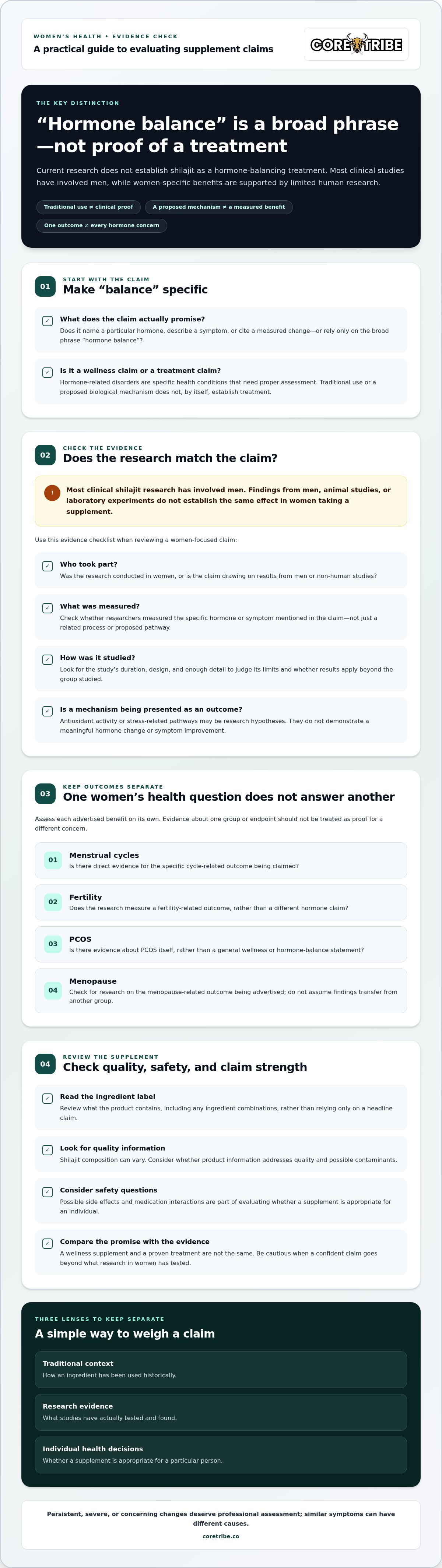
Keep three ideas separate when weighing a claim:
- Traditional context: how an ingredient has been used historically.
- Research evidence: what studies have actually tested and found.
- Health decisions: whether a supplement is appropriate for an individual.
This framework helps distinguish a wellness ingredient from a proven treatment, while leaving room to examine what research does and doesn’t say.
What Does Research Actually Say About Shilajit and Women’s Hormones?
Claims about shilajit and hormones can sound convincing when they refer to familiar processes such as stress response or antioxidant activity. But a proposed biological pathway is not the same as evidence that taking a supplement meaningfully changes hormone levels or symptoms. For shilajit for hormone balance women, the key question is whether studies directly tested women and measured a relevant outcome.
Evidence for shilajit as a way to balance women’s hormones is limited, and current research doesn’t establish it as a treatment for hormonal conditions. Most clinical studies have involved men. Women-specific benefits rely more on traditional use, user reports, and indirect evidence than on dedicated human trials. Important questions therefore remain unanswered.
Which evidence is directly relevant to women?
Human clinical research is most useful when it studies women, defines the outcome in advance, and reports enough detail to judge its limits. For a hormone claim, check which hormone or symptom researchers measured, who took part, how long the study lasted, and whether the results can apply beyond that group.
Animal studies and laboratory experiments can help researchers explore possible effects, but they don’t show that the same effect occurs in women taking a supplement. Findings from men are also indirect. Differences in population, study design, and outcomes matter. Evidence about one group or endpoint shouldn’t be presented as proof of a benefit for menstrual concerns, fertility, PCOS, or menopause.
Traditional use and personal accounts offer context about how people have used shilajit, but they can’t establish cause and effect. Without strong studies in women that measure clearly defined hormone-related outcomes, claims about raising or regulating estrogen, progesterone, or thyroid hormones remain unproven.
How should proposed mechanisms be interpreted?
Researchers may investigate whether shilajit’s components relate to antioxidant activity or stress-related pathways. These are hypotheses about how an ingredient might act, not demonstrated clinical benefits. Even if a pathway is biologically plausible, it doesn’t show that a supplement changes hormone levels in a meaningful way or improves a particular symptom.
Mineral content alone doesn’t establish a hormone-balancing effect either. A nutrient’s presence is not proof that someone is deficient, that the body will absorb it in a useful amount, or that supplementation will change a health outcome. The guide to shilajit, sea moss, and ashwagandha side effects and benefits provides ingredient-specific context, but research on each ingredient should still be considered separately from evidence on a combined formula.
When reviewing a claim, look for the study population, what was measured, and whether the research tested the same ingredient or formulation being discussed. This keeps a promising mechanism in perspective without dismissing it or mistaking it for a proven result. You can also review Coretribe’s supplement options as part of your research.
Can Shilajit Help With Menstrual Cycles, Fertility, PCOS, or Menopause?
These concerns are often grouped under “hormone balance,” but they involve different questions and outcomes. A change in cycle regularity, fertility, PCOS symptoms, and menopause experiences can’t be treated as interchangeable evidence. Current evidence doesn’t establish shilajit as a way to prevent, diagnose, or treat reproductive or endocrine conditions.
| Concern | Evidence described in current sources | Reasonable conclusion |
|---|---|---|
| Menstrual cycles | Women-specific clinical evidence for cycle regularity or symptom relief is limited. | Claims about PMS, irregular periods, or heavy bleeding aren’t established. |
| Fertility | Current evidence doesn’t establish a specific fertility benefit in women. | Don’t interpret general wellness claims as evidence of improved fertility. |
| PCOS | Claims rely largely on indirect evidence, traditional use, or reports rather than dedicated human trials. | Shilajit isn’t a proven treatment for PCOS. |
| Menopause | Direct evidence in women experiencing menopause is limited. | Findings from other populations or life stages can’t establish menopause benefits. |
Are menstrual-cycle benefits established?
Interest in general wellness isn’t the same as demonstrated improvement in cycle timing, PMS, or bleeding. The evidence described here doesn’t establish shilajit as a way to make periods more regular or ease menstrual symptoms. Cycles can vary, but persistent, severe, or changing symptoms deserve clinical assessment rather than an assumption that a supplement will address the cause.
What about fertility, PCOS, and menopause?
Fertility is a specific outcome, not a synonym for vitality or hormone support. Likewise, PCOS requires condition-specific assessment, and evidence from a different group can’t show that shilajit helps with PCOS. Menopause is its own life stage. Results from younger people or studies measuring unrelated outcomes don’t demonstrate relief of menopause symptoms.
For each concern, ask whether research in relevant women measured the outcome being claimed, not simply whether shilajit has been studied. Anecdotes and proposed mechanisms may prompt further study, but they can’t confirm an effect or show who might benefit. Claims about shilajit for hormone balance women should be read in light of the specific population and outcome behind them.
If you’re considering a supplement while addressing cycle changes, fertility concerns, PCOS, or menopause symptoms, treat it as a separate wellness choice, not a substitute for evaluation or condition-specific care. A discussion with a healthcare professional can help you understand what may be causing symptoms and which options are appropriate. This keeps decisions grounded in your individual health needs, rather than broad claims that combine distinct experiences under one label.
How Can Women Assess Shilajit Safety and Supplement Claims?
A thoughtful decision starts with more than a promise on the front of a bottle. Shilajit products can differ in composition and quality, and “natural” doesn’t automatically mean safe for every person. Unpurified shilajit may contain heavy metals or other contaminants. Possible side effects include digestive upset and allergic reactions, and supplements can interact with medicines.
Before considering a supplement, check what’s in it, what evidence supports its claims, and whether it’s appropriate for your health circumstances. This is especially important when researching shilajit for hormone balance women, since a hormone-related claim doesn’t establish that a product is effective or suitable for you.
What should a supplement label and claim communicate?
Read the full label, not just the headline claim. Look for the complete ingredient list, serving directions, and clear information about the product’s contents. If a formula combines shilajit with other ingredients, consider each one separately: research on shilajit alone doesn’t automatically apply to a blend. Don’t infer a suitable dose or schedule from general online advice when product-specific support is unavailable.
Use this checklist when reviewing a supplement:
- Label clarity: Are all ingredients and serving directions easy to find and understand?
- Quality information: Is there meaningful documentation about identity and contaminant testing, such as a certificate of analysis? Don’t assume a quality claim has been independently verified unless supporting documentation is available.
- Claim quality: Does the language explain what evidence supports the claim, or promise to “balance” hormones without naming a measured outcome?
- Personal fit: Could an ingredient be relevant to your medications, health conditions, or current stage of life?
Vague words such as “pure,” “potent,” or “hormone balancing” aren’t a substitute for specific evidence. Promises to treat PCOS, regulate periods, or correct hormone levels deserve particular scrutiny. A clear label and responsible claims can help you assess a product, but they don’t prove that it will deliver a health benefit.
When should a woman seek professional guidance?
Seek individualized medical advice before using shilajit during pregnancy or breastfeeding. Check with a healthcare professional if you take medication, have an existing health condition, or have persistent or concerning symptoms. Supplement ingredients may cause side effects or interact with medicines, and the right decision depends on your circumstances.
The same care applies to multi-ingredient formulas. A product containing shilajit, sea moss, and ashwagandha brings more than one ingredient into the decision, so consider their potential effects and interactions individually. The guide to shilajit, sea moss, and ashwagandha side effects and benefits offers ingredient-specific context to support that review.
If you’ve reviewed the evidence and safety considerations and want to explore shilajit supplements, browse Coretribe’s supplement range with the product label and your individual needs in mind.
How Coretribe’s Shilajit Blend Fits Into a Thoughtful Wellness Choice
After weighing the evidence and safety considerations, decide whether a supplement suits your goals and circumstances. A product can be part of a wellness routine without being a proven answer to hormone concerns. Keeping that distinction clear helps you make a choice based on realistic expectations rather than broad promises.
What is the Coretribe shilajit blend?
Coretribe ® Pure Shilajit Capsules - Mixed Sea Moss & Ashwagandha combines shilajit with sea moss and ashwagandha. It’s a supplement option for readers interested in this blend of ingredients, not a hormone-balancing treatment or a solution for conditions such as PCOS. A claim about one ingredient also doesn’t establish that the complete formula produces a specific effect.
Research on an individual ingredient may not apply directly to a formula containing several ingredients. Women-specific evidence for shilajit and hormone outcomes remains limited, so the product name or ingredient combination shouldn’t be read as proof of a menstrual, fertility, or menopause benefit. Review the product label for its ingredient and serving information, and consider the blend in light of the evidence discussed in this article.
What is a sensible next step?
Before adding any supplement, consider why you’re interested in it. If your goal is to address a persistent symptom or a diagnosed condition, focus first on appropriate evaluation and care. If you’re considering a supplement for general wellness, weigh the evidence, review all ingredients, and account for your medications, health conditions, and life stage. Individualized professional guidance can help when those factors raise questions.
A practical decision doesn’t require certainty about every possible effect. It does require separating what’s known from what’s hoped for, and avoiding a product if you can’t make sense of its label or claims. The phrase shilajit for hormone balance women may describe a search, but it doesn’t define a proven outcome. You can make a thoughtful choice even when the science leaves room for more research.
- Clarify your goal: Know whether you’re seeking general wellness support or help with a specific symptom.
- Review the full formula: Consider each ingredient and follow the product’s own label rather than assuming a general dose applies.
- Check your circumstances: Seek individualized guidance if you’re pregnant or breastfeeding, use medication, or have a health condition.
- Keep claims in perspective: Don’t treat a supplement as a substitute for assessment or condition-specific care.
If the blend aligns with your interests after you’ve considered these points, you can explore Coretribe’s supplement range as part of your research. An informed wellness choice rests on clear expectations, careful consideration, and respect for both the limits of current evidence and your individual needs.
Choose Your Next Step With Confidence
Your next step doesn’t need to be a quick yes or no. Start by identifying what you hope to support, then weigh that goal against the strength of the evidence and your own health circumstances. If symptoms are the concern, getting clarity about their cause can be more useful than relying on a broad “hormone balance” promise.
For anyone considering shilajit for hormone balance women, a measured approach leaves room for curiosity without treating a supplement as a proven solution. You can decide that it’s not right for you, seek individualized guidance, or explore it as one part of a broader wellness routine. Make the choice with realistic expectations and careful attention to your needs.
To explore shilajit-containing options as part of your research, browse Coretribe’s supplement range. Let your decision be guided by evidence, personal circumstances, and steady care for your wellbeing, not a promise of guaranteed results.
Frequently Asked Questions
Is shilajit proven to balance hormones in women?
No, current evidence doesn’t establish shilajit as a reliable way to change women’s hormone levels or treat hormone-related conditions. Traditional use and proposed biological mechanisms can guide research, but they aren’t proof of a clinical effect. The most relevant evidence would come from well-designed studies in women measuring specific outcomes. If symptoms persist, keep a brief record of their timing and discuss them with a qualified healthcare professional.
Can shilajit affect estrogen or progesterone levels?
There isn’t enough evidence to assume shilajit predictably raises, lowers, or balances estrogen or progesterone in women. A suggested biological pathway doesn’t show that taking a supplement causes a meaningful hormone change. If you’re considering shilajit for hormone balance women, avoid using it to self-treat suspected hormone changes. Share the exact product label and your concerns with a healthcare professional before making changes to your routine.
Is shilajit safe for women who are pregnant or breastfeeding?
Women who are pregnant or breastfeeding should seek individualized medical advice before using shilajit or another supplement. Traditional use and general wellness claims can’t establish safety in these circumstances, and product formulas may differ. Bring the full ingredient label to a healthcare professional who understands your situation, and discuss suitable alternatives if needed. Supplements shouldn’t replace prenatal, postpartum, or other recommended care.
Can shilajit help with PCOS or irregular periods?
Shilajit isn’t established as a treatment for PCOS or irregular periods. For example, a change in cycle timing that continues over several cycles is a reason to discuss what might be contributing, rather than assuming a supplement will correct it. Seek clinical assessment if symptoms are persistent, severe, or changing. Share any supplement you’re considering so it can be considered alongside your health history and care plan.
Does shilajit help with menopause symptoms?
It hasn’t been established that shilajit reduces menopause symptoms such as hot flashes or sleep changes. Evidence would need to study people experiencing menopause and measure those specific outcomes, rather than infer a benefit from general wellness claims or research in another population. If symptoms affect your sleep or daily routine, a healthcare professional can help you review options in light of your health history and preferences.
Can women take shilajit with medications?
Don’t assume shilajit is compatible with every medication. If you take regular medicines, manage a chronic condition, or use several supplements, show the product’s complete ingredient label to a healthcare professional or pharmacist before adding it. This gives them specific information to review for potential interactions and personal risks. Don’t stop, replace, or change a prescribed treatment because of a supplement claim.
How should women approach taking shilajit supplements?
Start by defining your goal and reading the full product label, including ingredients and directions. There isn’t a universal dose that can be assumed to suit every product or person, so don’t copy a schedule from a general online source. Ask a healthcare professional about use if you take medication, are pregnant or breastfeeding, have a health condition, or have ongoing symptoms. Follow the relevant product label and seek guidance when unsure.

