


What if the shilajit that looks most convincing isn’t the one with the clearest proof? A dark appearance, glowing reviews, and label words like “pure” or “potent” can make a product seem trustworthy, but they don’t establish what’s in it. The signs of high quality shilajit are easier to assess when you look beyond presentation and ask what evidence supports the claims.
Lab reports and ingredient labels can be difficult to interpret, especially when brands use technical terms without explaining them. This guide shows you how to assess useful quality evidence before buying, understand what a Certificate of Analysis can tell you, and recognize claims or at-home tests that can’t reliably confirm quality. You’ll learn what to look for in contaminant testing, how to read key label details, and how to compare different product forms. By the end, you’ll have a practical framework for evaluating shilajit and choosing an option that fits your preferences.
Key Takeaways
- The signs of high quality shilajit come from evidence about identity, purity, and traceability, not a particular look or persuasive label language.
- Use a certificate of analysis carefully: check that it relates to the product or batch you’re considering and see which contaminants it tests for.
- Treat appearance, at-home tests, and a fulvic-acid claim as limited signals, not proof of overall quality.
- Use a pre-purchase checklist to compare ingredient clarity, batch-linked testing information, contaminant coverage, and the care taken with claims.
- Explore Coretribe’s shilajit options, including Pure Shilajit Capsules blended with Sea Moss and Ashwagandha, with your quality criteria in mind.
What Are the Signs of High-Quality Shilajit?
Quality depends on whether a product’s identity is clear, its purity is supported by relevant evidence, and its details can be traced to useful documentation. A label or striking appearance is only a starting point. Dark colour, sticky texture, or words like “pure” and “potent” don’t independently confirm what a product contains or how it was assessed.
Shilajit quality is best judged through verifiable evidence about identity, contaminants, and traceability, not appearance or marketing language. This gives you a more useful basis for comparing products than relying on a single visual cue. It also keeps product quality separate from health outcomes: evidence about a product’s contents doesn’t prove that it will deliver a particular effect. Traditional use and emerging research can provide context, but they don’t replace product-specific evidence.
Identity, purity, and traceability: the core signals
Start with the ingredient list. It should clearly identify shilajit, rather than using a vague phrase that leaves its role in the formula uncertain. If it’s a blend, note the other named ingredients too. Ingredient information tells you what the product claims to contain; it doesn’t establish strength, effectiveness, or the quality of the finished formula.
Traceability means being able to connect a product, ideally a specific batch, with documentation about it. That link matters because a report that doesn’t identify the relevant product or batch may say little about the item you’re considering. For general background on shilajit’s composition and traditional use, see the Shilajit Wikipedia page, while keeping that general overview distinct from evidence about an individual supplement.
Why appearance alone cannot authenticate shilajit
Shilajit’s natural variation means colour, texture, and smell are observations, not dependable stand-alone tests of authenticity or purity. Appearance can’t tell you whether contaminants were assessed, and a familiar earthy smell can’t verify composition. Treat sensory details as descriptions, not proof.
Be cautious with home tests that promise a definitive answer. Dissolving, warming, or exposing a sample to flame may show how it behaves under those conditions, but those observations don’t establish what else is present or whether the product meets a meaningful purity standard. Without a validated method and clear interpretation, a dramatic result is not a quality verdict.
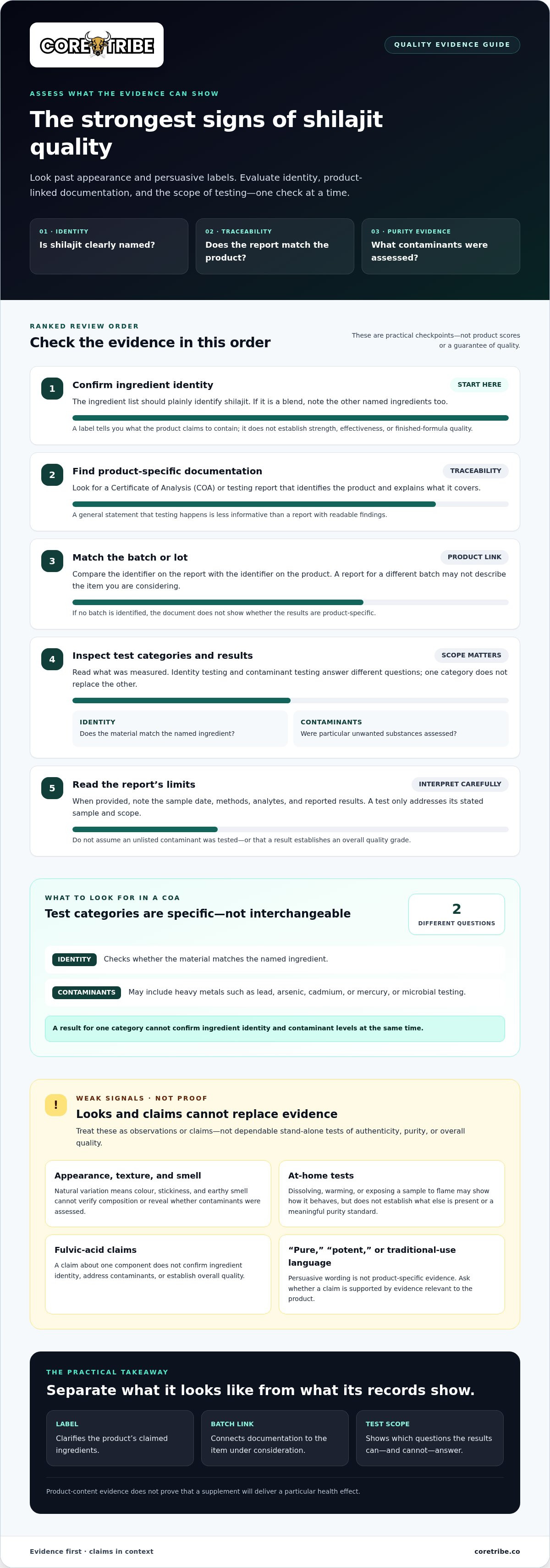
Use a practical order of checks: confirm that shilajit is plainly named as an ingredient, look for documentation tied to the product or batch, then check what the documentation evaluates. A claim about one component, such as fulvic acid, doesn’t confirm ingredient identity, address contaminants, or establish overall quality. The same caution applies to claims about traditional use or potency. Ask whether they’re supported by evidence relevant to the specific product.
You don’t need to become a laboratory expert. The key is to separate what a product looks or sounds like from what its documentation can show. Clear labeling helps identify the product; relevant, traceable evidence supports a more informed assessment.
How to Read Shilajit Testing and Purity Evidence
A certificate of analysis (COA) reports specified laboratory findings. It can help you assess a shilajit product, but only if you can tell what was tested and whether the results relate to the product you’re considering. A polished report isn’t automatically a complete one. Read it as a record of particular tests, not a blanket endorsement of every label statement.
A test report supports evaluation, but it doesn’t prove every claim about a product. Use this four-step review to make the document more useful:
- Locate the documentation. Look for a COA or testing report that identifies the product and explains what it covers. A general statement that testing happens is less informative than a report with readable findings.
- Match the batch. Compare any batch or lot identifier on the report with the identifier on the product. If the report is for a different batch, it may not describe the product you’re considering. If no batch is identified, the document doesn’t show whether the results are product-specific.
- Inspect the test categories. Check what was measured. Identity testing asks whether the material matches the named ingredient; contaminant testing asks whether particular unwanted substances were found. A report may list heavy metals such as lead, arsenic, cadmium, or mercury, or microbial testing. One category doesn’t answer the other.
- Note the limitations. Read the sample date, methods, analytes, and reported results if provided. A test only addresses the sample and substances included in its scope. Don’t assume an unlisted contaminant was tested or that a result establishes an overall quality grade.
What a certificate of analysis can help you assess
Check whether the document names the product or batch, then scan for the test categories and results rather than relying on a “tested” label. A report’s existence alone doesn’t establish its scope, completeness, or relevance. A result for one category, for example, can’t confirm ingredient identity and contaminant levels at the same time. Treat each finding as an answer to a specific question.
Purity testing and the limits of a single result
Contaminant testing matters because natural materials can vary, and appearance can’t reveal what a laboratory may detect. Still, don’t interpret a single result as proof of universal safety or purity. Results apply to the stated sample, testing method, and analytes; they don’t automatically cover every batch or every possible contaminant. Heavy-metal methods such as ICP-MS may appear in reports, but the method name doesn’t replace checking which metals were tested and what the results say.
Keep this framework beside you when comparing labels and reports. If you’re considering shilajit in different product formats, you can explore Coretribe’s shilajit offerings and apply the same careful questions to the product information.
Shilajit Quality Claims: Strong Evidence Versus Weak Signals
Product descriptions often mix testable details with persuasive language. Evidence can help answer specific questions about a product, while a visual cue or broad claim may offer context without verifying anything. A weak signal doesn’t prove a product is poor; it simply shouldn’t carry the same weight as documentation tied to the product and its stated tests.
Stronger evidence
Weaker signal
A test report identifies the product or batch and names the tests performed.
A label says “tested” without showing what was tested or which product the results describe.
Ingredient information clearly identifies shilajit and other ingredients in a blend.
“Pure” or “potent” appears without a clear explanation or supporting information.
A stated constituent amount is supported by relevant test information.
A fulvic-acid percentage appears alone, without wider product evidence.
Documentation gives a basis for evaluating particular quality questions.
Premium presentation, an origin story, or customer reviews create a favorable impression.
Does a high fulvic-acid claim prove shilajit is high quality?
No single constituent claim can establish overall quality. A stated fulvic-acid amount addresses one component; it doesn’t by itself establish that the ingredient is shilajit, show the product’s contaminant profile, or confirm the quality of the finished supplement. Distinguish a number printed on a label from a result supported by relevant testing. Neither a stated amount nor a test result guarantees effectiveness or safety.
This distinction helps you assess the signs of high quality shilajit without treating one prominent figure as a complete verdict. Consider what the claim measures, what evidence supports it, and what questions remain unanswered.
Which label and marketing claims deserve closer scrutiny?
Words such as “pure,” “potent,” and “premium” aren’t automatically false, but they need specifics to be meaningful. Look for supporting information that explains what each claim refers to. An origin story or reference to traditional use may add cultural or historical context, but it doesn’t independently verify the contents of a particular batch.
Be especially careful with absolute promises about purity, superiority, or effects. Ask what evidence could support the exact statement and whether it concerns the product itself. Reviews can describe a buyer’s experience, but they can’t substitute for laboratory findings. Use them as personal impressions, not verification.
Keep claims in proportion. Treat documentation as evidence for the specific tests and details it presents; treat appearance, reviews, and broad marketing language as prompts for further evaluation, not proof in either direction.
A Practical Checklist for Choosing a Shilajit Supplement
A clear checklist makes label comparisons calmer and more consistent. The signs of high quality shilajit aren’t a single impressive phrase or product format. Look for details you can evaluate, then consider whether the supplement suits your routine.
A five-point label and evidence review
- Check ingredient clarity. Shilajit should be clearly named in the ingredient list. If it’s a blend, review the other listed ingredients so you understand what the product contains.
- Look for product or batch identification. Testing documentation is more useful when it identifies the product or connects results to a specific batch or lot.
- Review the test scope. Check whether the documentation addresses ingredient identity, contaminants, or both. Note the specific contaminant categories and don’t assume unlisted substances were tested.
- Read the claims with care. Words such as “pure” or “potent” need supporting detail to carry meaning. Absolute promises about purity, superiority, or effects deserve closer scrutiny.
- Keep appearance in perspective. Colour, texture, and smell may describe a product, but they can’t establish its identity or contaminant profile.
Keep the list handy when comparing options. If a document is hard to connect to a product, or a label makes a broad claim without explaining it, pause and assess what information is actually available. A gap in evidence doesn’t prove a product is poor, but it does mean you have less information to use in your decision.
Product form is a separate choice. Capsules, resin, or another format may suit different preferences and routines, but format alone doesn’t prove quality. After reviewing the ingredient information and evidence, consider which form you prefer.
Once you’ve set your criteria, explore Coretribe’s shilajit range and apply the same thoughtful review to the product information.
When to consider personal safety before buying
Quality evidence and personal suitability are different questions. Your health conditions, medicines, and individual circumstances may affect whether a supplement is appropriate for you. If you have questions or take medication, consider discussing supplement use with a qualified healthcare professional before starting. A label or laboratory result can’t predict every individual response or guarantee that adverse effects won’t occur.
For additional context, consult a shilajit and ashwagandha side effects guide and a shilajit, ashwagandha, and sea moss guide when evaluating a blend or considering these ingredients together. Use those resources to inform questions, not as a substitute for advice tailored to your circumstances. Make your decision with both the product evidence and your own needs in view.
How Coretribe Fits Into a More Informed Shilajit Search
A thoughtful shilajit search starts with clear priorities: understand the ingredient list, review testing information, and separate evidence from marketing language. Those same habits can guide your exploration of Coretribe’s shilajit offerings. Product names and formats help you understand what kind of supplement you’re considering, but they aren’t proof of purity, testing, or potency.
Choosing between Coretribe’s shilajit product formats
Coretribe offers Coretribe Pure Shilajit Capsules - Mixed Sea Moss & Ashwagandha, a capsule option that combines shilajit with Sea Moss and Ashwagandha. If you’re comparing blends, read the label to understand which ingredients are included. For broader ingredient context, you can also consult a shilajit and ashwagandha synergy guide and consider how discussions of combined ingredients relate to your preferences.
Coretribe Shilajit Honey Sticks offer another shilajit format. Your preferred format can be a practical part of the decision, but it doesn’t establish a product’s identity, purity, or potency. Consider which form fits your routine, then assess the product information and relevant evidence for that option.
A supplement may appeal to you for its format or listed ingredients without those features answering every quality question. Seeing Sea Moss and Ashwagandha named in a blend tells you which additional ingredients are included. It doesn’t provide laboratory findings about the shilajit. Use the label to understand the formula, and evaluate quality claims on their own terms.
Make an informed next step
As you compare options, return to the checklist: identify the ingredients, look for documentation related to the product or batch, review which tests and contaminants are covered, and read broad claims cautiously. Distinguish between what the label states and what supporting evidence demonstrates. This is more useful than treating a product name, format, or appealing description as a substitute for verification.
Personal preference still matters. You might favor capsules or honey sticks based on the form you find easier to incorporate into your routine. That preference can help narrow your choices, but it isn’t evidence about testing or product quality. An ingredient combination can guide your interest without establishing a health outcome. For more background on the ingredients discussed together, a shilajit and ashwagandha synergy guide can offer additional context alongside the product label.
The goal is to choose with a clear view of both the formula and the information supporting its claims, rather than relying on one signal. When you’re ready, explore Coretribe’s available products and use the same careful questions as you review each option.
Choose Your Next Step With Clarity
The signs of high quality shilajit are most useful when they help you make a considered decision, not a rushed one. Use the evidence you’ve reviewed to guide your next step while keeping your preferences and circumstances in view. A clear label and relevant documentation can inform your choice, but they can’t promise a particular experience or outcome.
If you’re exploring shilajit options, Coretribe offers Pure Shilajit Capsules blended with Sea Moss and Ashwagandha, as well as Shilajit Honey Sticks. Consider the format and listed ingredients that suit your preferences, then review each product’s information with the same care you’d bring to any supplement decision.
Explore Coretribe’s shilajit and wellness products and take your next step with confidence and care.
Frequently Asked Questions
What are the clearest signs of high-quality shilajit?
The clearest signs of high quality shilajit are clear ingredient information and relevant evidence you can connect to the product. If a container has a lot code, for example, compare it with the identifier on the testing document rather than relying on a report for an unspecified sample. Then check whether the report addresses the questions that matter to you. These details help you judge the strength of the information, not predict a health outcome.
Can you tell if shilajit is pure by its colour or texture?
No. Colour and texture can describe a sample, but they can’t show what substances it contains or whether it was tested for contaminants. Shilajit products may come in different forms, so comparing a capsule with a resin by appearance won’t establish which is purer. Treat sensory observations as observations, not conclusions. Don’t use a home test or product photo as a substitute for relevant product information and testing evidence.
Does fulvic acid content prove shilajit is high quality?
No. A fulvic-acid statement concerns one constituent, not the full quality of a product. A label may state an amount, but that alone doesn’t tell you whether the amount was independently measured, whether the ingredient is correctly identified, or whether contaminants were assessed. Even a supported result doesn’t establish effectiveness or safety. Consider the claim alongside the ingredient list and other product-specific information, rather than treating it as a complete quality score.
How do I read a shilajit certificate of analysis?
First, check the report’s product name and batch or lot identifier, then compare them with the package. Look for the sample date, tests performed, and actual results, not just a general “passed” statement. For each result, note what substance was tested and any units or method details provided. A report covering heavy metals, for example, doesn’t automatically show whether ingredient identity was assessed. If key details are missing, interpret the document cautiously.
Is raw shilajit better than purified shilajit?
Raw shilajit isn’t automatically better. Raw material can contain unwanted impurities, so shilajit intended for consumption should be purified. The word “purified” on its own, however, doesn’t tell you how the finished product was evaluated. Look for information about the final product and relevant testing, rather than assuming raw means more authentic or purified guarantees safety. Processing descriptions and product-specific evidence answer different questions, and neither proves a health benefit.
Can high-quality shilajit still cause side effects?
Yes. Evidence of product quality can’t guarantee that a supplement will suit every person or prevent an individual reaction. Your health circumstances and medicines may affect whether supplement use is appropriate. If you take medication, have a health condition, or are unsure whether shilajit is suitable for you, discuss it with a qualified healthcare professional. Stop and seek appropriate medical advice if you experience a concerning reaction after taking a supplement.
What should I avoid when buying shilajit?
Be cautious about buying based only on dramatic appearance, glowing reviews, or promises of guaranteed effects. Pause if a label uses terms such as “pure” or “potent” without useful detail, or if a testing document can’t be matched to the product being sold. For a blend, read the full ingredient list so you know what else is included. These gaps don’t prove a product is poor, but they leave important questions unanswered.

