


A jar of shilajit can look convincing and still leave an important question unanswered: is it genuinely pure? If you're searching for how to test shilajit purity at home, simple checks may help you spot obvious inconsistencies, but they can’t confirm what isn’t visible, including heavy metals or the amount of specific compounds.
It makes sense to want a quick, practical way to assess a product before using it. Tests involving water, texture, or heat may offer clues, but passing them isn’t proof that shilajit is safe or uncontaminated. That distinction matters when supplier claims and lab reports can be difficult to interpret.
This guide explains what at-home observations can reveal, where their limits begin, and what to look for in a batch-specific laboratory report. It also covers how product format affects the checks you can make, so you can make a more informed choice without relying on appearance alone.
Key Takeaways
- Learn what visual checks and simple observations may flag, and why they can’t establish purity or safety.
- Use a cautious approach to how to test shilajit purity at home, treating water behavior and texture as clues rather than proof.
- Understand what to look for in a Certificate of Analysis and why the report must match the product being assessed.
- See how resin, powders, capsules, and blends differ in the observations you can make at home.
- Base your decision on relevant, traceable purity evidence rather than relying on a single sensory test.
What Does Shilajit Purity Mean, and Can You Check It at Home?
Purity is more than whether a sample looks dark, sticky, or convincing. It raises three questions: Is the product actually shilajit? What does it contain? Are unwanted substances present? Shilajit is a naturally occurring material with a complex composition, so appearance alone can’t tell you how much of a particular compound it contains or whether contaminants are present. For background on its origins and composition, see What is Shilajit?
A home observation and a chemical analysis answer different questions. You can look for an unusual appearance or behavior and note how it differs from what you expected. But sight, touch, and simple household tests don’t measure heavy metals or establish the concentration of specific compounds. A sample that seems normal may still need appropriate laboratory testing to assess those substances.
Definition: Home checks are preliminary observations that may flag something unusual. They are not laboratory verification of shilajit’s identity, composition, or contaminant levels.
What can an at-home shilajit check actually tell you?
An at-home check can help you describe what you see, not determine everything in the product. You might record its color, texture, or behavior in water, then use an unexpected result as a reason to review the product information more closely. These observations are clues, not chemical tests. They can’t confirm composition or rule out contaminants, even when a sample looks ordinary.
Why purity and authenticity are not the same claim
Authenticity asks whether the product is what its label claims: shilajit rather than a substitute or an adulterated mixture. Purity raises broader questions about composition and unwanted substances. A product could contain genuine shilajit and still have contaminants, or be presented as shilajit without clear evidence of its identity. Neither word, on its own, establishes that a product is safe or suitable for a particular person.
“Genuine” and “pure” shouldn’t be treated as interchangeable assurances. A seller’s description, a familiar appearance, or a passed home check may provide context, but none independently shows what a finished product contains. The same caution applies across product forms: once shilajit is combined with other ingredients or prepared as capsules or honey sticks, inspecting the visible material may tell you little about the shilajit inside.
So, how to test shilajit purity at home has a limited answer: observe carefully, document anything unusual, and treat the result as a prompt for further evaluation, not a verdict. Assessing specific substances requires evidence from tests designed to measure them. The next step is to understand what a laboratory report covers and whether it corresponds to the product you’re considering.
How to Check Shilajit at Home Without Treating Clues as Proof
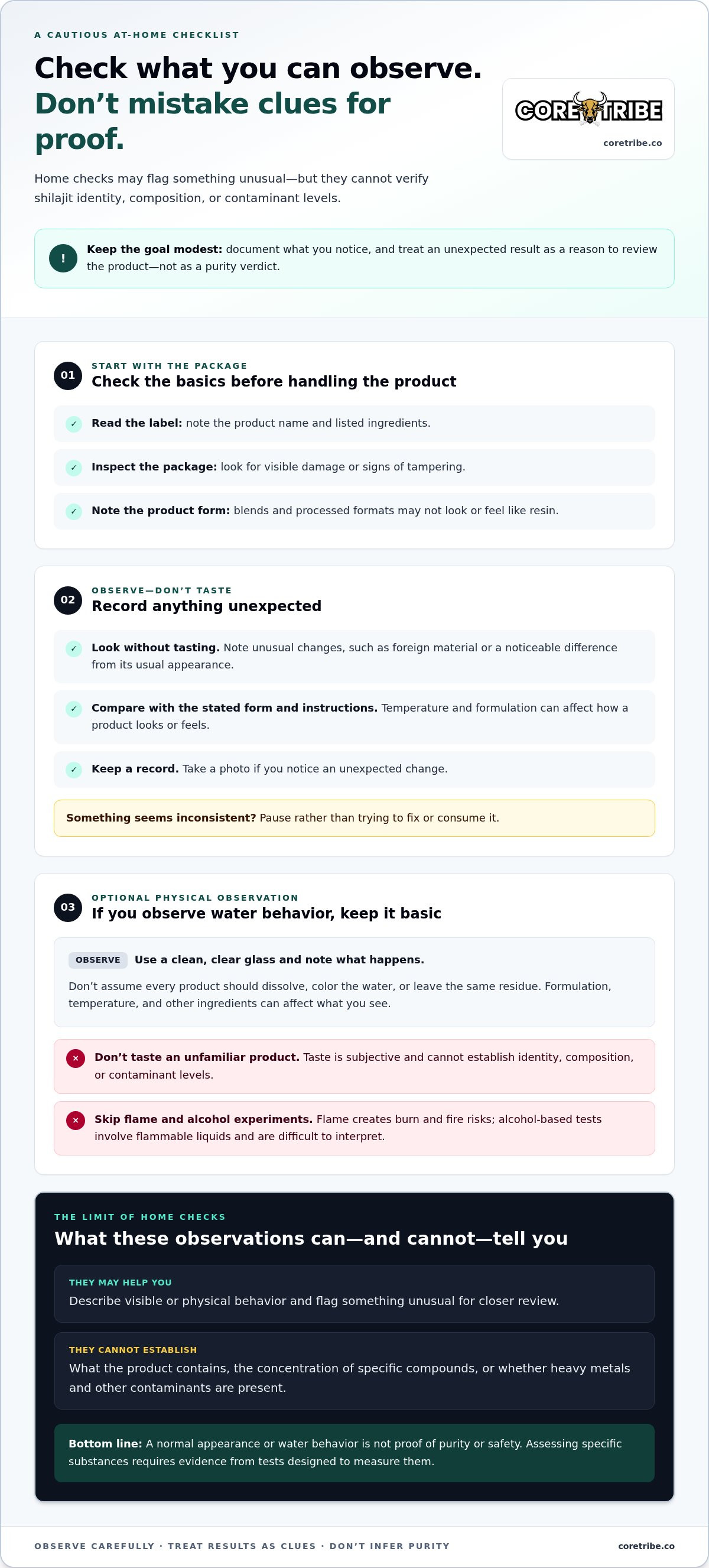
If you’re considering how to test shilajit purity at home, keep the goal modest: document what you can observe and flag anything unexpected. A simple check can help you describe a product, but it can’t identify every ingredient or reveal invisible contaminants. Don’t turn a familiar appearance or an online test result into a purity verdict.
A cautious visual and texture check
Start with the product as packaged. Note its form, label, seal, and consistency, and take a photo if you see an unexpected change. Don’t infer purity from a particular color, shine, smell, or texture. Handling can vary with temperature and formulation, and blends or processed formats may not look or feel like resin.
- Check the package and label for the product name, listed ingredients, and any visible damage or signs of tampering.
- Observe the product without tasting it. Record unusual changes, such as foreign material or a noticeable difference from its usual appearance.
- Compare your observations with the stated product form and instructions. If something seems inconsistent, pause rather than trying to fix or consume it.
These steps create a useful record, not a verdict. An unusual appearance is a reason to look for better information; a normal appearance doesn’t establish what the product contains.
What water-solubility observations do, and do not, show
If you choose to observe how the product behaves in water, treat it as a basic physical check. Use a clean, clear glass and note what happens without assuming every product should dissolve, color the water, or leave the same residue. Temperature, formulation, and other ingredients can affect what you see, so the result isn’t a reliable authenticity test.
Solubility, color, taste, or texture cannot measure contaminants. Material that disperses in water can still contain substances that aren’t visible to the eye. Don’t taste an unfamiliar product as a test. Taste is subjective and can’t establish identity, composition, or contaminant levels.
Skip flame and alcohol experiments. Applying a flame creates avoidable burn and fire risks, while alcohol-based tests introduce flammable liquids and produce results that are difficult to interpret. Neither method can tell you whether heavy metals or other specific contaminants are present. A dramatic reaction may look persuasive without answering the question that matters.
Use home observations to decide whether anything warrants a closer look, then rely on evidence that can assess the product’s contents. If you’re comparing formats, explore shilajit product options, keeping in mind that capsules, blends, and honey sticks don’t necessarily allow the same visual checks as resin.
What Lab Evidence Can Confirm Shilajit Purity More Reliably?
A laboratory report can answer specific questions that color, texture, or water behavior can’t. A Certificate of Analysis (COA) summarizes tests on a sample, but its value depends on what was tested and whether the sample represents the product you’re considering. A broad statement such as “purity tested” is less informative than a report naming the product, batch, test methods, analytes, and results.
For elemental contaminants, including heavy metals, a laboratory may use inductively coupled plasma mass spectrometry, or ICP-MS. This method can measure specified elements in the tested sample. It doesn’t automatically establish that every contaminant was assessed or that the sample came from the finished product on sale. The report’s scope and product match matter.
How to read a shilajit Certificate of Analysis
Start with the identifiers: product name, batch or lot number, sample description, and test date. Compare them with the product label or lot details. A report for raw material, a different formula, or another production batch may not describe the finished product in your hand. A recent, batch-specific report is more relevant than an undated or generic document.
- Check the analytes. Look for named targets, such as lead, arsenic, cadmium, mercury, and thallium, rather than a general claim of “heavy-metal testing.”
- Read the results and units. Note whether values are reported by weight, per serving, or in another unit. Compare figures only when their units and basis match.
- Look for method and lab details. ICP-MS may be used for elemental analysis. Laboratory accreditation, such as ISO/IEC 17025 accreditation, can provide context about testing competence, but it doesn’t expand a report beyond the tests it lists.
- Interpret “not detected” carefully. Check whether the report gives a detection or quantification limit. “Not detected” means the substance wasn’t detected above the method’s stated limit, not necessarily that none is present.
Which purity questions require laboratory evidence?
Contaminants such as lead or thallium can’t be assessed by taste, solubility, or appearance. A metals panel can provide results for the elements it names; it says nothing by itself about microbes or the amount of a particular compound such as fulvic acid. Those questions require suitable tests for those targets. A COA should identify the relevant methods and results rather than imply that one test covers everything.
Each purity claim should be supported by test evidence that measures the specific substance or quality being claimed. A report showing selected results isn’t a blanket safety guarantee. Laboratory results apply to the sample and batch identified in the report. The key question isn’t simply whether a COA exists, but whether its scope supports the claim and its identifiers match the product.
Home observations can help you decide what to investigate, but they can’t replace this evidence. If you’re researching how to test shilajit purity at home, keep the distinction clear: household checks describe physical clues, while suitable lab methods measure named substances in a tested sample.
How Product Form Changes What You Can Test at Home
The physical checks available depend on the product form. You can inspect and handle a piece of resin directly, while a capsule, powder, or blend may contain other ingredients that change its appearance and behavior. A check that seems meaningful for one form may be uninformative for another. No form makes visual inspection a way to verify contaminants.
- Resin: You can observe its color, consistency, and response to handling, but these traits vary and can’t confirm its composition.
- Powder: You can note its appearance and texture, but fine particles may make it difficult to distinguish shilajit from other ingredients by sight.
- Capsules: The shell hides the contents, which may include other ingredients or excipients. Opening one doesn’t turn its appearance into a purity test.
- Blended products: Added ingredients can affect color, taste, texture, and solubility, making it hard to attribute observed behavior to shilajit alone.
For example, a shilajit product combined with sea moss and ashwagandha can’t be judged by assuming its color or water behavior comes from shilajit alone. For more context on these ingredients together, explore this shilajit, ashwagandha, and sea moss guide. The ingredient list matters when interpreting what you see.
Can you use the same home checks for resin and capsules?
No. Resin allows direct observation of its surface and consistency; capsules don’t offer the same view, and an opened capsule may reveal a mixture rather than shilajit alone. A powder or blend also won’t necessarily behave like resin in water. Don’t use a raw-looking sample to validate a finished product. Assess evidence for the actual formulation and batch instead.
Product form also affects what a lab report needs to identify. A report for a raw ingredient isn’t automatically evidence about a finished capsule or honey stick, because processing and added ingredients change the product being assessed. Match the evidence to the exact form and batch, not just to the word “shilajit.”
A practical checklist for assessing a shilajit product
Keep your review focused. Record the product form, exact label identity, and batch or lot details, then compare them with any available report. Check that the report names the finished product and the specific substances tested. For a blended formula, the ingredient list helps explain why a sensory observation may reflect more than shilajit.
- Write down the product name and form as shown on the label.
- Note the batch or lot identifier and whether it matches the report.
- Identify which substances the report measures, rather than relying on a general purity statement.
- Treat appearance, taste, or water behavior as observations, not proof.
If you’re considering a combined formula, this shilajit supplement side effects and benefits guide offers broader ingredient context. The practical answer to how to test shilajit purity at home depends on format: make observations where possible, but base confidence on evidence relevant to the finished product. Explore Coretribe’s shilajit offerings as you compare product forms and labels.
Choosing Shilajit with Clearer Purity Evidence
A thoughtful choice doesn’t depend on a jar passing a kitchen test. Treat visible or physical observations as clues, then give more weight to evidence that identifies the product and batch and names what was measured. No single sensory result can establish purity or rule out contaminants, even if the material looks or behaves as expected.
A final evidence-first checklist before choosing
Before relying on a purity claim, compare it with its supporting information. The details should point to the product you’re actually considering, not simply to shilajit in general or a different ingredient form.
- Match product identity and form. Check that the evidence names the same finished product, such as resin, powder, capsules, or a blend.
- Look for batch details. A batch or lot identifier helps connect the report to a particular production batch. Compare it with the packaging where possible.
- Check the test scope. Look for named substances and reported results. A statement that a product is “tested” doesn’t show which contaminants or other qualities the test assessed.
- Read broad claims carefully. Words such as “pure” or “clean” are more meaningful when the supporting evidence specifies what was tested and for which product.
This is a practical way to assess evidence, not a guarantee of safety or suitability. A report only supports conclusions about the sample, analytes, and methods it identifies. If any of those details are missing or don’t match the product, the claim may offer less reassurance than it first appears to.
Where Coretribe’s shilajit products fit
Product form shapes what you can observe and which information is relevant. Coretribe offers Coretribe ® Pure Shilajit Capsules - Mixed Sea Moss & Ashwagandha and Coretribe®Shilajit Honey Sticks. The capsule product is blended with sea moss and ashwagandha, while the honey sticks are another shilajit offering. As with any product, appearance or a household check can’t establish purity; consider the label and any evidence for the finished product when assessing a claim.
If your starting question was how to test shilajit purity at home, keep the answer grounded: you can observe and record physical clues, but you can’t use them to verify contaminant levels. A more informed decision comes from matching the product identity, batch, test scope, and measured substances rather than relying on one result or a broad assurance.
As you compare formats and supporting information, explore Coretribe’s available products to view its shilajit offerings alongside other products.
Make Your Next Shilajit Choice with Confidence
Make your next step a decision you can explain: choose a product whose identity and supporting evidence make sense to you, rather than relying on a dramatic result from a home experiment. The question of how to test shilajit purity at home has a clear boundary: observations may guide your questions, but they can’t replace evidence that measures specific substances.
If you’re comparing formats, Coretribe offers Coretribe ® Pure Shilajit Capsules - Mixed Sea Moss & Ashwagandha and Coretribe®Shilajit Honey Sticks. Their forms differ, so consider each product on its own terms and don’t infer purity or testing results from appearance alone.
Review the options and decide what fits your preferences. Explore Coretribe’s shilajit and wellness products, and continue your wellness journey with care and confidence.
Frequently Asked Questions
Can you test shilajit capsules at home without opening them?
No. An unopened capsule doesn’t let you inspect its contents, and the capsule’s exterior can’t reveal the blend’s composition or contaminant levels. You can check the label, lot information, packaging condition, and any documentation provided for the product. Keep the container intact while assessing it, and compare its identifiers with the report rather than trying to judge purity from the capsule shell.
Does shilajit change consistency when the temperature changes?
Yes, resin may feel softer in a warmer environment and firmer in a cooler one. That change alone doesn’t show that the product is pure or adulterated. For a fair observation, note the storage conditions and let the container return to its usual indoor environment before comparing consistency. Don’t use direct heat to force a reaction, since it can change the material and make observations harder to interpret.
Can a home test tell whether shilajit contains lead or arsenic?
No. If you’re wondering how to test shilajit purity at home, household observations can’t detect or measure lead or arsenic. These elements require appropriate laboratory analysis, such as an elemental test using ICP-MS. Look for a report that names each element and gives its result and units. A report that tests lead doesn’t automatically show whether arsenic or other contaminants were included.
What does a non-detect result on a shilajit lab report mean?
“Non-detect” means the lab did not measure the named substance above the method’s detection threshold in the tested sample. It doesn’t necessarily mean the substance is completely absent. Check the report for a detection or quantification limit and note the units. For example, a non-detect result for lead says nothing about arsenic unless arsenic was also tested and reported.
How can I tell whether a Certificate of Analysis matches my shilajit batch?
Compare the product name and form on the report with the package, then check whether the lot or batch number matches. Also review the sample description and test date. A report with a similar product name but a different lot may not describe your container’s batch. If a number is missing or doesn’t align, treat the report as unverified for that specific product rather than assuming it applies.
Does a strong smell or taste mean shilajit is pure?
No. Smell and taste can vary, and neither can confirm identity, composition, or contaminant levels. They’re subjective observations, not analytical measurements. Don’t taste an unfamiliar product to assess it; an unusual flavor won’t tell you what substances are present. If you notice an unexpected odor or a change from the product’s usual condition, record it and use product documentation for a more meaningful assessment.
Can a lab report for raw shilajit verify a finished capsule blend?
No, not by itself. A report for raw shilajit describes the sample tested, not necessarily the finished capsules containing it. Processing and added ingredients can change the final product’s composition, so the raw-material report can’t establish what is present in the blend. For a relevant assessment, look for documentation that identifies the finished product and its batch, with results for the substances being claimed.

