


A daily supplement routine isn’t automatically safe or necessary. If you’re asking, “can you take cordyceps every day,” you may be looking for a clear answer amid conflicting claims about its benefits, dosage, and safety.
Some healthy adults may consider regular use, but the evidence doesn’t establish a routine that’s right for everyone. Long-term use hasn’t been studied well enough to remove all uncertainty. Your health, medicines, and the product’s directions all matter.
This guide explains what’s known and what remains unclear. It covers potential side effects, why people taking blood thinners, diabetes medicines, or immunosuppressants should seek medical advice first, and why cordyceps isn’t recommended during pregnancy or breastfeeding. You’ll also find practical steps for reading a supplement label, approaching dose and duration cautiously, and noting how you feel if you decide to try it. The aim is an informed decision, not a one-size-fits-all answer.
Key Takeaways
- Wondering “can you take cordyceps every day”? The answer depends on your health, the product directions, and what the available evidence can tell us.
- Find out why results from lab, animal, and human studies may not translate directly into a daily routine.
- Learn which health conditions and medicines call for extra caution before trying cordyceps.
- Use a practical checklist to review a supplement label, follow its directions, and note how your body responds.
- After weighing the safety information and evidence, consider Coretribe’s Cordyceps offering as one option in the supplement category.
Can You Take Cordyceps Every Day? The Short, Balanced Answer
Whether you can take cordyceps every day depends on your health and the specific supplement. Daily use isn’t a universal recommendation. Cordyceps refers to a genus of fungi with a history of use in traditional practices and modern supplement forms. The name covers different species, and products can vary in preparation and concentration. An overview of Cordyceps fungi can help explain this diversity, but traditional use doesn’t prove that a supplement is safe for everyone or effective for a particular purpose.
That distinction matters. Traditional use can explain interest in a fungus, but modern human research is needed to assess specific products, outcomes, and patterns of use. Early findings may help shape future research, but they don’t establish that long-term use is safe or guarantee a health outcome. Evidence about one species or preparation also can’t automatically be applied to every supplement called cordyceps.
Possible use is not the same as proven daily benefit. That’s a useful starting point when weighing regular use against occasional use.
What does daily cordyceps use mean?
Daily use generally means taking a supplement regularly, often according to its label, rather than using it only now and then. Neither daily nor occasional use is automatically right for everyone. Products may differ in fungal species, preparation, and concentration, which makes it difficult to generalize a routine from one product to another.
Follow the directions for the product you have, but treat them as instructions for that product, not proof that it suits everyone. A label tells you how the manufacturer intends the supplement to be used. It can’t account for your health history, medicines, or individual response, and it doesn’t establish a suitable long-term schedule for you.
What can a reader reasonably conclude?
The measured conclusion is that some people may consider regular use, but research doesn’t establish a universal daily routine or prove long-term safety across products and populations. Historical use provides context, not the same kind of evidence as controlled human research. Human studies can also differ in the cordyceps used, who took part, and how long use was assessed. Their results shouldn’t be treated as a guarantee for an individual.
Keep expectations grounded. Cordyceps supplements shouldn’t be assumed to reliably increase energy or endurance, strengthen immunity, or treat disease. Those outcomes need evidence for the particular use, and supplements shouldn’t replace medical care. Start by considering the exact product and your own circumstances. If you have a health condition, take medicines, or are unsure whether regular use is suitable, seek advice from a healthcare professional before starting.
What Research Says About Taking Cordyceps Regularly
Research on cordyceps includes laboratory experiments, animal studies, and human trials, but these forms of evidence answer different questions. Lab work can explore how compounds interact with cells under controlled conditions. Animal research can suggest effects worth investigating. Neither proves that a supplement produces the same result in people or that daily use is safe over the long term.
Human studies are more directly relevant, but their findings can still be difficult to apply broadly. Researchers may study different cordyceps species or preparations, use different amounts, recruit different populations, and follow participants for different periods. A result from one extract and study group doesn’t automatically apply to another product or to you. Reviews published in 2025 and 2026 have synthesized research on proposed effects, but a review can only be as conclusive as the studies it evaluates.
Why cordyceps studies may not answer the daily-use question
“Cordyceps” isn’t one uniform ingredient. Species and processing can affect what a preparation contains, so a trial of one extract may not reflect another supplement. Study duration matters as well: research that observes people over a limited period can’t establish what happens with extended everyday use. To judge whether a study is relevant, look for the species, preparation, participants, and length of the study, rather than relying on a headline about a potential benefit.
Evidence also needs to be read in light of the study type. A laboratory finding about a biological pathway is a lead for further research, not proof of a noticeable effect in daily life. Animal results can help researchers develop questions for human trials, but they don’t replace them. Human research is the closest match to a person’s experience, though differences in study design and participants can limit how widely results apply.
Potential benefits: possibilities, not promises
Interest in cordyceps often focuses on energy, exercise performance, immune activity, and other proposed effects. Possible biological mechanisms may help explain why researchers study these areas, but a plausible mechanism doesn’t demonstrate a reliable health outcome. Treat findings from early research as preliminary unless stronger human evidence supports the specific claim. They also don’t establish that daily use will benefit everyone.
Studying an outcome is different from proving that a supplement can treat a condition. Cordyceps shouldn’t be presented as a disease treatment or a substitute for appropriate medical care. When a claim sounds certain, consider what kind of study supports it and whether the research examined the same species and preparation as the supplement in question.
The evidence points to areas worth studying, but it doesn’t establish dependable benefits or long-term safety for everyday use across cordyceps products. So, can you take cordyceps every day? Research alone can’t give everyone a yes. The answer also depends on personal health and the product’s directions. Readers exploring supplements can browse Coretribe’s supplement selection with those evidence limits in mind.
Who Should Be More Cautious About Daily Cordyceps?
“Natural” describes an origin, not a guarantee of safety. A supplement can still affect the body or interact with treatment, and information about cordyceps safety is incomplete. If you have a chronic condition or take regular medicines, discuss cordyceps with a healthcare professional before using it regularly. Share the product label and ingredient list so they can consider the specific supplement, not just its general name.
Extra caution is especially important for people taking blood thinners, diabetes medicines, or immunosuppressants. Cordyceps may affect blood clotting or blood sugar, and possible effects on immune activity could matter for someone using medicines that suppress the immune system. These are potential interaction concerns, not proof that an interaction will occur in every person. Don’t change a prescribed dose or stop a medicine to make room for a supplement.
Medicines and health conditions that deserve extra care
Speak with a healthcare professional before starting if you use medicine that affects clotting or blood sugar, or treatment that suppresses immune activity. Do the same if you have an ongoing health condition that requires monitoring, since adding a supplement may complicate decisions about symptoms or treatment. Bring the product details and a list of your medicines, including over-the-counter products and other supplements, to help assess possible risks.
People who are pregnant or breastfeeding should avoid cordyceps unless a qualified healthcare professional advises otherwise. Safety research in these groups is lacking, so there isn’t enough information to establish that use is safe. If you’re planning a procedure or already receive care for a significant condition, mention any supplement use to the clinician overseeing that care.
Possible side effects and warning signs
Reported side effects appear to be generally mild, but information is limited. They can include digestive upset, nausea, or dry mouth, particularly when someone is starting or taking a larger amount. Not everyone experiences these effects, and not experiencing them doesn’t show that a supplement is right for you.
If a new or concerning reaction occurs, stop taking the supplement and seek medical advice. Get urgent care for a severe reaction, such as trouble breathing or swelling of the face or throat. Note when you began using cordyceps, how you followed the label directions, and any symptoms that appeared. Those details can help a healthcare professional assess what may be happening.
One uneventful serving can’t establish that continued use will be safe. Responses may change over time, as can a person’s medicines or health circumstances. Before adding cordyceps to a daily routine, consider your individual risk factors rather than assuming a natural supplement is harmless. If you’re asking, “can you take cordyceps every day?” consult a healthcare professional who knows your health history.
How to Approach a Daily Cordyceps Routine Carefully
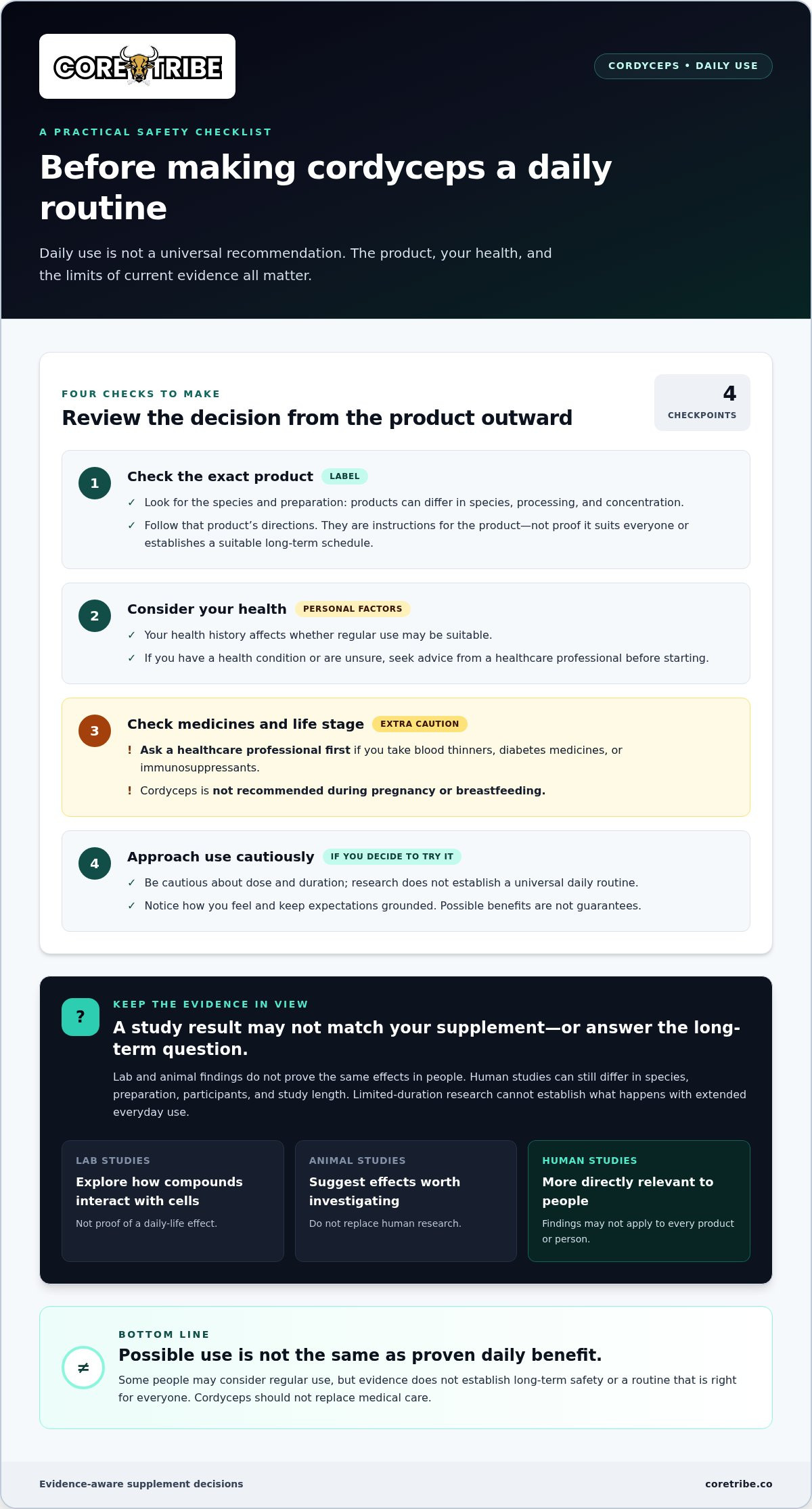
A careful routine starts with your circumstances, not a standard dose copied from a general article. Before adding cordyceps, consider your health, medicines, and other supplements. If you have an ongoing condition, take regular medication, are pregnant or breastfeeding, or have questions about possible interactions, seek guidance from a qualified healthcare professional first. Don’t change prescribed treatment to accommodate a supplement.
Then take a stepwise approach:
- Review your health considerations. Think about the conditions you manage and the medicines you use. A pharmacist or healthcare professional can help assess whether the supplement may be appropriate alongside them.
- Read the specific product label. Check the named species, full ingredient list, serving directions, and warnings. Cordyceps products can differ in species, preparation, and concentration, so directions for one supplement may not apply to another.
- Follow the directions for that product. Don’t assume that a dose discussed online or a serving size on another product is right for yours. Evidence doesn’t establish one universal dose, cycling schedule, or duration for everyone.
- Monitor your response and reassess. Keep a simple record of when you take it, changes you notice, and any unwanted effects. If you experience a new or concerning reaction, stop taking it and seek medical advice.
Read the supplement label before starting
Look for the named species, ingredients, serving instructions, and cautions. Make sure you’re reading the label for the product you actually have. If a detail is unclear, don’t guess or use directions from another brand. The label provides product-specific instructions, but it can’t determine whether daily use suits your health circumstances.
Avoid introducing several new supplements at once. If you start cordyceps alongside other unfamiliar products, it can be difficult to tell which one might be linked to a change or reaction. Adding only one new supplement at a time makes your notes more useful and gives you a clearer basis for discussing any concerns with a healthcare professional.
Monitor your response and reassess
In a notebook or phone note, record when you began, how you followed the label, and any symptoms or changes you notice. Include relevant changes to medicines or other supplements. A perceived improvement is worth noting, but it doesn’t prove cordyceps caused it or establish a health benefit. If symptoms worry you, persist, or worsen, stop use and seek qualified medical guidance.
You don’t need to force a daily routine if the evidence, label, or your circumstances leave you uncertain. If you want to consider cordyceps among other supplement options, explore Coretribe’s supplement collection and review each product’s information carefully.
Exploring Cordyceps Through Coretribe's Supplement Collection
After weighing the evidence and your own circumstances, you may decide to explore cordyceps supplements, or you may prefer to wait. Either is a reasonable choice. Coretribe offers Cordyceps for readers considering the category, but browsing a supplement is separate from deciding whether it fits your health needs. If you’re still asking, “can you take cordyceps every day,” exploring a product won’t answer that by itself. The label, available evidence, and your personal circumstances still matter.
What to keep in mind when exploring supplements
Use the same careful approach with any supplement you consider. Read the ingredient list and serving directions, check which species or ingredients are named, and look for relevant warnings. Compare the actual product label with claims you encounter elsewhere. Different forms and preparations may not be interchangeable, so don’t apply another product’s instructions or claims to the one you’re considering.
Give more weight to clear, specific use information than to dramatic promises. A confident-sounding claim doesn’t establish that a product will produce a particular outcome, and a supplement label isn’t a substitute for advice about your medicines or health conditions. If something on a label is unclear, pause rather than guessing. If you have a health concern or take regular medication, discuss the product with a qualified healthcare professional before use.
Coretribe’s Cordyceps is distinct from its other supplement offerings. Information about one ingredient shouldn’t be taken as evidence of the effects or safety of another. For broader context on approaching wellbeing as part of everyday life, read this mind-body balance guide. The guide to Shilajit, Sea Moss, and Ashwagandha side effects addresses those ingredients specifically, not cordyceps.
Continue learning about a balanced supplement routine
A thoughtful routine doesn’t require adding a supplement simply because it’s available. Consider what you hope to learn from trying it, what the label says, and whether your health circumstances call for professional guidance. If you choose to use a supplement, keep track of how you take it and any changes you notice. That record can help you reassess your decision and share useful details with a healthcare professional if questions arise.
When you’re ready to browse, explore Coretribe’s supplement collection at your own pace. Read the product information carefully and let your circumstances guide your next step.
Choose Your Next Step With Care
A supplement routine should fit your needs, not a trend or a promise. If you’re still wondering, “can you take cordyceps every day,” take time to make a considered choice. Review the information available, reflect on your health circumstances, and seek guidance from a qualified healthcare professional if you’re unsure. Choosing not to start, or deciding to pause, can be just as thoughtful as trying a supplement.
To explore your options, browse Coretribe’s supplement collection. Read the product information carefully and let your personal circumstances guide what comes next.
Frequently Asked Questions
Can you take cordyceps every day?
Some adults may consider regular use, but that doesn’t establish long-term safety or make daily use suitable for everyone. Check the directions on the exact product you have rather than borrowing instructions from another supplement. If you take medicine or manage a health condition, ask a healthcare professional to review it with you. Keep the label available so you can discuss its ingredients and serving instructions accurately.
Is cordyceps safe to take every day for everyone?
No. Safety can vary with the person, the supplement, and their health circumstances. People who are pregnant or breastfeeding should seek professional advice because safety information for these groups is limited. Guidance is also sensible for anyone managing an ongoing condition or taking regular medicines, particularly blood thinners, diabetes medicines, or immunosuppressants. A natural source doesn’t guarantee a product will be appropriate alongside your individual care.
How much cordyceps can you take in a day?
There isn’t one daily amount that can be recommended for every cordyceps supplement. Products may use different species and preparations, and their serving directions can differ. Read the label for the specific product you have, and don’t combine serving amounts from multiple products without guidance. If you take medicines, have a health condition, or are unsure whether the directions suit you, ask a healthcare professional before use.
What happens if you take cordyceps every day?
People may respond differently, and taking cordyceps daily doesn’t guarantee a noticeable benefit. Digestive upset, nausea, or dry mouth have been reported, while potential interactions may matter for people taking certain medicines. If you notice a concerning reaction, stop using the supplement and seek medical advice. Write down when symptoms began and what else you took that day; this can help a healthcare professional assess the situation.
Can you take cordyceps at night?
There isn’t enough basis to say that nighttime use reliably improves or disrupts sleep for everyone. Timing may be a personal preference, but the product’s directions should guide how you take it. If you try it at night, note the time and any changes in how you feel or sleep, without assuming the supplement caused them. If you notice a troubling response, stop use and seek medical advice.
Should you take breaks from cordyceps?
No universal break schedule is established, so a cycling pattern shouldn’t be treated as necessary or proven. Follow the directions for your specific product, and don’t extend or change its suggested use based on a schedule intended for another supplement. If you’ve been using cordyceps regularly and want to continue, review that decision with a healthcare professional if you have health concerns, take medicines, or develop new symptoms.

