


Could a mineral-rich supplement really help thinning hair grow back, or are online claims running ahead of the science? If you’re weighing shilajit for hair growth, it’s reasonable to want more than confident promises. The evidence for shilajit on its own is limited, and it hasn’t established the supplement as a hair-loss treatment.
Hair changes can have many causes, from inherited patterns to health conditions and nutritional issues. The right next step depends on what’s behind them. A supplement may sound appealing, but it shouldn’t replace looking into the cause or getting medical advice when hair loss is sudden, persistent, or concerning.
This guide explains what human research does and doesn’t show, why results from a combination supplement can’t prove shilajit works by itself, and what to consider before taking it. You’ll also learn when it makes sense to seek an evaluation and how to assess supplement claims without relying on promises the evidence can’t yet support.
Key Takeaways
- Traditional use and early research offer context, but they don’t establish shilajit as a proven hair-growth treatment.
- Research on a supplement combination containing shilajit components can’t show that shilajit alone caused the reported hair changes.
- Separate claims about shilajit for hair growth from evidence, and consider other possible causes of thinning before choosing a next step.
- Recording when shedding began and how it changes can help you decide when to seek a clinical assessment.
- Set realistic expectations when reviewing supplements: read the label carefully and don’t treat broad wellness claims as proof of hair benefits.
Shilajit for Hair Growth: What People Hope It Can Do
Noticing more hair in the brush or a widening part can feel personal, especially when the change is gradual and hard to explain. That concern helps explain interest in shilajit for hair growth, but the evidence has a clear limit: traditional use and general wellness interest don’t demonstrate that shilajit regrows human hair. It helps to separate what people hope it may do from what research has actually shown.
What is shilajit, and why is it discussed for hair?
Shilajit is a naturally occurring, mineral-rich substance associated with traditional wellness practices. Its history and reported uses help explain its appeal, but they don’t establish a specific effect on hair follicles. Traditional context: shilajit has been used in folk and alternative medicine. Clinical evidence: that history alone isn’t proof of human hair regrowth. Shilajit on Wikipedia offers a broader overview, including traditional uses and the limits of evidence for health effects.
Interest often rests on a plausible-sounding idea: if a substance supports general well-being, perhaps it could also support hair. But a proposed connection is not a demonstrated outcome. A useful distinction is: Traditional use can explain why shilajit is discussed for hair, but only well-designed human research measuring hair outcomes could show whether it promotes regrowth. That distinction matters when supplement claims sound more certain than the evidence.
What does healthy hair growth depend on?
Each hair grows from a follicle and moves through a cycle of growth, transition, rest, and shedding. The visible strand is largely made of keratin, a structural protein. These are related parts of hair biology, not proof that a supplement changes follicle activity or keratin production. Hair growth is also influenced by genetics, age, health, and other factors.
Shedding and thinning can have different causes and unfold on different timelines. Someone may notice increased shedding after a health change, while hereditary pattern loss can develop gradually. Other health-related factors can affect hair, too. That’s why the same supplement claim may not apply equally to two people, even when their hair changes look similar.
For a grounded starting point, describe what has changed: is hair coming out more than usual, or does it seem less dense in a particular area? Note when the change began and whether it followed a shift in health, routine, or medication. Those observations don’t diagnose the cause, but they can help put the concern in context. Don’t assume shilajit acts directly on follicles simply because it is described as mineral-rich or rooted in traditional practice.
How Strong Is the Evidence for Shilajit and Hair Growth?
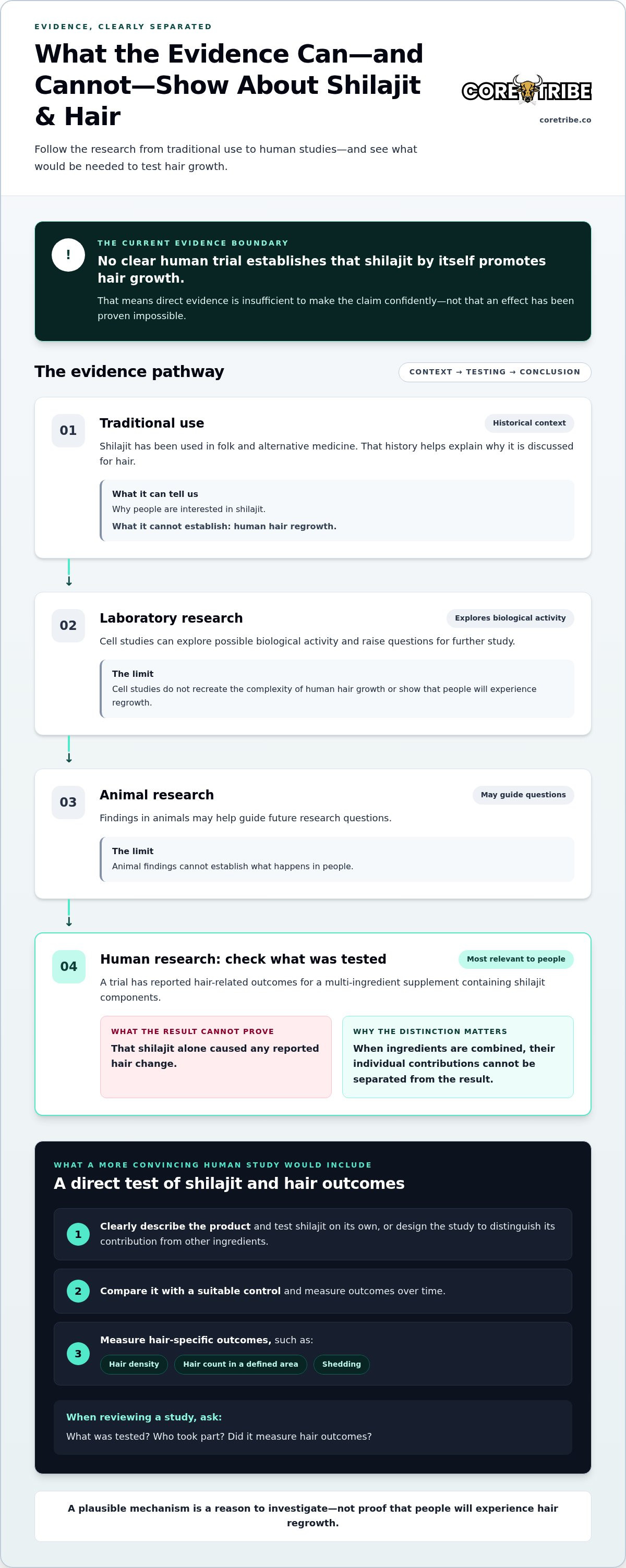
The evidence needs to be separated by type. Traditional use can explain why shilajit is discussed for hair, while laboratory and animal research can raise questions for further study. Neither shows that people will experience hair regrowth. Human studies are more relevant, but the key detail is what was tested: shilajit alone, or a combination of ingredients?
What research would demonstrate a hair-growth benefit?
A convincing human study would compare a clearly described shilajit product with a suitable control and measure hair-specific outcomes over time. These could include changes in hair density, the number of hairs in a defined area, or shedding. General changes in wellness or other health markers don’t answer whether hair improved. Nor would a small preliminary study, by itself, establish a reliable treatment effect.
Biological plausibility is a reason to investigate a possible hair benefit, not proof that people will experience one. This distinction helps keep claims grounded, even when a proposed mechanism sounds credible.
What can current research reasonably tell us?
Traditional use: Historical use provides context, not a controlled test of hair growth. Laboratory research: Cell studies can explore biological activity, but they don’t recreate the complexity of human hair growth. Animal research: Findings in animals may guide research questions, but they can’t establish what happens in people. The review on shilajit as a natural phytocomplex discusses the substance in a broader scientific context; it is not evidence of a hair-growth benefit.
Human trials: A trial has reported hair-related outcomes for a multi-ingredient supplement containing shilajit components. Because the product combined ingredients, its results can’t show that shilajit alone caused any change. Based on the research summarized here, no clear human trial establishes that shilajit by itself promotes hair growth. That’s different from proving it can never have an effect; it means the direct evidence is insufficient to make the claim confidently.
To isolate shilajit’s effect, researchers would need to test it on its own or design a study that can distinguish its contribution from those of other ingredients. Until then, claims that it supports hair because of general antioxidant, mineral, or wellness properties go beyond what those properties demonstrate. They don’t establish an effect on hair density, shedding, or follicles.
PubMed Central (PMC) is an archive for searching biomedical literature, not a stamp of approval for every claim in its papers. When reviewing a study, look at what it tested, who took part, and whether it measured hair outcomes. If you’re exploring shilajit supplements for general wellness rather than as a hair treatment, you can browse Coretribe’s supplement options with those evidence limits in mind.
Shilajit Hair Claims Versus Other Causes of Hair Thinning
Hair thinning can look similar from the outside but have different explanations. Shilajit’s general wellness reputation may make it seem like a natural answer, yet it doesn’t identify why hair is changing or show that regrowth will follow. Start by separating claims about the supplement from what is known about hair loss.
| Claim or possibility | Evidence status | Responsible interpretation |
|---|---|---|
| Shilajit supports hair because of its mineral or antioxidant properties | These general properties don’t establish a hair outcome | Don’t assume they increase density or reduce shedding |
| Taking shilajit leads to hair regrowth | Direct evidence for shilajit alone is insufficient | Consider it an unproven hair-growth idea, not an established treatment |
| Thinning is related to hereditary pattern loss or a health factor | Both are broad possibilities, among others | The pattern and context matter; a clinician can help assess the cause |
Can general wellness claims explain hair regrowth?
No. An antioxidant or mineral-related claim doesn’t show that a supplement changes hair density, follicle activity, or shedding. Even when a nutrient is relevant to health, its presence in a product doesn’t prove that someone has a deficiency or that taking more will address hair changes. Marketing language may describe a proposed benefit, but it isn’t the same as independent clinical evidence measuring hair outcomes.
Why identifying the cause matters
Hair changes can be hereditary, temporary, or associated with health factors, and these broad patterns aren’t interchangeable. A clinician may consider health history and, when appropriate, tests such as ferritin or thyroid testing. These aren’t tests everyone needs, and results require clinical context. Sudden or patchy loss, scalp pain, or another change that concerns you is a reason to seek medical advice rather than rely on a supplement alone.
The main misconception behind many shilajit for hair growth claims is that support for general wellness automatically means hair regrowth. It doesn’t. Hair outcomes need to be studied directly, and the cause of thinning can shape which next steps make sense. Even a supplement containing minerals cannot be assumed to correct a deficiency without appropriate assessment.
Describe the change rather than self-diagnosing it: note where thinning appears, whether shedding seems increased, and when you first noticed it. This information can help a clinician consider possible causes and discuss options suited to your circumstances. Avoid treating every increase in shedding as the same problem or assuming a supplement is the answer because its ingredients sound relevant. A thoughtful approach starts with the hair change itself, then weighs any supplement claim against evidence for that specific outcome.
What to Do If You Are Considering Shilajit for Hair
If you’re thinking about shilajit for hair growth, begin with the change you’ve noticed, not a supplement promise. A few simple observations can help you decide whether to seek advice and give a healthcare professional useful context. Shilajit isn’t an established hair-loss treatment, so don’t let trying it become a reason to put off understanding what may be happening.
A grounded checklist before trying a supplement
Take these steps before adding a supplement to your routine:
- Record what you notice. Note when shedding or thinning began, whether it seems to be changing, and where it appears. If useful, keep dated notes or photos in consistent lighting to track changes over time.
- Consider the timing. Write down any health, medication, or routine changes around the time you first noticed the difference. This won’t identify the cause on its own, but it may help a clinician assess the bigger picture.
- Read the entire label. Review all ingredients and follow the product’s stated directions. Don’t assume general wellness claims mean a supplement is suitable for you or designed to address hair changes.
- Discuss it with a qualified healthcare professional. This is especially important if you take medicines, have a health condition, are pregnant or breastfeeding, or have questions about possible interactions. Share the product label so its ingredients can be considered in context.
A thoughtful review is more useful than adding several new supplements at once. If you make changes, keep a record of what you take and when. That can help you describe your routine clearly during a health discussion.
When should hair loss be assessed?
Consider seeking medical advice if hair loss persists, begins suddenly, appears in patches, or feels distressing. You don’t need to determine the cause before asking for help. A clinician can consider the pattern, timing, health history, and other relevant factors, then decide whether further assessment is appropriate.
Hair changes can have different explanations, so evaluation may help distinguish among them before you choose an approach. Depending on your situation, a clinician can discuss established options and whether any tests or follow-up make sense. Diagnosis and treatment decisions should be based on your circumstances, not on a supplement’s broad claims.
Don’t delay evaluation of persistent hair loss in favour of an unproven supplement. You can ask a healthcare professional whether shilajit is appropriate for your situation, but keep that conversation separate from identifying and addressing the cause of hair changes.
If you’re considering shilajit for general wellness rather than as a hair treatment, you can explore Coretribe’s supplement options while keeping these evidence limits in mind.
Choosing Shilajit With Realistic Expectations
Shilajit should not be presented as a proven hair-growth treatment. When weighing the claims, keep two questions separate: Are you interested in a shilajit supplement for general wellness, or are you expecting it to prevent shedding or regrow hair? Current evidence doesn’t establish that shilajit alone delivers those hair outcomes. This distinction can help you make a considered choice without treating a supplement as a substitute for understanding a hair change.
How to keep supplement expectations evidence-led
Start with the label. Read the full ingredient list, serving information, directions, and warnings so you know what the product contains and how it is intended to be used. If it combines shilajit with other ingredients, remember that evidence about one ingredient cannot automatically be applied to the whole formula, or vice versa. Look for specific, clearly explained claims rather than assuming broad terms such as “supports wellness” mean a product has been shown to affect hair.
Consider what you want from the supplement before deciding. Interest in trying shilajit is different from expecting it to change hair density, stop shedding, or cause regrowth. Those are specific outcomes, and they need specific evidence. If you take medication, have a health condition, are pregnant or breastfeeding, or are unsure whether an ingredient is appropriate for you, discuss the label with a qualified healthcare professional. Don’t use a supplement in place of an assessment or care recommended for persistent hair loss.
A measured approach also means avoiding changes that make it hard to tell what you’re taking or how your routine is affecting you. Keep a record of supplements you use, and follow the directions on each product’s label. If hair concerns continue, prioritize discussing them with a clinician rather than waiting to see whether an unproven option works.
Where Coretribe fits into a broader wellness routine
For readers interested in a shilajit-containing supplement, Coretribe ® Pure Shilajit Capsules - Mixed Sea Moss & Ashwagandha is one option to review. Its name identifies a blend that includes shilajit, sea moss, and ashwagandha; it should not be treated as a hair treatment or as evidence that shilajit promotes hair growth. As with any supplement, read the ingredient information and consider whether it fits your needs.
The practical takeaway is simple: choose a supplement, if you choose one, for reasons that match what is known, not for a promised hair result. If you’d like to explore Coretribe’s wellness options, browse the wellness collection. Keep product discovery separate from medical guidance about hair loss, and seek assessment when changes persist or concern you.
Make Your Next Step a Thoughtful One
Hair concerns can take time to understand, and you don’t need to make a rushed decision because a supplement is trending or a claim sounds reassuring. Consider what you want from a supplement, what information would help you feel confident, and whether your hair changes deserve professional attention first. For shilajit for hair growth, let the evidence set expectations rather than letting hope stand in for proof.
If you’re considering shilajit for general wellness, review the product information carefully and discuss it with a qualified healthcare professional when your health, medicines, or circumstances make that relevant. Keep any supplement choice separate from decisions about evaluating or addressing hair loss.
When you’re ready to explore wellness products, browse Coretribe’s wellness collection at your own pace. An informed choice is a worthwhile step toward caring for yourself with confidence.
Frequently Asked Questions
Can shilajit make hair grow faster?
No reliable evidence shows that shilajit makes human hair grow faster. Hair length changes gradually, and growth speed isn’t the same as reduced shedding or increased visible density. If your concern is a thinning part, faster-growing strands may not address it. Rather than judging shilajit for hair growth by a promised timeline, track the specific change you care about and discuss persistent concerns with a healthcare professional.
Is there clinical evidence that shilajit regrows hair?
Current evidence doesn’t establish that shilajit on its own regrows hair in people. A reported trial of a combination supplement containing shilajit components cannot show which ingredient, if any, contributed to its hair-related results. To assess a claim, check whether a study measured hair outcomes in people and whether shilajit was tested separately. A paper mentioning shilajit’s general properties isn’t, by itself, evidence of regrowth.
Can shilajit cause hair loss?
Available information doesn’t establish that shilajit causes hair loss, but it also doesn’t prove that it prevents it. If shedding changes after you begin any supplement, note when you started it and when you noticed the change. Timing alone can’t confirm a cause, since other factors may be involved. Share the full ingredient label and your notes with a qualified healthcare professional, especially if the change continues or worsens.
How long should I take shilajit before expecting hair growth?
There’s no evidence-based timeframe for shilajit-related hair growth because a reliable benefit hasn’t been established. Be cautious of marketing that promises visible results by a particular date. If you’re monitoring a change, use consistent notes or photos rather than relying only on memory. Ongoing shedding or thinning is a better reason to seek advice about possible causes than to keep extending a trial of an unproven supplement.
Is shilajit safe to take with hair-loss medication?
It depends on the medication, the supplement’s full ingredients, and your health circumstances, so don’t assume they’re compatible. Before combining them, show the label to a qualified healthcare professional or pharmacist and ask about possible interactions. This is especially useful if you take more than one medicine or use a multi-ingredient supplement. Don’t stop, reduce, or change prescribed treatment unless the prescriber advises you to do so.
What should I do if my hair is thinning suddenly or in patches?
Arrange a professional assessment for sudden or patchy thinning, particularly if it comes with scalp discomfort or other symptoms. Before the appointment, note when you first noticed the change, where it appears, and whether anything else changed around that time. These details can help guide a discussion, though they can’t diagnose the cause. Avoid trying to identify the problem from supplement claims or postponing care to test a product.
Can a shilajit supplement replace proven hair-loss treatment?
No. Shilajit hasn’t been established as a replacement for evaluation or care recommended for a specific cause of hair loss. If you’re considering adding it to an existing routine, discuss the product and its ingredients with your healthcare professional. Keep taking prescribed treatment as directed unless the prescriber recommends a change. This helps ensure that supplement decisions don’t interrupt care chosen for your individual needs.

