


What can research actually support about the benefits of taking shilajit daily, and where does the evidence fall short? Shilajit has a long history of traditional use, but online claims can make its effects sound more certain than human studies show. Research suggests possible changes in some measured outcomes, but the evidence is limited and results aren’t guaranteed for everyone.
Before adding a supplement to your routine, it helps to separate traditional use from outcomes tested in people. This guide reviews the available human research, explains its limitations, and covers safety and product quality so you can weigh potential benefits against realistic expectations.
We’ll look at findings from human studies, including a 2026 pilot study that reported changes in strength, endurance, and fatigue, and explain why its design limits what we can conclude. You’ll also learn why purity and contaminant testing matter, which safety considerations deserve attention, and how to decide whether daily shilajit fits your wellness priorities.
Key Takeaways
- Compare claims about the benefits of taking shilajit daily with the strength and limits of human research.
- Understand why traditional use and promising findings don’t establish that shilajit will have the same effects for everyone.
- Learn which personal safety considerations and product-testing details matter before considering daily use.
- Use a practical framework to clarify your wellness goal, assess suitability, and track changes without assuming shilajit caused them.
- Explore the Coretribe ® Pure Shilajit Capsules - Mixed Sea Moss & Ashwagandha as a blend option, not a proven treatment.
What are the benefits of taking shilajit daily, and what should you expect?
Could taking shilajit each day lead to a noticeable difference, or do the claims go beyond the evidence? Start by separating traditional uses from outcomes researchers have measured in people. Shilajit is a naturally occurring, mineral-rich material associated with mountainous regions and used in traditional wellness practices. Its origins and composition are outlined on the Shilajit Wikipedia page, but historical context alone can’t establish a health effect.
The benefits of taking shilajit daily depend on the outcome, preparation, and quality of the available research. Some claims come mainly from tradition or laboratory findings; others have been explored in human studies. Neither a long history of use nor an early research finding guarantees an effect for every person.
What does daily shilajit use mean?
Daily use means taking a shilajit product repeatedly over time. It describes a routine, not evidence that the routine works. Products can differ in formulation and composition, so findings from one preparation may not apply to another. This section focuses on expectations and evidence, not capsule-taking instructions; practical directions belong in a dedicated capsule-use guide.
Which benefit claims deserve careful interpretation?
Energy, stamina, mental clarity, and hormonal or reproductive wellness are commonly discussed claims. Traditional use helps explain the interest in these areas, while laboratory research can point to questions for future studies. Neither establishes that people will experience those benefits. Human studies provide more direct evidence, but their results still need to be judged in light of their design and scope.
A possible benefit is a research question, not proof that shilajit treats a health condition. Even when a human study reports a change, that finding applies to the participants, product, and conditions studied. One study can’t establish a universal benefit from daily use, and a change in one measure shouldn’t be stretched into a promise of broader wellness effects.
When you read a claim, ask what kind of evidence supports it:
- Traditional use: provides cultural and historical context, but isn’t the same as a controlled test of outcomes.
- Laboratory findings: show how a substance behaves in experimental settings, but don’t demonstrate the same effect in people.
- Human research: tests outcomes in people, though results may be limited by participant numbers, study duration, or design.
For example, a laboratory result related to a compound in shilajit may help researchers decide what to investigate next. On its own, it can’t tell you whether a daily supplement will improve focus or energy. Similarly, feeling better is meaningful personal feedback, but it doesn’t prove shilajit caused the change.
Approach daily use with a specific expectation rather than a sweeping promise. Ask what outcome was measured, whether it was studied in people, and whether the research preparation resembles the product you’re considering. These distinctions help you weigh claims fairly and set realistic expectations before reviewing evidence for individual benefits.
What does research say about shilajit’s potential daily benefits?
Some human findings are encouraging, but they don’t support treating shilajit as an all-purpose daily supplement. Results come from specific preparations, doses, participant groups, and study designs. A reported change in one outcome is a reason for further study, not proof of a broad health benefit or a prediction of what any individual will experience.
How strong is the evidence behind commonly discussed benefits?
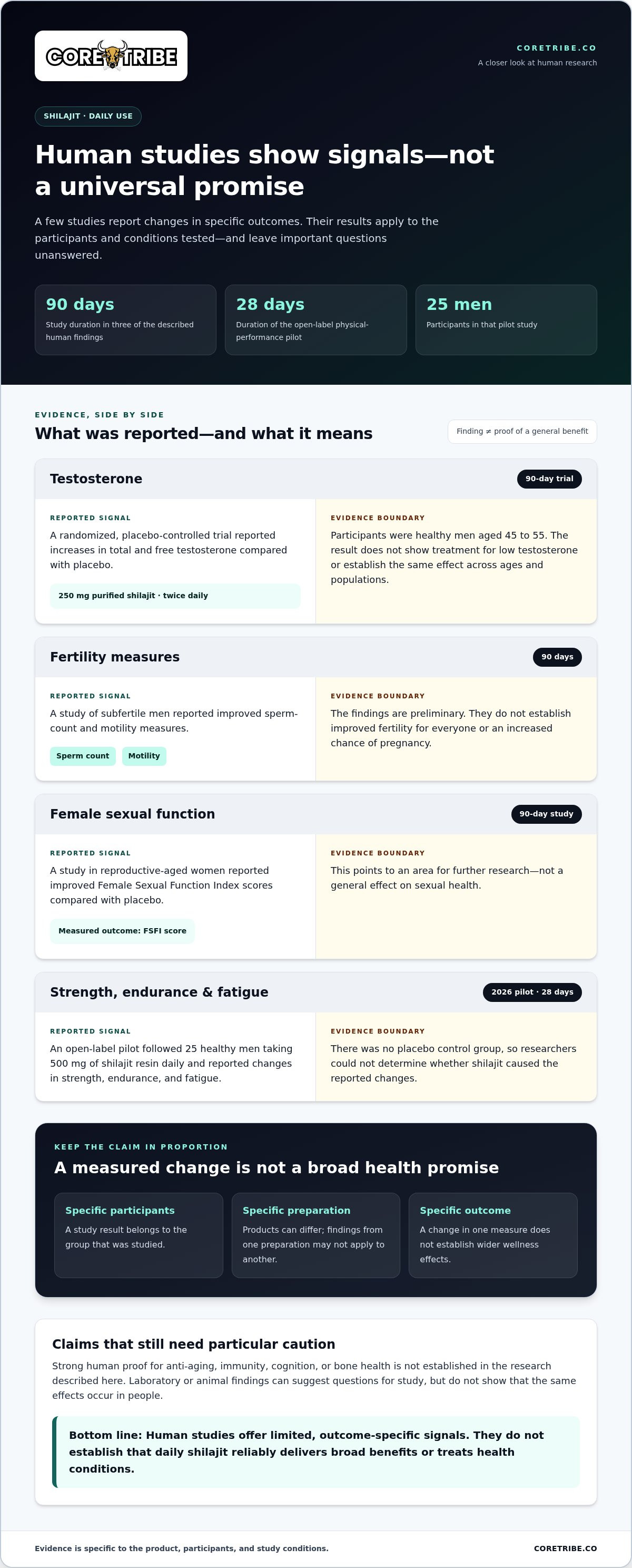
Consider the evidence claim by claim. Human studies have explored testosterone, fertility, sexual function, and physical performance, but the findings remain limited. Don’t generalize results beyond the participants and conditions tested.
- Testosterone: A 90-day randomized, placebo-controlled trial studied healthy men aged 45 to 55 taking 250 mg of purified shilajit twice daily. It reported increases in total and free testosterone compared with placebo. This finding applies to a defined group; it doesn’t show that shilajit treats low testosterone or has the same effect across ages and populations.
- Fertility: A study of subfertile men reported improved sperm-count and motility measures after 90 days. The results are preliminary and don’t establish that shilajit improves fertility for everyone or increases the chance of pregnancy.
- Female sexual function: A 90-day study in reproductive-aged women reported improved Female Sexual Function Index scores compared with placebo. This points to an area for further research, not a general effect on sexual health.
- Strength, endurance, and fatigue: A 2026 open-label pilot followed 25 healthy men taking 500 mg of shilajit resin daily for 28 days and reported changes in these measures. Because there was no placebo control group, researchers couldn’t determine whether shilajit caused the changes.
Claims about anti-aging, immunity, cognition, or bone health call for particular caution: strong human proof for these outcomes isn’t established here. Laboratory or animal findings can help researchers form hypotheses, but they don’t show that the same effects occur in people.
Human studies can identify promising signals in specific groups, but they can’t yet establish that daily shilajit reliably delivers broad benefits or treats health conditions. Confidence in the benefits of taking shilajit daily should remain modest, especially when a claim rests on a small or uncontrolled study.
Why do fulvic acid and mineral content appear in shilajit discussions?
Fulvic acid and mineral content are commonly mentioned when describing shilajit. These terms describe composition, not clinical results. Shilajit’s composition can vary, and the presence of a compound doesn’t show that a finished product provides a particular benefit. A percentage in a product description also isn’t proof of effectiveness; study findings apply to the preparation researchers actually tested.
If you’re comparing formats while learning what the research can support, you can explore Coretribe’s shilajit options. Keep the evidence in view: the specific Coretribe ® Pure Shilajit Capsules - Mixed Sea Moss & Ashwagandha is a blend containing shilajit, Sea Moss, and Ashwagandha, not a proven treatment for the outcomes discussed above.
Is taking shilajit daily safe? Addressing the biggest concern
Natural origin doesn’t guarantee safety for everyone. Weigh possible benefits alongside the limited evidence, your individual health factors, and product quality. Purity matters because a supplement’s contents can’t be judged by its name or traditional reputation alone. This isn’t a reason for alarm, but daily use is a personal health decision, not a guarantee of suitability.
Who should seek medical guidance before using shilajit?
Ask a qualified healthcare professional before considering shilajit if you have a health condition or take medication, particularly medicines that affect blood pressure or blood sugar. Avoid shilajit if you have hemochromatosis, Wilson’s disease, or sickle cell anemia. Children and people who are pregnant or breastfeeding should not use it. General information can’t determine what’s appropriate for you.
Reported side effects are generally described as mild, but may include digestive upset, headache, or an allergic reaction. Stop and seek appropriate medical advice if you experience a concerning reaction. Don’t use a supplement as a substitute for medical care or prescribed treatment; a clinician can help consider possible interactions and individual risks.
Why do sourcing and testing matter for supplements?
Product quality and ingredient identity affect how confidently you can assess a supplement. The U.S. FDA doesn’t approve dietary supplements before they’re sold; manufacturers are responsible for safety, good manufacturing practices, and proper labeling. Clear product information and credible testing can help inform a decision, though a label alone can’t establish safety for every person.
Heavy-metal contamination is a specific concern raised in shilajit research. A 2025 study published in BMC Chemistry detected thallium in all 13 crude and 5 commercial samples it tested. That finding applies to those samples, not every shilajit product on the market. It highlights why testing panels that cover only familiar contaminants may leave questions unanswered.
For a more informed review, look for a current, batch-specific Certificate of Analysis (COA). It can show whether a particular batch was assessed for contaminants and whether the results correspond to the product being considered. Relevant testing may include lead, arsenic, cadmium, mercury, microbial contaminants, and ideally thallium. A COA is useful information, not a guarantee of personal suitability or a promise of benefit.
The benefits of taking shilajit daily don’t remove the need to consider your health circumstances and product quality. If either raises questions, pause and seek qualified guidance before making it part of a routine.
How can you evaluate daily shilajit use realistically?
A clear framework can keep a supplement decision grounded in your goals rather than broad promises. Before starting a daily routine, consider what you hope to learn, what research says about that outcome, whether it suits your circumstances, and what the product label tells you. This won’t predict a result, but it can help you make a more informed choice.
- Define your goal. Choose one specific wellness priority, such as tracking perceived energy or general wellbeing. A focused goal is easier to reflect on than a vague hope for better health overall.
- Review the evidence. Look for human research on the outcome you care about. Note who participated, what preparation was studied, and whether the design can support a cause-and-effect conclusion.
- Assess personal suitability. Consider your health circumstances and any medicines you take. If you’re unsure whether shilajit is appropriate for you, seek guidance from a qualified healthcare professional before using it.
- Inspect product information. Read the ingredients, directions, warnings, and manufacturer details. Clear labeling helps you understand what you’re considering, but doesn’t prove the product will produce a particular effect.
What should you look for on a supplement label?
Start with the full ingredient list, including additional ingredients, then review serving directions and warnings. Check that the label identifies the manufacturer and presents product information clearly. Products with the same main ingredient may still differ in composition. Follow the label directions; don’t treat a listed serving amount as a universal dose or exceed the stated directions.
How should you judge whether a routine is helping?
Before beginning, write down your goal and a few relevant observations, such as how you generally feel during the day. Review your notes over time instead of relying on a single unusually good or difficult day. Sleep, diet, stress, activity, and other changes can also influence how you feel. A perceived improvement may be useful personal feedback, but it can’t establish that shilajit caused it.
Expectations matter, too. Effects may differ from person to person, and no result is guaranteed. If you’re considering a combination product, review each listed ingredient rather than attributing a change to shilajit alone. The shilajit, Sea Moss, and Ashwagandha side effects and benefits guide offers further context on that blend. For format-specific information, see the shilajit capsule-taking guide.
Use the benefits of taking shilajit daily as a question to evaluate, not an outcome to expect. If you’re ready to explore the format available from Coretribe, browse shilajit options and review the product information with your goals in mind.
Explore Coretribe’s shilajit capsule blend with a clear perspective
After reviewing the evidence and safety considerations, apply the same measured approach to choosing a product. A supplement’s availability doesn’t establish that it will deliver a particular outcome. Start with its ingredients, compare them with your priorities, and distinguish potential benefits from proven treatment effects.
What is in Coretribe’s shilajit capsule offering?
Coretribe ® Pure Shilajit Capsules - Mixed Sea Moss & Ashwagandha is a capsule blend containing Shilajit, Sea Moss, and Ashwagandha. Consider these ingredients when deciding whether the combination aligns with your needs. Each ingredient deserves its own thoughtful review. The presence of several ingredients together doesn’t demonstrate that the blend will produce a specific benefit or that research on one ingredient applies to the full formula.
For a closer look at how these ingredients are discussed together, the Shilajit, Ashwagandha, and Sea Moss synergy guide offers additional context. Distinguish explanations of ingredient relationships from evidence showing a tested health outcome. That distinction helps keep product descriptions in perspective.
What is a measured next step?
Review the product information alongside what you’ve learned about research limitations and personal suitability. Consider why you’re exploring a supplement, read its label and directions, and think about the role of each ingredient. If you have a health condition, take medication, or are uncertain about using a supplement, seek guidance from a qualified healthcare professional. Supplements should complement appropriate medical care, not replace it.
It can also help to decide in advance what you’ll pay attention to if you choose to use a product. Keep your observation practical and modest. For example, note a general change related to your original wellness goal, while remembering that sleep, stress, diet, and other parts of daily life can affect how you feel. A personal observation can inform your reflection, but it isn’t proof that the product caused the change.
The benefits of taking shilajit daily aren’t guaranteed, and research doesn’t establish this capsule blend as a treatment. A clear perspective means considering the ingredients, evidence, and your own circumstances together, without expecting a supplement to replace foundational habits or medical care.
If this blend fits what you’re looking for, review its product information and consider whether each ingredient suits your priorities. You can also explore Coretribe’s wellness collection.
Choose your next step with care
Let curiosity lead to a considered choice. Before adding a supplement to your routine, decide what you want it to support and whether that goal matches the available evidence and your personal needs. The benefits of taking shilajit daily aren’t a promise of a particular result, so a grounded decision matters more than chasing every claim.
If you’re considering a shilajit option, Coretribe offers Coretribe ® Pure Shilajit Capsules - Mixed Sea Moss & Ashwagandha, as well as shilajit honey sticks as a separate product. Review each format and its product information in light of your priorities; a blend’s ingredients don’t guarantee a specific outcome. Supplements are not a substitute for appropriate medical care.
Explore the options at your own pace and choose what aligns with your wellness goals. Explore Coretribe’s wellness collection.
Frequently Asked Questions
Can you take shilajit every day?
Daily shilajit use may be suitable for some people, but it isn’t right for everyone. Consider your health circumstances, the product’s directions, and whether evidence supports your intended goal. Taking a supplement regularly doesn’t make it effective by itself. Read the label and don’t exceed its directions. If you have a health condition, take medication, or are unsure about suitability, seek advice from a qualified healthcare professional.
What are the possible benefits of taking shilajit daily?
The possible benefits of taking shilajit daily aren’t equally supported by research. Human studies have examined specific measures related to hormones, fertility, sexual function, and physical performance, while broader claims about anti-aging or immunity have less strong human support. Traditional use and laboratory findings can guide research, but don’t prove effects in people. Treat reported benefits as preliminary, not guaranteed, and never as a substitute for medical treatment.
Is shilajit safe to take every day?
Daily use can’t be assumed safe for every person or every product. Suitability depends on individual health factors, medications, product quality, and directions. Some people may experience effects such as digestive upset or headache. If you’re pregnant or breastfeeding, have a health condition, or take medication, consult a qualified healthcare professional before use. Stop taking a supplement and seek appropriate advice if you experience a concerning reaction.
How long does it take to notice benefits from shilajit?
There’s no established timeline that applies to everyone, and research hasn’t shown when each person should expect to notice a change. If you choose to use shilajit, write down your goal and a simple starting point, such as your usual energy level. Review your notes over time. A change you notice may be useful personal feedback, but it doesn’t prove shilajit caused it; sleep, stress, and other factors matter too.
Can shilajit interact with medications?
Shilajit may affect how some medications work, but reliable information about specific interactions is limited. Don’t stop, change, or replace prescribed medication to make room for a supplement. If you take medication, share the product label and ingredient list with a qualified healthcare professional or pharmacist before use. This is especially important if your treatment plan involves ongoing monitoring, since a new supplement could complicate decisions about your care.
Should you take shilajit on an empty stomach?
There isn’t a universal rule that shilajit should be taken on an empty stomach. Directions differ between products and formats, so follow the label rather than assuming one routine fits all. If you’re using capsules, the shilajit capsule-use guide offers format-specific information. Ask a qualified healthcare professional if you have concerns about how a supplement fits your routine.
Does shilajit need to be purified before use?
Choose a product with clear identity and quality information rather than assuming raw material is suitable to consume. Contaminants are a concern for supplements. The FDA doesn’t approve dietary supplements before they’re marketed; manufacturers are responsible for their safety and labeling. Testing documentation can help you assess a particular product, but no label or test result proves it’s appropriate for every person or guarantees a health benefit.

