


What if a lower cortisol number doesn’t automatically mean you feel less stressed? That’s an important question behind the growing interest in ashwagandha for cortisol reduction.
If you’ve seen conflicting claims, it can be hard to tell whether the herb has meaningful effects or whether every supplement works the same way. Research suggests ashwagandha may lower cortisol in some study participants, but cortisol isn’t simply a harmful “stress hormone.” It has normal roles in the body, and a change in a measured level doesn’t always translate into a noticeable change in how someone feels.
This guide explains what the evidence supports, where it has limits, and which safety questions matter before considering a supplement. We’ll look at cortisol’s role in the stress response, why studies can reach different conclusions, and how the extract, dose, and study duration affect interpretation. The aim is a balanced view, not a promise of results.
Key Takeaways
- Cortisol has normal, essential roles in the body, so a single measurement isn’t a complete picture of health or stress.
- Research on ashwagandha for cortisol reduction includes different measures, extracts, doses, and study periods, so results may not apply to every supplement.
- A change in serum cortisol doesn’t necessarily mean a person will feel less stressed; these outcomes are related but distinct.
- Before considering ashwagandha, weigh your health context, medicines, product-label details, and potential safety concerns.
- Coretribe ® Pure Shilajit Capsules - Mixed Sea Moss & Ashwagandha combines those named ingredients, but the blend should not be assumed to have been clinically shown to lower cortisol.
Ashwagandha for cortisol reduction: what cortisol does and why it matters
Cortisol is often described as a hormone that needs to be driven down. That overlooks its everyday purpose. Produced by the adrenal glands, cortisol helps the body respond to changing demands and supports essential functions, including regulating metabolism, blood pressure, and inflammation. Its release is part of a coordinated stress response, not, by itself, a sign that something is wrong.
This context matters when considering ashwagandha for cortisol reduction. The goal isn’t to make cortisol as low as possible. A test result is one piece of information, and its meaning depends on a person’s circumstances and how and when it was measured. Supplement research can’t diagnose a health condition or guarantee an individual result.
What does cortisol do in the body?
Cortisol helps the body adapt when demands change, such as during illness, physical activity, or an emotionally challenging moment. It also supports normal processes outside stressful situations. The hormone follows a daily rhythm, typically changing throughout the day, and can respond to immediate circumstances. A test result is a snapshot, not a complete measure of someone’s health or stress.
Timing and measurement method matter. A blood, saliva, or urine test can reflect different aspects of cortisol, and the circumstances around collection can affect interpretation. One higher reading doesn’t automatically mean there’s a disorder or that supplementation is needed. Persistent symptoms or concerns about test results are best understood in a broader health context, rather than by trying to change a number on your own.
What does ashwagandha mean in supplement research?
Ashwagandha is the common name for Withania somnifera, a plant with a history of use in traditional health practices. Its botanical background and traditional applications are outlined in Withania somnifera (Ashwagandha). Supplements may use the root, leaves, or a combination. These materials aren’t interchangeable by default, so the plant part and preparation help define what a study actually tested.
“Adaptogen” is a term used in traditional and research discussions of herbs associated with the body’s response to stress. It doesn’t guarantee that a product will lower cortisol, ease stress, or produce a particular effect. Research findings apply to the preparations and conditions studied, not automatically to every supplement carrying the same plant name. Ingredients and extraction methods can differ.
A useful starting point is to understand cortisol as a normal, changing hormone, then examine evidence for specific ashwagandha preparations. The sections that follow look at proposed effects on the stress response and what clinical trials can, and can’t, tell us.
How ashwagandha may influence the stress response and cortisol
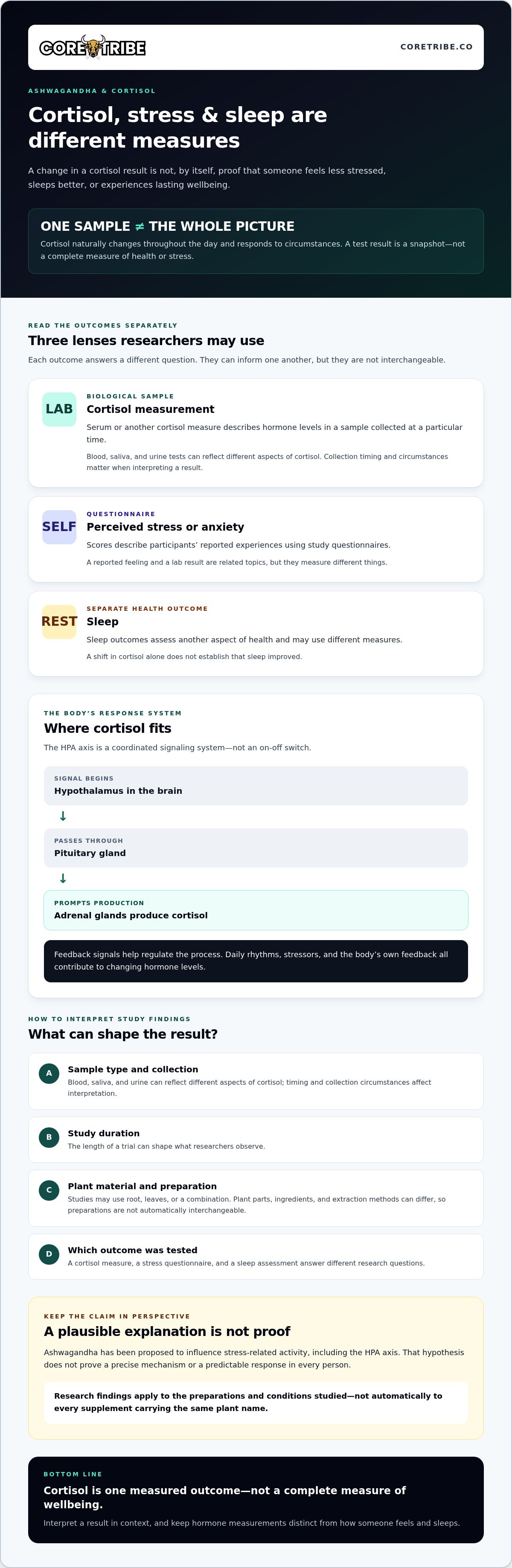
To make sense of claims about ashwagandha and stress, separate the body’s response system from the outcomes researchers measure. The hypothalamic-pituitary-adrenal (HPA) axis is one part of that system. Ashwagandha is sometimes proposed to influence stress-related processes, but a plausible biological explanation isn’t proof that it acts through one specific pathway in every person.
Where cortisol fits into the HPA axis
The HPA axis works through signals between the hypothalamus in the brain, the pituitary gland, and the adrenal glands. In simplified terms, the hypothalamus signals the pituitary, which releases a messenger that prompts the adrenal glands to produce cortisol. Cortisol participates in the body’s response, while feedback signals help regulate the process.
This is a coordinated, changing system, not an on-off switch. Stressors, daily rhythms, and the body’s own feedback all contribute to shifts in hormone levels. Researchers have suggested that ashwagandha could affect stress-related activity, including the HPA axis. That hypothesis shouldn’t be mistaken for proof of a precise mechanism or a predictable response in every user.
Why stress scores and cortisol results are not interchangeable
A study may assess participants’ experiences with questionnaires, measure cortisol in a biological sample, or track outcomes such as anxiety or sleep. These measures answer different questions. A stress questionnaire reflects how participants report feeling; a lab result reflects a hormone measurement taken under particular conditions.
Results also depend on study design. The timing and type of sample, trial length, and preparation being studied can all shape what researchers observe. A change in one measure doesn’t establish that every other measure changed too. If cortisol levels shift in a study, that alone doesn’t prove participants felt less stressed, slept better, or experienced lasting wellbeing.
Cortisol is one measured outcome, not a complete measure of wellbeing. When evaluating claims about ashwagandha for cortisol reduction, check which outcome was tested, how it was measured, and whether the findings apply to the specific preparation under study.
Keep the outcomes distinct as you review evidence:
- Serum or other cortisol measures describe hormone levels in a sample collected at a particular time.
- Perceived stress or anxiety scores describe participants’ reported experiences using study questionnaires.
- Sleep outcomes assess a related but separate aspect of health and may use different measures.
These outcomes can inform one another, but none is a shortcut for the rest. If you’re comparing supplement options, Coretribe’s wellness supplements offer a place to review listed ingredients. Keep those product details separate from clinical findings about other formulations.
What clinical trials say about ashwagandha for cortisol reduction
Clinical evidence offers a reason for interest, but its meaning depends on the trials behind the headline. A 2024 systematic review and meta-analysis combined results from nine randomized trials involving 558 participants. The review reported reductions in stress, anxiety, and serum cortisol among participants in the included trials. Those findings describe the evidence pooled in that review, not a guaranteed effect from every ashwagandha supplement.
What the 2024 systematic review and meta-analysis found
The trials examined different ashwagandha preparations and study periods, so the pooled result brings together evidence that isn’t perfectly uniform. Reported daily amounts ranged from 125 to 600 mg, and study durations ranged from 30 to 90 days. These figures describe the trials. They aren’t personal dosing instructions or recommendations for how long to take a supplement.
The 2024 systematic review and meta-analysis of nine randomized trials and 558 participants reported improvements in stress, anxiety, and serum cortisol, but its varied studies call for cautious interpretation.
| Outcome measured | What the review reports | Interpretation limit |
|---|---|---|
| Perceived stress | Reduction reported across included trials | Questionnaire results reflect participants’ reported experience |
| Anxiety | Reduction reported across included trials | This is a distinct outcome, not a direct cortisol measure |
| Serum cortisol | Reduction reported across included trials | A measured hormone change doesn’t establish how an individual feels |
Why the findings do not guarantee an individual result
A meta-analysis combines study results to estimate an overall pattern. That pooled average can help researchers assess whether an effect appears across trials, but it can’t predict an individual reader’s response. Participants, study conditions, and the preparations tested may differ from your circumstances and the supplement you’re considering.
Formulation matters, too. Trials may use specific extracts or plant materials, while products on the market can vary in plant part, extraction, and composition. A result for one studied preparation shouldn’t automatically be applied to another simply because both contain ashwagandha. The review provides evidence about its included trials, not a clinical test of every product.
The authors also called for further research. The relatively limited study periods leave questions about longer-term use and safety. A balanced reading is neither “ashwagandha always lowers cortisol” nor “the research shows nothing.” The review suggests potential effects in the studied settings, while leaving uncertainty about how reliably they translate to different products, longer use, or any one person.
Safety, suitability, and practical questions before considering ashwagandha
Even if a study’s findings sound promising, a supplement may not suit every person or health situation. Before considering ashwagandha for cortisol reduction, review your health context, medicines, and the exact product information. This article is educational. It can’t diagnose a cortisol problem or replace individualized medical advice.
Who should take extra care?
The National Institutes of Health’s Office of Dietary Supplements notes that short-term use appears generally well tolerated for many adults, but reported side effects include drowsiness and stomach upset, such as diarrhea or vomiting. Rare cases of liver injury have also been reported. Safety beyond short-term use isn’t well established.
Ashwagandha may not be appropriate during pregnancy or breastfeeding, or for people with thyroid or autoimmune disorders. It may also interact with medicines, including some used for thyroid conditions, blood pressure, diabetes, seizures, or immune suppression, as well as sedatives. If you’re pregnant, breastfeeding, managing a health condition, taking medicines, or concerned about symptoms, discuss supplement use with a qualified clinician before starting.
How to assess a supplement claim responsibly
A practical review can help keep marketing claims in perspective. Consider these steps:
- Review your health context. Consider existing conditions, pregnancy or breastfeeding, and any symptoms or test results that prompted your interest in cortisol.
- Account for medicines. Share a complete list of medicines and supplements with a qualified clinician or pharmacist so potential interactions can be considered.
- Read the product label. Look for the plant part, extract details, serving information, and other ingredients. Don’t assume products with the same herb name contain the same preparation.
- Compare like with like. Check whether the product’s stated formulation resembles the preparation used in a study. If details differ or aren’t given, the study may not tell you much about that product.
- Keep evidence in perspective. Trial amounts describe what researchers tested, not a personal dosing plan. Don’t self-prescribe from a study or use a cortisol claim instead of seeking care for persistent concerns.
A label can help you understand what a supplement contains, but it can’t establish that the product will produce the same result as a research preparation. A claim about cortisol also doesn’t determine whether a supplement is suitable for you. Your individual circumstances matter.
If you’re exploring supplements, browse Coretribe’s wellness supplements and review each product’s listed ingredients and label information. A clinician can help you weigh those details against your health needs, particularly if medicines or an ongoing condition are part of the picture.
Ashwagandha in a broader wellness routine: where Coretribe fits
Research on supplements is one part of a wider conversation about wellbeing, not a replacement for the foundations of care. Restful sleep, practical ways to manage stress, and appropriate medical support each have a place in a balanced routine. If you’re exploring ashwagandha for cortisol reduction, keep the evidence in perspective and choose based on the complete product label, not a single headline claim.
How to think about a multi-ingredient supplement
A blend brings ingredients together, but it doesn’t automatically inherit research findings for each ingredient on its own. A study of a particular ashwagandha extract, for example, doesn’t establish the effects of every combination containing ashwagandha. Review the full ingredient list and serving information, then consider each ingredient in the context of your health, medicines, and other supplements.
Shilajit, sea moss, and ashwagandha are sometimes discussed together as complementary ingredients, but the presence of several ingredients alone doesn’t establish that they work synergistically or produce a specific result. When you encounter claims about shilajit, ashwagandha, and sea moss synergy, distinguish proposed ingredient combinations from evidence on a finished blend.
A grounded next step with Coretribe
Coretribe ® Pure Shilajit Capsules - Mixed Sea Moss & Ashwagandha is a capsule blend containing shilajit, sea moss, and ashwagandha. Those are its named ingredients; their presence doesn’t show that the product has been clinically tested or proven to lower cortisol. Research on specific ashwagandha preparations shouldn’t be treated as validation of this multi-ingredient blend.
Before considering any supplement, read its label and reflect on how its ingredients fit your circumstances. If you’re pregnant or breastfeeding, managing a health condition, or taking medicine, discuss supplement use with a qualified clinician. Consider claims about shilajit, sea moss, and ashwagandha in light of the evidence for the specific product, rather than assuming a blend is suitable for everyone.
To compare products and their listed ingredients, explore Coretribe’s supplement collection. Supplements are one possible part of a wellness routine, not a substitute for sleep, ongoing stress care, or medical guidance when you need it.
Choose your next step with clarity
Let curiosity, not pressure, guide your decision. Before trying a supplement, decide what you’re hoping to support and what would count as a meaningful change for you. Keep expectations grounded, and allow for the possibility that a product may not have the effect you want. If concerns about stress, symptoms, or test results are affecting your wellbeing, a qualified clinician can help you consider them in context.
If you’re exploring options, review the ingredients and product information rather than relying on a broad claim about ashwagandha for cortisol reduction. Coretribe’s supplement collection includes options to consider as part of a thoughtful wellness routine, without treating any product as a guaranteed outcome.
Explore Coretribe’s supplement collection and review the listed ingredients as you decide what fits your needs. A measured, informed choice is a good place to begin, and steady care for your wellbeing can take many forms.
Frequently Asked Questions
Is cortisol always harmful?
No. Cortisol is a normal hormone that helps the body respond to changing demands and supports everyday functions. A result can vary depending on when and how it was collected, so one number doesn’t tell the whole story. If you’re reviewing a test, note when it was taken and discuss its meaning alongside your symptoms and health history with a qualified healthcare professional, rather than trying to interpret or treat it alone.
Can ashwagandha lower cortisol?
Some clinical research, including a 2024 meta-analysis, reported lower serum cortisol among participants using the ashwagandha preparations studied. That’s a reason for continued research, not proof that every supplement will have the same effect. The trials differed in formulation, participants, and duration, and a group result can’t predict your individual response. If you’re considering ashwagandha for cortisol reduction, compare the specific product with the preparations studied and keep expectations measured.
How quickly might ashwagandha affect stress or cortisol?
There’s no reliable timeline that applies to everyone. Trials included in one meta-analysis lasted from 30 to 90 days, but those durations describe study designs, not directions for personal use or a promise of when effects might appear. Results may depend on the preparation and individual circumstances. If stress or other symptoms persist, discuss them with a qualified clinician instead of extending use or changing your approach based on a trial schedule.
Can ashwagandha affect cortisol test results?
It may be relevant to discuss, since studies have measured serum cortisol in people taking ashwagandha. Test results also depend on the sample type, collection timing, and testing approach. Tell the healthcare professional who orders or reviews your test about any supplements you take, including when you started them. Follow their instructions about testing and supplements; don’t start or stop a product on your own to try to influence a result.
Can you take ashwagandha with medication?
It depends on the medicine, your health history, and the supplement’s formulation, so don’t assume it’s suitable simply because it’s sold without a prescription. Before combining products, show the full label and your medication list to a qualified healthcare professional or pharmacist. This is especially relevant if you take ongoing treatment or manage a health condition. Don’t change prescribed medication to accommodate a supplement unless your prescriber advises you to.
Is ashwagandha safe for long-term use?
Current evidence doesn’t establish long-term safety for every person or formulation. The 2024 review calls for more research on longer-term safety, and the NIH Office of Dietary Supplements discusses safety separately from potential benefits. A short clinical trial can’t show that indefinite use is safe. If you’re considering continued use, discuss your circumstances with a qualified healthcare professional, particularly if you have health concerns, take medicines, or notice unwanted effects.
Does a supplement containing ashwagandha have the same evidence as a trial extract?
Not necessarily. A trial tests a particular preparation and schedule, while products may differ in plant part, extract details, serving information, and other ingredients. A blend may not have been studied in the same trial. Compare the label with the research description, and don’t treat the word “ashwagandha” alone as proof of equivalent formulation or results. If key details are unclear, avoid assuming the evidence transfers directly.

