


Sea moss isn’t a guaranteed gut-health fix, but it may contribute fiber and minerals as part of a varied diet. The potential benefits of sea moss for gut health depend on what a product contains and how your body responds; it can’t replace a balanced source of dietary fiber or care for ongoing digestive symptoms.
It makes sense to be curious about a traditional sea vegetable that’s now sold in gels and supplements. This guide explains what sea moss’s fiber and minerals may offer, how much they contribute, and what to consider when choosing a product. Two products may differ in their fiber or iodine content, so serving size and ingredient details matter. The article also covers possible side effects and safety considerations. For context, the National Institutes of Health Office of Dietary Supplements lists an adult recommended dietary allowance of 150 mcg of iodine per day, while seaweed iodine levels can vary. With a measured, informed approach, you can weigh sea moss’s possible place in your routine without treating it as a cure-all.
Key Takeaways
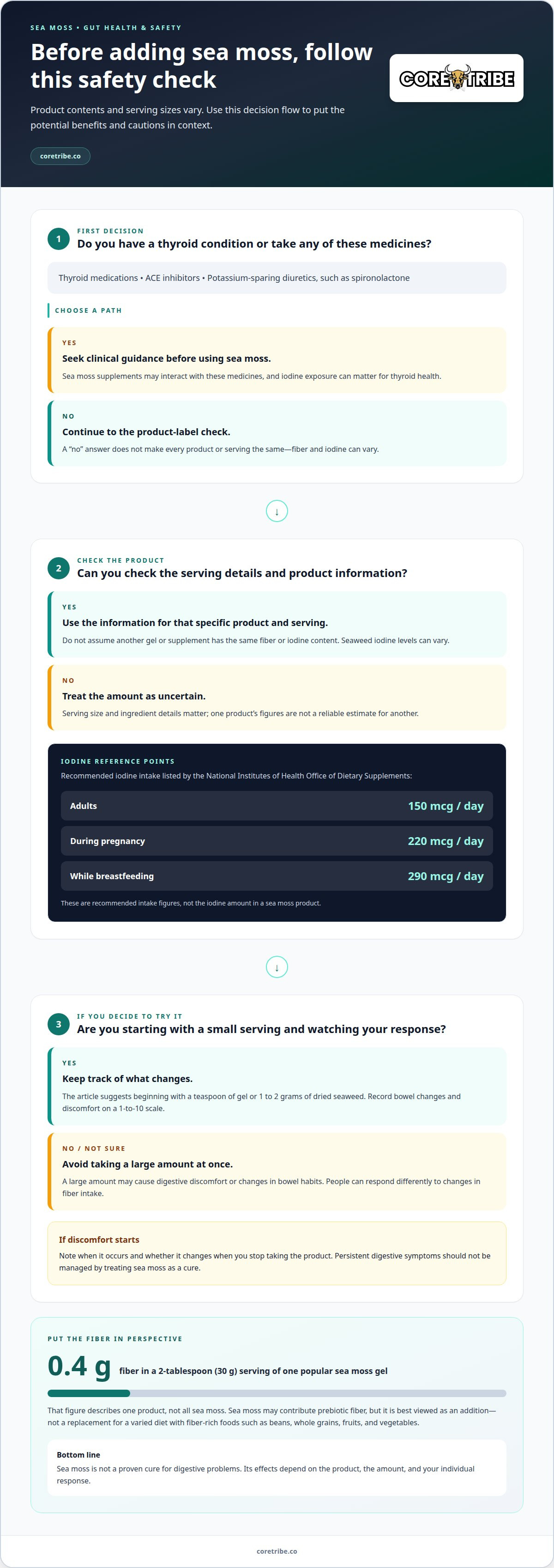
- Understand how sea moss fiber may support gut bacteria, and why it shouldn’t be treated as a substitute for a varied, fiber-rich diet.
- Learn why sea moss mineral content, especially iodine, can vary between products and servings.
- Use the ingredient list, serving guidance, and available quality information to make a more informed product choice.
- Recognize when iodine intake, digestive discomfort, or medication interactions may make extra caution important.
- See how Coretribe ® Pure Shilajit Capsules - Mixed Sea Moss & Ashwagandha fits into the range of sea moss supplement options discussed.
Does sea moss boost gut health?
Sea moss may contribute fiber and minerals, but it isn’t a proven cure for digestive problems. Its effects depend on the product, amount, and your response.
Digestive Effects and Bowel Regularity
Bowel regularity describes how consistently stool moves through the digestive tract, and fiber can influence that process. Soluble fiber absorbs water and forms a gel, while prebiotic fibers can nourish beneficial gut bacteria. Because people respond differently, changing your fiber intake may affect bowel habits without producing the same results for everyone.
Sea moss products vary in fiber content, so the amount in one serving may differ from another. Taking a large amount at once may also cause digestive discomfort or changes in bowel habits. Start with a small serving and observe your response before increasing it. This makes it easier to assess whether sea moss suits your routine.
Intestinal Inflammation and Symptoms
Intestinal inflammation is irritation in the digestive tract and can accompany symptoms such as discomfort or changes in bowel habits. Seaweed contains compounds with anti-inflammatory properties, but this general finding does not establish sea moss as a treatment for intestinal inflammation. A possible property of seaweed is not evidence that a supplement will relieve a specific digestive condition.
Digestive symptoms can have causes unrelated to sea moss, including dietary changes or a health condition. If discomfort begins after you add sea moss, note when it occurs and whether it changes when you stop taking the product. Sea moss can absorb pollutants, including heavy metals, from its environment, so product quality matters for safety as well as digestion. Gut health and the immune system interact, but a supplement should not replace evaluation of persistent symptoms.
Reported Timing of Digestive Benefits
Some sea moss users report improved digestion within 1-2 weeks of consistent daily use, though that report doesn’t predict an individual response. To make a trial more informative, begin with a teaspoon of gel or 1 to 2 grams of dried seaweed. Record symptoms on a 1-to-10 scale, noting bowel changes and discomfort. That simple record can help distinguish a change from ordinary day-to-day variation.
Iodine also matters because it supports thyroid hormone production, which helps regulate metabolism. The National Institutes of Health Office of Dietary Supplements states that the recommended iodine intake during pregnancy is 220 mcg per day. The National Institutes of Health Office of Dietary Supplements states that the recommended iodine intake while breastfeeding is 290 mcg per day. Sea moss iodine content can vary, and supplements may interact with thyroid medications, ACE inhibitors, and potassium-sparing diuretics such as spironolactone. If you take these medicines or have a thyroid condition, seek clinical guidance before using sea moss.
Sea moss as a source of prebiotic fiber and minerals
Sea moss can provide prebiotic fiber and minerals, but its contribution depends on the product and serving. Compared with beans, whole grains, fruits, and vegetables, sea moss is better viewed as one possible addition, not a primary fiber source.
Prebiotic Fiber and Gut Health
Prebiotic fiber is dietary fiber that beneficial gut bacteria can use as nourishment. Sea moss is described as a source of this fiber, connecting it to gut health through the food available to bacteria.
Amounts matter: one popular sea moss gel provides 0.4 g of fiber in a 2-tablespoon (30 g) serving. That figure describes one product, not every gel or dried seaweed. Read the serving information for the specific product, because preparation and portion sizes affect how much fiber you actually get.
Fiber Diversity and Hydration
Fiber diversity means eating fiber from different plant foods rather than relying on one ingredient. A varied mix can include beans, oats, berries, vegetables, and seaweed, each offering a different combination of fibers and nutrients.
One dietary approach recommends 30 different plant foods each week to diversify fiber intake. This doesn’t mean sea moss must be part of that mix. It’s more useful to treat it as one option among familiar foods, since the 0.4 g in a serving of one gel is modest beside fiber-rich beans or whole grains. With fiber-rich supplements, adequate water intake also matters; the cited guidance suggests 1.5 to 2 litres daily.
Sea Moss Fiber and Gut Bacteria
Gut bacteria use some dietary fibers as nourishment, and prebiotic fibers can support this relationship. Sea moss may contribute, but checking the serving’s fiber amount puts its role in perspective. It cannot replace the broader variety of fiber sources in a balanced diet.
A 2-tablespoon (30 g) serving of one popular gel contains 22 mg of calcium, 43 mg of magnesium, 2.7 mg of iron, and 19 mg of potassium. Sea moss also contains iodine, but mineral amounts vary by source and product. Those minerals are distinct from fiber, so their presence doesn’t make a low-fiber serving equivalent to beans, oats, or fruit.
Fiber can help people feel fuller for longer, but sea moss alone isn’t a weight-loss solution. A gel serving with 0.4 g of fiber should be considered in the context of the whole meal and overall eating pattern, not as a standalone appetite strategy. For a broader look at sea moss supplement options, consider how the ingredient fits alongside varied plant foods.
Are Sea Moss Supplements Safe?
Sea moss safety depends on iodine exposure, serving size, product form, and medication use. Gel and supplements may affect digestion differently because their ingredients, amounts, and serving directions can vary. Compare the product labels rather than assuming one form is equivalent to another.
Iodine and Serving Size
Iodine is an essential nutrient, but excess intake can affect thyroid function. According to the National Institutes of Health Office of Dietary Supplements, the adult upper limit for iodine is 1,100 mcg. This figure refers to total iodine intake, not just sea moss, so other supplements and foods also matter when estimating daily exposure.
Sea moss iodine content can vary, which makes a universal serving difficult to apply across products. Suggested amounts in the available guidance include 1 to 3 grams of dried sea moss as a starting amount, and a suggested maximum of 1 to 2 tablespoons of hydrated gel or roughly 1 to 4 grams of dried sea moss. These are different forms, so don’t treat their weights as interchangeable. A study found that 4 g of sea moss daily was generally safe, but that finding doesn’t establish the right amount for every product or person.
Forms, Formulation, and Nutrient Availability
Sea moss is sold as gel, dried seaweed, and supplements such as capsules. A gel serving and a capsule serving may contain different amounts of sea moss, iodine, and other ingredients. Check the serving directions and ingredient list to understand what a product provides, especially when it includes other nutrients or botanicals.
Bioavailability describes how much of a nutrient the body can absorb and use. An ingredient list alone does not show how much of each mineral becomes available after digestion. Processing, formulation, and the overall product composition can affect what a serving delivers. “Superfood” is a marketing description, not a measure of nutrient absorption or proof that a product improves digestion.
Medication Interactions and Routine
Sea moss supplements can interact with thyroid medications, ACE inhibitors, and potassium-sparing diuretics such as spironolactone. People with a thyroid condition should avoid sea moss unless a healthcare provider recommends it. These interactions matter even when a product is marketed as natural, because iodine and minerals can affect the same body systems as some medicines.
For a cautious routine, follow the product’s serving directions and avoid combining multiple iodine-containing supplements. If you take thyroid medication, a clinician may recommend thyroid-level testing six to eight weeks after starting sea moss. Consider the full ingredient list and your current medicines before adding sea moss, rather than treating gel, dried seaweed, and capsules as equivalent.
Choosing sea moss products
Sea moss contains iodine and can also absorb heavy metals and other pollutants from its environment. Check the ingredient and serving labels for iodine information, and look for product-specific testing details that address contaminants.
Choose the product form that suits your routine: gel, dried seaweed, or capsules. These forms are not automatically equivalent, because each serving may contain different amounts of sea moss and iodine. Compare the listed serving size with the amount you plan to take, then consider total iodine from other supplements and foods. Capsule and gel labels may present serving information differently, so assess each product on its own terms.
Ingredient names deserve attention, too. “Irish moss” is a common name associated with Chondrus crispus, but a product’s front label alone may not explain its full composition. Read the complete ingredient list, including added ingredients, and note whether the product is a blend. For example, a capsule containing sea moss alongside other botanicals should not be assessed as though sea moss were its only ingredient.
Gel texture can help you assess how a product looks and feels, but it does not establish iodine content or contaminant levels. Appearance, color, and thickness are not substitutes for label or testing information. If a product provides batch-specific testing results, review what they cover and whether they address heavy metals. Do not infer that “natural” or “clean” wording means a product has been tested.
For digestive use, compare the fiber and serving information rather than choosing by format alone. One popular gel provides 0.4 g of fiber per 2-tablespoon (30 g) serving, but that figure applies to that product, not all sea moss. A capsule may list a different serving basis or omit a comparable fiber amount. These details help set realistic expectations about what each serving contributes.
Taking sea moss also calls for attention to iodine and thyroid hormones. The National Institutes of Health Office of Dietary Supplements sets the adult upper limit at 1,100 mcg of iodine, and total intake includes other sources. If you use thyroid medication or have a thyroid condition, discuss sea moss with a healthcare provider before starting. A practical choice is one with a clear ingredient list, understandable serving directions, and relevant safety documentation, rather than claims that promise broad digestive benefits.
What are the risks of sea moss for gut health, including side effects and interactions?
Sea moss can affect digestion, thyroid function, and medication safety. Its risks depend on iodine levels, serving size, product quality, and personal health. A practical assessment considers both the seaweed itself and the other ingredients in a gel, capsule, or blend.
Digestive changes can follow a new fiber-rich supplement. Starting with a large serving may cause discomfort or changes in bowel habits, especially if your usual diet contains less fiber. Begin with a small amount and observe your symptoms before changing the serving. If discomfort appears after taking sea moss, pause and note whether it improves. This pattern can help distinguish a product response from other dietary changes.
Iodine is another key concern because sea moss iodine levels vary. Excessive iodine intake can affect thyroid function and cause problems such as goiter, an enlarged thyroid. Consider seaweed alongside other iodine sources, including supplements and foods. A product’s serving directions can help define the amount used, but they do not establish how much iodine every batch contains. People with thyroid conditions should avoid sea moss unless a healthcare provider recommends it.
Medication interactions also deserve attention. Sea moss supplements can interact with thyroid medications, ACE inhibitors, and potassium-sparing diuretics such as spironolactone. These examples matter because a sea moss product may add iodine or minerals to an existing routine. Before taking it with one of these medicines, discuss the combination with a healthcare provider. Keep the full product ingredient list available, especially for blends containing several active ingredients.
Sea moss can absorb environmental pollutants, including heavy metals and chemicals. Product quality therefore matters beyond texture, flavor, or the convenience of gel versus capsules. Look for safety or testing information that specifically addresses contaminants, and distinguish those results from general marketing language. Calling a product “natural” does not describe its testing. Batch-related details are useful because seaweed’s growing environment influences what it may absorb.
Carrageenan and poligeenan are not interchangeable terms. Food-grade carrageenan is generally recognized as safe, while poligeenan can form from carrageenan under harsh conditions, including temperatures above 170 F. This distinction helps put alarming ingredient discussions in context: the stated condition is severe processing, not ordinary preparation. Check the product’s ingredients rather than assuming every sea moss gel contains carrageenan or poligeenan.
Before adding a sea moss product, weigh digestive tolerance, iodine exposure, medication use, and contaminant information together. Explore sea moss supplement options with those safety considerations in mind.
Coretribe: Coretribe ® Pure Shilajit Capsules - Mixed Sea Moss & Ashwagandha
Coretribe ® Pure Shilajit Capsules - Mixed Sea Moss & Ashwagandha offer a sea moss-containing option for readers considering a blended supplement. The product combines sea moss with shilajit and ashwagandha, so review its ingredient information and serving directions as part of your decision.
Choose this option if a blended capsule fits your routine and you have considered the iodine and medication cautions discussed above. Sea moss supplements can interact with some medicines, and iodine content can vary among seaweed products. If you have a thyroid condition, take thyroid medication, or are pregnant or breastfeeding, discuss sea moss use with a healthcare provider before starting.
For questions about the product, contact Coretribe.
Make your next wellness choice with intention
A thoughtful view of sea moss benefits for gut health starts with a clear purpose. Decide what you want to add to your routine, then choose products that fit without crowding out everyday sources of nourishment. A supplement can be one part of a broader approach, not its center.
Take time to make a considered choice rather than reacting to bold wellness claims. Ingredient transparency, a comfortable format, and fit with your existing routine can guide your decision. If sea moss does not suit your needs, a varied diet remains a valuable foundation for digestive wellbeing.
For a closer look at Coretribe’s wellness products, explore the available offerings. Take the next step at your own pace, with curiosity and care.
Frequently Asked Questions
Sea Moss: Superfood or Another Trend?
Sea moss is a nutrient-containing red seaweed, but “superfood” does not mean it can replace a balanced diet. Think of it as one optional ingredient, not a complete solution for digestion or overall wellness. Its fiber and mineral content can vary between products, so the term alone will not tell you what a serving provides. A practical choice starts with the ingredient list, serving details, and your dietary needs.
Is carrageenan safe?
Food-grade carrageenan is generally recognized as safe, while poligeenan is a different substance associated with harsher processing. Carrageenan can form poligeenan under harsh conditions, including temperatures above 170 F. That distinction matters when interpreting broad claims about seaweed ingredients. Read the actual ingredient names on a product label rather than assuming that sea moss, carrageenan, and poligeenan are interchangeable terms.
How long before I notice gut health benefits?
Some sea moss users report digestive changes within 1-2 weeks of consistent daily use, but that timing is not a reliable forecast for everyone. Keep a simple record of what you take and any changes in bowel habits or discomfort. For example, note whether symptoms began before or after introducing a gel or capsule. This can help you assess your own response without assuming every change comes from sea moss.
What Exactly Is Sea Moss?
Sea moss, also called Irish moss, is a red algae identified as Chondrus crispus. It belongs to the Rhodophyta, or red algae, family and is used as a sea vegetable. It is sold in forms such as gels, dried seaweed, and supplements. Those forms can differ in serving size and composition, so “sea moss” alone does not describe a product’s exact ingredients or nutrients.
What are the downsides of sea moss?
Possible downsides include digestive discomfort, variable iodine intake, and exposure to pollutants such as heavy metals or chemicals. Sea moss can also interact with thyroid medications, ACE inhibitors, and potassium-sparing diuretics such as spironolactone. These concerns make the product label and your current medicines relevant. If digestive symptoms appear after starting a sea moss product, pause use and consider whether the timing corresponds with the change.
Who should avoid taking sea moss?
People with a thyroid condition should avoid sea moss unless a healthcare provider recommends it. Anyone taking thyroid medication, an ACE inhibitor, or a potassium-sparing diuretic such as spironolactone should discuss potential interactions before use. Pregnancy and breastfeeding also call for attention to total iodine intake, as recommended amounts differ from the adult recommendation. Include sea moss and other supplements in that overall picture when discussing your routine with a clinician.
What nutrients and compounds in sea moss may support gut health?
Sea moss contains prebiotic fiber and minerals, including iodine, calcium, magnesium, iron, and potassium. It also contains nutrients such as folate, vitamin K, and zinc. Prebiotic fiber can nourish beneficial gut bacteria, while minerals have roles throughout the body. Exact amounts depend on the product and serving, so a nutrient name on the label is not proof of a particular digestive effect.
What does scientific research say about sea moss and gut health?
Sea moss has fiber and minerals that may be relevant to digestion, but those properties alone do not establish that it treats gut conditions or improves symptoms for everyone. Reports of digestive changes after use are not the same as evidence that sea moss caused them. For a measured view, distinguish general information about seaweed compounds from findings about a specific sea moss product, serving, and digestive outcome.

