


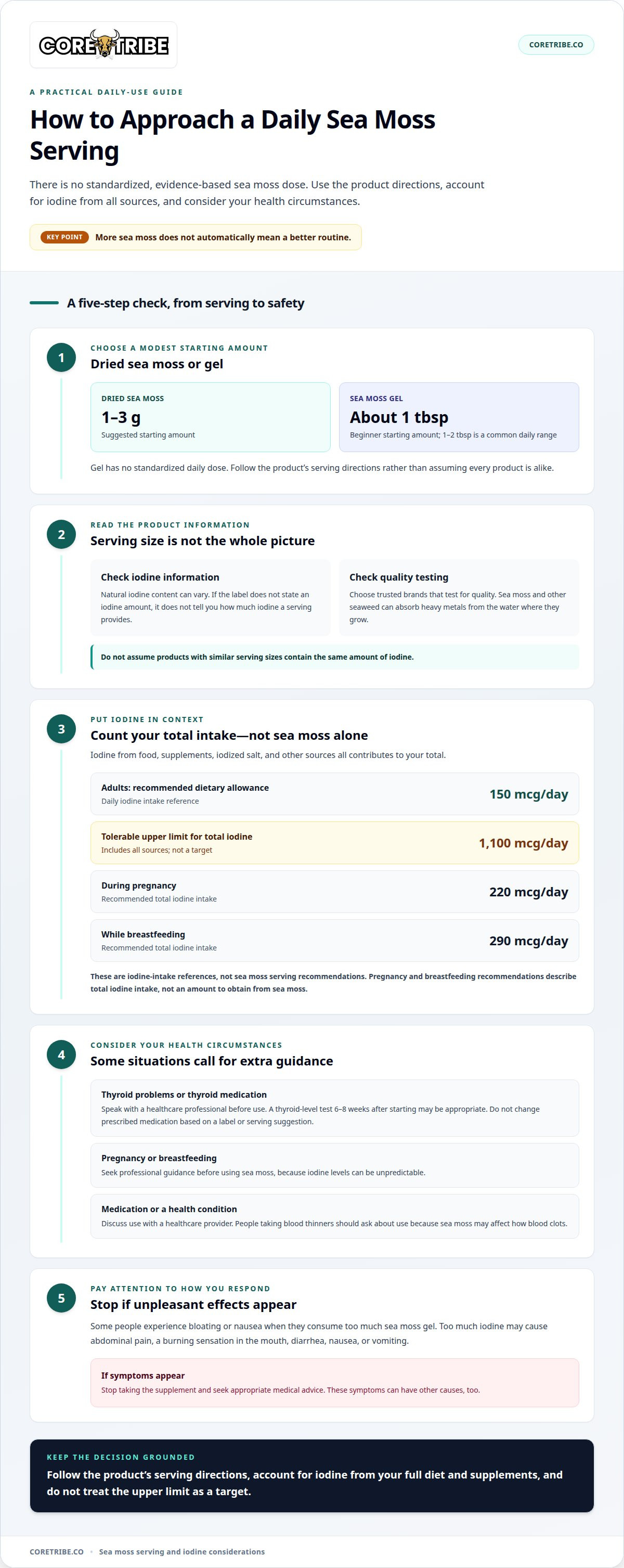
More sea moss doesn’t automatically make a better daily routine. If you’re deciding how much sea moss to take daily, a suggested starting amount is 1 to 3 grams of dried sea moss; for gel, beginners can start with about 1 tablespoon daily, with 1 to 2 tablespoons a common daily range. There’s no standardized, evidence-based dose, and iodine content can vary.
It’s understandable to want a clear amount when sea moss is presented as a source of potential wellness benefits. There is no standardized, evidence-based daily dose for sea moss, so how much sea moss to take daily depends on the product’s serving directions and its iodine content. This guide compares dried sea moss and gel, explains why iodine intake and personal health factors matter, and covers when extra caution is important, including if you have a thyroid condition, take medication, are pregnant, or are breastfeeding.
Key Takeaways
- Start with a modest amount of dried sea moss or gel, then pay attention to how your body responds.
- Sea moss gel has no standardized daily dose, so follow the product label rather than assuming every product is alike.
- Consider iodine from your full diet and supplements when deciding whether sea moss fits your routine.
- People with thyroid concerns or medication use should discuss sea moss with a healthcare professional before adding it.
- Sea moss contains nutrients, but evidence that supplements improve specific health conditions remains inconclusive.
Iodine intake recommendations and upper limits
Iodine is essential, but the amount in sea moss can vary between products. Compare the product’s serving directions and iodine information with your overall intake to put a serving into context.
Iodine Intake Guidance
The recommended dietary allowance is the daily intake level intended to meet most healthy people’s needs. According to the National Institutes of Health Office of Dietary Supplements, the recommended dietary allowance for iodine for adults is 150 mcg per day. The same organization sets the tolerable upper limit for total iodine intake at 1,100 mcg per day. That upper limit includes iodine from food, supplements, and other sources, not sea moss alone.
These figures are reference points, not a sea moss dosage. A serving’s contribution depends on its iodine content, which may differ between products. Account for other sources, such as iodized salt or a multivitamin, rather than considering a sea moss serving in isolation.
Sea Moss Labels and Product Quality
Sea moss is red algae, and its natural iodine content can be unpredictable. If a label lists sea moss without stating its iodine amount, it won’t tell you how much iodine a serving provides. Don’t assume products with similar serving sizes contain the same amount.
Choose products from trusted brands that test for quality, and read the serving directions and ingredient information. Sea moss and other seaweed can absorb heavy metals from the water where they grow, so quality testing matters beyond iodine alone. If the label lists an iodine quantity, consider it alongside your other dietary sources.
Excess Iodine Effects
Excess iodine means total intake has risen beyond what the body needs, potentially affecting thyroid function. Too much iodine may cause abdominal pain, a burning sensation in the mouth, diarrhea, nausea, or vomiting. These symptoms can have other causes, but they are reasons to stop taking a supplement and seek appropriate medical advice.
More sea moss isn’t necessarily better for gut health or general wellness. Adding servings without considering iodine from food and supplements can raise total intake without a clear benefit. Follow the product’s serving directions, and don’t treat the upper limit as a target.
Thyroid Considerations and Conditions
The thyroid uses iodine to make hormones, so both inadequate and excessive intake can matter. People with thyroid problems should speak with a doctor before using sea moss, because its iodine content may complicate decisions about intake and treatment.
If you take thyroid medication, discuss sea moss use with your healthcare professional. A follow-up thyroid-level test six to eight weeks after starting sea moss may be appropriate. Don’t change prescribed medication based on a sea moss label or serving suggestion.
Pregnancy and breastfeeding have distinct iodine recommendations. According to the National Institutes of Health Office of Dietary Supplements, the recommended iodine intake during pregnancy is 220 mcg per day. The recommended iodine intake while breastfeeding is 290 mcg per day. These recommendations describe total iodine intake, not an amount to obtain from sea moss. Because sea moss iodine levels can be unpredictable, seek professional guidance before using it during these life stages.
Potential health benefits of sea moss
Sea moss provides naturally occurring minerals and other nutrients, but its presence in a supplement doesn’t prove a specific health effect. Northwestern Medicine advises against giving sea moss to children and does not recommend sea moss supplements during pregnancy or breastfeeding because iodine levels can be unpredictable and contaminants may be present.
People with thyroid problems should speak with a doctor before using sea moss. Anyone considering a new supplement should discuss it with a healthcare provider, especially if taking medication or managing a health condition.
Nutrients and potential benefits
Sea moss naturally contains fiber, iodine, calcium, zinc, and folate, along with traces of other vitamins and minerals. A 2-tablespoon (10-gram) serving provides 0.13 grams of fiber, 7.2 milligrams of calcium, and 0.2 milligrams of zinc. These nutrients contribute to its nutritional profile, but a serving’s amounts don’t establish a treatment effect.
Claims about digestive support, immunity, or weight management need careful interpretation. Sea moss contains fiber, but that serving’s 0.13 grams is a small contribution to overall intake. For more dietary fiber, fruits, vegetables, whole grains, and legumes offer other options. There’s no conclusive evidence that sea moss supplements improve specific health conditions or lead to significant weight loss.
Carrageenan and digestive health
Sea moss and carrageenan are often discussed together in conversations about digestion. A related concern involves poligeenan, which is distinct from food-grade carrageenan. Poligeenan forms under harsh conditions, including temperatures above 170 F. The World Health Organization labeled poligeenan a chemical that might cause cancer in humans in 1993. This specific classification should not be treated as proof that eating sea moss causes cancer.
Digestive effects can matter in everyday use: some people experience bloating or nausea when they consume too much sea moss gel. Pay attention to how your body responds, and stop using it if unpleasant symptoms appear. Gut health depends on a broader pattern of foods, not a single supplement.
When to seek healthcare guidance
A healthcare provider can assess sea moss use alongside your medications, thyroid history, and other supplements. People taking blood thinners should discuss use because sea moss may affect how blood clots. Those who are pregnant or breastfeeding should seek guidance before considering supplements, given concerns about unpredictable iodine and possible contaminants.
If you’re exploring other wellness supplements, browse the available supplement options while keeping your health needs and existing medications in view.
Suggested starting amount of dried sea moss
A practical starting point depends on the form: dried sea moss, gel, and capsules aren’t interchangeable by spoonful or weight. For dried sea moss, Northwestern Medicine advises starting with 1 to 3 grams.
There isn’t a standardized, evidence-based daily dose for sea moss capsules or dried sea moss. Follow the product label, and account for other supplements and medicines that may affect your routine.
Pregnancy and breastfeeding call for extra caution, not a sea moss serving target. Northwestern Medicine does not recommend sea moss supplements during pregnancy or while breastfeeding because iodine levels can be unpredictable and contaminants may be present.
Daily Sea Moss Gel Amount
A commonly suggested daily amount for sea moss gel is 1 to 2 tablespoons, but this is a general range rather than a standardized dose. If you’re new to gel, begin with about 1 tablespoon daily and observe how you respond before considering more.
Product directions matter because gel composition and serving guidance can differ. A serving described as 2 tablespoons (10 grams) may help you interpret a label, but it doesn’t establish that every gel has the same nutrient or iodine content. Don’t increase the amount simply to pursue more vitamins, minerals, calcium, or immune support.
Dried Sea Moss and Capsule Doses
Dried sea moss has a suggested starting amount of 1 to 3 grams, while capsules should be used according to their own product directions. Capsule size alone doesn’t tell you how much sea moss or iodine a serving supplies, so read the label rather than converting gel tablespoons into capsules.
Northwestern Medicine advises adding small amounts to foods instead of taking high-dose capsules or gels. A more conservative estimate considers around 3-4 grams of dried seaweed equivalent per day safe for adults, but that isn’t a personalized target or proof of benefit. The amount that makes sense depends on the product and the rest of your diet.
Keep the first week simple: use a small gel serving or the product’s stated starting amount, and avoid combining several sea moss supplements. If you tolerate it, follow the label rather than increasing the amount beyond its directions. Bloating or nausea can occur if someone takes too much gel; reduce or stop use if symptoms arise.
Sea moss contains nutrients, but a capsule or serving isn’t a substitute for a varied diet or prescribed medicine. If you take medication, have a health condition, or are unsure how a product fits your routine, ask a healthcare professional before starting. During pregnancy or breastfeeding, don’t assume general adult amounts are suitable guidance.
Is it safe to consume sea moss daily?
Daily use can be tolerated by some adults, but it isn’t automatically suitable for everyone. One study found that taking 4 g of sea moss a day was generally safe; that finding doesn’t establish a universal dose or guarantee that every person will respond alike. Product composition, existing conditions, and other supplements can all affect an individual routine.
Digestive discomfort and fiber
Digestive effects are a practical reason to start with a small serving rather than increasing quickly. Some people experience bloating or nausea after taking too much sea moss gel. A 2-tablespoon (10-gram) serving provides 0.13 grams of fiber, so sea moss is not a substantial fiber source by itself.
Notice changes after eating sea moss, especially when introducing it alongside other supplements or a new food. If bloating or nausea begins after increasing a serving, stop or reduce use and observe whether symptoms improve. Persistent or severe digestive problems deserve medical attention, since sea moss may not be the only possible cause.
Fiber affects digestion, but a small amount from sea moss won’t replace a varied diet. Beans, whole grains, fruits, and vegetables, for example, can contribute dietary fiber to meals. If your bowel habits change after starting a supplement, consider recent food changes, medication use, and the product’s serving directions.
Allergic reactions and product source
Digestive discomfort and an allergic reaction are different concerns. If you suspect an allergic reaction after eating sea moss or taking sea moss supplements, stop using the product and seek medical advice. Severe or rapidly worsening symptoms call for urgent care. Don’t take another serving to test whether the reaction happens again.
The product’s source also matters for safety. Sea moss and other seaweed can absorb heavy metals from the water where they grow, so choose products from trusted brands that test for quality. Check the ingredient list and serving directions, and avoid using a product if its contents or condition raise concern.
Daily use and individual factors
Daily consumption isn’t necessary to get nutrients from food. Some people use sea moss a few times a week, while others choose not to use it. A routine should account for the product label and the person’s health, rather than aiming to maximize intake or change body weight.
Ask a doctor before using sea moss if you have a health condition, take medication, or use several supplements. People taking blood thinners should be especially cautious because sea moss may affect how blood clots. A doctor can consider those factors and possible interactions when discussing whether continued use fits your health needs.
General daily sea moss gel dosage
For adults who choose sea moss gel, a commonly suggested daily range is 1 to 2 tablespoons. Treat that as a general guide, not a standardized dose: iodine levels and serving directions can vary by product. The practical takeaway is to begin modestly, measure the serving, and use the product label rather than translating advice for dried seaweed, capsules, or powder directly into gel.
For a new routine, start with a small serving for the first week. About 1 tablespoon daily is a suggested beginner amount; people who tolerate it may increase to 2 tablespoons per day. Don’t exceed 2 tablespoons daily without professional advice. If the label describes servings differently, follow its directions while keeping total gel intake in view.
Measuring helps make intake consistent. A 2-tablespoon serving is identified as 10 grams of sea moss, while a 1-tablespoon daily serving can be divided into ½ tablespoon in the morning and ½ tablespoon in the evening. Splitting it is a practical option, not a requirement. If you miss a day, resume your usual amount rather than doubling the next serving.
Gel volume also helps estimate how quickly a jar may be used. A 16 oz jar holds about 32 tablespoons, and a 32 oz jar holds about 64 tablespoons. At 1 tablespoon daily, a 16 oz jar lasts about a month; at 2 tablespoons daily, it lasts roughly 2 weeks. These estimates describe portion use, not a reason to increase intake.
Sea moss gel isn’t interchangeable with Irish moss powder or other seaweed forms by spoon measure. Processing and concentration can change how a product is portioned, so follow its own label. An antioxidant claim on packaging also doesn’t set a serving size or establish a health outcome. Keep the amount tied to the product’s stated serving and your overall supplement routine.
Some people use sea moss only a few times a week rather than daily. That may be a simpler pattern if you’re assessing tolerance or don’t want a daily supplement habit. Stop or reduce use if bloating or nausea occurs, and consider iodine in other foods and supplements before adding more gel.
Choose a measured, label-led routine rather than chasing a larger portion. If you’re considering a supplement as part of your wellness routine, explore supplement options and keep the product’s serving directions in mind.
Coretribe: Coretribe ® Pure Shilajit Capsules - Mixed Sea Moss & Ashwagandha
Coretribe ® Pure Shilajit Capsules - Mixed Sea Moss & Ashwagandha offer a capsule option for readers considering sea moss as part of a supplement routine. Since sea moss products can differ in serving directions and iodine content, use the product label to understand its recommended amount and account for other sources of iodine in your diet.
A capsule isn’t a substitute for individualized medical guidance. If you have a thyroid condition, take medication, or are pregnant or breastfeeding, discuss sea moss use with a healthcare professional before starting. This can help you weigh the supplement alongside your health needs and existing routine.
For questions about Coretribe, you’re welcome to contact the team.
Make your next wellness choice with care
Let your sea moss routine be guided by clear product information and your broader health needs, rather than pressure to take more. If you’re still weighing how much sea moss to take daily, base your decision on the serving directions and advice relevant to your circumstances. A measured approach leaves room to reconsider whether a supplement belongs in your routine at all.
For readers exploring other wellness products, Coretribe offers Coretribe®Shilajit Honey Sticks and the Revive Dress, alongside its sea moss and ashwagandha capsules. Each has a different purpose, so choose what fits your interests and needs. There’s no need to add several products at once.
For questions about the available offerings, contact Coretribe with your questions. Take your next step at a pace that feels thoughtful and sustainable.
Frequently Asked Questions
What Is Sea Moss?
Sea moss is a type of red algae found in the Atlantic Ocean, also commonly called Irish moss. It’s used in foods and supplements, including prepared gel, capsules, gummies, and powder. Gel, for example, can be blended into a smoothie or stirred into another food. Its form matters because spoonfuls of gel can’t be directly compared with capsule or powder servings.
Are There Risks To Watch Out For?
Yes. Sea moss contains iodine, and excessive intake may affect thyroid function or cause abdominal pain, nausea, diarrhea, vomiting, or a burning sensation in the mouth. Some people also report bloating or nausea after consuming too much gel. Seaweed can absorb heavy metals from the water where it grows. People with thyroid conditions or taking blood thinners should discuss use with a doctor.
Is Sea Moss Gel a Superfood or Another Overhyped Trend?
Sea moss gel is a food ingredient with naturally occurring nutrients, not a proven cure-all. Its presence in a wellness routine doesn’t establish that it will improve a particular health condition or cause weight loss. Think of it as one possible ingredient, not a replacement for varied meals or medical care. A smoothie with fruit and yogurt, for example, offers other foods alongside the gel.
Should sea moss be taken on an empty stomach?
There’s no need to take sea moss gel on an empty stomach; it can be added to food instead. Try mixing a measured serving into a smoothie, oatmeal, or another meal. If eating it this way causes discomfort, pause use and consider whether the serving or product suits you. Capsule directions may differ, so follow the label for that specific form.
What’s the Best Dosage?
There’s no standardized, evidence-based daily dose that applies to every sea moss product. For a cautious start, Northwestern Medicine advises 1 to 3 grams of dried sea moss; beginners using gel can start with about 1 tablespoon daily. The best practical approach is to follow the product’s serving directions and account for its form, your other supplements, and your health needs.
What is the recommended daily amount of sea moss gel for adults?
A commonly suggested adult amount is 1 to 2 tablespoons of sea moss gel per day, though this isn’t a standardized dose. If you’re new to gel, start with about 1 tablespoon and follow the product label. For deciding how much sea moss to take daily, consider the iodine in your other foods and supplements, not just the gel serving.
How many teaspoons or tablespoons of sea moss gel should you take daily?
Use the product’s serving measure, with about 1 tablespoon daily as a suggested starting point for someone new to gel. A common daily range is 1 to 2 tablespoons, but don’t assume a teaspoon serving from one product equals the same amount of another. If the label gives directions in teaspoons, follow that label rather than converting between products.
How much iodine is in sea moss, and what is the safe daily iodine limit?
Iodine content varies, so a sea moss serving doesn’t have one dependable iodine amount across products. According to the National Institutes of Health Office of Dietary Supplements, the recommended dietary allowance for adults is 150 mcg per day, and the tolerable upper limit for total iodine intake is 1,100 mcg per day. The upper limit includes iodine from food and supplements; it isn’t a target.

