


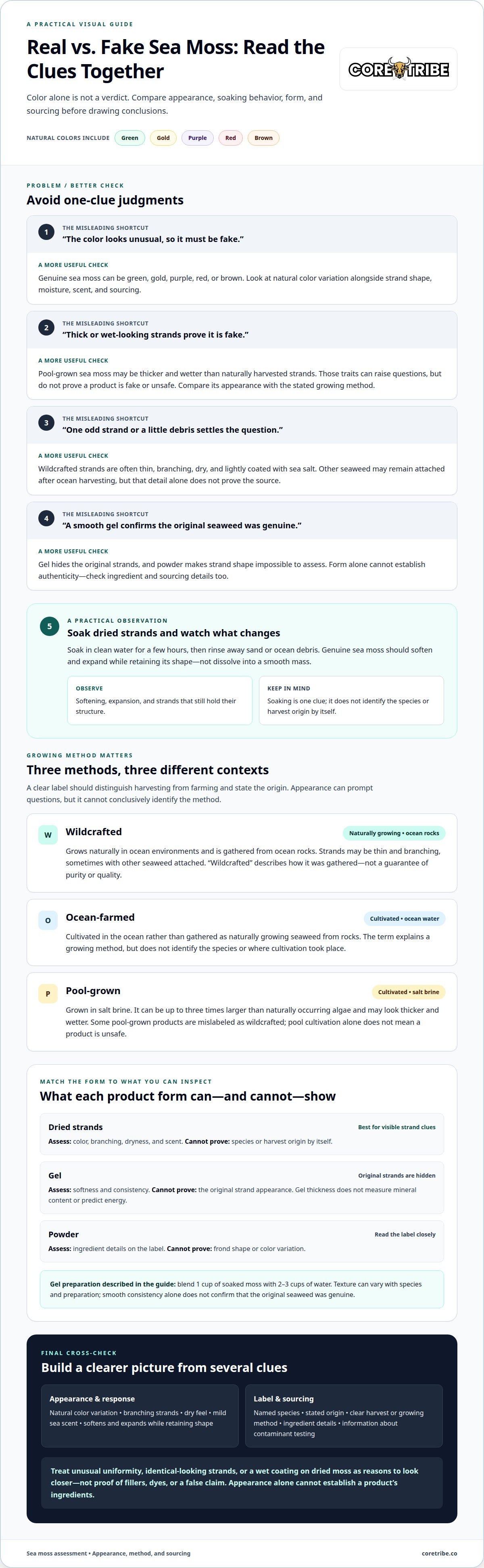
Real vs fake sea moss isn’t a simple color test: genuine sea moss can be green, gold, purple, red, or brown. Shape, texture, scent, and sourcing offer more useful clues. Naturally harvested strands are often thin and dry, with a mild sea scent; pool-grown sea moss may be thicker and wetter, but that doesn’t automatically make it fake. The key is whether the product’s appearance matches its stated origin and growing method.
It makes sense to look for clear signs before choosing a sea moss product. Labels and photos can be hard to interpret, and species, regions, and drying methods all affect how sea moss looks and feels.
This guide explains how to assess color, strand shape, texture, smell, cultivation, and sourcing without relying on one visual clue. You’ll also learn what soaking can reveal and how pool-grown sea moss differs from products falsely described as wildcrafted. Together, these checks can help you make a more informed choice.
Key Takeaways
- Use color as one clue, not a verdict: genuine sea moss can show several natural shades.
- Compare strand shape, dryness, texture, and scent together to build a clearer picture of product quality.
- Learn how wildcrafted, ocean-farmed, and pool-grown sea moss differ in growing conditions and appearance.
- Use soaking to observe how dried strands soften and expand while retaining their structure.
- Look for clear details about the sea moss’s origin, species, and harvest method when assessing a product’s claims.
Natural colors, shape, texture, and smell
Genuine sea moss can be green, gold, purple, red, or brown. Assess its color alongside strand shape, moisture, smell, and how it changes after soaking.
Authentic Sea Moss Appearance
Wildcrafted sea moss is typically sold dried as thin, branching strands, with a dry feel and a light coating of sea salt. Its color may vary across the strands rather than appearing perfectly uniform. A mild ocean or seaweed scent is a useful quality cue; avoid using it if it has a strong, unpleasant odor.
To assess the strands, soak them in clean water for a few hours. Genuine sea moss should soften and expand while retaining its shape, rather than dissolving into a smooth mass. Some sand or ocean debris may wash away, so rinse the strands before assessing their texture.
Fake Sea Moss Appearance
No single color or strand shape proves that a product is fake. Still, an unusually uniform shade, identical-looking strands, or a wet, thick coating on dried moss can raise questions about processing or cultivation. These clues don’t prove the presence of fillers or dyes; appearance alone can’t establish a product’s ingredients.
For a practical additives check, read the ingredient list and compare it with the product description. Look for clearly named ingredients beyond sea moss, and don’t treat vivid color or thick texture as evidence of purity. Online photos may differ from the product itself, so refreshing the images won’t replace checking the ingredient details.
Dried, Gel, and Powder Forms
Sea moss may be sold dried, prepared as gel, or processed into powder. Dried strands let you inspect branching and salt residue directly. Gel hides those original features, while powder makes strand shape impossible to assess. Form alone doesn’t prove authenticity, so consider ingredient and sourcing details alongside visible clues.
For a simple gel observation, soak the dried moss, then blend 1 cup of soaked moss with 2-3 cups of water. The resulting texture can vary with the species and preparation. A gel’s thickness doesn’t measure mineral content or predict energy, and a smooth consistency by itself doesn’t confirm that the original seaweed was genuine.
| Form or cue | What you can assess | What it can’t prove |
|---|---|---|
| Dried strands | Color, branching, dryness, scent | Species or harvest origin by itself |
| Gel | Softness and consistency | Original strand appearance |
| Powder | Ingredient details on the label | Frond shape or color variation |
To distinguish genuine sea moss from a suspicious product, weigh several clues together: strand structure, natural color variation, mild scent, response to soaking, and ingredient details. Authentic wildcrafted moss is generally thin, dry, and branching, and softens without losing all its structure.
Wildcrafted, ocean-farmed, and pool-grown cultivation methods
There’s no single average price for sea moss products in the United States. Cost depends on the harvest method, origin, processing, and whether the product is dried or prepared.
Growing and harvesting methods explain key differences between wildcrafted, ocean-farmed, and pool-grown products. A harvest claim is most useful when the label clearly names the method and origin.
Wildcrafted Sea Moss
Wildcrafted sea moss grows naturally in ocean environments and is harvested from ocean rocks. Its growth depends on its natural setting, not a controlled salt-brine pool. Strands may have other seaweed attached, as can happen with ocean harvesting. That detail may support an ocean-origin claim, but it doesn’t prove the product’s source by itself.
For example, Chondrus crispus is a sea moss species associated with natural coastal environments. “Wildcrafted” describes how seaweed was gathered, not a guarantee of purity or quality. Clear sourcing details should explain where it was harvested and distinguish wild harvesting from cultivation.
Ocean-Farmed Sea Moss
Ocean-farmed sea moss is cultivated in the ocean rather than gathered as naturally growing seaweed from rocks. It differs from wildcrafted moss because it is cultivated, and from pool-grown moss because it grows in ocean water. The term describes a growing method; it doesn’t identify the species or establish where cultivation occurred.
Pool-grown sea moss is cultivated in salt brine. It can be up to three times larger than naturally occurring algae and may look thicker and wetter. Some pool-grown products are mislabeled as wildcrafted, so the stated growing method matters. Pool cultivation alone doesn’t mean a product is unsafe.
To distinguish ocean-harvested from pool-harvested moss, consider several clues together. Other seaweed may remain attached to ocean-harvested strands, while pool-harvested moss typically has no other seaweed attached. Larger size or a uniform appearance can prompt closer scrutiny, but neither clue conclusively identifies the harvest method.
Use these practical checks when comparing selection results:
- Look for a stated growing method: wildcrafted, ocean-farmed, or pool-grown.
- Check whether the origin describes a natural ocean harvest or salt-brine cultivation.
- See whether the product’s description separates harvesting from farming.
- Look for information about testing, including testing for contaminants.
These details help assess a claim without treating one appearance clue as proof. A named location and specific method provide more useful sourcing information than “natural” alone. If a label says wildcrafted but describes pool cultivation, its claims conflict. Compare the method, origin, and any testing details to decide whether the product suits your preferences.
Color and strand-shape cues
Color and frond structure offer clues, but neither proves authenticity on its own. Compare the species, dry appearance, and strand features before drawing conclusions.
Sea Moss Color Variation
Natural sea moss varieties can be green, gold, purple, red, or brown. These shades reflect natural variation, so color alone isn’t a reliable test for genuine sea moss. Color can also vary across strands; a uniform appearance doesn’t prove that a product contains chemical dye.
Use color as a prompt to inspect other details. Compare the stated species with the dried strands, then check the ingredient list for added coloring. A shade doesn’t reveal the product’s nutrients, growing method, or origin. Nor does the word “Atlantic” identify a particular color or species on its own.
Sea Moss Color When Dry
Drying can change how sea moss looks. Dried Mastocarpus stellatus can darken to brown, while Chondrus crispus can retain red and purple hues. These differences help explain why dried strands from different species may not share the same color, even when both are sold as sea moss.
Assess dry strands in good light and consider whether their color is consistent with the named species. Brown isn’t automatically a warning sign, especially for Mastocarpus stellatus. Look for several clues: pigmentation, frond shape, and visible structures together offer a more useful comparison.
Frond shape adds detail that color can’t. Chondrus crispus has wider fronds with flat, forked, smooth blades. Dried Mastocarpus stellatus may have reproductive papillae, small raised structures that distinguish it from those smoother blades. These are clues to species, not a simple genuine-or-fake verdict.
After rehydration, Chondrus crispus may have a glassy-looking sheen. Mastocarpus stellatus lacks this described sheen, and its gel can be less consistent after rehydration and processing. A difference in gel texture may therefore reflect the species rather than an added ingredient.
For a practical comparison, sort the clues instead of relying on a color match:
- Compare the stated species with its expected frond shape.
- Look for brown tones in dried Mastocarpus stellatus, or red and purple hues in Chondrus crispus.
- Check whether the strands show smooth blades or reproductive papillae.
- Use the ingredient list to assess added coloring, since color alone can’t identify a chemical additive.
Color and strand shape are more informative when considered together. A single shade, whether brown or vivid green, can’t establish whether sea moss is genuine.
When wet, Chondrus crispus has a glassy-looking sheen, unlike Mastocarpus stellatus. This offers another comparison point alongside dry color and frond structure.
Origin, species, and harvest-method transparency
A useful sea moss label connects three details: species, growing or harvesting method, and geographic origin. These details make a broad “Irish sea moss” claim easier to assess, since that common name alone doesn’t identify a species or harvest location.
Sea moss has three main species, including Chondrus crispus and Mastocarpus stellatus. They belong to the same class but different families and genera. Their natural differences mean color, shape, and texture can vary without indicating a counterfeit product. A purple strand, for example, doesn’t identify its species or establish where it was harvested.
Geography can help put a species claim in context. Mastocarpus stellatus occurs along the Maine coast, where it commonly grows on low-draining rock ledges and in natural pools where seawater drains slowly. Green tips may appear on Maine specimens. These habitat details help explain natural variation, but appearance alone can’t establish a product’s origin.
Chondrus crispus and Mastocarpus stellatus can grow in the same environments without competing. Both tolerate freezing temperatures and high environmental stress. Sharing a habitat doesn’t make them the same species, or guarantee that a product labeled “Irish sea moss” contains either one. A scientific species name gives more precise information than a broad common name.
Use the label and sourcing description as a connected record. Look for:
- A named species, such as Chondrus crispus or Mastocarpus stellatus.
- A geographic origin that identifies a place, rather than only a broad regional label.
- A clear harvest method, such as wild-harvested, ocean-farmed, or pool-grown.
- Information about ethical and sustainable sourcing.
- Details about third-party laboratory testing, including contaminant testing.
These details answer different questions. Species identifies the seaweed; origin names where it came from; harvest method describes how it was obtained. Third-party testing addresses product analysis, not geography, while a sustainability statement describes sourcing practices. Neither replaces the other.
For example, a label naming Mastocarpus stellatus and Maine provides more specific clues than “Irish sea moss.” If the product also states its harvest method and testing information, its claims are easier to assess. For wellness choices, consider sourcing details together rather than treating a species name or purple color as proof of authenticity.
Across its range, Mastocarpus stellatus is found from Maine to Scotland and Ireland. Chondrus crispus is smoother and more rubbery than Mastocarpus; the two belong to the same class but different families and genera. Both tolerate freezing temperatures and high environmental stress. Check that sea moss is ethically and sustainably sourced, confirm its sourcing location, and look for third-party lab testing.
The sea moss market and counterfeit products
Counterfeit concerns often involve misleading harvest claims, unclear ingredients, or products that don’t match their descriptions. A careful real vs fake sea moss comparison separates appearance clues from evidence about contents, origin, and testing.
Authentic Sea Moss Products
An authentic product should have a description connecting its seaweed, origin, and harvest method. For example, a label naming Chondrus crispus gives a more specific species claim than “sea moss” alone. Clear ingredient information and third-party testing details add context, but neither appearance nor a product name proves what’s inside.
In the United States, labeling depends on whether a product is marketed as food, gel, or a dietary supplement, and on its claims. “Wildcrafted” or “Irish sea moss” wording alone doesn’t verify the contents or establish that a product meets applicable labeling requirements.
Counterfeit Sea Moss Products
A counterfeit product may misrepresent its species, ingredients, or growing method. For example, pool-grown sea moss might be presented as wildcrafted. Pool-grown sea moss isn’t automatically unsafe, but a mismatch between the harvest claim and the described growing method makes the product description unreliable.
Contaminated or counterfeit products can pose health risks because their actual contents or cleanliness may differ from what buyers expect. Appearance and soaking can’t identify contaminants, so visual inspection isn’t a safety test.
Soaking can help assess physical behavior, but it has limits. Real sea moss can expand three times after soaking, while pool-harvested sea moss may not expand in size. That difference offers a clue about the material, not a laboratory result. It can’t identify an additive, confirm a species, or detect contaminants.
For a more reliable real vs fake sea moss assessment, check whether the product details tell a consistent story:
- Compare the named species with the ingredient list.
- See whether the harvest description matches the stated growing method.
- Look for geographic origin and third-party testing information.
- Read the claims alongside the product form, such as dried strands, gel, or supplement.
A “wildcrafted” claim deserves scrutiny if the description says the sea moss was cultivated in a pool. Likewise, a product naming Chondrus crispus should provide details consistent with that species claim. These discrepancies don’t establish exactly what a product contains, but they are reasons to treat its description cautiously.
Keep the distinction clear: soaking tests expansion, not safety; color and texture offer clues, not proof. For an informed choice, rely on consistent ingredient, origin, harvest, and testing details rather than a dramatic claim or appearance cue.
Coretribe: Coretribe ® Pure Shilajit Capsules - Mixed Sea Moss & Ashwagandha
Coretribe ® Pure Shilajit Capsules - Mixed Sea Moss & Ashwagandha offer a convenient supplement option for readers interested in a formula that includes sea moss. This may suit you if you’re exploring sea moss as part of a broader supplement routine, rather than buying and preparing dried strands or gel.
The product name identifies its listed ingredients, but doesn’t replace the checks discussed above for standalone sea moss, such as origin, harvest method, or species. Keep those distinctions in mind when choosing between a prepared supplement and raw sea moss.
If you have questions about this product, please contact Coretribe.
Carry a More Thoughtful Approach Into Your Wellness Routine
A thoughtful approach to real vs fake sea moss can help you make choices based on clear product information, not appearance alone. Carry that care into your wider routine: consider which formats and products suit your preferences, and let ingredient details guide your next step.
Coretribe offers Coretribe ® Pure Shilajit Capsules - Mixed Sea Moss & Ashwagandha, Coretribe®Shilajit Honey Sticks, and Revive Dress. Each serves a different place in its wellness and apparel range, so choose according to what you’re looking for rather than treating them as substitutes for checking sea moss sourcing.
Explore Coretribe’s wellness offerings as you decide what belongs in your routine. A calm, informed choice is a meaningful place to begin.
Frequently Asked Questions
What is Sea Moss?
Sea moss is a common name for edible red seaweeds, not a true moss. Products may come from different seaweed species, including Chondrus crispus and Mastocarpus stellatus. Species and habitat affect appearance and texture. Sea moss products may be dried strands, prepared gel, or powder, so read the ingredient and product-form details to understand what you’re choosing.
What is Fake Irish Moss (Mastocarpus stallatus)?
Mastocarpus stellatus, often misspelled “stallatus,” is a real seaweed species, not counterfeit sea moss. The phrase “fake Irish moss” can be confusing because it may refer to this distinct species rather than a fraudulent product. It differs from Chondrus crispus in classification and appearance. Check the scientific name on a label instead of assuming every product called Irish moss is the same species.
What ingredients should be in genuine sea moss gel?
A basic homemade sea moss gel uses sea moss and water; its ingredient list should reflect anything else added during preparation. For packaged gel, read the full label rather than assuming every product has the same recipe. If you want a simple seaweed-and-water product, look for those ingredients and check whether the label names sweeteners, flavorings, or other additions. Ingredients describe the product but don’t establish its harvest origin.
Does wildcrafted sea moss have a different color or smell from farmed sea moss?
Sea moss can look different, but color and scent alone can’t reliably identify its growing method. Species, region, and drying affect color, while a mild ocean or seaweed smell is a useful quality cue. Pool-grown strands may look more uniform than naturally grown ones. A consistent shade doesn’t prove farming, just as a varied shade doesn’t prove wild harvesting. Compare these clues with the product’s stated sourcing method.
How can you verify a sea moss seller’s sourcing and lab testing?
Look for a product description that names its seaweed species, geographic origin, and harvest or cultivation method. Then check for information about third-party laboratory testing and contaminants. These details address separate questions: sourcing explains where and how the seaweed was obtained, while testing describes product analysis. A general “wildcrafted” claim without a location or method provides less detail than a specific sourcing description.

