


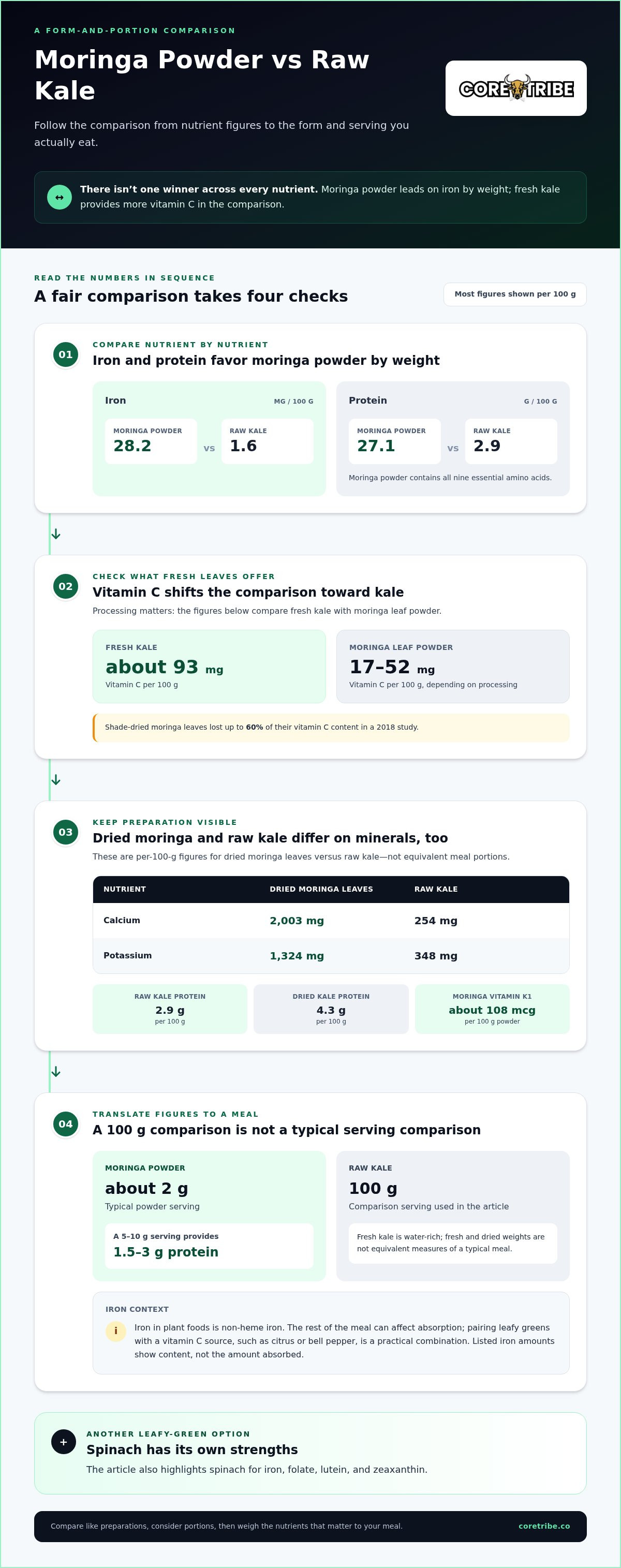
The more concentrated green doesn’t win every nutrient. Moringa powder contains 28.2 mg of iron per 100 g, compared with 1.6 mg in raw kale, so moringa leads on iron by weight. Comparing moringa’s nutritional value with kale’s also shows a trade-off: fresh kale provides about 93 mg of vitamin C per 100 g, while moringa leaf powder contains 17-52 mg, depending on processing.
Kale has earned its reputation as a nutrient-rich leafy green, while moringa offers a different nutrient mix in concentrated, dried form. To compare moringa nutritional value vs kale, look beyond headline figures and consider how each is usually eaten. This guide compares iron, vitamin C, vitamin A, potassium, and other nutritional highlights, while accounting for the difference between moringa powder and fresh kale.
Spinach also has distinct strengths, including iron, folate, lutein, and zeaxanthin. By the end, you’ll have a clearer basis for choosing greens according to your meals and nutritional priorities, and comparing moringa’s nutritional value with kale’s in everyday portions.
Key Takeaways
- Compare serving forms carefully: dried moringa powder and fresh kale differ in concentration, so per-100-gram figures don’t tell the whole story about everyday portions.
- Choose between them by nutrient priority rather than assuming one green leads across the board; their strengths vary across iron, vitamins, and minerals.
- Consider spinach as another option for meals where iron, folate, lutein, or zeaxanthin are priorities.
- Use the comparison to decide which leafy green best fits your usual meals, preparation style, and nutritional goals.
Moringa vs Kale: Which Superfood Wins?
Moringa powder contains more protein by weight, while raw kale provides a fresh, water-rich serving. Research has examined three moringa flavonoids for potential roles in inflammation and protection against heart disease and cancer, but these findings do not establish either green as a treatment.
Moringa's Nutritional Profile
Moringa leaves provide plant protein alongside vitamins, minerals, and phytonutrients. Moringa leaf powder contains 27.1 g of protein per 100 g, while a typical powder serving is about 2 g. A 5-10 g serving provides 1.5-3 g of protein. Moringa is also described as a complete plant protein, containing all nine essential amino acids. Its dried form makes nutrients more concentrated by weight than fresh leaves.
Kale's Nutritional Profile
Kale offers plant protein in a fresh, familiar leafy green, with vitamin K and antioxidants such as quercetin and kaempferol. Raw kale contains 2.9 g of protein per 100 g, and 100 g is the comparison serving used here. Dried kale leaves contain 4.3 g per 100 g. These figures show why food form matters: fresh and dried weights aren’t equivalent measures of a typical meal.
| Option | Form | Protein per 100 g | Serving context | Other highlights |
|---|---|---|---|---|
| Moringa | Leaf powder | 27.1 g | Typical serving: about 2 g | All nine essential amino acids |
| Kale | Raw | 2.9 g | Comparison serving: 100 g | Vitamin K, quercetin, and kaempferol |
| Kale | Dried leaves | 4.3 g | Per 100 g dried weight | More concentrated than fresh kale |
The table compares equal weights, not equal meal portions. A 100 g portion of raw kale and a 2 g sprinkle of powder differ greatly in size, so per-100-gram figures shouldn’t be read as what you’ll consume at one meal. For a practical comparison, consider the amount used in your smoothie, salad, or cooked dish, then compare nutrients for that amount.
Protein is only one consideration. Moringa’s complete amino-acid profile makes its powder distinctive among plant ingredients, while kale offers its own mix of vitamins and phytonutrients. Both provide minerals, but their overall nutritional value depends on the form, portion size, and other foods in the meal. Choose according to the nutrients you want and how you plan to use each green.
Iron comparison
Moringa powder contains more iron by weight, but preparation affects the comparison. Raw kale, dried leaves, and powder are not equivalent serving measures.
Moringa's Iron Content
Moringa leaf powder contains 28.2 mg of iron per 100 g. In a raw-food comparison, moringa has roughly three times as much iron as kale. The comparison shifts with processing: moringa powder is described as containing at least six times as much iron as kale. Moringa is also called the “miracle tree,” but that nickname doesn’t explain how much iron a person absorbs.
Kale's Iron Content
Raw kale contains 1.6 mg of iron per 100 g. Freeze-dried kale contains approximately 8-10 mg per 100 g, reflecting the more concentrated form. Those values describe different preparations, not different amounts in an ordinary plate. A 100 g measure of raw leaves and the same weight of dried kale represent very different quantities of leafy greens.
Absorption matters as well as the amount listed. Iron in plant foods is non-heme iron, and the rest of the meal can affect how much the body absorbs. Pairing leafy greens with a vitamin C source, such as citrus or bell pepper, is a practical way to combine them. Listed iron amounts describe content, not the amount absorbed.
Calcium and potassium add context to this wellness comparison. Dried moringa leaves contain 2,003 mg of calcium and 1,324 mg of potassium per 100 g. Raw kale contains 254 mg of calcium and 348 mg of potassium per 100 g. Since the figures compare dried leaves with raw leaves, they shouldn’t be treated as equivalent serving sizes.
To compare iron, first identify the form you’ll actually eat. A sprinkle of powder is not equivalent to a plate of raw kale. Then consider the rest of the meal, including a vitamin C-rich ingredient. This makes the figures more useful than simply declaring one superfood the winner.
Claims about inflammatory effects cannot be inferred from iron content alone. A nutrition table can show the amount of iron, calcium, or potassium in a food, but it cannot establish an individual health outcome. Compare like preparations and portions, then choose the green that suits your meal.
Nutrient values of moringa powder versus raw kale per 100 g
Per-100-gram figures reveal nutrient density, but dried powder and fresh leaves represent very different food portions. Processing also affects nutrients, so compare preparation and serving size before drawing conclusions.
Moringa Powder
Moringa powder is made from dried moringa leaves, concentrating nutrients by weight. Per 100 g, moringa leaf powder contains 27.1 g of protein, 28.2 mg of iron, and approximately 108 mcg of vitamin K1. Dried moringa leaves contain 2,003 mg of calcium and 1,324 mg of potassium per 100 g. A typical powder serving is about 2 g, far below the 100 g comparison basis.
Moringa leaves and powder aren’t nutritionally equivalent in every respect: powder is dried and concentrated, while fresh leaves retain their water. Drying can also change nutrient levels. For example, shade-dried moringa leaves lost up to 60% of their vitamin C content in a 2018 study. Raw moringa leaves per 100 g have no matching figures in this comparison; the listed moringa values refer to dried leaves or powder.
For everyday use, start with 1-2 teaspoons of moringa powder daily, as recommended in the available usage guidance. Mix it into a smoothie, soup, yogurt, salad dressing, or baked goods. Moringa leaves can also be brewed as tea; the guidance recommends 1-3 cups per day. Powder and tea are distinct formats, so the figures for powder shouldn’t be applied directly to tea.
Raw Kale
Raw kale provides a fresh-vegetable comparison rather than a dried-powder equivalent. Per 100 g, raw kale contains 254 mg of calcium, 348 mg of potassium, and about 817 mcg of vitamin K1. Its water-rich leaves make 100 g a substantial portion compared with a small spoonful of powder.
Here’s how selected values compare by weight:
| Food and form | Calcium | Potassium | Vitamin K1 |
|---|---|---|---|
| Dried moringa leaves or powder | 2,003 mg | 1,324 mg | 108 mcg |
| Raw kale | 254 mg | 348 mg | 817 mcg |
The table shows why no single food wins every nutrient comparison. Moringa contains higher listed calcium and potassium values per 100 g in its dried form, while raw kale provides more vitamin K1. These are weight-based comparisons, not equal servings.
One safety detail deserves careful context: a study found high-dose moringa leaf extract caused liver and kidney damage in rats at concentrations equivalent to approximately 3 g per kg of body weight. That finding concerns high-dose extract in rats, not an ordinary serving of leaves or powder. Keep the form and amount distinct when interpreting it.
Vitamin C, vitamin A, and potassium comparison
Fresh kale stands out for vitamin C, while dried moringa and kale show different values for vitamin A and potassium. Processing and food form matter, so compare each vegetable in its stated form and per-100-gram measure.
Moringa's Vitamin Content
Dried moringa leaves are listed with 16,300 IU of vitamin A and 17.3 mg of vitamin C per 100 g. Moringa powder’s vitamin C varies from 17-52 mg per 100 g, depending on processing. The range shows why a powder’s processing method matters when comparing its vitamin content with fresh greens or dried leaves.
Moringa is also described as containing at least twice the B vitamins of kale, and six times as much vitamin B6. These comparisons are about the greens’ nutrient content, not what a small spoonful provides. The actual amount consumed depends on the serving and form.
Kale's Vitamin Content
Fresh kale provides about 93 mg of vitamin C per 100 g. The vitamin content of dried kale can vary depending on how it is processed. These figures describe different forms, so they shouldn’t be read as direct measures of equal portions on a plate.
Processing affects the comparison: shade-dried moringa leaves lost up to 60% of their vitamin C in a 2018 study. Freeze-dried kale retains 85-97% of its vitamin C, as stated in the supplied nutrient data. Science comparisons therefore need to identify both the vegetable and its processing method.
Potassium figures also vary by form. Potassium levels vary between fresh and dried kale. Dried moringa leaves are listed with 1,324 mg per 100 g. These measurements show a higher value for dried moringa by weight, but they don’t represent equal servings of fresh and dried greens.
| Food and form | Vitamin C per 100 g | Vitamin A per 100 g | Potassium per 100 g |
|---|---|---|---|
| Moringa powder or dried leaves | 17-52 mg powder; 17.3 mg dried leaves | 16,300 IU dried leaves | 1,324 mg dried leaves |
| Raw kale | 93 mg | Not included in these raw-food figures | 348 mg |
| Dried kale leaves | 120 mg | 9,990 IU | 491 mg |
For a practical comparison, first identify whether your ingredient is fresh, dried, or powdered. Then compare its listed nutrients at the same weight, while remembering that a 100 g measure of powder differs greatly from a fresh vegetable portion. Choose fresh kale when vitamin C from a fresh food is your priority; compare dried forms when assessing nutrient density by weight.
Nutritional highlights of moringa, kale, and spinach
Each green offers a different mix of nutrients and plant compounds. Compare their strengths and choose the one that works for your everyday meals.
Moringa's Nutritional Highlights
Dried moringa leaves offer a concentrated source of nutrients by weight. They contain 40 antioxidant compounds and 35 compounds described as anti-inflammatory. These counts describe compounds, not guaranteed health outcomes. Moringa also provides beta-carotene, with dried leaves listed at 6,780 mcg per 100 g. Consider the dry form when comparing nutrient density with fresh vegetables.
Moringa powder is easy to add to everyday meals: stir it into soup, yogurt, a smoothie, or salad dressing. A small amount can season a larger dish, while dried leaves can be brewed as tea. Whether you choose organic or conventional greens, keep the food’s form in mind: drying changes its weight and nutrient concentration.
Kale's Nutritional Highlights
Kale stands apart for its vitamin K content and leafy texture. One cup provides approximately 26 mg of lutein and zeaxanthin combined, two compounds associated with the vegetable’s nutritional profile. Kale also contains antioxidants such as quercetin and kaempferol. Its fresh leaves work well in salads, while massaging them with oil or lemon softens their texture.
Both kale and moringa have substantially more beta-carotene than carrots, according to the comparison data. Their amounts vary by form: raw kale contains approximately 9,226 mcg per 100 g, while dried moringa provides around 6,780 mcg per 100 g. Those figures help compare concentration, but don’t represent equal meal portions.
Spinach brings another mix of nutrients to the plate. It naturally provides iron and folate, as well as lutein and zeaxanthin. It can suit meals where those nutrients are a priority, while kale contributes its own antioxidants and moringa powder offers a compact way to add dried leaves. Rotating greens across meals can add a range of plant compounds to a varied diet.
For a simple choice, use fresh kale when you want leafy texture, spinach when iron and folate matter, or moringa powder when a dried ingredient fits the recipe. None is a universal winner; the best fit depends on the nutrient and form you want to include. Explore wellness products for your routine as you shape a balanced approach to everyday nutrition.
Coretribe: Coretribe ® Pure Shilajit Capsules - Mixed Sea Moss & Ashwagandha
Coretribe ® Pure Shilajit Capsules - Mixed Sea Moss & Ashwagandha are a separate option for readers exploring wellness supplements alongside food choices. They are not a substitute for moringa, kale, spinach, or the nutrients these greens provide. The distinction is simple: leafy vegetables supply dietary nutrients, while this product is a supplement blend.
If you’re exploring supplements beyond this comparison of greens, Coretribe also offers Shilajit honey sticks and Shilajit supplements. Choose what fits your routine, while grounding food choices in the nutrients you want from meals. Visit coretribe.co to explore Coretribe’s offerings.
Make Your Next Choice Work for You
Let your eating habits, not a superfood label, guide your next step. Comparing moringa’s nutritional value with kale’s can help inform your choices, but your regular meals and preferred preparation matter too. Choose ingredients you enjoy using, and bring variety to your table with different greens and nutrients.
If you’re exploring wellness products beyond food, consider what fits your routine and goals. Coretribe offers supplements and apparel, which can complement a wellness routine but are not substitutes for nutrient-rich meals.
Explore Coretribe’s wellness offerings and take the next step toward a routine that feels right for you.
Frequently Asked Questions
Moringa: The Underdog?
Moringa is notable for its concentrated nutrients in dried form, but kale has its own strengths. Moringa powder contains more iron by weight, while fresh kale provides more vitamin C than the listed range for moringa powder. Moringa’s flavonoids have been studied for potential health roles, but that research does not make it a treatment. These greens are distinct ingredients, not rivals with one universal winner.
What About Protein?
Moringa powder has much more protein per 100 g than raw kale, but a typical portion is far smaller than that comparison weight. For a smoothie, a small scoop can add protein without replacing a substantial food serving. Kale works differently: it contributes protein as part of a fresh vegetable portion. Compare the amounts you actually add to a meal, rather than treating equal weights as equal servings.
What nutrients are in raw kale per 100 grams?
Raw kale provides vitamin C, vitamin K1, calcium, potassium, iron, protein, and beta-carotene. Per 100 g, its listed values include 93 mg of vitamin C, 817 mcg of vitamin K1, 254 mg of calcium, and 348 mg of potassium. It also contains 1.6 mg of iron and 2.9 g of protein. These figures describe raw leaves, not dried kale.
How do moringa and kale compare in calories, protein, fiber, and carbohydrates?
Protein comparisons depend on whether you’re measuring dried moringa powder or fresh kale. Drying removes water and concentrates nutrients per gram; fresh kale contains more water, so the same weight represents a larger food portion. Compare calories, fiber, and carbohydrates using the same preparation and realistic serving sizes too. A teaspoon of powder in a drink and a bowl of kale are not equivalent portions.
How do moringa and kale compare in vitamins A, C, and K?
The vitamin comparison changes with food form. Dried moringa leaves are listed with 16,300 IU of vitamin A, while dried kale leaves are listed with 9,990 IU per 100 g. Fresh kale provides 93 mg of vitamin C per 100 g; moringa powder’s vitamin C varies with processing. Raw kale has 817 mcg of vitamin K1 per 100 g, compared with 108 mcg in moringa powder.
How do moringa and kale compare in calcium, iron, and potassium?
By weight, dried moringa leaves contain more listed calcium and potassium than raw kale. The comparison gives moringa 2,003 mg of calcium and 1,324 mg of potassium per 100 g; raw kale has 254 mg and 348 mg, respectively. Moringa powder contains 28.2 mg of iron per 100 g, compared with 1.6 mg in raw kale. These forms aren’t equal meal portions.
How do serving sizes affect the nutrition comparison between moringa and kale?
Serving size changes how useful the per-weight numbers are. A typical moringa powder serving is about 2 g, while the comparison uses 100 g of raw kale. That means a nutrient lead per 100 g doesn’t automatically translate to more of that nutrient in a meal. Compare the amount you use, such as powder stirred into yogurt against the kale in a salad.
How does cooking affect the nutrients in moringa and kale?
Cooking and drying can change nutrient levels, especially for vitamin C, so preparation matters. Shade-dried moringa leaves lost up to 60% of their vitamin C in a 2018 study, while freeze-dried kale retains 85-97% according to the comparison data. For home cooking, use a method and cooking time that suit the recipe, and remember that raw, cooked, dried, and powdered forms differ.

