


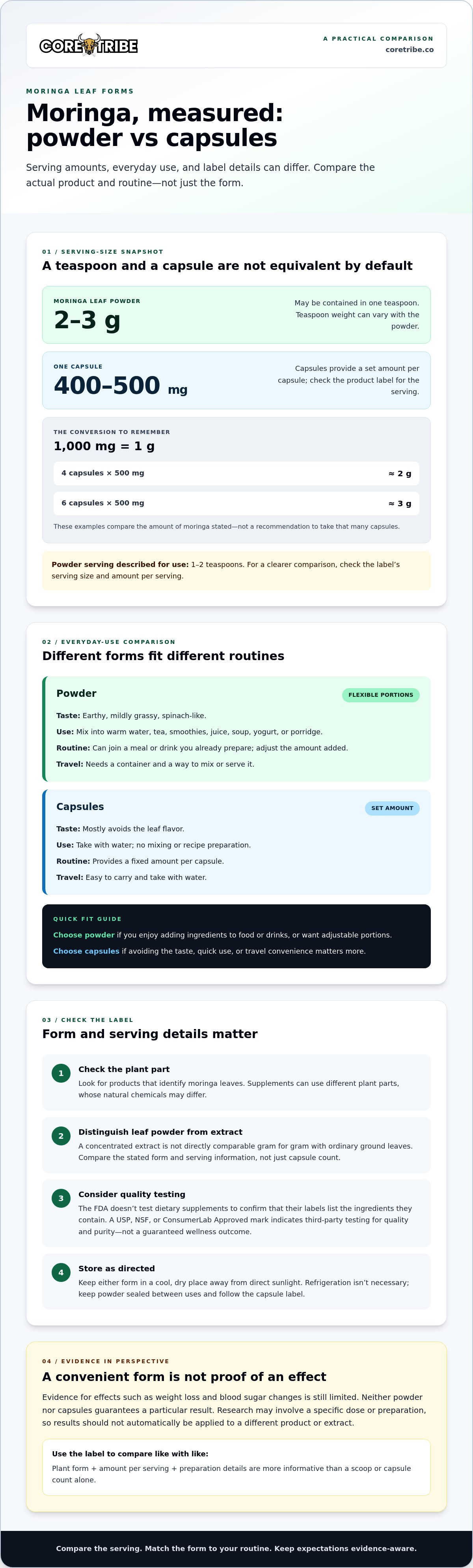
The more convenient form isn’t automatically the better fit: in the moringa leaf powder vs capsules comparison, powder makes it easier to adjust how much you use and mix it into food or drinks, while capsules offer a set amount with less preparation. A teaspoon of powder may contain around 2 to 3 grams, while a capsule may contain around 400 to 500 milligrams, so serving sizes can differ considerably.
If you’re considering moringa’s nutrient profile but aren’t sure which form suits your routine, compare taste, convenience, serving size, and what research says about health effects. Neither form guarantees a particular result.
This guide compares how moringa leaf powder and capsules are made and used, what their nutrition can look like, and how to weigh wellness goals and safety. Use these points to choose the form that fits your preferences and daily habits.
Key Takeaways
- Choose powder if you want to mix moringa into foods or drinks and adjust the serving; capsules suit routines that favor convenience and a measured amount.
- Compare the actual serving amounts on product labels before treating a scoop and a capsule serving as equivalent.
- Consider taste, preparation, and travel habits when deciding which form is easier to use consistently.
- Look beyond wellness claims: evidence for effects such as weight loss and blood sugar changes is still limited.
- Review safety considerations and learn what steps to take if you experience a supplement side effect.
Moringa Powder vs Moringa Capsules: Which Is Better for You?
Moringa leaf powder is made from dried, ground leaves. Capsules contain moringa material inside a shell and are usually taken with water. The better fit depends on taste, serving flexibility, and whether mixing drinks suits your routine.
In the moringa leaf powder vs capsules comparison, powder offers more ways to use the leaves. Stir it into warm water, herbal tea, smoothies, juice, soup, yogurt, or porridge. Its earthy, mildly grassy, spinach-like taste is noticeable in most foods. Capsules avoid that flavor and need no mixing, making them a simpler option if preparation feels like a hurdle.
Capsules are easy to carry and take with water when traveling. Powder can travel too, but it needs a container and a way to mix or serve it. At home, powder lets you adjust the amount added to a drink or meal; capsules provide a fixed amount per capsule. This matters if you prefer adjusting servings gradually rather than taking a set quantity.
Serving sizes aren’t automatically equivalent. A teaspoon of powder may weigh around 2 to 3 grams, while a capsule may contain around 400 to 500 milligrams. Since 1,000 milligrams equals 1 gram, four capsules containing 500 milligrams each provide around 2 grams of moringa. Six such capsules provide around 3 grams. Compare the labeled serving, not just the number of capsules, with the powder amount you use.
A typical powder serving described for use is 1 to 2 teaspoons, but teaspoon weight can vary with the powder. For a clearer comparison, check the label’s serving size and amount per serving. Also distinguish whole-leaf powder from extract: concentrated extract is not directly comparable gram for gram with ordinary leaf powder.
| Option | Taste | Convenience | Serving flexibility |
|---|---|---|---|
| Powder | Earthy, grassy, spinach-like | Mix into food or drinks | Adjust the amount used |
| Capsules | Flavor mostly avoided | Take with water; handy for travel | Fixed amount per capsule |
Choose powder if you enjoy blending ingredients or want flexible portions. Choose capsules if taste, quick use, or travel convenience matters more.
Neither format alone establishes an effect on blood sugar or antioxidant activity. Compare the plant form and serving details on the label, then choose an option you can use consistently as part of your routine.
Choosing a form for different wellness goals
Start with the habit you want to maintain, not a promised health effect. Powder suits routines built around meals or drinks, while capsules can fit a simpler supplement schedule. Neither format alone determines whether moringa supports a specific wellness goal. The plant part, amount, and processing also shape what each serving provides.
For a food-first routine, choose moringa powder if you already make smoothies, soups, or oatmeal. Add it to a familiar recipe so its earthy flavor becomes part of the meal. A teaspoon can be a practical starting point for mixing, but follow the product label’s serving directions. If measuring or tasting the leaves feels inconvenient, capsules may fit better.
Daily schedules can help clarify the choice:
- At home: Powder can join breakfast or a drink you already prepare.
- On the move: Capsules travel neatly and require water rather than a recipe.
- For adjustable portions: Powder lets you change the amount added to food.
- For a consistent serving: Capsules provide a set quantity per capsule.
These are differences in routine, not proof that one form works better for blood sugar, weight management, or another goal. Research may involve a particular dose or preparation, such as dried leaves, so don’t assume the results apply directly to a different product or extract. Match the form and serving instructions to the evidence you’re considering.
Read the ingredient panel before choosing. Moringa supplements can be made from different plant parts, whose natural chemicals may differ. Look for products that identify moringa leaves and distinguish whole-leaf powder from extract. A concentrated extract isn’t interchangeable with the same weight of ground leaves, so compare the stated form and serving information, not just the capsule count.
Quality checks matter for both powder and capsules. The FDA doesn’t test dietary supplements to confirm that their labels list the ingredients they contain. A USP, NSF, or ConsumerLab Approved mark indicates third-party testing for quality and purity. Treat these marks as a quality consideration, not evidence that a product will produce a specific wellness outcome.
Store either form in a cool, dry place away from direct sunlight. Refrigeration isn’t necessary. Keep powder sealed between uses, and follow the label’s storage directions for capsules. For a broader botanical routine, browse wellness supplement options alongside these practical criteria.
Nutritional differences between moringa powder and capsules
Moringa oleifera leaves supply nutrients in either form, but the amount and composition of a serving matter. Compare the labeled serving and plant form before judging nutritional value.
Nutrients and Fiber
Dried moringa leaf powder retains natural fiber because it contains ground leaves. Capsules made from whole-leaf powder can provide similar nutrients by weight, but the shell adds no moringa leaf. A smaller capsule serving may therefore provide less leaf material than a larger powder serving. Check the amount per serving on the label, not just its list of nutrients.
Moringa leaves contain vitamins A, C, and E, along with iron, calcium, potassium, and antioxidants. Comparisons with familiar foods can provide context, but they don’t replace serving-size checks. One gram of moringa powder is described as providing twice as much protein as a serving of yogurt, four times as much vitamin A as carrots, and three times as much potassium as bananas. Actual amounts depend on the product.
Comparisons with kale also need careful interpretation. Moringa is described as containing twice as much protein, four times as much calcium, and six times as much iron as kale. These comparisons aren’t a complete nutritional profile; serving amount and preparation affect what you consume. Moringa leaves also contain all nine essential amino acids. When both products contain whole-leaf material, powder and capsules mainly differ in delivery and serving size.
Absorption Comparisons
Powder mixes directly into liquids or food, while a capsule’s shell must break down during digestion. This can affect how quickly the contents are released, but it doesn’t establish that one form delivers more nutrients overall. For a fair comparison, match the amount of moringa leaf rather than comparing one capsule with a spoonful by appearance.
Extract capsules need separate consideration. An extract may be concentrated, so its weight isn’t directly equivalent to the same weight of dried leaves. Check whether the label identifies whole-leaf powder or extract, then compare the stated serving and nutrient information. Don’t assume a concentrated form automatically provides better absorption or greater benefit.
For a practical comparison, first check whether both products use moringa leaves. Next, compare serving amounts and note any description of an extract. Then consider how the form affects the nutrients you consume: powder can be added to meals, while capsules provide a measured amount without changing a recipe.
When both contain ground leaves, the difference between moringa powder and capsules is usually the format, not an entirely different nutrient source. Fiber and leaf content depend on how much whole-leaf material each serving provides. For the clearest nutrition comparison, compare equivalent amounts on product labels and distinguish whole-leaf products from extracts.
Evidence for weight loss, blood sugar, and other health effects
Moringa’s possible health benefits need careful interpretation. Powder and capsules can contain the same leaf material, but evidence for one preparation doesn’t automatically establish effects for every product. Study results depend on the preparation, amount used, participants, and outcome measured.
One trial offers a specific example. According to the Authors of the randomized trial, participants with prediabetes taking 2,400 milligrams of dried moringa leaf powder daily for 12 weeks improved fasting blood glucose and A1C levels more than participants taking a placebo. The trial included 66 participants. These findings concern that study’s powder and serving, not every capsule, extract, or person with blood sugar concerns.
Weight-loss evidence is less direct. A systematic review of 36 studies, mostly involving animals, found that moringa may have effects related to obesity. Animal findings don’t establish weight loss in people. A smoothie with moringa powder, for example, doesn’t replace a balanced eating pattern or demonstrate a weight-management effect by itself.
Convenience differences between powder and capsules shouldn’t be confused with different clinical effects. A capsule may make a measured serving simpler, while powder can be mixed into food. Neither format guarantees a particular outcome. Check whether a study examined dried leaves, powder, or extract before applying its findings to a product made differently.
Amount matters for tolerability, too. Excessive moringa intake may cause digestive discomfort, including mild gastrointestinal symptoms. In one study, researchers classified 1 teaspoon of leaf powder as a low dose, 2 teaspoons as a medium dose, and 3 teaspoons as a high dose; mild gastrointestinal symptoms were more likely at higher doses. Follow the product label rather than increasing servings to pursue stronger effects.
Medication use calls for particular care. Moringa may interact with medicines, and those interactions aren’t fully understood. Listed examples include levothyroxine, diabetes medications, antihypertensive medications, blood thinners, and medicines processed in the liver. People taking diabetes medication should discuss moringa with a healthcare professional before adding it to their routine.
Pregnant or breastfeeding people should discuss moringa use with a healthcare professional because safety data is limited. The U.S. Food and Drug Administration hasn’t reviewed moringa for safety and effectiveness. In the United States, people can report dietary supplement side effects to the FDA by calling 888-723-3366. Record the product name, serving, and symptoms when reporting an unwanted effect.
Moringa leaf powder and capsule forms
The form starts with the plant material: moringa leaves can be dried, ground into powder, or placed inside capsules. Powder is described as a 1:1 whole-leaf product, meaning it represents the ground leaf rather than a concentrated extract. Capsules may contain whole-leaf powder or extract, so the word “capsule” alone doesn’t describe what’s inside.
Moringa supplements can also use seeds, stems, roots, or seed pods. These plant parts contain different natural chemicals and may affect the body differently. To understand a product, identify the plant part first, then check whether it contains dried leaf powder or extract. A front label that says “moringa” doesn’t provide those details by itself.
Extracts are made differently from simple dried leaves. Moringa extract is often concentrated at a 10:1 or 20:1 ratio and described as 10 to 20 times more concentrated than raw powder. That ratio helps distinguish forms, but it doesn’t make a gram of extract equivalent to a gram of leaf powder. Compare the serving directions and form stated on the label.
Capsules can contain powdered leaves or extract, and some can be opened to add their contents to food or beverages. If you open one, check the label first and mix the contents into a small portion of yogurt, soup, or a smoothie. This can make the contents easier to use in food, but it won’t turn an extract into whole-leaf powder.
For a practical label-reading sequence, use these steps:
- Find the plant part, such as leaf, seed, root, or stem.
- Check whether the form is dried powder or extract.
- Compare the serving amount and any extract ratio.
- Look for directions on swallowing, opening, or mixing capsules.
Moringa leaf, powdered or dried, is described as the most common supplement form in the United States. Powder makes the plant material visible and can be added directly to meals. Capsules package the material conveniently, but their contents may be less obvious without reading the ingredient panel. Neither format establishes a disease treatment or replaces dietary variety.
Choose based on the material you want and how you’ll use it. For whole leaves mixed into food, select a clearly labeled leaf powder; for a portable format, compare capsule ingredients and serving details. People who are pregnant or breastfeeding should seek medical guidance before using moringa, since safety data is limited.
Explore botanical supplement options and compare product forms with these label-reading steps.
Coretribe: Coretribe ® Pure Shilajit Capsules - Mixed Sea Moss & Ashwagandha
Coretribe ® Pure Shilajit Capsules - Mixed Sea Moss & Ashwagandha offer a different botanical option for readers exploring supplements beyond moringa. They aren’t moringa capsules, so read the label for their ingredients and directions rather than treating them as a substitute for moringa leaf powder or capsules.
If you prefer capsules but are also considering other botanicals, Coretribe’s products may interest you. Choose according to the ingredient you’re looking for and how it fits your wellness routine, not on the assumption that different plants have the same effects.
For details about this supplement and Coretribe’s other offerings, visit coretribe.co.
Make your next wellness choice with care
Comparing moringa leaf powder and capsules is also a chance to consider what you want from a daily wellness routine. Choose with intention, give yourself time to see whether the format fits your meals and habits, and keep expectations grounded in the evidence. A thoughtful approach helps build a routine around clear preferences rather than pressure to try every supplement.
If you’re also exploring other botanical wellness products, take a moment to see what fits your interests and read each product’s details before deciding. Explore Coretribe’s wellness offerings as you consider your next step. Let your choice reflect the routine you want to sustain, and move forward with confidence and care.
Frequently Asked Questions
Which One Should You Choose?
Choose the form that fits your habits and makes it easier to follow the product’s directions. Someone who already adds greens to breakfast may find powder easy to use, while someone packing supplements for work may prefer capsules. Also compare the plant part and serving amount on the label. For a particular health goal, don’t assume convenience or format means proven effectiveness.
Are There Any Side Effects?
Digestive discomfort can occur, particularly with excessive intake or higher amounts. Moringa may also interact with medicines, including diabetes drugs, blood thinners, and levothyroxine. Before adding it, list your medicines and supplements to discuss with a healthcare professional. If you develop a concerning symptom after taking moringa, stop using it and seek medical advice; don’t increase the serving to try to offset an unwanted effect.
Bioavailability: Does Form Affect Absorption?
The form can affect how the material is released during digestion, but that doesn’t prove a meaningful difference in how much the body ultimately absorbs. A capsule shell must break down, while powder is already dispersed when mixed into food or liquid. That difference alone can’t predict an individual response. Compare the ingredient form and serving, and don’t treat faster release as evidence of greater health benefit.
Can You Use Both Forms Together?
You can use both forms as part of a routine, but count the moringa in each serving together. Adding powder to breakfast and taking capsules later still contributes to your total daily intake. Check both labels before combining them, especially if one product is an extract rather than whole-leaf powder. Combining formats doesn’t establish added benefit and can make it easier to exceed directions unintentionally.
What Does Science Say About Moringa?
Research offers early signals, not established proof for broad health claims. Human findings on blood sugar involve specific preparations and study conditions; they don’t establish that every moringa supplement has the same effect. Evidence related to weight loss is less conclusive, with much research involving animals. Treat claims about disease prevention or treatment cautiously, and don’t replace prescribed care with moringa powder or capsules.
How much moringa leaf powder or capsule should you take daily?
Follow the serving directions on your specific product label; amounts vary by form and concentration. One teaspoon per day is a commonly recommended amount for moringa, but a teaspoon’s weight varies with the powder. Capsules also differ in leaf content, so compare milligrams per serving rather than assuming one capsule equals one teaspoon. Ask a healthcare professional about use alongside medicines or during pregnancy or breastfeeding.
How do you convert moringa powder dosage to capsules?
Convert the powder amount to milligrams, then divide by the milligrams of moringa in each capsule. For example, 2 grams equals 2,000 milligrams; five capsules containing 400 milligrams each provide the same total leaf weight. This arithmetic applies only when both products contain comparable whole-leaf material. If a capsule contains extract, its concentration makes a simple weight-for-weight conversion unreliable.
Are moringa powder and capsules equally nutritious and effective?
Powder and capsules can provide similar nutrients when both contain equivalent amounts of whole moringa leaf, but serving sizes and ingredients can differ. Powder retains the plant’s natural fiber, while capsule shells add no moringa nutrients. Effectiveness is a separate question: evidence about one preparation doesn’t automatically apply to another. Compare the amount of leaf, plant part, and whether the product is powder or extract before drawing conclusions.

