


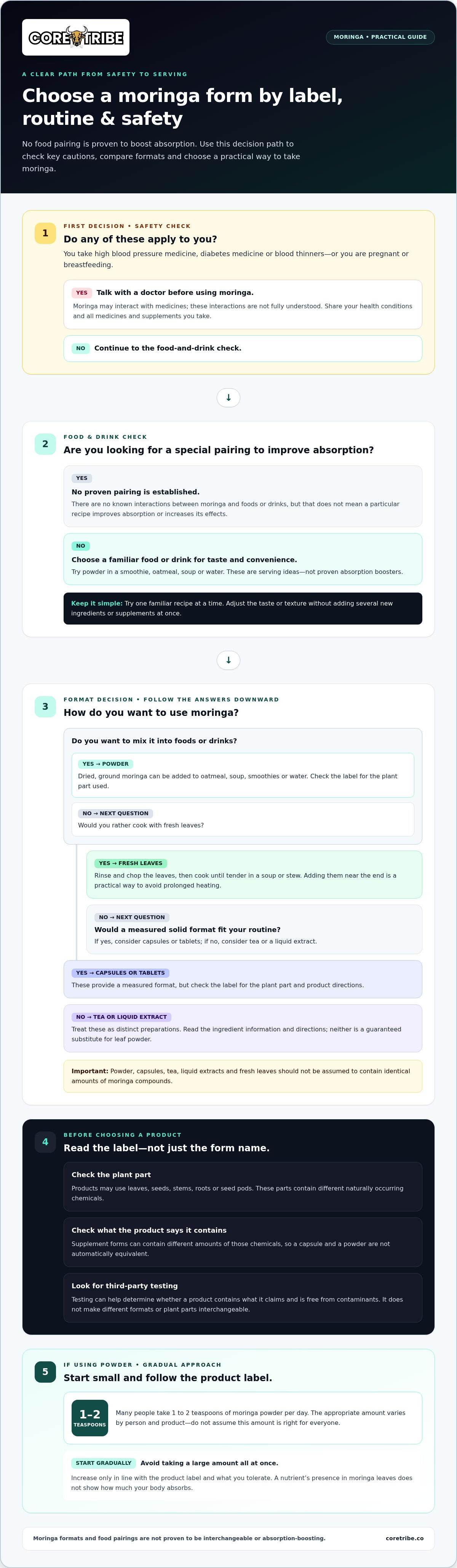
The best way to absorb moringa better isn’t necessarily to take more. If you’re wondering how to absorb moringa better, start with the form and its label: many people take 1 to 2 teaspoons of moringa powder per day, though the appropriate amount varies by person and product. There are no known interactions between moringa and foods or drinks.
It’s reasonable to look for a food pairing or supplement form that helps your body make the most of moringa. However, no proven method guarantees better absorption, and the plant part used can affect a product’s contents.
This guide compares moringa powder, capsules, tea, and other forms; explains what’s known about taking moringa with food; and offers a careful approach to powder portions. It also separates established guidance from uncertain claims, helping you make an informed choice and decide when to discuss moringa with a healthcare professional.
Key Takeaways
- Compare powder, capsules, tea, and fresh leaves by convenience and the plant part used, rather than assuming every form is equivalent.
- Learn practical ways to add moringa powder to everyday foods and drinks without treating a particular pairing as a proven absorption booster.
- Understand why nutrients and antioxidant claims depend on the plant part and the strength of the available evidence.
- Use a gradual approach to powder and follow the product label instead of taking a large amount at once.
- Know when medication use, pregnancy, or breastfeeding makes a conversation with a healthcare professional especially important.
Does moringa interact with foods or drinks?
There are no known interactions between moringa and foods or drinks. You can mix moringa powder into a smoothie, soup, or glass of water without needing a particular pairing. This guidance concerns food and drink interactions; it doesn’t prove that a specific recipe improves absorption or increases moringa’s effects.
Moringa leaves contain vitamins A, C, and E, but their presence alone doesn’t show how much your body absorbs. Available evidence doesn’t establish which moringa nutrients are poorly absorbed or which preparation method reduces antinutrients.
Moringa may interact with medicines, and those interactions aren’t fully understood. If you take high blood pressure or diabetes medicines, blood thinners, or are pregnant or breastfeeding, talk with a doctor before using moringa. Tell your healthcare provider about your health conditions and all medicines and supplements you take.
For everyday use, choose a food or drink that makes the powder easy to take consistently. Start with a familiar recipe, then adjust the taste and texture without assuming that the addition changes how moringa works. For example, stir it into breakfast oatmeal or blend it with fruit and yogurt. Soup is another practical option. These are serving ideas, not proven ways to improve absorption.
To see what fits your routine, keep the rest of the recipe the same. Add moringa powder to a familiar food or drink, such as a smoothie, and see whether you like its earthy flavor. If the texture doesn’t appeal to you, try another base, such as soup instead of water. Avoid adding several new supplements or ingredients at once, so it’s easier to identify what you tolerate.
- In a smoothie: Blend the powder with fruit and yogurt for a mixed texture.
- In oatmeal: Stir it into a bowl you already enjoy.
- In soup: Mix it into a serving for a savory option.
- In water: Try a small glass if you prefer a simple drink.
Moringa seeds are rich in fatty acids, but that doesn’t show that eating them with a particular food boosts absorption. Keep food choices practical rather than relying on claims about special pairings. The distinction is simple: foods and drinks have no known interactions with moringa, while medication interactions may occur and remain incompletely understood. If you take blood thinners or medicines for blood sugar or blood pressure, discuss moringa with your doctor before adding it to your routine.
Moringa forms, including powder, capsules, tea, and fresh leaves
Moringa is available in several forms, but the format alone doesn’t tell you what a product contains. Supplements may come as liquid extracts, tablets or capsules, or dried, ground powder that can be added to food. Tea and fresh leaves are other ways people use the plant, but they shouldn’t be assumed to match a supplement in composition.
Rinse and chop fresh leaves, then cook them until tender in dishes such as soups or stews. Adding chopped leaves near the end of cooking is a practical way to avoid prolonged heating. No particular preparation method is established as a way to improve nutrient absorption or reduce antinutrients.
Cooking or drying can change a food’s composition, but there isn’t enough information to say how either process affects moringa’s nutrient bioavailability. Treat fresh leaves, tea, dried powder, and capsules as distinct formats rather than assuming they provide identical amounts of the plant’s compounds.
Before choosing a product, check the label for the plant part used. Moringa products may be made from leaves, seeds, stems, roots, or seed pods, which contain different naturally occurring chemicals. Supplement forms can also contain different amounts of those chemicals, so a capsule and a powder aren’t automatically equivalent.
- Powder: Dried, ground moringa can be added to food, such as oatmeal or soup.
- Capsules or tablets: These provide a measured format, but check the label for the plant part.
- Liquid extracts: Read the product directions and ingredient information to understand the format.
- Tea: Treat it as a separate preparation, not a guaranteed substitute for leaf powder.
- Fresh leaves: Rinse, chop, and cook them in a familiar dish.
To assess a product, check whether the label identifies the plant part and clearly describes its contents. Third-party testing can help determine whether a moringa product contains what it claims and is free from contaminants. Testing is useful information, but it doesn’t make different plant parts or formats interchangeable.
Choose the form that fits your routine, then compare its label with your intended use. If you’re considering other botanical supplements alongside moringa, explore the available supplement options as a separate choice, not as a moringa substitute.
Moringa leaf nutrients and antioxidants
Moringa leaves contain vitamins A, C, and E, along with plant chemicals. Their presence describes the leaf’s composition, but doesn’t show how much your body absorbs from a serving. A nutrient list also doesn’t establish a health outcome. The plant part and preparation matter because moringa supplements can use leaves, seeds, stems, roots, or seed pods. These parts contain different chemicals, so “moringa” alone doesn’t describe a uniform ingredient.
Leaf powder is the most studied moringa form in clinical trials. It retains the plant’s full spectrum of nutrients, but that doesn’t prove every nutrient is fully absorbed. Research on leaf powder also doesn’t automatically establish the effects of a root, seed, or stem product. When assessing a claim, compare the plant part named on the label with the form discussed.
Moringa contains flavonoids and phenolic acids, plant compounds often discussed for antioxidant activity. The potential antioxidant and anti-inflammatory effects of moringa remain uncertain. Laboratory findings don’t establish that eating moringa produces the same effects in people. Keep this distinction in mind when a product description presents antioxidant language as a direct promise of a health benefit.
The word “antioxidant” can sound like a measure of potency, but it doesn’t tell you how much a product provides or what your body does with it. Moringa’s naturally occurring chemicals vary between forms and plant parts. A leaf-based powder and a seed-derived supplement shouldn’t be treated as chemically identical simply because both come from Moringa oleifera.
Use a practical label-reading approach to understand what you’re choosing:
- Identify the plant part: Look for leaves, seeds, stems, roots, or seed pods.
- Match the claim to the form: Leaf research doesn’t automatically apply to every plant part.
- Separate composition from effect: A listed vitamin or plant compound doesn’t prove a specific outcome.
- Read antioxidant wording carefully: Lab findings aren’t the same as demonstrated effects in people.
Even leaf products can differ in composition. Growing location, cultivation weather, harvest timing, and post-harvest processing can all affect a product’s makeup. The same plant name therefore doesn’t guarantee identical concentrations of naturally occurring compounds in different powders or supplements. A label that identifies the plant part provides useful context, but can’t establish how much of each compound reaches your body.
For a balanced decision, treat nutrient content, absorption, and health effects as separate questions. Moringa leaves contain vitamins A, C, and E; moringa contains flavonoids and phenolic acids; and lab findings alone don’t demonstrate benefits in people. This distinction keeps the plant’s nutritional profile in view without turning a promising compound into a proven result.
Limits of evidence and common misconceptions
Myth: Moringa has well-established effects on blood sugar and cholesterol. The evidence is less certain. Moringa’s effects on the human body aren’t well defined, and its benefits for lowering blood sugar or cholesterol remain unclear. A claim about one health outcome shouldn’t be treated as established evidence for another. Moringa shouldn’t replace evidence-based treatment for diabetes or other chronic conditions.
Myth: Every part of the plant has the same safety evidence. Most safety and efficacy information concerns moringa leaves. Roots, bark, and seeds have different phytochemical and risk profiles. Findings about leaf powder therefore don’t automatically establish the safety or effects of a root, bark, or seed product. Identify the plant part before comparing a product with research on moringa leaves.
Myth: A natural supplement is automatically reviewed for safety. The U.S. Food and Drug Administration has not reviewed moringa for safety and effectiveness. Dietary supplements also aren’t approved by the FDA. A product’s availability or natural origin isn’t evidence that its benefits or risks have been established through FDA review.
Myth: Products with the same plant name have identical contents. Moringa products can vary in their contents and contaminants, including heavy metals. Quality, potency, and purity can differ between manufacturers. Composition can also change with growing location, weather, harvest time, and post-harvest processing. A leaf product from one source may therefore differ from another, even when both labels name moringa.
Myth: Side effects and medicine interactions are fully understood. Research hasn’t identified common side effects sufficiently to establish what they are. Moringa may interact with medicines, but those interactions aren’t fully understood. If you take high blood pressure or diabetes medicines, or blood thinners, discuss moringa with a doctor before use. If you’re pregnant or breastfeeding, speak with a doctor first as well.
Use these evidence limits to guide a careful decision:
- Match claims to the plant part studied, especially leaves versus roots or seeds.
- Don’t replace prescribed or other evidence-based care with moringa.
- Tell your healthcare provider about your conditions, medicines, and supplements.
- Consider product content and contamination risks, not just the plant name.
These limitations don’t mean every moringa product carries the same risks. They do mean that confident claims can go beyond the available evidence. For example, lab findings or antioxidant language on a label don’t establish a treatment effect in people. Distinguish what a product contains from what it can reliably do, and take extra care if you use medicines or have a chronic condition.
Suggested moringa powder amount and gradual dosing
Many people take 1 to 2 teaspoons of moringa powder per day. The appropriate amount varies by person and product, so treat this range as general guidance, not a universal dose. A powder’s concentration and serving instructions can differ from another product’s. Read the label before measuring, and use its directions as your starting point. If you’re considering how to absorb moringa better, keep the serving measured and consistent rather than increasing it in search of a stronger effect.
Starting with a small amount helps you observe how your body responds. Avoid taking a large amount at once, especially if moringa is new to your routine. Keep your portion consistent as you monitor how you feel, rather than changing the amount and adding other new supplements at the same time. This makes your response easier to interpret. To consider how to absorb moringa better, focus on steady, label-led use rather than taking more than directed.
Use a gradual, label-led approach:
- Read the product label. Note its serving directions and the plant part listed.
- Start small. Take a modest amount rather than jumping straight to a larger serving.
- Observe your response. Pay attention to how you feel after taking it.
- Follow the directions. Don’t exceed the label or take a large amount at once.
- Choose quality testing. Prefer a reputable brand whose product has quality testing.
A teaspoon measure can help keep powder portions consistent, but the same spoonful may not mean the same amount across products. Powder density and product directions can differ, so follow the specific label rather than copying someone else’s routine. If the label provides a serving measure, use it instead of estimating from another product. Keep the package nearby to refer to its directions each time you measure.
Taking moringa with food can make your routine easier to maintain, but a recipe doesn’t determine the correct daily amount. For example, mixing powder into breakfast doesn’t mean you should add another serving later. Track your total for the day, and don’t double up because one serving was mixed into food rather than taken on its own.
The 1 to 2 teaspoon range is a commonly used amount, not proof that every person needs that quantity. Product differences matter, and a smaller starting amount gives you room to notice your response. If you use moringa alongside other supplements or medicines, include it in the full list you share with your healthcare provider. That gives them a clearer picture of what you take.
For a broader look at wellness supplements, browse the supplement selection and consider each product separately from your moringa routine.
Coretribe: Coretribe ® Pure Shilajit Capsules - Mixed Sea Moss & Ashwagandha
Coretribe ® Pure Shilajit Capsules - Mixed Sea Moss & Ashwagandha are a separate botanical supplement for readers exploring wellness products beyond moringa. They aren’t a moringa product and shouldn’t be treated as a way to increase moringa absorption or replace guidance about moringa.
If you’re considering another supplement, keep it distinct from your moringa routine and include it when discussing your supplements with a healthcare provider. This makes it easier to consider each product alongside your medicines and health conditions, rather than assuming that combining supplements improves results.
For a closer look at the capsules, visit coretribe.co.
Choose a thoughtful next step for your wellness routine
If you’re considering how to absorb moringa better, focus on a steady routine rather than chasing a special pairing or a larger serving. Consider how a product fits your everyday habits, and keep supplement decisions separate from treatment decisions. This measured approach helps you make informed choices as your needs change.
For readers exploring other wellness products, Coretribe offers Coretribe ® Pure Shilajit Capsules - Mixed Sea Moss & Ashwagandha, Coretribe®Shilajit Honey Sticks, and Revive Dress. These are separate options, not moringa products or substitutes for guidance about moringa. Explore them at your own pace and choose only what suits your interests.
Explore Coretribe’s offerings and take your next step with care and confidence.
Frequently Asked Questions
What Is Moringa and What Makes It Beneficial?
Moringa leaves contain vitamins A, C, and E, along with flavonoids and phenolic acids. These nutrients and plant compounds help explain interest in moringa as a food or supplement. However, their presence doesn’t establish a specific health benefit or show how much your body absorbs. Proposed antioxidant and anti-inflammatory effects have been shown in laboratory settings, but haven’t been established as benefits in people.
How Can You Safely Add Moringa to Your Routine?
Introduce one moringa product at a time, follow its label, and start with a small amount. For example, avoid starting powder and capsules together, as that makes your response harder to interpret. Tell your healthcare provider about moringa, your health conditions, and all medicines and supplements you take. If you take blood pressure or diabetes medicines, blood thinners, or are pregnant or breastfeeding, discuss moringa with a doctor first.
How Much Should You Take?
Many people take 1 to 2 teaspoons of moringa powder per day, but that isn’t a dose for everyone. The appropriate amount depends on the person and the product. Use the serving directions on your specific label, rather than copying another product’s measure. Start small, observe how you respond, and avoid taking a large amount at once. Capsules and extracts have different directions, so don’t convert powder amounts to them.
What should I know about moringa before using it?
Check which plant part the product uses, since leaves, seeds, stems, roots, and seed pods contain different chemicals. Product contents and contaminants, including heavy metals, can vary. Third-party testing can help assess whether a product contains what it claims and is free from contaminants. The U.S. Food and Drug Administration has not reviewed moringa for safety and effectiveness, so don’t treat its availability as proof of established benefits.
Which forms of moringa are best absorbed: powder, capsules, tea, or fresh leaves?
Available information doesn’t identify one form as best absorbed. Powder, capsules, tablets, liquid extracts, tea, and fresh leaves differ in preparation and composition. Leaf powder is the most studied form in clinical trials, but that doesn’t prove it’s absorbed better than other forms. Choose based on the product label and the format you can use consistently, without assuming each delivers the same compounds.
Does taking moringa with food or fat improve nutrient absorption?
No particular food or fat pairing is established as a way to improve moringa nutrient absorption. There are no known interactions between moringa and foods or drinks, so you can add powder to a meal or drink for convenience. Moringa seeds are rich in fatty acids, but that doesn’t show that taking leaf powder with fat improves absorption. Treat recipe ideas as serving preferences, not proven absorption techniques.
How much moringa is typically taken, and is there an evidence-based dose?
A commonly used amount is 1 to 2 teaspoons of powder per day, though the appropriate amount varies by person and product. This is a general amount, not a universally established evidence-based dose. Follow the directions for your product, start with a small amount, and avoid large servings. Don’t apply a powder measurement to tea, capsules, or extracts, since their composition and serving instructions can differ.
Is there clinical evidence that moringa improves nutrient absorption or health outcomes?
Clinical evidence doesn’t establish that moringa improves nutrient absorption or reliably produces specific health outcomes. Leaf powder is the most studied form in clinical trials, but research on one form doesn’t prove effects across every product or plant part. Moringa’s effects in people remain poorly defined, and laboratory findings about antioxidant activity don’t establish treatment benefits. Don’t use moringa instead of evidence-based care for diabetes or other chronic conditions.

