


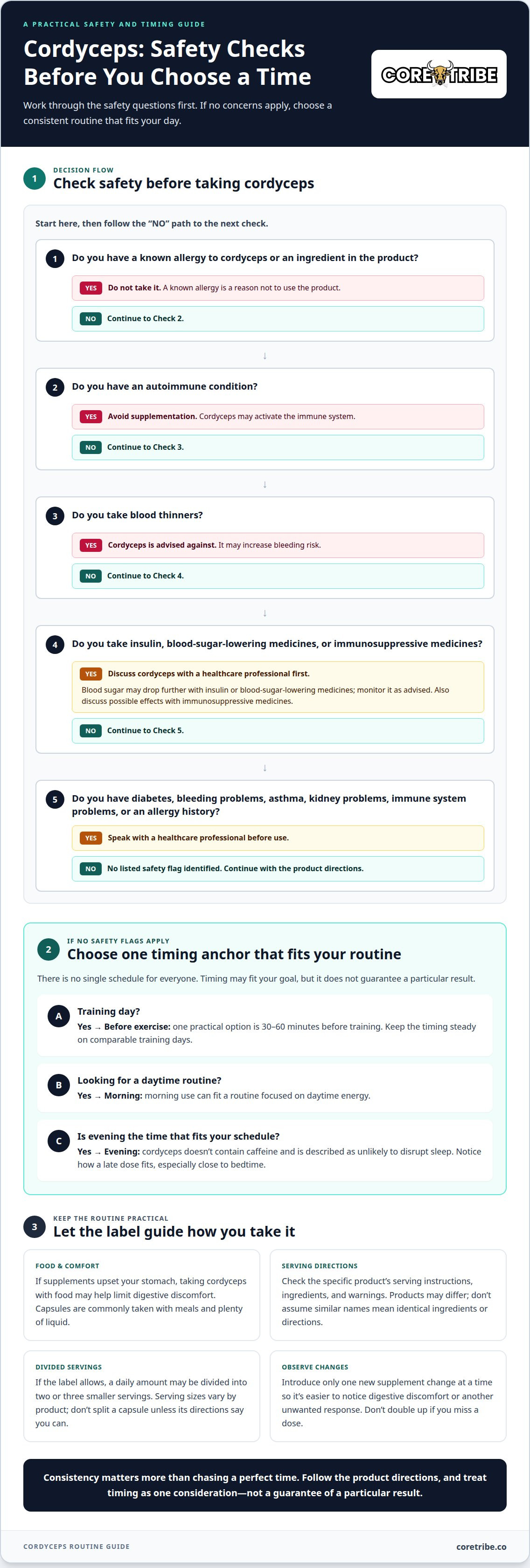
The best time to take cordyceps is often in the morning or before a workout, though some people take it during an energy slump. There’s no single schedule for everyone, so follow your supplement’s directions and choose a routine you can maintain.
It’s natural to wonder whether better timing can make a supplement more effective. With cordyceps, the answer depends partly on your goals, but benefits aren’t equally well established for every use. Timing is one consideration, not a guarantee of a particular result.
This guide explains how morning, workout, and divided-dose routines may suit different needs, along with possible side effects and medication interactions. It also offers a balanced look at what cordyceps may support, where evidence remains uncertain, and when it makes sense to speak with a healthcare professional before use.
Key Takeaways
- Morning or pre-workout use may suit an energy-focused routine; consistency matters more than chasing a perfect time.
- Taking cordyceps with food may help limit digestive discomfort, while the product’s directions should guide how you take it.
- Dividing a daily amount into smaller servings may be a practical approach, but don’t double up if you miss a dose.
- Digestive upset and allergic reactions are among the possible side effects; learn what to watch for before starting.
- Medication use and certain health conditions can affect whether cordyceps is appropriate, so review potential interactions with a healthcare professional.
Can Cordyceps Be Taken With Other Supplements or Medications?
Taking cordyceps with food is a practical option if supplements upset your stomach. Capsules are commonly taken with meals and plenty of liquid. Food may help reduce digestive discomfort, while an empty stomach may not suit someone prone to nausea. Follow the directions for your specific product rather than assuming all cordyceps supplements are used the same way.
Check the label before combining cordyceps with other supplements. A product may contain cordyceps alone or include additional ingredients, so review the full ingredient list. The species name, such as Cordyceps sinensis, can also help identify what the product contains. Don’t assume that supplements with similar names have identical ingredients or directions.
Medication interactions deserve particular care. Cordyceps may increase bleeding risk, so people taking blood thinners are advised to avoid it. It may also lower blood sugar, which can be a concern with insulin or blood-sugar-lowering medicines. Anyone taking these medicines should discuss cordyceps with a healthcare professional and monitor blood sugar as advised.
- Blood thinners: Cordyceps may raise bleeding risk.
- Insulin or blood-sugar-lowering medicines: Blood sugar may drop further.
- Immunosuppressive medicines: Discuss possible effects with a healthcare professional.
Health conditions can affect safety, even without medication. People with diabetes, bleeding problems, asthma, kidney problems, immune system problems, or allergies should speak with a healthcare professional before use. People with autoimmune conditions are advised to avoid supplementation because cordyceps may activate the immune system. A known allergy to cordyceps or an ingredient in the product is a reason not to take it.
For a workout, some athletes take cordyceps before training. One practical timing option is 30-60 minutes before exercise. This gives you a consistent point to observe how the supplement fits your routine, rather than changing several variables at once. Taking cordyceps before a workout doesn’t replace the product directions or resolve a medication concern.
Use the label as your starting point: check the serving instructions, ingredients, and warnings. If a healthcare professional has recommended a different schedule, follow that advice. When combining cordyceps with other supplements, introduce only one change at a time. For example, avoid starting cordyceps and another new supplement on the same day. This makes it easier to notice digestive discomfort or another unwanted response.
How Does Timing Affect the Benefits of Cordyceps?
Morning use can fit a routine focused on daytime energy, while pre-workout use aligns supplementation with training. Neither timing establishes that cordyceps will improve endurance for everyone. Traditional use and modern interest in species such as Cordyceps sinensis don’t replace the need to consider the specific supplement, training demands, and your regular schedule.
There is no single onset time that applies to everyone. In one study, young adults taking a mushroom blend containing Cordyceps militaris saw a gradual increase in VO₂ max over three weeks. That describes the study period, not a promise that everyone will notice an effect after the same interval or from cordyceps alone.
For training, taking cordyceps before a session lets you assess how it fits your exercise routine. The suggested pre-workout window discussed earlier can provide a consistent reference point. For example, use the same timing on comparable training days rather than shifting between morning, mid-session, and evening. This makes it easier to judge whether the routine fits your usual preparation.
Endurance depends on more than supplement timing. A demanding run, a strength session, and a recovery day place different demands on your body. Consider sleep, meals, hydration, and training stress when judging whether a timing routine suits you. If you change when you take cordyceps, avoid changing your workout plan at the same time. Otherwise, you may not know which change affected your experience.
Evening use may suit someone whose schedule leaves no earlier opportunity. Cordyceps doesn’t contain caffeine and is described as unlikely to disrupt sleep when taken in the evening. Still, notice how a late dose fits your routine, particularly if you take it close to bedtime. Morning use may be a more convenient anchor if you prefer keeping supplements separate from nighttime habits.
A simple approach is to choose one regular time that matches your goal: morning for a daytime routine, or before training for an exercise-focused routine. Keep that timing steady while you observe your response, and follow the product directions. The best time to take cordyceps is ultimately a practical fit, not a shortcut around rest or consistent training. For a supplement that fits this routine, explore cordyceps and wellness products.
Dividing daily intake into several doses
Some cordyceps routines divide the daily amount into two or three smaller doses instead of taking it all at once. This can make intake easier to fit around breakfast, lunch, and dinner. It doesn’t mean everyone needs multiple servings. The supplement label sets the daily amount, and any schedule should stay within its directions.
For example, someone whose label allows divided servings might take one with breakfast and another later with a meal. If directions allow three servings, they could spread them across morning, midday, and evening. These are scheduling examples, not dose instructions: serving sizes vary by product. Don’t split a capsule unless its directions say it can be divided.
Capsules are often taken in several doses throughout the day, but the most useful pattern is one you can follow consistently. Pairing each serving with an existing routine, such as a morning meal or lunch break, can help prevent accidental omissions. A simple calendar reminder can also support a steady schedule without making supplement use a complicated ritual.
Daily use is commonly suggested for people seeking consistent performance benefits. That doesn’t establish that taking cordyceps every day improves results for everyone. Supplements aren’t a substitute for medicine or for training fundamentals, including recovery and regular meals. Treat the product directions as the limit, not an invitation to add servings when a workout feels harder.
To decide whether one serving or divided intake fits your day, start with the label’s daily instructions. Then consider your routine: a single morning serving may be easier to remember, while two smaller servings may fit meals better. Keep the schedule stable as you observe how it suits you. Changing timing and serving frequency together makes it harder to tell which adjustment affected your experience.
Traditional Chinese medicine often comes up in discussions of cordyceps, but traditional use doesn’t establish a modern dosing schedule. Its bioactive properties also don’t mean more frequent intake is automatically more helpful. Follow the label’s instructions because products can differ in form and serving directions. If a healthcare professional has given you a specific plan, follow it rather than adding a separate schedule.
If you miss a serving, don’t take a double or extra amount to make up for it. Resume the next scheduled serving according to the product directions. This keeps your daily total within the intended instructions. If you divide intake into two or three portions, a missed midday serving doesn’t mean an additional evening serving is necessary.
The practical goal is a repeatable schedule, not a complex timing formula. Choose a pattern that fits your meals and daily commitments, then follow it consistently. If multiple servings are difficult to remember, a simpler schedule approved by the label may be easier to maintain. Cordyceps may support a routine, but divided intake is a way to organize use, not proof of stronger effects.
Cordyceps uses and uncertain benefits
People use cordyceps for several different aims, including energy, immune regulation, kidney problems, and slowing aging. These uses don’t establish that the cordyceps mushroom treats those concerns. Its health benefits remain poorly defined, so a supplement’s traditional reputation should be kept separate from demonstrated effects in people. The intended use matters: an energy routine is different from trying to manage a health condition.
Exercise is one area of interest, but study design shapes what the results can tell us. The researchers who conducted the study followed 28 individuals participating in high-intensity exercise while taking a mushroom blend containing cordyceps. The study lasted three weeks. Because participants took a blend, its results cannot show that cordyceps alone caused any observed change.
A separate study of young adults taking a mushroom blend containing Cordyceps militaris observed a gradual increase in VO₂ max over three weeks. VO₂ max relates to the body’s capacity to use oxygen during exercise, making it relevant to endurance. Still, a change observed in one study doesn’t establish that every cordyceps product will improve fitness or reduce fatigue.
Immune effects also require careful interpretation. A human study found increased natural killer cell activity in men four weeks after taking Cordyceps militaris. That is a measured immune marker, not proof of fewer illnesses or better overall health. People with immune-related conditions or taking immunosuppressive medicine should discuss use with a healthcare professional, given this potential immune activity.
Antioxidant language can sound like a broad promise, but it doesn’t answer practical questions on its own. A claim about antioxidant properties doesn’t establish which outcome someone might notice, how soon it might appear, or whether a particular product produces it. In the United States, the FDA has not reviewed cordyceps supplements for safety and effectiveness. Product claims shouldn’t be confused with an FDA finding.
For a grounded decision, match the supplement’s intended role to the evidence. If your aim is exercise support, consider the small body of research in context: the studies involved blends, particular participants, and defined study periods. If your aim is kidney health, immune regulation, or aging, don’t treat traditional use as a substitute for medical care. The evidence described here does not establish cordyceps as a treatment for those concerns.
The clearest takeaway is that cordyceps has traditional and modern uses, but evidence differs by outcome. Exercise studies offer specific early observations, while broader health benefits remain uncertain. Keep your goal concrete, such as tracking how a consistent training routine feels, and avoid interpreting one change as proof of a supplement effect. For persistent fatigue or a health concern, seek medical assessment rather than relying on a mushroom supplement alone.
What is the recommended cordyceps dosage for adults?
There isn’t one adult dose that applies to every cordyceps supplement. Research studies have used 1 to 4.5 grams per day, while a typical amount cited for most adults is 1-3 grams per day. Those figures describe different uses and products, not a personalized prescription. The right starting point is the serving direction on the specific product label.
Supplement formats also differ. Cordyceps products are often offered in daily amounts ranging from 500 to 1,500 milligrams, while one stated standard dose for cordyceps powder is approximately 1,200 mg. These figures aren’t interchangeable: powder, extracts, and capsules may have different concentrations and serving sizes. Compare the stated daily serving, rather than matching a capsule count to a study’s gram amount.
Exercise research has used a range of amounts. Studies focused on athletic performance have used daily doses up to 4g, and doses of 3-4.5 grams per day have been studied for aerobic performance in runners. These are study amounts, not a direction to take the maximum. The research also includes different products and formulations, so a study dose may not correspond directly to your supplement.
Use the label as your practical guide. Check the serving size, the number of servings per day, and whether directions apply to powder or capsules. For example, if a capsule label gives a daily serving in milligrams, don’t convert it into grams or add servings to match a study. Take cordyceps as directed, with meals and liquid if the product instructions recommend it.
Daily totals matter when a serving is divided. If the label directs multiple servings, add them together before taking another supplement containing cordyceps. A morning serving and a later serving both count toward the same daily amount. If you miss one, don’t take a double or extra dose to compensate; resume the schedule stated on the label.
Health conditions and medicines can affect whether cordyceps is appropriate, regardless of dose. Blood thinners and blood-sugar-lowering medicines are important interaction considerations. Discuss use with a healthcare professional if you take these medicines or have a condition that may affect safety. A smaller amount doesn’t automatically remove an interaction concern.
For a clear starting point, follow your product’s directions instead of treating research doses as a universal target. Choose a cordyceps supplement and review its serving instructions before adding it to your routine. Explore cordyceps supplements as you consider which format fits your daily schedule.
Coretribe: Cordyceps
Coretribe offers Cordyceps for readers considering this supplement as part of an energy or exercise routine. The guidance in this article can help you consider timing, serving directions, and possible medication interactions before deciding whether it fits your needs. Because cordyceps products can differ, follow the directions on the specific product rather than assuming one schedule applies to every format.
If you’re comparing cordyceps with other wellness supplements, focus on your intended use and any health or medication considerations. Cordyceps isn’t a substitute for prescribed treatment, and people with relevant health conditions or medication concerns should discuss use with a healthcare professional. For questions about Coretribe’s Cordyceps, contact Coretribe.
Make Your Next Wellness Choice Thoughtfully
Let your routine guide your next step. The best time to take cordyceps is when you can follow the schedule consistently, while keeping your wider health needs in view. If you’re considering adding it, choose a product that fits your intended use and read its directions before making it part of your day.
Coretribe’s wider range includes Coretribe® Pure Shilajit Capsules - Mixed Sea Moss & Ashwagandha, Coretribe® Shilajit Honey Sticks, and Revive Dress. Each has a distinct place in the brand’s offerings, so focus on the option that suits what you’re looking for rather than assuming every product serves the same purpose.
Questions about whether a supplement fits alongside your medicines or health needs are best discussed with a healthcare professional. For a closer look at Coretribe’s offerings, explore the available wellness products. Take your next step at a pace that feels considered and right for you.
Frequently Asked Questions
When is the Best Time to Take Cordyceps?
Morning or before exercise are practical options, depending on your routine. For a workout, take it 30-60 minutes before training if that fits the product directions. For general daytime use, a morning serving can be easier to pair with breakfast. Choose one regular time and avoid changing several parts of your routine at once, so you can notice how the timing feels.
Does cordyceps interact with foods or drinks?
Taking cordyceps with a meal may help reduce digestive discomfort, and capsules are commonly taken with meals and plenty of liquid. Water is a straightforward choice for swallowing a capsule. Key interaction concerns involve certain medicines rather than a particular food: blood thinners and blood-sugar-lowering medicines deserve particular attention. If you take medication, discuss cordyceps use with a healthcare professional.
Does the caterpillar fungus have side effects?
Yes. Cordyceps can cause digestive effects such as nausea, diarrhea, constipation, or an upset stomach; dry mouth is also possible. Allergic reactions can occur, so avoid a product if you know you’re allergic to cordyceps or one of its ingredients. If an unwanted effect appears after use, stop taking it and seek advice from a healthcare professional, especially if symptoms are severe.
How Do Cordyceps Mushrooms Work in the Body?
Cordyceps is studied for possible effects on energy and immune activity, but research doesn’t establish one confirmed pathway that explains every claimed benefit. Results from a supplement also depend on its contents and form. Treat claims about fatigue, exercise, or immune function as separate questions, rather than assuming one proposed effect proves another. Cordyceps supplements aren’t a replacement for medical treatment.
Should Cordyceps Be Taken in the Morning or Evening?
Morning use suits people who want to anchor a supplement to the start of the day. Evening use is another option, since cordyceps doesn’t contain caffeine and is described as unlikely to disrupt sleep. If you’re unsure how it fits your schedule, keep the timing consistent and notice whether it affects your comfort or bedtime routine.
What time of day is best to take cordyceps supplements?
The best time to take cordyceps supplements is when it fits your intended use and product directions. A morning serving can support a steady daytime habit, while a serving before training connects it with an exercise routine. For example, someone who forgets supplements at breakfast might choose a regular meal they rarely miss. Consistency makes the routine easier to follow.
Should cordyceps be taken in the morning or before exercise?
Choose morning use for a general daytime routine, or take it before exercise if you want to align it with training. Athletes may use cordyceps in the morning or 30-60 minutes before a workout. The choice doesn’t guarantee a performance effect. Keep your workout preparation and supplement timing steady, and follow the specific directions on your product.
Should cordyceps be taken with food or on an empty stomach?
Taking cordyceps with food is a sensible option if supplements cause stomach discomfort. Capsules are commonly taken with meals and plenty of liquid. For example, pair a capsule with breakfast if that meal is a reliable part of your day. Follow the label if it gives different directions, and don’t take extra servings to make up for a missed dose.

