


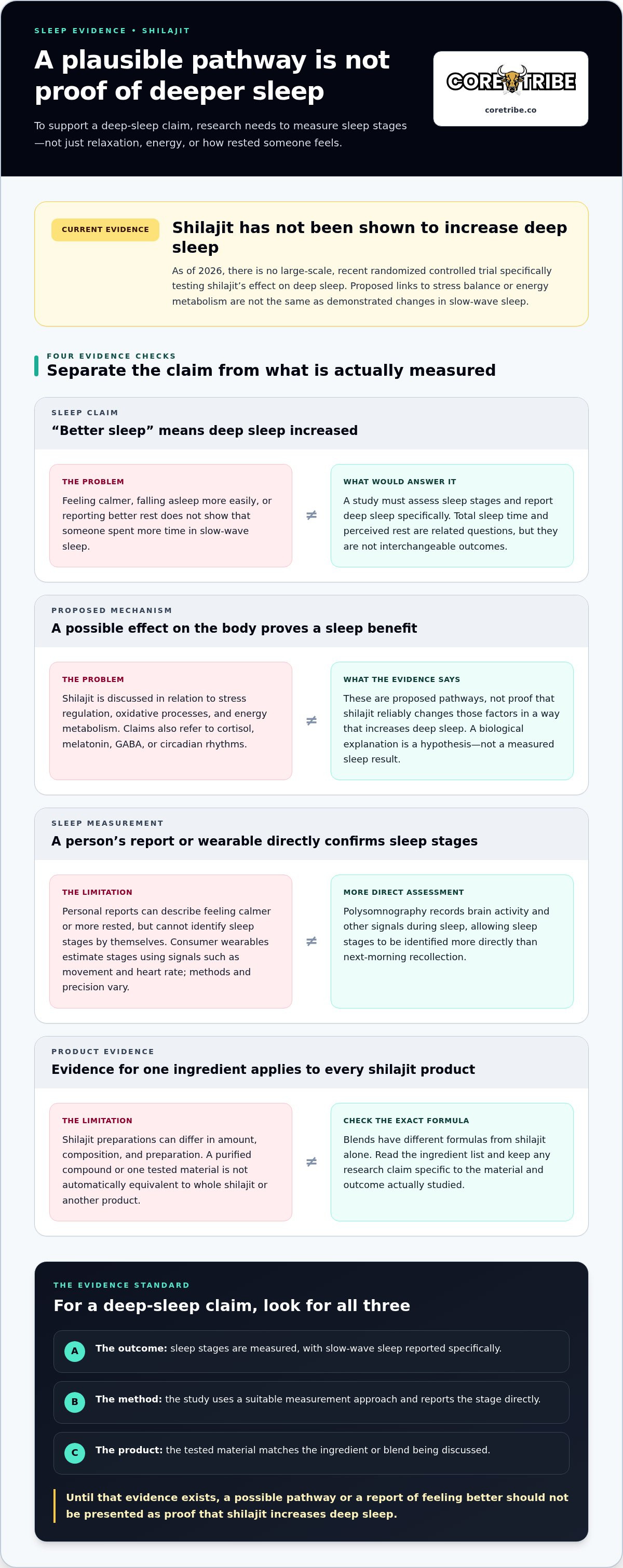
A plausible explanation for how a supplement might affect sleep isn’t proof that it changes your sleep stages. If you’re asking, “does shilajit increase deep sleep,” the honest answer is that current research doesn’t establish that it does. Proposed links to stress balance, energy metabolism, or feeling more rested aren’t the same as evidence of increased slow-wave sleep measured overnight.
It’s easy to find sleep claims confusing because “better sleep” can mean different things, and deep sleep is only one part of the picture. As of 2026, there’s no large-scale, recent randomized controlled trial specifically testing shilajit’s effect on deep sleep. This article explains what deep sleep is and how it’s measured, separates direct human evidence from traditional use and proposed mechanisms, and reviews what’s known about nighttime use, safety, and supplement quality. The goal is to help you weigh the evidence without mistaking a possible pathway for a proven sleep benefit.
Key Takeaways
- Deep sleep is slow-wave sleep, a specific stage rather than a general feeling of rest.
- When asking “does shilajit increase deep sleep,” look for studies that measure sleep stages, not only self-reported rest or fatigue.
- Proposed effects on stress or energy offer possible explanations, but they don’t establish a sleep benefit.
- Review a supplement’s label and ingredients, and look for credible third-party testing when assessing quality.
- Coretribe’s shilajit capsules with sea moss and ashwagandha, and shilajit honey sticks, are offerings to explore, not proven sleep aids.
What Is Deep Sleep, and Where Does Shilajit Fit?
Current evidence doesn’t establish that shilajit increases deep sleep. That distinction matters because “sleep support” can describe many experiences, from feeling calmer at bedtime to sleeping longer. Neither automatically shows that someone spends more time in a particular sleep stage. To answer “does shilajit increase deep sleep,” research needs to measure deep sleep itself, not just ask people how rested they feel.
What does deep sleep mean?
Deep sleep, also called slow-wave sleep, is a stage of non-REM sleep marked by slow patterns of brain activity. It’s one part of the broader sleep cycle, which also includes lighter non-REM stages and REM sleep. These stages recur across the night. Deep sleep is not the same as total time asleep or an individual’s impression of how restorative the night felt. For an overview of how sleep stages fit together, see Understanding Sleep Stages.
These differences matter when assessing a claim. A person may feel relaxed, fall asleep more easily, or report better sleep quality without an objective change in slow-wave sleep. Total sleep time answers how long someone slept; a sleep-stage result addresses how that sleep was distributed. They’re related questions, but they aren’t interchangeable outcomes.
Measurement matters too. Polysomnography records brain activity and other signals during sleep, allowing sleep stages to be identified more directly than through someone’s recollection the next morning. Consumer wearables may estimate sleep stages using signals such as movement and heart rate, but their methods and precision vary. A claim about increased deep sleep is more persuasive when a well-designed study uses a suitable measurement method and reports that stage specifically.
What is shilajit, and why is it linked to sleep?
Shilajit is a naturally occurring substance used in traditional wellness practices. It contains fulvic acid and other compounds, including minerals. Researchers have discussed possible biological effects that could relate indirectly to rest. But a proposed effect on stress, energy processes, or another body system is a hypothesis about how something might work, not evidence that it increases slow-wave sleep in people.
It also helps to distinguish ingredient context from sleep evidence. Shilajit products can vary in form and additional ingredients, so the label matters when interpreting a claim or considering a supplement. Coretribe’s Shilajit, Ashwagandha, and Sea Moss synergy guide provides context on those ingredients. It isn’t proof of a deep-sleep effect.
The key question isn’t simply whether shilajit has a plausible connection to wellness. It’s whether human research has measured sleep stages and shown a reliable change in deep sleep. That standard keeps general feelings of rest separate from a specific, measurable sleep outcome.
How Could Shilajit Affect Sleep, and What Is Still Unproven?
Shilajit is sometimes linked to sleep through proposed effects on stress, oxidative processes, or energy metabolism. These ideas may help researchers decide what to investigate, but they don’t show that people sleep differently after taking it. A biological pathway is a possible explanation, not a measured result. This distinction is especially important when a claim names a specific stage such as slow-wave sleep.
Proposed pathways are not the same as measured sleep
Some explanations suggest that compounds in shilajit could influence systems involved in stress regulation or cellular energy. Other claims refer to cortisol, melatonin, GABA, or circadian rhythms. Treat these cautiously: the available information doesn’t establish that shilajit reliably changes these factors in a way that increases deep sleep. And a plausible effect on one body process doesn’t prove a meaningful sleep outcome.
For example, a change in a stress-related measure, if observed, wouldn’t by itself demonstrate that someone spent more time in slow-wave sleep. Researchers would need to assess sleep directly and show that the change is linked to the supplement. Personal reports of feeling calmer or more rested can be useful, but they can’t identify sleep stages on their own.
Deep-sleep claims require studies that measure sleep stages, not just reports of relaxation, energy, or general sleep quality. Keep this standard in mind when reading confident explanations of how a supplement might work.
Why ingredient and product evidence matters
Evidence about an isolated compound doesn’t automatically apply to whole shilajit. A purified substance studied on its own may differ from a complex preparation containing multiple constituents. The amount, composition, and preparation can also vary, so results from one tested material can’t simply be applied to every product that uses the same ingredient name.
Blends add another consideration. A product combining shilajit with other ingredients has a different formula from shilajit alone, and each ingredient may have its own evidence and considerations. Even if research examines one component for a particular outcome, that doesn’t establish that the complete blend produces the same effect or changes deep sleep. Read the ingredient list to see what a study or product actually concerns.
Coretribe offers shilajit capsules blended with sea moss and ashwagandha, as well as shilajit honey sticks. These are options to explore as shilajit products, not proven sleep aids. The shilajit, sea moss, and ashwagandha side-effects guide provides broader ingredient context to consider alongside any sleep-related claim.
When comparing formulations, start with the specific label and keep claims in proportion to the evidence. You can browse Coretribe’s wellness offerings with that evidence-first perspective: a proposed pathway is a reason to ask questions, not a promise of deeper sleep.
Does Shilajit Increase Deep Sleep? Weighing the Evidence
Current evidence doesn’t establish that shilajit increases deep sleep. To support that specific claim, research needs to test a defined shilajit preparation in people and measure sleep stages directly. Reports of feeling more rested, traditional use, or a possible biological pathway may be relevant to broader questions about wellness, but none alone demonstrates an increase in slow-wave sleep.
What would convincing evidence need to show?
A useful human study would identify the preparation being tested and describe who took part. It would compare shilajit with an appropriate control, explain how long the study lasted, and use a suitable method to measure sleep stages. The size of the study and any conflicts of interest also matter when deciding how much weight to give its findings.
Keep the measured outcome in view. A study can assess fatigue, relaxation, or participants’ own ratings of sleep without determining how much deep sleep they got. Those measures can matter, but they answer different questions. Details such as group size, duration, comparison method, and funding help readers judge whether a finding is preliminary or dependable.
How to read broad sleep-benefit claims
Look closely at the wording. “Supports sleep” might refer to general rest, while “increases deep sleep” makes a narrower claim about a specific stage. A source should explain what it measured and how. If it reports only a broad symptom or someone’s impression, don’t treat that as evidence of a change in slow-wave sleep.
It also helps to distinguish types of evidence. Traditional use offers historical context; laboratory work can explore biological activity; animal research can suggest questions for later studies. None is interchangeable with controlled human research that measures sleep stages. A reported 2020 study involving shilajit and people with moderate fatigue is sometimes mentioned in sleep discussions, but that reference alone doesn’t show that the study established an increase in deep sleep. The measured outcome and study design matter.
Use this quick evidence check when you encounter a sleep claim:
- Outcome: Does the study name deep sleep or report only general sleep quality, fatigue, or relaxation?
- Measurement: Were sleep stages assessed, or were outcomes self-reported?
- Preparation: Was the tested material whole shilajit, an isolated compound, or a blend?
- Study design: Was there a comparison group, and are the size and duration clear?
Results from one preparation don’t automatically apply to every shilajit product, and evidence about an isolated compound doesn’t establish the effects of the whole substance. This is especially relevant for blends, where ingredients have separate evidence profiles. Read study findings and product claims in the context of the exact formulation being discussed.
Shilajit may be discussed as a possible area of sleep research, but proven deep-sleep improvement requires direct human evidence that measures sleep stages. For anyone asking “does shilajit increase deep sleep,” the grounded answer is that broad sleep-related findings may prompt further study, but they don’t yet establish that specific outcome.
Considering Shilajit for Sleep? A Cautious Evidence-and-Safety Checklist
If you’re considering shilajit, treat it as a supplement choice, not a proven way to increase deep sleep. Ask what a sleep claim actually means, review the specific product information, and consider your own health circumstances. This keeps the decision grounded in what’s known rather than in a promise the evidence may not support.
Questions to ask before trying a supplement
First, check whether the claim refers to deep sleep, general sleep quality, relaxation, or another outcome. These terms aren’t interchangeable. Then read the product’s label and ingredient list, including directions and warnings. If it’s a blend, note each ingredient rather than assuming evidence about one component applies to the whole formula.
- What outcome is claimed? Look for a clear distinction between measured sleep stages and broader reports of rest or recovery.
- What’s in the product? Review the complete ingredient list and follow the product’s own directions. Don’t infer a dose from another brand or study.
- What quality information is available? Because poorly purified shilajit may contain contaminants, look for credible third-party testing and a Certificate of Analysis (COA) that relates to the product.
- Does it fit your health situation? If you’re pregnant, managing a health condition, or taking medication, discuss supplement use with a qualified healthcare professional. They can help consider personal risks and possible interactions.
These checks don’t confirm that a product will improve sleep. They help you understand what you’d be taking and make a more informed choice. If the answer to “does shilajit increase deep sleep” is central to your decision, keep the evidence boundary in mind: a label or proposed benefit isn’t proof of a sleep-stage effect.
How to interpret your own sleep observations
A simple sleep log can help you notice patterns, though it can’t diagnose a sleep disorder or prove that a supplement caused a change. Keep bedtime and wake time as consistent as you reasonably can, and record how rested you feel the next day. If you try something new, avoid changing several habits or supplements at once. Otherwise, it’s harder to tell what may be influencing your experience.
Wearables can offer a rough picture of sleep duration and estimated stages, but treat deep-sleep readings as approximations, not clinical measurements. A night-to-night change on a device doesn’t establish that shilajit caused a real change in slow-wave sleep. Give more weight to sustained patterns and how you feel during the day than to a single number.
Persistent sleep difficulties or significant daytime impairment deserve professional evaluation, rather than repeated self-experimentation with supplements. A sleep log may help you describe the pattern, but a qualified professional can assess the concern in context.
If you’re exploring shilajit as part of a broader wellness routine, browse Coretribe’s wellness offerings and review each product’s label and ingredients with these questions in mind.
How Coretribe Shilajit Fits Into an Informed Wellness Choice
The evidence-led conclusion is straightforward: shilajit isn’t established as a way to increase deep sleep. That applies to shilajit generally, and a product’s presence in a sleep discussion doesn’t prove that it changes sleep stages. If you’re asking “does shilajit increase deep sleep,” keep the answer separate from a brand’s broader wellness positioning or from your own experience of feeling rested.
What Coretribe offers, and what that does not prove
Coretribe offers Coretribe ® Pure Shilajit Capsules - Mixed Sea Moss & Ashwagandha, a capsule blend with shilajit, sea moss, and ashwagandha. Another shilajit offering is Coretribe®Shilajit Honey Sticks. You can consider these products in the context of their ingredients and your personal needs, but their availability doesn’t establish that they increase deep sleep or treat a sleep disorder.
That distinction is central to choosing thoughtfully. A product description tells you what the brand offers; a clinical study tells you what researchers tested and measured. Even if a study finds an effect for a particular ingredient or preparation, it doesn’t automatically prove that a different formulation has the same effect. Look at what the research actually examined, and keep claims proportional to those findings.
A balanced next step for wellness-minded readers
Before choosing any supplement, consider the complete ingredient list, your individual circumstances, and how closely the available evidence matches the product and outcome you care about. If your goal is better sleep, also consider the wider habits and health factors that shape rest. A holistic approach doesn’t require treating a supplement as the answer; it means weighing options calmly and paying attention to what is and isn’t known.
Coretribe’s guide to holistic mind-body balance offers broader wellness context for thinking about sleep alongside overall well-being. It doesn’t replace individualized medical guidance. If you have ongoing sleep concerns, a health condition, or take medication, discuss supplement decisions with a qualified healthcare professional.
To learn more about the brand’s shilajit and other wellness options, explore Coretribe’s wellness collection. Use the product details to understand what’s in each offering, while keeping the central point in view: shilajit’s potential sleep pathways are not proof of increased deep sleep.
Let Better Questions Guide Your Next Step
As you consider sleep support, focus on the outcome you actually want and the kind of evidence that could demonstrate it. The question “does shilajit increase deep sleep” can help you spot when a claim describes general rest but implies a specific sleep-stage benefit. Keeping that distinction in mind makes it easier to assess new information without rushing toward a promise.
Build your choices around what fits your health needs and broader wellness priorities. A supplement can be one consideration, but it doesn’t replace attentive habits or professional guidance when sleep problems persist. Take time to read product details, compare claims with the evidence behind them, and choose with care rather than pressure.
To explore wellness options with an informed perspective, browse Coretribe’s wellness collection. Review the product details and ingredients, and let clear evidence guide your next step.
Frequently Asked Questions
Does shilajit increase deep sleep?
Current evidence doesn’t establish a reliable increase in deep sleep from shilajit. To support that claim, well-designed human studies would need to measure sleep stages directly, rather than assess only general rest, energy, or self-reported sleep quality. A possible biological explanation isn’t a proven result. It’s sensible to revisit the evidence as new studies examine specific preparations and sleep outcomes.
Can shilajit help you sleep better?
Some people may notice a difference, but evidence that shilajit improves sleep remains limited and depends on the outcome being studied. Feeling rested the morning after taking a supplement, for example, doesn’t show that your deep sleep increased. Consider what a source actually measured before relying on its claim. If sleep difficulties continue or affect daily life, discuss them with a qualified healthcare professional.
Is it better to take shilajit in the morning or at night?
No timing has been established as a way to increase deep sleep. People may respond differently, and directions can vary between products, so follow the label for the specific supplement rather than assuming bedtime use is preferable. If you notice that taking it at a particular time affects your sleep or wellbeing, pause and seek advice from a qualified healthcare professional, especially if you take medication or manage a health condition.
Can shilajit keep you awake?
Responses can vary, and available information doesn’t establish a predictable effect for everyone. If you start a supplement, notice whether your sleep or daytime wellbeing changes, but don’t treat one person’s experience as proof of what will happen to you. Follow the product directions, and avoid changing several habits or supplements at once so patterns are easier to interpret. Seek professional advice if sleep disruption is severe or persists.
Does shilajit affect melatonin or cortisol?
Claims about melatonin or cortisol should be treated as proposed mechanisms unless supported by relevant human research. Current information doesn’t establish that shilajit reliably changes either one. Even if a study measures a biomarker, that alone doesn’t prove a person gets more deep sleep. Check whether the source studied people, identified the exact shilajit preparation, and measured the outcome it claims to explain.
Is shilajit safe to take every day?
Daily use isn’t a universal recommendation; suitability depends on the product’s directions and your health circumstances. Read the label carefully, including its ingredients and warnings. If you’re pregnant, managing a health condition, or taking medication, speak with a qualified healthcare professional before using a supplement. Don’t replace prescribed treatment with shilajit. Product quality also matters, so consider whether credible testing information is available for the specific supplement.
Can shilajit replace treatment for insomnia?
No. Shilajit shouldn’t be presented as a proven insomnia treatment or a replacement for professional care. Ongoing difficulty sleeping can have different causes, and identifying what’s contributing may require an appropriate assessment. If sleep problems persist, interfere with daily activities, or leave you struggling to function, discuss them with a qualified healthcare professional. Supplement information can support general learning, but it can’t diagnose a condition or guide treatment on its own.

