


What if taking shilajit feels subtle, inconsistent, or different from what you’ve read online? That’s possible. If you’re wondering what to expect when taking shilajit, the clearest answer is that experiences vary. Stories about dramatic changes or exact timelines are not guarantees.
It makes sense to want a clear picture before adding a supplement to your routine. Research on shilajit is still developing, so it can be difficult to distinguish a meaningful change from normal fluctuations in energy, sleep, or mood. It’s also worth understanding potential unwanted effects and who should use extra caution.
This guide covers what people may notice, why experiences can differ, and how to track changes without assuming the supplement caused them. It also explains safety considerations, when to pause use and seek qualified medical advice, and how to decide whether shilajit fits your routine.
Key Takeaways
- Learn what to expect when taking shilajit without treating personal stories or timelines as guaranteed outcomes.
- Understand why experiences may range from an immediate impression to gradual changes or no noticeable difference.
- Use a simple record of sleep, meals, routine changes, and observations to put perceived effects in context.
- Remember that natural origin doesn’t guarantee safety or suitability; know when to pause use and seek qualified medical advice.
- Compare supplement formats for convenience, and read labels carefully, especially for blends such as Coretribe ® Pure Shilajit Capsules - Mixed Sea Moss & Ashwagandha.
What to Expect When Taking Shilajit: Start With Realistic Expectations
To set realistic expectations, start with what shilajit is and what research can tell us. Shilajit is a naturally occurring, mineral-containing substance that forms over long periods and is used in some supplements. Its composition can vary, so the name alone doesn’t tell you exactly what a product contains. The Shilajit Wikipedia page offers background on its origins, composition, and traditional uses. Traditional use, however, isn’t proof of a health outcome.
People may describe feeling more energetic or focused, or notice no change at all. These accounts describe personal experiences, but they don’t establish that shilajit caused the experience or that others should expect the same. Research is still limited. Small human studies and other early research cannot establish a dependable effect for every person or product.
Reported experiences describe what some people feel; strong human evidence is needed to show whether an effect is reliable, meaningful, and attributable to shilajit.
What people may mean by noticing an effect
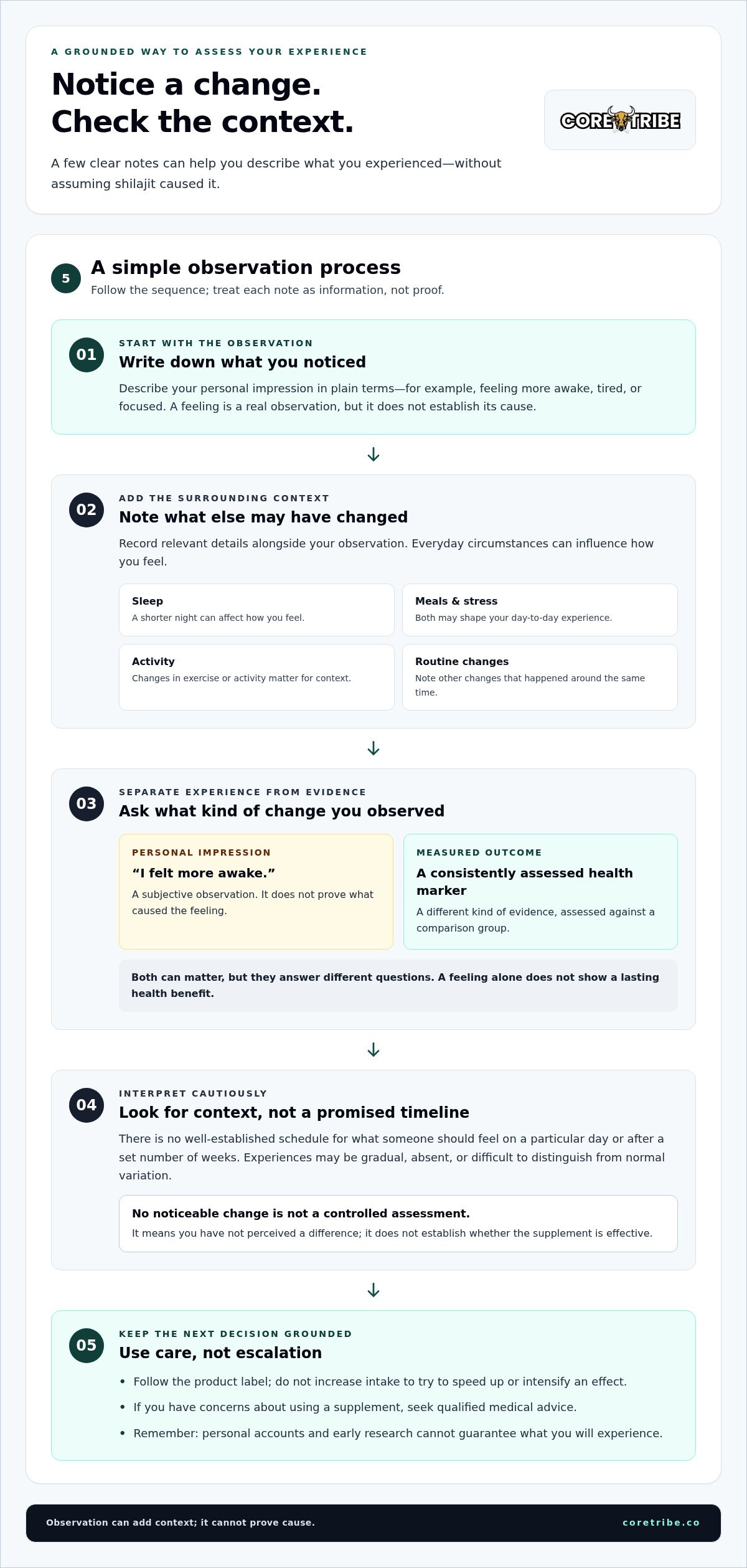
A subjective impression is different from a measured clinical outcome. “I felt more awake” is a personal observation; a measured change in a defined health marker, assessed consistently against a comparison group, is a different kind of evidence. Both can matter, but they answer different questions. A feeling may be real without proving its cause or showing that it reflects a lasting health benefit.
Energy, mood, sleep, and concentration shift with everyday circumstances. A shorter night, a demanding day, a meal, stress, or a change in exercise can all affect how you feel. If you notice a difference, treat it as something to observe rather than an expected sign that the supplement is working. Other people’s descriptions aren’t a checklist of typical results.
Why there is no universal shilajit timeline
There isn’t a well-established schedule that says what someone should feel on a particular day or after a set number of weeks. Products can differ in composition and formulation, and people’s health, routines, and other supplements differ too. That makes one person’s experience difficult to compare with another’s.
Study design also shapes what can be concluded. Research on a particular preparation, group of participants, or outcome doesn’t automatically predict how a different product will affect an individual. Limited evidence can’t support a precise timeline for everyone, so be cautious of confident promises about immediate or guaranteed changes. When considering a blend, it can help to understand its ingredients separately. The shilajit, sea moss, and ashwagandha synergy guide provides ingredient context, but it can’t predict personal outcomes.
What You Might Notice Over Time, and What Remains Uncertain
People often want a clear timeline: an immediate sensation, a change after a few weeks, or a sign that shilajit is working. There’s no predictable sequence. Taste, smell, routine, and personal impressions may differ, and any perceived change needs to be considered alongside other influences. These are possibilities, not stages everyone should expect to pass through.
First impressions versus changes noticed later
An early impression may be practical: a product’s taste or smell, how easy it is to fit into your day, or whether taking it becomes part of your routine. Those observations don’t establish a physiological effect. A day when you feel unusually alert, tired, or focused also isn’t enough to show that shilajit caused the change.
Sleep, meals, stress, activity, and ordinary day-to-day variation can all influence how you feel. If you notice a difference later, consider whether other parts of your routine changed around the same time. Don’t increase your intake to try to speed up or intensify an effect. Follow the product label, and seek qualified medical advice if you have concerns about using a supplement.
What current evidence can and cannot tell you
Research findings depend on what was studied: the specific preparation, participants, comparison group, and outcome measured. Laboratory or animal research doesn’t establish a benefit in people. Findings from a small or narrowly focused human study can’t guarantee the same result for a different person or product.
A 2012 review available through the NIH research on Shilajit’s cognitive effects discusses traditional use and potential cognitive applications, drawing on early research. It offers scientific context, not a dependable forecast of how an individual will feel. Traditional use and plausible mechanisms can guide research questions, but they aren’t substitutes for well-designed human studies that establish whether an outcome is reliable.
Changes over time, or no noticeable change
Some people may report a gradual subjective difference; others may notice nothing. Neither response follows a universal timetable, and online accounts can’t tell you what will happen in your own case. No noticeable change does not establish whether a supplement is effective. It means you haven’t perceived a difference, which is not the same as a controlled assessment of an outcome.
For a grounded approach to what to expect when taking shilajit, distinguish what you felt from what can be measured, and avoid treating coincidence as cause. If you’re comparing supplement options, you can explore Coretribe’s available products while keeping product information separate from claims about what shilajit may do.
How to Judge Your Experience Without Mistaking Correlation for Effect
A few clear notes can make your experience easier to describe and less vulnerable to memory or expectation. They won’t prove that shilajit caused a change, but they can show what you noticed and what else was happening in your routine. Keep the process simple: focus on one or two relevant observations, such as perceived energy or sleep quality, rather than tracking every sensation.
A simple way to record what changes
Use a notebook or notes app and keep entries factual. For example, write “felt sluggish after a short night of sleep” rather than “the supplement didn’t work.” Include product label details so you can distinguish one formula from another, particularly if the ingredients or product change. Avoid interpreting a brief pattern as medical evidence.
- Choose one or two observations. Pick something meaningful to you, such as perceived energy or sleep, and describe it in consistent, plain language.
- Note the date and product details. Record the product name and relevant label information, along with when you began using it or made a change.
- Add useful context. Briefly note factors that could shape how you feel, including sleep, meals, stress, exercise, illness, or a change in your usual routine.
- Record unwanted effects too. Note what happened and when, without assuming the supplement was necessarily the cause. If symptoms concern you, pause use and seek qualified medical advice.
- Review for patterns cautiously. Look at your notes together rather than relying on one unusually good or difficult day. Treat any pattern as an observation to discuss, not proof of cause and effect.
How to interpret no change or mixed results
No noticeable difference is a valid outcome. It isn’t a reason to increase intake or keep using a supplement in pursuit of a promised sensation. Follow the product label, and speak with a qualified health professional if you’re unsure whether continuing is appropriate for you.
Mixed notes can also be useful. Perhaps you felt more alert after a better night’s sleep, but not on a stressful day when meals were irregular. That doesn’t reveal what shilajit did; it shows how closely everyday factors can overlap with a perceived effect. Tracking helps you describe those circumstances, not isolate the supplement as a controlled study would.
If you’re considering a blend, record its full ingredient list rather than attributing any impression to shilajit alone. The shilajit, sea moss, and ashwagandha side effects and benefits guide provides related safety context. This measured approach to what to expect when taking shilajit helps keep personal observations useful without turning them into promises or unsupported conclusions.
Potential Side Effects, Interactions, and Safety Checks to Know
A natural origin doesn’t guarantee that a supplement is pure, safe, or suitable for you. Shilajit products may differ in composition and quality, and unpurified material can contain contaminants, including heavy metals. Research on purified shilajit is still limited, so evidence from small studies can’t establish safety for every person, product, or pattern of use. Don’t treat “natural” as a substitute for checking the label or considering your health circumstances.
Product testing can help assess what’s in a supplement, but it can’t prove that the product is suitable for you personally. A quality check addresses product composition; individual suitability depends on your health and circumstances.
Who should get professional advice before use
Talk with a qualified health professional before using shilajit if you’re pregnant or breastfeeding, have a medical condition, or take regular medication. Safety information during pregnancy and breastfeeding is insufficient, and health conditions or medications may affect whether a supplement is appropriate. Shilajit contains iron, so people with iron-overload conditions such as hemochromatosis should avoid it unless a clinician advises otherwise. If you have a hormone-sensitive condition, seek medical guidance before use.
This general information can’t account for your medical history, medications, or individual risks, and it doesn’t replace individualized medical advice. Avoid starting a supplement based on a social media recommendation or using it as a substitute for care. If you experience a concerning or severe reaction, stop taking it and seek medical advice promptly. For an emergency or severe symptoms, seek urgent care.
Why sourcing and testing matter
Purification and quality controls matter because raw or poorly processed shilajit may carry contaminants. Products can also vary in ingredients and manufacturing quality, so the name “shilajit” alone doesn’t establish what a particular supplement contains. Read the full label, especially for blends, and look for a batch-specific Certificate of Analysis from an independent laboratory that identifies the tested batch and the contaminants assessed. A report is useful only for the product and batch it covers; it doesn’t prove personal suitability or guarantee an effect.
Research trials of purified shilajit have reported it was generally well tolerated in the studied settings, but that doesn’t rule out reactions or settle safety for people who weren’t represented in those studies. Testing and careful sourcing are safeguards, not permission to ignore symptoms or personal risk factors. The shilajit sourcing and safety guide offers more context on evaluating a blend and its ingredients.
When weighing format and ingredients, explore Coretribe’s supplement options and review each product label carefully before making a decision.
Choosing a Shilajit Format and Taking Your Next Step
Once you’ve considered uncertainty around effects and safety, the practical question is which format fits your routine. Capsules and honey sticks differ in presentation and use, but format alone doesn’t show which is more effective. Compare the label, ingredients, serving directions, and how manageable each format feels for your day. No form can promise a particular experience.
Capsules, honey sticks, and blended formulas
Capsules offer shilajit in capsule form, while honey sticks present it in a stick format. These differences may matter for convenience or personal preference, but they don’t establish a difference in health effects. Coretribe offers Coretribe ® Pure Shilajit Capsules - Mixed Sea Moss & Ashwagandha and Coretribe®Shilajit Honey Sticks. The capsule product name identifies a blend, so consider its ingredients together rather than treating any perceived change as evidence about shilajit alone.
Before choosing a supplement, read the full ingredient panel and serving directions on its label. Check which ingredients are included, how the product instructs you to use it, and whether those ingredients fit your circumstances. With a blended formula, an experience after use can’t automatically be attributed to one ingredient. Don’t change the labeled serving in an attempt to intensify an effect.
A considered next step for curious readers
Keep four points in view: experiences vary, current research can’t provide a guaranteed personal outcome, safety and suitability depend on individual circumstances, and labels deserve a careful read. When comparing formats, focus on ingredients and everyday practicality rather than online promises or assumptions that one form works better. A product’s format is a choice about how it fits your routine, not a reliable forecast of what you’ll feel.
If you’re comparing options, you can explore Coretribe supplements and review each product’s label. Make your decision without pressure to experience a particular result. If you’re pregnant or breastfeeding, have a medical condition, or take regular medication, consult a qualified clinician before using shilajit. Personal guidance can help you weigh suitability in a way general information cannot.
A thoughtful choice doesn’t depend on predicting exactly what to expect when taking shilajit. It means understanding that responses can differ, reading what’s in the product, and paying attention to how you feel. If you have concerns or experience a troubling reaction, pause use and seek qualified medical advice rather than trying to push through or adjust the serving yourself.
Make Your Next Choice With Care
Your next step doesn’t need to be a commitment to a particular result. Let what to expect when taking shilajit guide a thoughtful decision: consider whether a supplement fits your routine, review its ingredients, and give more weight to careful information than to promises or anecdotes. If personal health circumstances raise questions, speak with a qualified clinician before trying it.
Coretribe offers Coretribe ® Pure Shilajit Capsules - Mixed Sea Moss & Ashwagandha and Coretribe®Shilajit Honey Sticks. Review the product details and choose what aligns with your preferences, without assuming one format guarantees a particular effect. Explore Coretribe supplements and take the time you need to make a considered choice.
A steady, informed approach is a worthwhile starting point. Balance curiosity with care, and choose what feels right for your wellbeing.
Frequently Asked Questions
Can you feel shilajit working the first time you take it?
Some people may notice an immediate subjective impression, while others feel no difference. One experience can’t show that shilajit caused a change: sleep, food, stress, and expectations can all affect how you feel that day. Avoid treating a sudden sensation as proof of effectiveness. If you notice a concerning reaction, stop using the supplement and seek appropriate medical advice rather than taking more to see what happens.
How long does it take to notice anything from shilajit?
There’s no reliable timeline that applies to everyone. Research results depend on the preparation studied, the participants, and the outcome measured, so they can’t predict an individual response. Be cautious of claims that promise results within a fixed number of days. If you’re considering what to expect when taking shilajit, keep brief notes and avoid changing several parts of your routine at once, which can make observations harder to interpret.
Is it normal not to feel anything when taking shilajit?
Yes, it’s possible not to notice a clear difference, and that doesn’t mean you’re doing anything wrong. A supplement may not create a sensation you can identify, and everyday changes can obscure subtle impressions. Don’t increase the amount to try to force a result. Follow the product label, and if you’re uncertain about continued use, discuss your circumstances with a qualified healthcare professional.
Can shilajit cause side effects?
A supplement can cause unwanted effects, and individual responses and product quality may vary. “Natural” doesn’t guarantee purity or suitability, so consider the full ingredient list and the product’s safety information. If you develop a concerning reaction, stop taking it and seek medical advice. Ask a qualified healthcare professional before use if you’re pregnant, breastfeeding, managing a health condition, or taking medication.
Should you take shilajit with food or on an empty stomach?
Follow the directions on the specific product label rather than assuming every shilajit supplement is used the same way. Formulations can differ, and food may affect personal comfort. If the directions don’t address a safety question that matters to you, ask a qualified healthcare professional or pharmacist before use. This general information doesn’t prescribe a dose or replace advice based on your health history.
Can you take shilajit with other supplements?
Check with a qualified healthcare professional or pharmacist before combining supplements, especially if you take medication or have a health condition. Ingredients can overlap across products, and starting several supplements together can make it difficult to identify which one may be linked to a change or unwanted effect. Review each label, including blends, and don’t assume familiar ingredients are automatically suitable when taken together.
What should you do if you feel unwell after taking shilajit?
Stop taking the supplement and seek medical advice if symptoms are concerning, persistent, or severe. Keep the packaging and note when you took it, what you experienced, and whether you used other supplements or medicines. That information may help a healthcare professional assess the situation. Seek urgent care for an emergency, and don’t restart the supplement just to test whether the reaction happens again.

