


An empty stomach isn’t automatically the better choice. If you’re asking, “can you take shilajit on an empty stomach?” the short answer is yes, if the product directions allow it. Current human research doesn’t show that fasting improves absorption. Human trials reporting benefits gave shilajit with meals, while empty-stomach advice is largely rooted in traditional practice and wellness claims.
It’s understandable to feel caught between confident but conflicting recommendations. What matters most is choosing a routine you can tolerate and follow consistently, rather than assuming fasting offers a proven advantage. This guide explains what the research can and can’t tell you, why taking shilajit with food may feel gentler if you notice stomach discomfort, and what to look for on your product label. It also covers when it’s sensible to seek professional advice, so you can make a considered choice that fits your routine.
Key Takeaways
- Wondering “can you take shilajit on an empty stomach”? Weigh the available evidence without assuming fasting is essential.
- Understand what bioavailability means and why it doesn’t, by itself, prove that taking shilajit before food improves absorption.
- Compare empty-stomach and with-food routines by comfort, convenience, and what remains uncertain.
- Use a simple approach: follow the product label, notice how your body responds, and change one routine factor at a time.
- Know when pregnancy, breastfeeding, health conditions, or medication use make professional guidance especially important.
Can You Take Shilajit on an Empty Stomach? The Short, Honest Answer
Yes, shilajit may be taken before food if the product directions allow it. Fasting isn’t proven necessary, and the available evidence doesn’t show that an empty stomach reliably improves absorption. Traditional use, a supplement label, and human clinical research are different kinds of guidance, so keep them separate rather than treating one as proof of another.
Shilajit has a history of traditional use, including in Ayurvedic practice. Some traditional and modern wellness sources recommend taking it before eating, sometimes claiming this enhances uptake. For background on its composition and traditional context, see the Shilajit Wikipedia article. That history helps explain why the practice is familiar, but it doesn’t establish a clinical timing advantage.
Product instructions can differ, so use the label for your specific supplement, especially if it gives directions about meals. If the label doesn’t require fasting, there’s no sound basis for assuming you must delay breakfast to get a benefit. Personal comfort matters too. If taking a supplement before eating feels unpleasant, that’s a practical reason to consider another routine while still following the label.
What does “empty stomach” mean in this question?
In everyday use, “empty stomach” means taking a supplement before eating rather than alongside a meal. It doesn’t have one universal meaning or a single required fasting duration for shilajit. Labels may use different wording or provide product-specific directions, so follow the instructions for the form you have. Don’t assume water or another supplement affects shilajit absorption in the same way food might.
What can research actually say about timing?
Research on shilajit generally isn’t the same as research comparing when to take it. Human studies have examined shilajit under particular study conditions, but the evidence available here doesn’t establish that taking it before food works better than taking it with food. Human timing comparisons are limited, and studies that didn’t compare meal timing can’t answer that question directly.
In the human trials reporting positive effects, shilajit was administered with meals. That makes taking it with food a studied approach, but it doesn’t prove that food is essential or that fasting is ineffective. Traditional practice and personal anecdotes can inform a routine, but they aren’t clinical proof of superior absorption. Current evidence doesn’t establish one universally best timing for shilajit.
So, can you take shilajit on an empty stomach? It may be an option when the label permits and it feels comfortable, but there’s no established need to fast for better results. Treat timing as a personal routine choice, not a promise of improved uptake. If you’re unsure how to interpret the directions, use the label as your starting point rather than relying on broad claims about fasting.
Shilajit Absorption and Digestion: What Fasting Can, and Cannot, Tell You
Bioavailability sounds like a simple measure of how much of a supplement “gets into your system,” but it doesn’t automatically tell us which routine works best. It refers to the amount of a substance absorbed and available for the body to use. To show that fasting improves shilajit bioavailability, research would need to compare relevant meal timings and measure meaningful differences, not simply offer a possible explanation for why absorption might change.
Shilajit is a complex natural material, not a single isolated ingredient. Its composition can vary, and a supplement’s form and product quality affect how findings should be interpreted. A result from one preparation can’t automatically establish how every shilajit product behaves. A plausible mechanism also doesn’t prove a real-world advantage to taking it before food.
Bioavailability is not the same as a proven fasting benefit
In everyday terms, bioavailability is the portion of a substance that becomes available for the body to use after it’s taken. It’s one concept researchers consider when studying supplements, but it isn’t the same as a demonstrated improvement in health or a direct comparison of meal timing. Without relevant comparative evidence, claims that fasting boosts shilajit absorption by a particular amount aren’t established.
A general idea about bioavailability does not prove that fasting improves shilajit’s absorption or outcomes. To evaluate a timing claim, look for evidence on shilajit itself, in comparable forms, with meal timing deliberately compared. A theory about one component, or a finding from another supplement, can’t settle the question for shilajit.
Why strong claims about stomach acidity need caution
Some explanations focus on stomach acidity or pH, suggesting that taking shilajit before food creates better conditions for absorption. That may sound plausible, but stomach conditions alone don’t show how much shilajit is absorbed, whether the body can use it, or whether a person experiences a meaningful benefit. A pH-based explanation needs reliable evidence that directly supports the claim.
Be cautious of confident statements that skip those steps. A mechanism is a proposed explanation, not proof that a supplement works better in daily use. Shilajit’s varied composition also makes broad claims harder to generalize across different preparations. Hearing that a substance could behave a certain way in the digestive tract doesn’t establish that fasting changes its effects.
For a wider look at how shilajit is discussed alongside other ingredients, Coretribe’s shilajit, Ashwagandha, and Sea Moss guide offers related context. That background can help you understand a product’s ingredients, but it shouldn’t be treated as evidence that a particular timing improves absorption.
If you’re asking whether taking shilajit on an empty stomach affects absorption, separate what’s biologically possible from what has been demonstrated. Follow your product’s directions, and avoid changing your routine based on an unverified percentage or a simplified acidity claim. If you’re exploring shilajit supplements, you can view Coretribe’s supplement options and use each product’s label as your guide.
Empty Stomach or With Food? Compare Comfort, Routine, and Evidence
There’s no single timing choice that suits everyone. An empty-stomach routine may be convenient if it fits your morning and feels comfortable. Taking shilajit with food may be more practical if you prefer not to take supplements before eating. Neither option is established as universally best, and fasting isn’t a requirement everyone must follow for shilajit to work.
| Consideration | Before food | With food |
|---|---|---|
| Convenience | May fit a routine built around taking supplements after waking. | May be easier to remember alongside a regular meal. |
| Personal comfort | Some people may prefer it; others may find it uncomfortable. | Could feel more comfortable for some, but isn’t guaranteed to prevent discomfort. |
| Absorption evidence | A fasting advantage hasn’t been established. | Studied in human trials, but that doesn’t prove food is necessary. |
Use the table to think through your routine, not as a ranking. If you notice discomfort, that’s a reason to reconsider how you take the supplement, but it doesn’t identify the cause by itself. The sensation could have more than one explanation, so don’t treat it as proof that fasting, food, or shilajit specifically is responsible.
When before food may fit your routine
Taking shilajit before eating may suit you if the product label permits it and you feel well with that routine. For example, you might naturally take supplements before breakfast and find that easy to remember. There’s no need to create a strict fasting window or delay a meal to chase an unproven absorption or energy advantage. Comfort and label directions are better guides.
When taking it with food may feel more practical
If taking a supplement before eating feels unpleasant, consider whether taking it with a meal fits the product’s directions. This is a comfort-led adjustment, not a proven way to improve absorption or prevent side effects. Pairing it with a meal you already eat may make the routine easier to maintain. Follow the specific label rather than assuming every shilajit product has identical instructions.
Don’t let confident online advice turn fasting into a pass-or-fail test. If you’re asking, “can you take shilajit on an empty stomach?” the practical answer is that it may be an option, but it isn’t the only acceptable routine. Choose an approach that aligns with the label and feels manageable. If you change timing because of discomfort, pay attention to how you feel without assuming that one change proves what caused it.
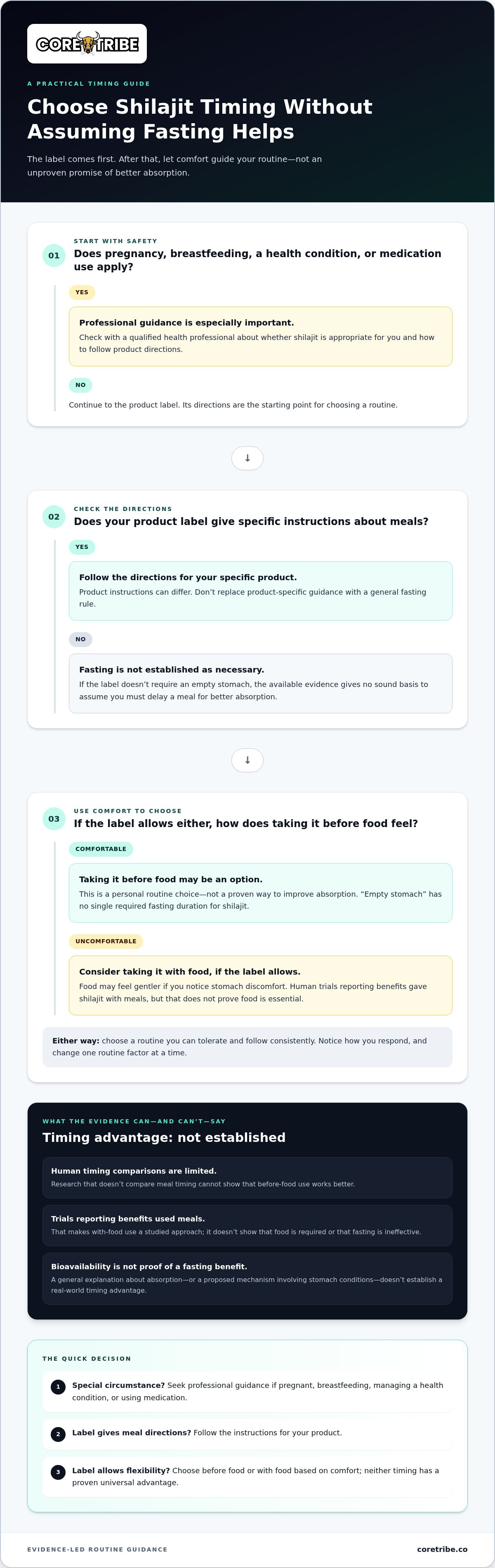
How to Decide on Shilajit Timing Without Overcomplicating Your Routine
You don’t need an elaborate schedule to choose when to take shilajit. Start with the directions for your exact product, then consider what feels comfortable and fits your ordinary day. Since a fasting advantage hasn’t been established, there’s no need to build a rigid routine around an assumed timing benefit.
A simple label-first decision process
Begin with the serving and timing instructions on your product label. If they specify taking it with food or apart from a meal, follow that guidance rather than general online advice. If the label leaves timing flexible, choose a regular moment that’s easy to remember, such as alongside an existing daily habit. A tolerable, label-aligned routine is more practical than a rigid fasting rule.
Once you’ve chosen a routine, use a straightforward way to notice how it feels. You might keep brief notes that include:
- When you took the supplement and whether you’d eaten.
- Whether taking it felt comfortable or inconvenient.
- Any symptoms you noticed and when they occurred.
These notes can help you describe your experience, but they can’t diagnose a cause or prove that a particular timing is better. Keep the routine otherwise steady as you observe it. If you change timing, serving amount, product, and other supplements all at once, it becomes harder to tell which change may relate to what you notice.
How to respond if fasting feels uncomfortable
Don’t push through persistent discomfort just to pursue an unproven fasting advantage. First, check whether your product’s directions allow you to take it with food. If they do, that may be a reasonable comfort-led adjustment. A meal isn’t guaranteed to prevent side effects, and discomfort alone doesn’t reveal its cause. Stop and seek qualified medical advice for symptoms that are ongoing, severe, or concerning.
Make the routine easy to reassess
After choosing a label-aligned time, ask yourself two practical questions: Is this comfortable enough to continue, and can I fit it into my day without stress? If either answer is no, review the label and consider a different permitted routine. Change one factor at a time, then note what you observe. You’re looking for a manageable habit, not a perfect schedule or a guaranteed response.
If you’re considering a shilajit supplement as part of a routine, explore Coretribe’s supplement options and use the directions on the specific product as your starting point. The right timing is the one that follows its label and feels practical for you.
Shilajit Safety, Product Directions, and a Thoughtful Next Step
Choosing when to take shilajit is only one part of using a supplement thoughtfully. Timing advice doesn’t replace the directions on the exact product label or individualized guidance from a qualified health professional. This matters especially if a product combines shilajit with other ingredients, since its full ingredient list and instructions may differ from those of shilajit on its own.
Product quality deserves attention, too. Raw, unprocessed shilajit isn’t safe to consume because it can contain heavy metals and other impurities. Purification and reliable verification are important considerations. Where available, a batch-specific, third-party certificate of analysis can provide information about what was tested. Don’t assume that a general statement about an ingredient or its source answers questions about a particular product.
When to seek advice before using shilajit
Speak with a qualified health professional before using shilajit if you take medication or have a health condition. This can help you consider whether the supplement and its ingredients are appropriate for your circumstances. If you’re pregnant or breastfeeding, don’t rely on a general article about timing to guide use. A shilajit, Sea Moss, and Ashwagandha side-effects guide can provide further background, but it can’t replace advice tailored to you.
Seek professional guidance as well if you experience symptoms that are persistent, severe, or concerning. Changing whether you take a supplement with food may not address the reason you feel unwell. Share the product label and any notes you’ve made about use with the professional you consult, so they can consider the specific ingredients and directions.
Choose a product and routine with clear expectations
Use the exact label as your source for serving information and timing directions. Coretribe ® Pure Shilajit Capsules - Mixed Sea Moss & Ashwagandha combines shilajit with other named ingredients. Don’t assume a fasting requirement or timing advantage. Review the full label and choose a routine that follows its directions rather than relying on broad claims about when shilajit must be taken.
The practical answer to “can you take shilajit on an empty stomach?” is that timing alone can’t establish whether a supplement is right for you. Consider the label, your comfort, your health circumstances, and the product’s quality information. If you’d like to explore shilajit and other supplement options, browse Coretribe’s supplement collection and review the directions for the product you’re considering.
Make Your Next Step Simple and Considered
Your supplement routine doesn’t need to become another rule to manage. If you’re still wondering “can you take shilajit on an empty stomach,” keep your next step simple: use the directions for the product you have, choose a routine that feels manageable, and don’t treat fasting as a requirement without evidence to support it.
Give yourself room to make a thoughtful choice rather than chasing a perfect schedule. Review the product information and consider how it fits your needs and everyday habits. For questions tied to medication, pregnancy, breastfeeding, or a health condition, seek guidance from a qualified health professional.
Explore Coretribe’s supplement collection to consider your options. Review the product label and choose a routine that fits its directions and your day.
Frequently Asked Questions
Does drinking water break an empty stomach when taking shilajit?
Plain water isn’t food, so in everyday use it usually doesn’t mean you’ve eaten. However, product directions can vary, and there’s no established evidence that water changes shilajit absorption. Follow the specific label if it says to take the product with water or gives other instructions. Don’t assume water, coffee, a meal, and other supplements all affect your routine in the same way.
Can you take shilajit with coffee?
There’s not enough direct evidence to say whether taking shilajit with coffee changes its absorption or effects. Check the product label for instructions, and don’t mix the supplement into a hot drink unless the directions allow it. If coffee itself tends to upset your stomach, taking both together may make it harder to tell what’s causing discomfort. Ask a pharmacist about possible concerns if you take medication.
Can shilajit cause nausea or stomach discomfort?
Some people report mild digestive discomfort with shilajit, though an upset stomach doesn’t establish that shilajit was the cause. Consider what else you ate or took, and check whether the label permits taking the product with food. Don’t push through persistent symptoms to maintain a fasting routine. Stop using it and seek qualified medical advice if symptoms are severe, ongoing, or concerning.
Can you take shilajit with prescription medication?
Check with a qualified health professional or pharmacist before combining shilajit with prescription medication. Evidence about interactions may be limited, and the appropriate advice depends on the specific medicine and supplement ingredients. Have the product label available so they can review the full formula, not only the word “shilajit.” Don’t stop, delay, or change a prescribed medicine to make room for a supplement.
Should you take shilajit during pregnancy or while breastfeeding?
Seek advice from a qualified health professional before using shilajit during pregnancy or while breastfeeding. General timing guidance can’t establish whether a supplement is appropriate during these stages, and combination products may contain additional ingredients to consider. Share the exact product label when asking for guidance. Don’t rely on advice about taking it with food or fasting as a substitute for individualized guidance.
Is shilajit on an empty stomach better than taking it with breakfast?
Current evidence doesn’t establish that either option is universally better. Human trials reporting positive effects administered shilajit with meals, but that doesn’t prove breakfast is necessary or that fasting is less effective. If your label permits either approach, choose the one that fits your day and feels comfortable. You don’t need to skip breakfast to pursue a timing benefit that hasn’t been demonstrated.

