


Can shilajit genuinely support stronger bones, or are supplement claims moving faster than the evidence? If you’re weighing shilajit for bone density, the uncertainty is understandable: one human trial can sound promising without proving that a supplement prevents bone loss or treats osteopenia or osteoporosis.
A 2022 randomized, placebo-controlled trial in postmenopausal women with osteopenia reported that shilajit extract helped preserve bone mineral density. That finding is worth understanding, but it is limited evidence, not a reason to replace established bone care. The results don’t show whether shilajit works for everyone, or whether other products and formulations have the same effects.
This article looks at what the study does and doesn’t show, how supporting bone health differs from treating low bone density, and which practical steps have a stronger foundation. It also covers how to approach supplements cautiously, including why product quality and possible risks matter. The aim is to help you make an informed decision without asking a supplement to promise more than the research can support.
Key Takeaways
- Learn what bone mineral density measures and why it matters when assessing bone health.
- Distinguish laboratory and animal findings from evidence gathered in people when evaluating shilajit for bone density.
- Use a claim-by-claim framework to see what research can support and where important questions remain.
- Explore practical starting points for bone-health conversations, including assessment, everyday habits, and clinical follow-up.
- Understand how Coretribe Pure Shilajit Capsules blended with Sea Moss and Ashwagandha may fit as a wellness supplement, not a bone treatment.
What Does Bone Density Measure, and Why Does It Matter?
Before connecting shilajit to bone-density outcomes, it helps to understand what research measures. Bone mineral density, often shortened to BMD, describes the amount of mineral in a given area of bone. It is one useful indicator of skeletal health, but it is not a complete measure of bone strength or a diagnosis on its own. This foundational overview of bone density explains the term and its relationship to health.
Lower measurements can be one factor clinicians consider when assessing fracture likelihood. But density and strength aren’t interchangeable: bone structure, movement, fall risk, medical history, and other factors may also matter. A scan doesn’t show how energetic or physically well someone feels, either. Feeling well cannot confirm bone density, and a low measurement alone doesn’t explain how someone feels day to day.
That distinction matters when evaluating shilajit for bone density. A claim about vitality, mineral content, or general wellness is not the same as evidence that a supplement changes BMD on a clinical scan. To support a bone-density claim, research needs to measure bone-related outcomes in people, rather than relying only on traditional use or laboratory and animal findings.
What does a bone-density test measure?
A dual-energy X-ray absorptiometry scan, usually called a DXA or DEXA scan, is commonly used to assess BMD. It estimates mineral content in measured areas, often including the hip or spine. The result may include a T-score, which compares the measurement with a reference value for a healthy young adult. In general, a score of -1.0 or above is considered within the normal range, between -1.0 and -2.49 is classified as osteopenia, and -2.5 or below is in the osteoporosis range under World Health Organization criteria. These categories aren’t a personal diagnosis on their own.
Clinicians interpret scan measurements alongside age, medical and fracture history, and other relevant health information. The score is one part of the assessment, so individual results need clinical interpretation.
What can affect bone density over time?
Bone tissue changes throughout life. Density may be influenced by age, hormonal changes, nutrition, movement, and some health conditions. These factors can interact, which is why a measurement is best understood in context. Adequate nourishment and regular weight-bearing or resistance activity are among the everyday factors commonly discussed in bone-health care. Medical conditions and personal history may call for more tailored guidance.
A bone-density measurement describes a finding; it isn’t a treatment. No single supplement can be assumed to offset multiple factors that affect bone health. Keeping that distinction in mind helps put shilajit claims in perspective and makes room for a grounded discussion of what research can and cannot tell us.
How Could Shilajit Relate to Bone Health, and What Is Still Unknown?
Shilajit is a naturally occurring, mineral-containing substance formed over long periods from organic material in mountainous environments. Its composition has prompted interest in how it might interact with biological processes relevant to bone. But containing minerals, or having a plausible biological effect, doesn’t establish that shilajit improves bone mineral density in people. That outcome has to be measured directly.
Early research may examine how substances affect cells or animals, including processes related to inflammation, oxidative stress, or bone remodeling. Such studies can help researchers form questions for clinical trials. They can’t show that people who take shilajit will have stronger bones, higher scan measurements, or fewer fractures. A body’s response can also differ between a laboratory model and people with varied health histories.
What kind of evidence would show a bone-density benefit?
The most relevant evidence would come from well-designed human trials measuring bone mineral density or fracture-related outcomes. Researchers would also need to consider who took part, what the comparison group received, how long the study lasted, and whether the tested substance was shilajit alone or part of a blend. Repeated findings from independent studies would provide stronger support than a single result.
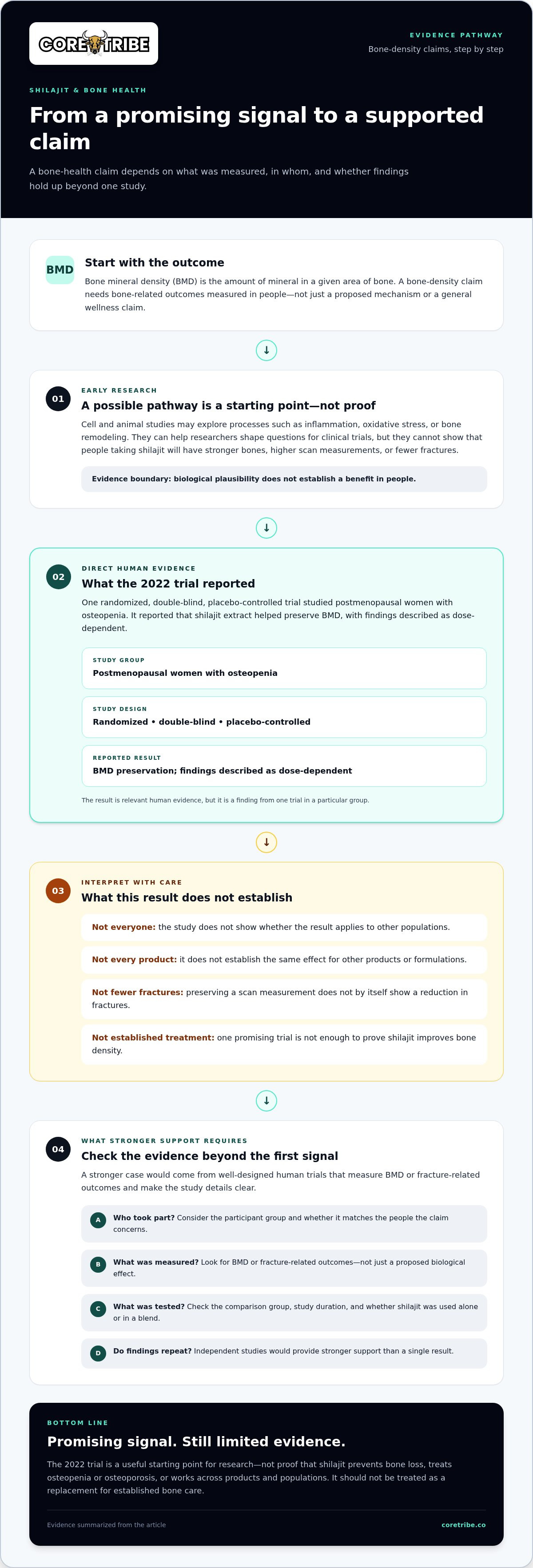
A 2022 randomized, double-blind, placebo-controlled trial in postmenopausal women with osteopenia reported that shilajit extract helped preserve bone mineral density, with findings described as dose-dependent. This is directly relevant human evidence, but it comes from one trial in a particular group. It doesn’t establish that the same result applies to other populations, products, or formulations, and it doesn’t by itself show a reduction in fractures.
The available human evidence offers a promising signal, but it isn’t enough to establish shilajit as a proven way to improve bone density. When assessing shilajit for bone density, a measured outcome in one study is more informative than a proposed mechanism. Replication and broader clinical evidence are still needed.
Why can early research be easy to overinterpret?
Cell and animal studies can point to possible biological pathways, but they don’t establish a clinical benefit in people. Human studies also need careful reading: small samples may make results less certain, short follow-up may miss longer-term changes, and scan measurements don’t automatically demonstrate fewer fractures or better daily function. Consider these limitations where they apply, rather than assuming every early finding predicts patient outcomes.
Combination formulas add another layer. If a study tests shilajit alongside other ingredients, its results can’t automatically be attributed to shilajit alone. For context on how ingredients may be discussed together, see this shilajit, Ashwagandha, and Sea Moss synergy guide. If you’re exploring supplements as part of a broader wellness routine, you can also browse Coretribe’s supplement range. Keep product discovery separate from decisions about bone-health care.
Does Shilajit Improve Bone Density? Weighing Claims Against Evidence
Does shilajit improve bone density? There is a limited human research signal, but not enough evidence to call it a proven bone-health treatment. A 2022 randomized, double-blind, placebo-controlled trial in postmenopausal women with osteopenia reported that shilajit extract helped preserve bone mineral density. The finding is relevant, yet one study in a specific group can’t establish benefits for everyone, every shilajit product, or fracture prevention.
For a claim about shilajit for bone density, look for direct measurements in people. Mineral content, traditional use, or a proposed biological pathway may explain why researchers are interested, but none alone demonstrates a change in bone density. A supplement associated with general wellness also isn’t automatically a treatment for low bone density.
| Claim | Evidence needed | What can reasonably be concluded | What remains uncertain |
|---|---|---|---|
| Shilajit contains minerals that support bones | Human studies measuring bone outcomes after use | Its composition may prompt research interest | Whether its minerals are absorbed or meaningfully affect bone density |
| Shilajit may influence processes related to bone | Relevant human trials, not only cell or animal research | Early findings may suggest a pathway worth studying | Whether that pathway produces a clinical benefit in people |
| Shilajit preserves bone mineral density | Well-designed, replicated trials that measure BMD over time | One 2022 trial reported preservation in postmenopausal women with osteopenia | How broadly the result applies and whether it affects fracture risk |
| A shilajit blend improves bone health | Trials of the exact combination and its bone-related outcomes | Evidence for one ingredient can’t establish an effect for a blend | Which ingredient, if any, accounts for an observed result |
How to assess shilajit bone-density claims
Read beyond the headline and identify what researchers actually measured. Was it bone density in people, or a related laboratory marker? Check who took part, how long the study lasted, what the comparison group received, and whether the research tested shilajit alone or a combination. Also compare the tested preparation with the product being discussed. A claim that goes beyond those details needs careful verification against medical sources.
What should readers conclude from uncertain evidence?
Uncertainty isn’t proof that shilajit has no effect; it means the evidence can’t yet support a confident, general promise. If you’ve been diagnosed with low bone density, don’t replace clinical evaluation or recommended care with a supplement. For broader ingredient and caution context, this shilajit, sea moss, and Ashwagandha side-effects and benefits guide can help frame questions about combination products. If you’re exploring supplements for general wellness, you can also browse Coretribe’s supplement range, keeping that choice separate from treatment decisions.
What Actually Supports Bone Health? Practical Steps to Discuss With a Clinician
Bone health is supported by a combination of everyday habits and care that reflects your personal health history. If you’re considering shilajit for bone density, keep that decision separate from the steps used to assess and manage bone health. A supplement can’t tell you whether your bone density is low or what care is appropriate.
A practical sequence to discuss with a clinician:
- Share relevant history. Mention previous fractures, known bone-density results, health conditions, medicines, and other factors that could influence bone health. This context can make the conversation more useful.
- Ask whether assessment is appropriate. Screening and testing depend on individual risk factors. A clinician can consider your history and help determine whether a bone-density test or another evaluation makes sense.
- Review daily habits. Discuss balanced nutrition, calcium and vitamin D needs, and regular weight-bearing or resistance activity. The right approach varies, and not everyone needs a supplement.
- Plan follow-up. If testing identifies a concern or you already have a diagnosis, ask how results should be followed and which care options are suitable. Don’t stop prescribed medication without discussing it with the prescribing clinician.
Which everyday habits can contribute to bone health?
Consistent habits can support overall health. A varied, balanced eating pattern can help provide nutrients involved in maintaining the body, including calcium and vitamin D. Needs differ, so food choices, health conditions, and current medicines can all matter when considering supplements. Weight-bearing movement and resistance exercise are also commonly included in bone-health conversations. Choose activities suited to your abilities and existing medical guidance, and avoid tobacco as a broad health measure.
There’s no single routine that fits everyone. Someone returning to activity after an injury, for example, may need different guidance from someone who already exercises regularly. Start with what’s manageable, and discuss changes if you have a medical condition, pain, or mobility concerns.
When should someone seek medical guidance?
Bring concerns about bone density, a history of fractures, or relevant health risk factors to a clinician. They can assess whether testing is appropriate, interpret results in context, and discuss whether treatment or follow-up is needed. A scan or a supplement’s marketing claims can’t replace that assessment.
Supplements don’t replace diagnosis, prescribed treatment, or professional advice. If you’re considering one, include it in a conversation about your overall routine, especially if you take medicines or have a health condition. If you’re exploring supplements for general wellness, browse Coretribe’s supplement range, but don’t treat product selection as a bone-health treatment plan.
Where Coretribe Shilajit Capsules Fit in a Thoughtful Wellness Routine
It helps to keep two questions separate: whether a supplement suits your general wellness routine, and whether it has been shown to change bone-density outcomes. Coretribe Pure Shilajit Capsules blended with Sea Moss and Ashwagandha are a wellness supplement option. They shouldn’t be viewed as a proven way to increase bone density, prevent osteoporosis, or treat another bone condition.
This distinction doesn’t require dismissing traditional ingredients or personal interest in supplements. It keeps a product’s role clear. A blend is not the same as the shilajit extract used in a particular clinical study, and evidence about one preparation can’t automatically be applied to a different formula. The product’s ingredients also don’t, on their own, demonstrate a bone-health effect.
How to frame a supplement choice responsibly
Begin with your own health context. If you take medication, have a medical condition, are pregnant, or have questions about possible interactions, discuss supplement use with a clinician or pharmacist. This is especially helpful when a product combines ingredients, since safety considerations may relate to the full formula rather than shilajit alone.
Before choosing any supplement, read its product information carefully and consider:
- Which ingredients are named, and whether the formula is a blend.
- Whether the product information addresses cautions relevant to your circumstances.
- Whether your reason for taking it is general wellness or a specific medical concern.
- Whether a clinician should review it alongside your medicines, health history, or current care plan.
These questions can guide a considered choice, but they don’t prove that a product has a particular safety profile or outcome. Don’t infer ingredient amounts, testing standards, or bone-density benefits unless reliable product information and relevant research directly support those details. If your goal is to understand or manage low bone density, keep that conversation focused on assessment and care with a qualified clinician.
Explore Coretribe’s wellness products
Coretribe’s capsule blend is a wellness product, not a bone-density treatment or a substitute for professional care. You can explore Coretribe’s product collection as one part of your general wellness research.
A thoughtful supplement decision fits your circumstances and doesn’t promise more than the evidence can show. For concerns about bone density, fracture history, or treatment, rely on clinician guidance. Keep supplement choices in their proper place: optional additions to a wellness routine, not replacements for diagnosis or established care.
Take Your Next Step With Confidence
Let your next step reflect what matters most to your health, not the boldest supplement claim. If you’re still weighing shilajit for bone density, keep your questions grounded in the evidence and your circumstances. A clinician can help you consider how a supplement fits alongside your health history, medicines, and any care already in place.
Supplement choices can be part of a broader wellness routine without carrying the responsibility of treating a bone condition. Coretribe offers Pure Shilajit Capsules blended with Sea Moss and Ashwagandha as a wellness option, not a proven bone-density treatment. Take time to review product information and consider whether it suits your needs.
If you’d like to explore Coretribe’s wellness products, browse the product collection. For bone-density concerns, fracture history, or treatment decisions, seek appropriate clinical guidance.
Frequently Asked Questions
Can shilajit increase bone density?
It’s not established that shilajit increases bone density for people generally. A 2022 controlled trial reported that shilajit extract helped preserve bone mineral density in postmenopausal women with osteopenia, but that result needs confirmation and may not apply to other groups or products. If you’re considering shilajit for bone density, treat the finding as an early clinical signal, not a proven effect or a reason to change your care.
Is shilajit good for osteoporosis?
Shilajit hasn’t been established as a treatment for osteoporosis. The available bone-density trial focused on postmenopausal women with osteopenia, so it doesn’t demonstrate that shilajit treats osteoporosis or prevents fractures. If you’ve received an osteoporosis diagnosis, discuss your care plan with a clinician before adding a supplement. Don’t delay recommended evaluation or stop prescribed treatment based on a product claim or a study in a different population.
What does research say about shilajit and bones?
Research includes a 2022 randomized, double-blind, placebo-controlled trial in postmenopausal women with osteopenia that reported preservation of bone mineral density. The result is relevant, but it comes from one study in a defined group and doesn’t establish effects on fractures, long-term health, or other populations. Findings about laboratory markers or animals answer different questions. They can suggest what to study, but they don’t confirm a benefit for patients.
Can shilajit replace calcium or vitamin D for bone health?
No. Shilajit shouldn’t be treated as a replacement for calcium or vitamin D, or for an assessment of whether you need either nutrient. Nutrient needs depend on diet, health history, and other individual factors, so taking extra supplements without a reason may not be appropriate. If you already use a multivitamin or eat fortified foods, for example, review your full intake with a clinician before adding another product.
Is shilajit safe to take every day?
Daily safety can’t be assumed for every person or product. Shilajit quality and purity may vary, and a 2025 study in BMC Chemistry reported thallium in the raw samples and commercial supplements it tested. That finding doesn’t establish contamination in every product, but it highlights why safety deserves attention. Review the product information and ask a clinician or pharmacist about daily use, especially if you take medicines or have a health condition.
How can I improve bone density naturally?
Build habits you can sustain: include varied, nourishing foods, choose regular movement that suits your abilities, and avoid tobacco. Walking or exercises using resistance may be options to discuss if they fit your health and mobility. Ask a clinician whether your calcium and vitamin D intake is adequate rather than assuming supplements are needed. If you’ve had a fracture or have known risk factors, everyday habits shouldn’t replace an assessment.
Should I talk to a doctor before taking shilajit for bone health?
Yes. A clinician or pharmacist can help you consider whether it fits your health circumstances. Bring the product label and a list of medicines and other supplements you use to make it easier to discuss ingredients and possible interactions. Ask for guidance before starting if you have a bone-density concern, a fracture history, or an existing diagnosis. Keep prescribed treatment unchanged unless the clinician responsible for your care advises otherwise.

