


Shilajit is being studied in connection with healthy aging, but that doesn’t make it a proven way to reverse aging or prevent wrinkles. If you’re exploring shilajit for anti-aging, it’s important to distinguish promising laboratory findings from demonstrated benefits in people.
It’s understandable to be curious. Traditional use and early research can sound compelling, while online claims often promise more than the evidence supports. The clearest answer so far is cautious: human studies have examined specific outcomes, but there’s little direct evidence that shilajit slows aging, extends lifespan, or changes wrinkles.
This article separates preclinical research from human findings, explains what “anti-aging” can reasonably mean, and outlines what to check when assessing supplement claims. It also covers why purification and contaminant testing matter, what product labels and regulatory oversight can tell you, and how to make a considered choice alongside everyday habits that support healthy aging.
Key Takeaways
- Healthy aging is about supporting well-being over time, not stopping the aging process.
- For shilajit for anti-aging, proposed biological mechanisms are not proof of visible or lasting benefits in people.
- Assess research by asking who was studied, what outcome was measured, and what the study can actually establish.
- Before choosing a supplement, check its label and look for clear details about ingredient amounts and product testing.
- Coretribe’s Pure Shilajit Capsules are blended with Sea Moss and Ashwagandha, but that combination isn’t proof of anti-aging effects.
What Does “Shilajit for Anti-Aging” Mean? Start With Healthy Aging
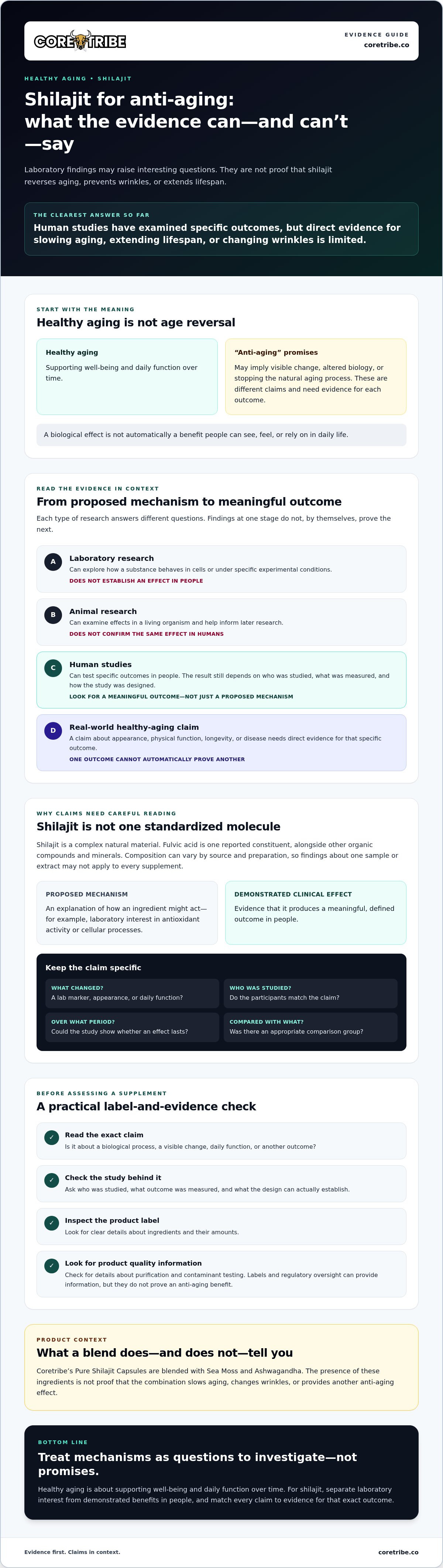
Healthy aging means supporting well-being and daily function over time. It doesn’t mean stopping or reversing the natural aging process. That distinction matters because “anti-aging” can refer to very different goals. A supplement claim might suggest a visible change, such as smoother-looking skin, or point to a biological process studied in cells. These are not interchangeable outcomes, and neither automatically shows that people will feel or look younger.
For readers searching for shilajit for anti-aging, the useful question is not simply whether shilajit has biological activity. It’s whether well-designed human research shows a meaningful benefit for a clearly defined aspect of healthy aging. A proposed mechanism can help researchers decide what to study, but it isn’t proof of a real-world result.
Why shilajit appears in healthy-aging conversations
Shilajit is a naturally occurring substance with a history of use in traditional wellness practices. Its composition has drawn scientific interest, though it can vary according to source and preparation. For an overview of its history, composition, purification, and traditional uses, see Shilajit.
Researchers may investigate particular constituents or how they behave in laboratory settings. This can help generate questions about possible biological effects. It doesn’t establish that taking a supplement improves longevity, changes appearance, or prevents age-related disease. Those outcomes need direct evidence, not an inference from tradition or a laboratory observation.
What an anti-aging claim would need to demonstrate
A change in a lab marker may be interesting, but it isn’t necessarily noticeable or valuable in daily life. To support a claim about healthy aging, research should connect a measured change to an outcome people experience, such as a relevant aspect of physical function. Results in cells or animals can inform later research, but they don’t establish the same effect in humans.
Study design also affects how much confidence a finding deserves. Short studies may not show whether an effect lasts. Small participant groups can make results less reliable, and without an appropriate comparison group, it can be difficult to tell whether the supplement caused the change. The people studied matter, too: findings in one population or for one outcome may not apply to everyone or to a different claim.
This article assesses what the evidence can and cannot tell us. It isn’t a guide to medical treatment. As you read, keep the claim specific: What changed, in whom, over what period, and compared with what? Those questions help separate healthy-aging research from promises of age reversal.
How Could Shilajit Relate to Aging? Separate Proposed Mechanisms From Proof
Shilajit is a complex natural material, not a single standardized molecule. Fulvic acid is one of its reported constituents, alongside other organic compounds and minerals, but the mix can vary with geographic source and preparation. That variability makes it difficult to assume findings about one sample or extract apply to every supplement. A review of shilajit’s traditional use and proposed biological activity describes it as a rejuvenator and as antiaging compound, but a review of possible mechanisms is not proof of clinical benefit.
A proposed mechanism explains how an ingredient might act. A demonstrated clinical effect shows that it produces a meaningful outcome in people. For shilajit for anti-aging, that distinction is essential.
Fulvic acid, oxidative stress, and cellular research
Oxidative stress describes an imbalance involving reactive molecules and the body’s defenses against them. Researchers study it in relation to cell function and aging, and shilajit constituents have prompted interest in antioxidant activity. But activity observed in a laboratory under specific experimental conditions doesn’t establish that taking a supplement reduces oxidative stress in people, let alone changes wrinkles, lifespan, or disease risk.
Evidence needs to be read by study type. A lab experiment can explore how a substance behaves in cells; an animal study can examine effects in a living organism. Neither result alone confirms the same effect in humans. Even a change in a human biomarker needs to be connected to an outcome that matters to people before it supports an anti-aging claim.
Mitochondria and energy: what the research can support
Mitochondria help cells produce usable energy. Because cellular energy processes are relevant to many areas of biology, researchers may investigate whether shilajit or its constituents affect them. That is a research question, not evidence that a supplement restores youthful energy or slows aging. Differences in composition also make it important to check whether a study’s tested material matches the product being discussed.
A 2026 open-label pilot study by Yadav et al. examined shilajit resin in healthy adults over 28 days and reported changes in muscle strength, endurance, and recovery. This is human research, but its specific performance outcomes and open-label design don’t demonstrate improved mitochondrial function, longer life, or an anti-aging effect. Interpret the findings within those limits rather than stretching them into broader promises.
If you’re curious about available options while keeping those evidence limits in mind, you can browse Coretribe’s shilajit supplements. A product’s presence on the market isn’t proof that it changes the aging process.
Does Shilajit Actually Slow Aging? Weigh the Evidence and Common Claims
No current evidence establishes that shilajit slows, reverses, or prevents human aging. Proposed mechanisms and individual study findings can be worth investigating, but they don’t prove benefits for lifespan, wrinkles, or overall vitality. The Cleveland Clinic likewise describes shilajit as promoted as an anti-aging supplement while noting that more research is needed.
What laboratory and animal studies can and cannot show
Laboratory experiments can examine how shilajit or specific constituents behave in cells under controlled conditions. Animal research can explore effects in a whole organism. These early stages help researchers form hypotheses, but the results don’t confirm that people will experience the same effects from a supplement. Findings about a particular extract also can’t automatically be applied to products with different sources or preparations.
That distinction matters for claims about antioxidant activity. A finding in a lab is not evidence of fewer wrinkles, a longer life, or lower disease risk in people. Those outcomes require appropriate human studies that measure them directly.
How to judge human evidence and online claims
A human study offers more direct evidence, but the details still matter. For example, a 2016 randomized controlled trial by Pandit et al. studied purified shilajit at 500 mg per day for 90 days in healthy men aged 45 to 55. The study reported an increase of approximately 20% in total testosterone. That is a specific hormone finding in a defined group, not proof that shilajit slows aging or improves lifespan, appearance, or health across populations.
Before trusting a headline, check who took part, what outcome researchers measured, how long the study ran, and whether it included a suitable comparison group. Also look for information about conflicts of interest and independent replication. One result, especially on a marker that isn’t itself an aging outcome, can’t support a much broader claim.
Evidence summary: “Shilajit has proposed biological mechanisms and some human research on specific outcomes, but current evidence does not demonstrate that it slows or reverses aging.”
| Evidence type | What it can suggest | What remains unknown |
|---|---|---|
| Laboratory or animal research | Possible biological effects worth studying | Whether they translate into benefits for people |
| Human studies | Effects on the particular participants and outcomes measured | Long-term aging effects, lifespan, and broad applicability |
| Online anti-aging claims | What a seller or author is promising | Whether well-designed evidence supports that promise |
Claims of guaranteed youthfulness, age reversal, or lifespan extension go beyond the evidence described here. For shilajit for anti-aging, treat such promises cautiously unless they’re backed by relevant, well-designed human research.
How to Evaluate Shilajit Supplements for Healthy-Aging Goals
A careful choice starts with the label and the evidence behind its claims, not with words like “youthful” or “advanced.” Use this checklist to compare products and identify what information you still need.
A practical checklist for reading shilajit labels
- Read the full ingredient list. Check whether the product contains shilajit alone or a blend, and look for the stated amount of each ingredient. Don’t assume a phrase such as “pure” or “high potency” tells you how much shilajit or a particular constituent it contains.
- Ask what testing supports quality claims. Shilajit’s geological origin makes contaminant testing relevant. A 2025 study in BMC Chemistry detected thallium in some commercial shilajit supplements. Look for accessible information about identity, purity, and testing for contaminants, including heavy metals. A certificate of analysis may help, but check what it tests, whether it applies to the product or batch you’re considering, and who performed the analysis. Don’t assume testing exists just because a label says “tested.”
- Request details behind vague claims. If a seller uses terms like “clinical strength,” “anti-aging,” or “maximum potency,” ask what evidence and measurements support them. Check whether research involved humans, the same type of preparation, and outcomes relevant to your goal.
- Confirm manufacturing statements directly. If a label or product page makes claims about sourcing, purification, or quality controls, ask the seller for supporting details. Treat unanswered questions as a reason to pause rather than filling gaps with assumptions.
- Set realistic expectations. No label can establish that shilajit reverses aging. For shilajit for anti-aging, distinguish a marketing promise from evidence showing a meaningful human benefit.
Safety, suitability, and realistic expectations
There isn’t a universal dose that can be recommended for every shilajit product or person. Follow product-specific directions, and ask a qualified healthcare professional before use if you take medication, have a health condition, are pregnant, or aren’t sure whether a supplement is suitable. Product quality and personal health history can both affect the decision. If symptoms need assessment, seek clinical care rather than trying to address them with a supplement.
Supplements also don’t replace the foundations of well-being: consistent sleep, balanced nutrition, sun protection, and appropriate clinical care. If you choose to consider shilajit, view it as a supplement rather than a substitute for those measures.
To compare available options with these label questions in mind, review Coretribe’s shilajit supplements and verify product-specific details before deciding.
Choosing a Shilajit Supplement: Where Coretribe Fits and What It Cannot Promise
Choosing a supplement is separate from deciding whether shilajit has proven anti-aging effects. You don’t need to buy a product to support healthy aging. If you’re curious about a shilajit blend, compare its current label with your goals and the evidence rather than treating a purchase as a path to age reversal.
Coretribe offers Pure Shilajit Capsules blended with Sea Moss and Ashwagandha. Those are the confirmed blend ingredients, but they don’t establish a clinical benefit. The product has not been shown to slow, reverse, or prevent aging, and individual outcomes aren’t guaranteed. Before drawing conclusions about this particular product, review its current label for serving information, ingredient amounts, and any available quality or testing disclosures. Don’t assume details that aren’t stated.
Questions to ask before choosing a shilajit blend
- What’s in the product, and how much? Read the full ingredient list and check whether the label states amounts for each ingredient and serving directions.
- Is a blend right for your purpose? A multi-ingredient formula may suit someone looking for a blend, but it can make it harder to assess shilajit on its own. Consider whether you want to evaluate one ingredient at a time, and check the evidence for the specific ingredients and outcomes you care about.
- Can the seller explain its claims? Ask for clear details behind statements about purity, testing, sourcing, or potency. Compare evidence and transparency, not dramatic promises or traditional use alone.
If information you need is missing, contact the seller for clarification before deciding. A label can help you understand what a product contains, but it can’t guarantee a healthy-aging outcome.
A balanced next step for curious readers
Healthy-aging habits such as adequate sleep, balanced nutrition, sun protection, and appropriate clinical care remain more grounded choices than supplement claims of age reversal. Shilajit for anti-aging remains an area of interest, not an established treatment. If you take medication, have a health condition, are pregnant, or are unsure whether a supplement is suitable, discuss it with a qualified healthcare professional.
If you’d like to compare products with those questions in mind, explore Coretribe supplements. Review current product details and decide whether the ingredients and available information fit your preferences, without expecting a proven anti-aging effect.
Choose Your Next Step With Clear Expectations
Shilajit may be a subject of interest in healthy-aging research, but shilajit for anti-aging isn’t a proven way to reverse aging, prevent wrinkles, or extend lifespan. Proposed mechanisms and early findings are not the same as demonstrated benefits in people.
Keep that distinction in mind as you assess a product: check its current label, ingredient amounts, and any available testing details, and be cautious of dramatic promises. Healthy-aging choices also extend beyond supplements, with everyday habits and appropriate clinical care remaining important parts of overall well-being.
Coretribe offers Pure Shilajit Capsules blended with Sea Moss and Ashwagandha, as well as Shilajit Honey Sticks. Neither should be considered a proven anti-aging treatment, and outcomes aren’t guaranteed. Take time to review product information and consider whether it fits your needs.
Frequently Asked Questions
Can shilajit reverse aging?
No established evidence shows that shilajit reverses aging in people. Research into its constituents and possible biological mechanisms may help guide future studies, but early laboratory or animal findings don’t demonstrate age reversal or longer life in humans. Treat claims about restored youth, wrinkle reversal, or guaranteed longevity cautiously. If you have a health concern, discuss options supported by evidence with a qualified healthcare professional.
Does shilajit help with wrinkles or skin aging?
Current evidence doesn’t establish shilajit as a treatment for wrinkles or skin aging. A proposed antioxidant effect isn’t the same as a human clinical study showing visible improvement. If a product makes a skin-related claim, check whether it cites human research that measured skin outcomes, and be wary of guaranteed results. A dermatologist can discuss options with better-established evidence for your particular skin concerns.
What does research say about shilajit and longevity?
Research hasn’t established that taking shilajit extends human lifespan. Studies of biological pathways, cells, or animals can help researchers develop questions, but they can’t confirm longevity benefits for people. Look for well-designed human trials that measure meaningful outcomes and, ideally, findings replicated independently. Traditional use and a supplement’s popularity aren’t proof of a longer life, so treat lifespan claims as unproven unless relevant evidence supports them.
Is shilajit safe to take every day?
Daily use may not be suitable for everyone, and products can differ in composition and quality. Check the current product label rather than assuming all shilajit supplements share the same ingredients or safety profile. If you take medication, have a health condition, are pregnant, or aren’t sure whether it’s appropriate for you, ask a qualified healthcare professional before using it. Don’t rely on a general online dose as personalized advice.
How can I tell whether a shilajit supplement is high quality?
Start with a complete ingredient list and clear amounts, then look for accessible details about product identity, purity, and contaminant testing. Verify claims with the seller; don’t assume a product has been tested or certified unless that information is provided. Compare the evidence behind its claims, too. If details are missing, ask for clarification or consider another product rather than relying on potency slogans or dramatic promises.
Can shilajit be combined with other supplements for anti-aging?
Combining supplements doesn’t establish an anti-aging benefit, and each ingredient may have its own safety considerations. Review the full formula and current label, including the amounts of listed ingredients, and consider possible interactions with medicines or health conditions. Ask a qualified healthcare professional before combining products if you’re uncertain about suitability. A blend isn’t automatically more effective simply because it contains several ingredients marketed for wellness.
What is more important than supplements for healthy aging?
Everyday health habits and appropriate clinical care deserve attention before unproven anti-aging supplements. Depending on your circumstances, useful foundations may include adequate sleep, balanced nutrition, regular movement, avoiding tobacco, and protecting your skin from excess sun exposure. A healthcare professional can help guide preventive care and screening. Supplements shouldn’t replace established care, and shilajit hasn’t been proven to reverse the aging process.
For a closer look at Coretribe’s supplement range, explore Coretribe supplements and review the current product information before deciding whether an option fits your preferences.

