


What if the clearest sign Cordyceps is working isn’t a sudden surge of energy, but a small, steady change during familiar activities? If you’re wondering how to know if cordyceps is working, it can be hard to tell a meaningful shift in stamina or energy from an ordinary good day.
That uncertainty is understandable. Sleep, stress, nutrition, exercise, and expectations can all influence how you feel, so one moment may not tell you much. There isn’t one timeline that guarantees a noticeable response for everyone.
This guide will help you assess your experience with realistic expectations. You’ll learn how to track energy, stamina, and other relevant changes alongside everyday influences, identify patterns worth considering, and decide whether your routine feels worthwhile. It also covers when to pause or seek advice from a healthcare professional.
Key Takeaways
- Define “working” as a consistent, personally meaningful change, not a guaranteed or dramatic sensation.
- Learn how to know if cordyceps is working by tracking one or two personal markers alongside sleep, activity, and routine changes.
- Separate repeatable patterns from one-off shifts that may reflect changes in sleep, workload, training, or diet.
- Read research in context: findings depend on the Cordyceps species, preparation, and outcome studied.
- No noticeable change is a valid result; use it to reassess your expectations and whether continuing makes sense.
How to Know If Cordyceps Is Working: Start with Realistic Signs
For Cordyceps to feel worthwhile, you’d need to notice a difference that matters to you and appears consistently. Perhaps your usual walk feels more manageable, or your energy seems steadier during a familiar part of the day. These are personal observations, not guaranteed effects or proof that the supplement caused a change.
The name Cordyceps describes a genus of fungi with a long history of traditional use. That background can’t predict exactly how you’ll respond. A particularly energetic morning, an unusually easy workout, a sluggish afternoon, or a tough training session is just one data point. Everyday fluctuations happen, so look for patterns rather than a dramatic sensation.
Which changes might be worth noticing?
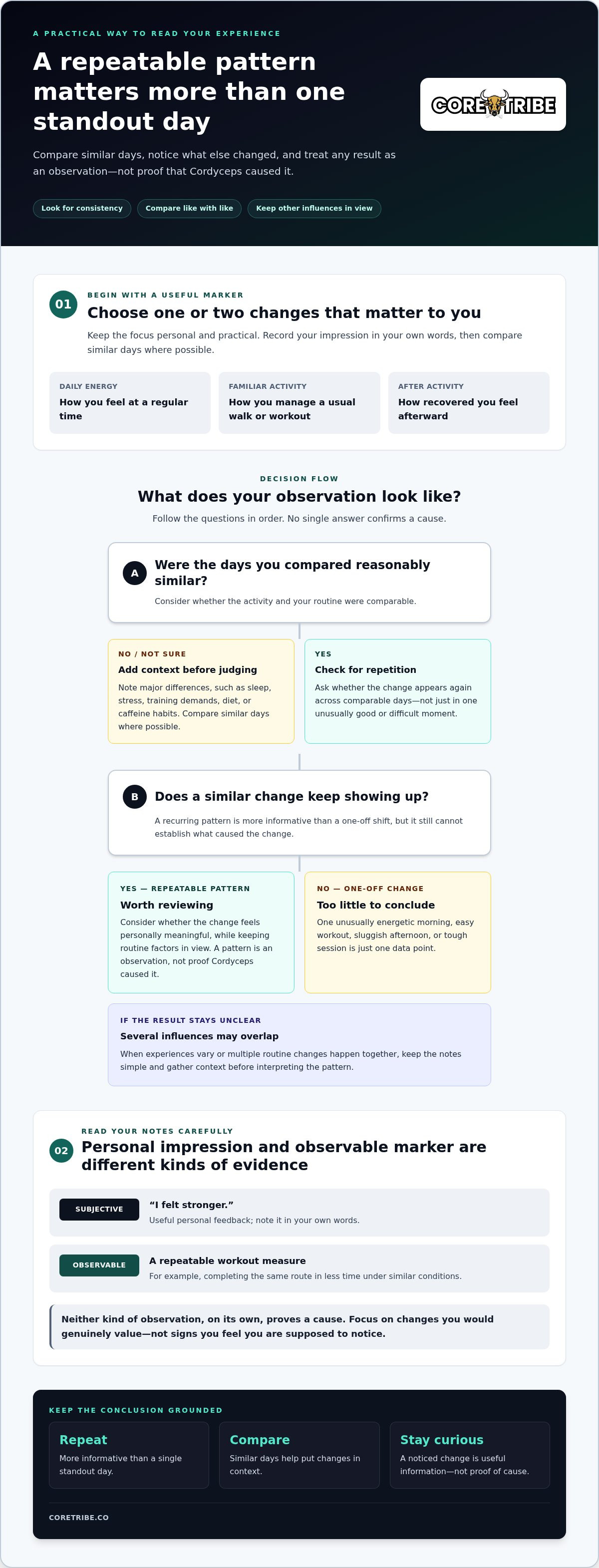
Choose one or two things that matter in your daily life. You might note your perceived energy at a regular time, how you manage a familiar workout, or how recovered you feel afterward. Record your impressions in your own words, then compare similar days where possible.
Keep subjective impressions separate from observable markers. “I felt stronger” is useful personal feedback. A repeatable workout measure, such as completing the same route in less time under similar conditions, is more concrete. Neither alone proves a cause. Focus on changes you’d genuinely value, not signs you feel you’re supposed to notice.
Why Cordyceps may feel different from person to person
There’s no universal sensation or timeline that everyone should expect. Routines and responses differ, and the same person may feel different from one day to the next. Sleep, training demands, stress, diet, and expectations can all shape perceived energy, exercise tolerance, and recovery.
That’s why the question of how to know if cordyceps is working is best approached with curiosity rather than certainty. If you notice a change, record when it happened and what else was going on. A noticed change is a useful observation, not proof that Cordyceps caused it. Comparing repeated experiences can help you judge whether a pattern feels personally meaningful while keeping other influences in view.
What Cordyceps Research Can, and Cannot, Tell You About Results
Research can show what researchers have tested, but it can’t promise what you’ll feel. Cordyceps is not one identical preparation: studies may use different species, materials, and methods, and supplements can vary too. A result from one preparation and outcome shouldn’t automatically be applied to every product or to your own experience.
Why species, preparation, and study design matter
Cordyceps militaris and Cordyceps sinensis are distinct species. A study’s findings apply most directly to the species and preparation it examined. The amount used, how it was prepared, who took part, and what researchers measured all affect how relevant the result may be. A broad claim that “Cordyceps works” leaves out this important context.
Before treating a study as evidence for an expected benefit, look at its participants, preparation, comparison group, and measured outcome. A finding about exercise performance, for example, isn’t automatically evidence that people will feel more energetic in everyday life. Memorial Sloan Kettering Cancer Center discusses claims including Boost your immune system and stamina while noting that more research is needed. Treat proposed uses as questions under study, not settled results.
How to interpret energy and exercise claims
“More energy” can mean different things. It may describe a person’s impression, such as feeling less tired, or a measured outcome, such as performance on a defined exercise test. A change in exercise performance doesn’t necessarily mean someone will notice a daily energy boost. The outcomes are related only if evidence supports that connection.
Expectations can also affect how someone reports feeling. That doesn’t make the experience imaginary; it means subjective impressions are best considered alongside consistent observations and the methods used in a study. For readers asking how to know if cordyceps is working, research can help set expectations, but personal tracking is still needed to understand an individual response.
Evidence about an ingredient can suggest what’s worth studying, but it can’t guarantee the same result for every user. If you’re exploring Cordyceps, Coretribe’s natural supplement range includes it. Consider any product as an option, not a promise of a particular outcome.
Cordyceps or Coincidence? Compare Your Experience Carefully
A noticeable change can have more than one explanation. You might feel brighter after a better night’s sleep, find exercise harder after a demanding week, or notice a shift after changing your diet or caffeine habits. Comparing similar days can help you see whether an experience repeats, but even a pattern can’t confirm that Cordyceps caused it.
What a consistent pattern looks like
Repeated observations across comparable days are more informative than one standout workout or unusually energetic morning. Keep your notes simple: record the change you care about and any major context, such as sleep or training. There’s no need to track every detail. A recurring pattern can guide your reflection, but it isn’t proof of cause.
| Observation | What it may suggest |
|---|---|
| Repeatable pattern | A similar change appears across comparable days. Worth reviewing alongside routine factors. |
| One-off change | A single unusually good or difficult day. Too little to draw a conclusion. |
| Unclear result | Experiences vary or several routine changes overlap. More context may be needed to interpret it. |
How expectations and other changes can confuse the picture
Expectations can shape how we interpret sensations, sometimes described as a placebo effect. That doesn’t mean a felt change is false; it means it helps to record what happened without deciding too quickly why. Note major shifts in sleep, exercise, stress, diet, or caffeine. Each can influence how you feel and make it harder to attribute a change to one cause.
Changing several supplements or routines at once creates a similar challenge. If your energy changes after adding Cordyceps, starting a new training plan, and improving your sleep in the same period, it’s difficult to separate their possible contributions. For a balanced overview of reported uses and cautions, see Memorial Sloan Kettering Cancer Center on Cordyceps.
An immediate sensation isn’t required for a supplement to have an effect, and feeling something right away doesn’t establish that it’s working. The question of how to know if cordyceps is working is better approached by reviewing repeated observations and the circumstances around them. Keep prescribed care unchanged unless your healthcare professional advises otherwise.
How to Track Cordyceps Effects Without Overcomplicating It
A short, consistent record can make your experience easier to review without turning supplement use into a project. Before starting, note what a typical day or familiar activity feels like. Continue using the same simple markers, and keep other routine changes in view. There’s no need to set a universal trial length or change how you use a product to chase faster results.
Create a useful baseline before assessing changes
Pick one or two measures that matter to you, such as perceived energy at a familiar time or how consistently you complete your usual activity. Note your typical experience before assessing changes, then use a brief note or simple scale in the same way each time. The goal is a useful comparison, not perfect data.
For example, an entry might include:
- Marker: Energy during an afternoon walk
- Observation: Felt easier, about the same, or more difficult than usual
- Context: Sleep, activity, or any notable change in stress, diet, or caffeine
Keep your notes brief enough to maintain. Follow the product label directions, and don’t exceed them in an attempt to speed up results. For related reading, see Cordyceps for stamina and a daily wellness supplement stack.
Review your notes and decide what they show
Compare like with like: a familiar walk on a typical day is more informative than comparing it with a strenuous workout after poor sleep. Look for repeated differences in your chosen markers, then note possible explanations such as changes in training, workload, sleep, or another supplement. If several factors shifted together, treat the result as uncertain rather than assigning the change to Cordyceps.
A personal log can support reflection, but it can’t diagnose a problem or prove what caused a change. Use it to decide whether your experience seems meaningful and whether continuing feels worthwhile. It isn’t a substitute for professional guidance when you have health concerns.
If you’re considering Cordyceps as part of your routine, explore Coretribe’s natural supplement range with realistic expectations and your own tracking approach in mind.
What to Do If You Notice No Change or Have Concerns
No noticeable change is a valid result. It doesn’t mean you tracked incorrectly or need to try harder to feel an effect. If you’re considering how to know if cordyceps is working, review your notes calmly: did you follow the product directions, were your expectations realistic, and did sleep, training, stress, or diet shift during the same period?
Then decide whether continuing makes sense for you. If you can’t identify a personally meaningful benefit, stopping may be a reasonable choice. You don’t need to keep taking a supplement simply because you’ve already started it. If you’re unsure, consider your health circumstances and ask a qualified clinician or pharmacist for guidance.
When to pause and seek professional guidance
If you develop concerning symptoms after taking Cordyceps, stop using it and seek medical advice. Get guidance from a clinician or pharmacist before use if you have a health condition, are pregnant, or have questions about possible interactions with medication. Share the product label and a list of medicines or supplements you take so they can consider your circumstances.
Cordyceps shouldn’t replace diagnosis, treatment, or prescribed medication. Don’t stop or change prescribed care to test a supplement; discuss treatment decisions with your healthcare professional.
How to make a considered next choice
Before continuing or trying something else, read the product label and follow its directions. Consider whether the listed ingredients and any cautions fit your personal circumstances. Be wary of claims that promise a specific result: supplement experiences can vary, and a confident claim isn’t a guarantee.
A simple decision check can help:
- No change, no concerns: Reassess whether continued use feels worthwhile.
- Possible benefit, no concerns: Review your notes and label directions before deciding whether to continue.
- Symptoms or safety questions: Pause and seek qualified medical or pharmacy advice.
If you’d like to explore other wellness options, Coretribe’s supplement collection is available to consider as part of your own informed decision. Choose calmly, keep expectations realistic, and let your needs guide the next step.
Make Your Next Cordyceps Decision With Confidence
Understanding how to know if cordyceps is working starts with looking for a repeatable change that matters to you, not waiting for a dramatic sensation. Simple notes about energy or exercise, alongside sleep and routine changes, can make your experience easier to assess. Research offers context, but findings don’t guarantee an individual result, and noticing no difference is a valid outcome.
Use what you’ve observed to decide whether continuing feels worthwhile. Follow product label directions, and seek qualified medical advice if you have health concerns, take medication, or experience troubling symptoms. Your wellbeing comes first.
Cordyceps is part of Coretribe’s supplement range, within a natural health and wellness offering. Explore Coretribe’s supplement collection to consider Cordyceps as one option, with realistic expectations and your own needs in mind.
Take a steady, thoughtful approach. The best next step is the one that feels informed and right for you.
Frequently Asked Questions
How long does it take to know if Cordyceps is working?
There’s no single timeline that applies to everyone, and research doesn’t establish a guaranteed point when effects should appear. To assess your experience, track a few relevant observations consistently, such as perceived energy or a familiar activity, while noting sleep, activity, stress, and other routine changes. Follow the product label, and don’t increase use simply because you haven’t noticed a change. A repeated pattern is more useful than a deadline.
What are the signs that Cordyceps is working?
Some people may watch for changes in perceived energy, exercise tolerance, or how recovered they feel, but these aren’t guaranteed effects or proof that Cordyceps caused a change. Choose observations that matter in your daily life, then look for a repeated pattern rather than relying on one unusually good day. Research findings can provide context, but they can’t predict exactly how an individual will feel.
Can you feel Cordyceps working right away?
You don’t need to feel an immediate sensation to assess a supplement, and feeling something quickly doesn’t prove Cordyceps caused it. Energy and alertness can shift with sleep, meals, caffeine, stress, and expectations. Keep brief notes over time, follow the product label, and be cautious of claims promising a rapid or certain effect. If you notice an unwanted reaction, stop use and seek advice from a qualified health professional.
What should I track while taking Cordyceps?
Keep a brief record of one or two personal measures, such as perceived energy at a regular time or a consistent workout marker. Add relevant context, including sleep, activity, stress, diet, and other supplements. A simple log you can maintain is more useful than trying to monitor everything. It can help you reflect on patterns, but it can’t diagnose a condition or prove that Cordyceps caused a change.
What happens if Cordyceps does not seem to work?
No noticeable change is a possible outcome, and it doesn’t mean you’ve done anything wrong. Review whether your expectations were realistic, your routine changed, and you followed the product directions. Don’t take more than the label recommends in an effort to notice an effect. If you have health concerns, take medication, or experience symptoms, consult a qualified health professional or pharmacist before deciding what to do next.
Is Cordyceps safe to take every day?
Daily use isn’t automatically suitable for everyone; considerations can include the product, your health history, and other supplements or medications. “Natural” doesn’t mean risk-free. Follow the directions on the specific product label, and seek guidance from a clinician or pharmacist if you have a health condition, take medication, are pregnant, or experience an unwanted reaction. They can help you consider your circumstances and any possible interaction questions.
Can Cordyceps improve exercise performance?
Some research has examined Cordyceps and exercise-related outcomes, but findings depend on the species, preparation, study design, and participants. They don’t guarantee better performance for an individual. Separate measured outcomes from marketing language and personal impressions, and check the details before relying on a specific study claim. Your own training notes can help you reflect on changes, but they’re observations, not proof that Cordyceps was responsible.

