


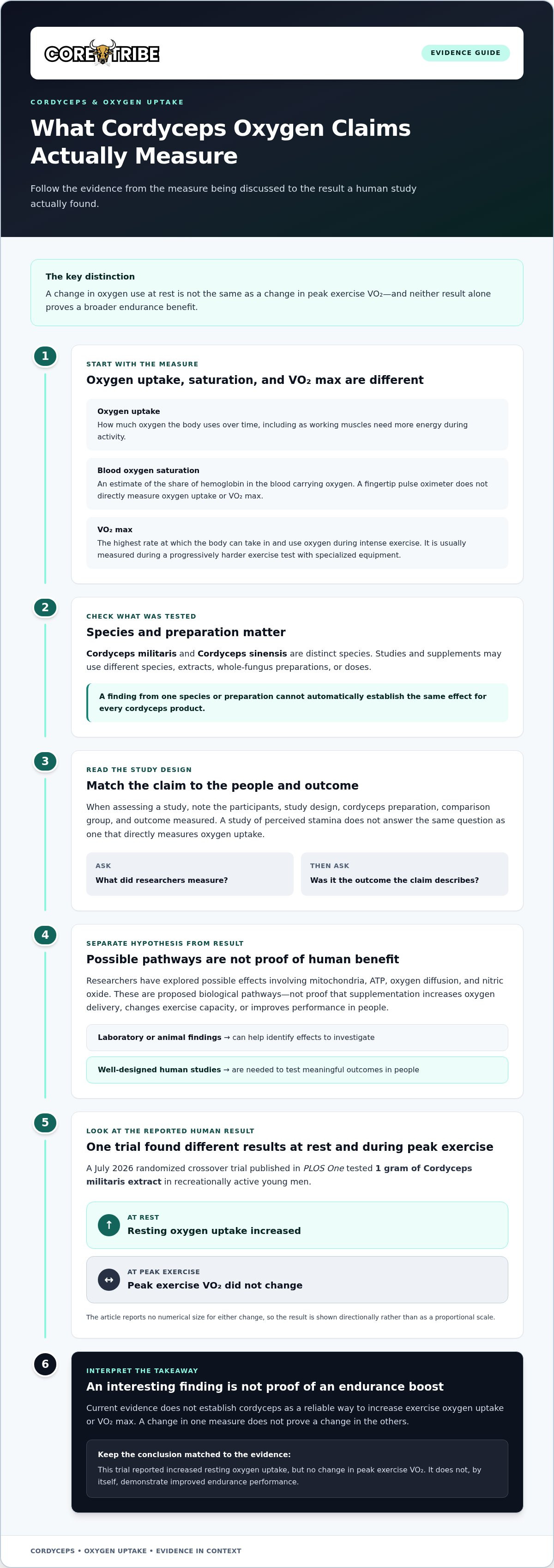
Cordyceps may affect oxygen use without improving peak exercise capacity. That distinction is central to the debate around cordyceps for oxygen uptake. A July 2026 randomized crossover trial published in PLOS One found that 1 gram of Cordyceps militaris extract increased resting oxygen uptake in recreationally active young men, but did not change peak exercise VO₂. It is an intriguing result, not proof of an endurance boost.
If you have seen claims about cordyceps, stamina, and VO₂ max that seem to conflict, the key is to distinguish the outcomes. Oxygen uptake describes how much oxygen the body uses over time; VO₂ max measures the highest rate it can use during intense exercise. A proposed biological pathway, or a change at rest, does not automatically translate into better performance.
This guide explains oxygen uptake and VO₂ max, separates proposed mechanisms from demonstrated human outcomes, and looks at what studies can and cannot show. It also covers cordyceps species, supplement labels, safety, and realistic expectations to help you make an informed decision about whether cordyceps fits your wellness routine.
Key Takeaways
- Learn how oxygen uptake differs from blood oxygen saturation and VO₂ max, so performance claims are easier to interpret.
- Understand why proposed effects of cordyceps for oxygen uptake remain hypotheses, not established explanations for human benefits.
- Assess study findings by checking the cordyceps species, study design, participants, and outcomes measured.
- Compare a supplement’s species, preparation, label details, and claims with your goals.
- Set realistic expectations and consider your health context. Supplements do not replace training, sleep, nutrition, or medical care.
Cordyceps and oxygen uptake: what the claim means
Can cordyceps help your body use oxygen during exercise, or does “oxygen support” simply suggest better stamina? Start by separating the measures. Oxygen uptake is the amount of oxygen the body uses over time, especially as working muscles need more energy during activity. Blood oxygen saturation is different: it estimates the share of hemoglobin in the blood carrying oxygen. A saturation reading does not tell you how much oxygen your body is using.
Oxygen uptake, oxygen saturation, and VO₂ max are different measures
Imagine walking uphill. Your muscles use oxygen at a changing rate, while your blood carries oxygen from the lungs to the tissues. A fingertip pulse oximeter estimates blood oxygen saturation; it does not directly measure oxygen uptake or VO₂ max. Its reading is one piece of information, not evidence that a supplement improves exercise performance.
VO₂ max is the highest rate at which the body can take in and use oxygen during intense exercise. It is usually measured during a progressively harder exercise test with specialized equipment. A higher VO₂ max may be relevant to aerobic fitness, but it is not the same as feeling less tired on a particular run. Oxygen delivery, oxygen uptake, stamina, and VO₂ max are connected parts of exercise physiology, not interchangeable outcomes. A change in one does not prove a change in the others.
What people mean when they say cordyceps supports oxygen
The phrase “supports oxygen” can refer to traditional use, a proposed effect on the body, or a measurable change in exercise capacity. Keep these ideas distinct. Cordyceps has a history of traditional use, and modern explanations suggest possible effects on processes involved in exercise. A biological hypothesis can help researchers decide what to test, but it does not show that people taking a supplement experience a measurable benefit.
Species and preparation matter, too. Cordyceps militaris is one cultivated species used in supplements, but evidence from one species or extract cannot automatically be applied to another. Results may also depend on the participants, study duration, comparison group, and outcome measured. A study of perceived stamina, for example, does not answer the same question as one that directly measures oxygen uptake.
So, cordyceps for oxygen uptake is a research question, not a guaranteed performance result. Claims about oxygen use or exercise benefits need relevant human studies that measure the outcome in question. This distinction helps you see where evidence ends and interpretation begins.
How cordyceps might affect exercise physiology
Proposed explanations for cordyceps and exercise focus on processes inside cells, not a simple increase in the amount of oxygen in the blood. These are biologically plausible areas to investigate, but plausibility is not proof that a supplement changes oxygen uptake or performance in people. It helps to separate laboratory hypotheses from outcomes measured in human trials.
Cordyceps species and preparations matter
Cordyceps militaris and Cordyceps sinensis are distinct species, not interchangeable names for one uniform ingredient. Supplements and studies may use different species, extracts, whole-fungus preparations, or doses, each with its own composition. A finding from one preparation cannot establish that every cordyceps product has the same effects. The specific ingredient tested matters.
From mitochondria and ATP to exercise outcomes
Mitochondria are structures inside cells that help release usable energy from nutrients. ATP, or adenosine triphosphate, is one of the cell’s immediate energy-carrying molecules. Muscles need ATP to contract, and their demand rises during exercise. This is why researchers explore whether cordyceps compounds might affect energy-related processes. Proposed pathways also include effects on oxygen diffusion or nitric oxide, a molecule involved in regulating blood vessels. These are hypotheses, not proof that supplementation increases ATP, improves oxygen delivery, or changes exercise capacity in people.
A plausible mechanism can guide research, but only well-designed human studies can show whether it leads to a meaningful outcome. Laboratory experiments and animal studies can help identify biological effects, but they do not reproduce the complexity of human exercise. A change in a cell-level process would also need to be linked to a measured outcome, such as oxygen uptake during a controlled exercise test.
One human clinical trial examined Cordyceps militaris supplementation and tolerance to high-intensity exercise in healthy adults. It reported findings related to exercise performance, but it cannot establish that proposed mitochondrial, ATP, oxygen-diffusion, or nitric-oxide pathways caused those results. Nor does one trial prove the same effects for other species, preparations, or populations. Read the study’s methods and outcomes before applying its conclusions broadly. The trial is described as improving tolerance to high intensity exercise.
If you are considering cordyceps for oxygen uptake, match claims to the exact preparation and human outcome studied rather than relying on mechanism language alone. Coretribe offers cordyceps as part of its wellness range. You can browse Coretribe’s wellness collection and assess product information against your goals and expectations.
Does cordyceps improve oxygen uptake? What studies can show
Current evidence does not establish cordyceps as a reliable way to increase exercise oxygen uptake or VO₂ max. A human trial offers a more limited signal: one specific Cordyceps militaris extract affected resting oxygen use, but not peak exercise VO₂. That finding is worth examining, but it does not show that other preparations improve aerobic performance or that people will notice a benefit.
Human studies versus laboratory and animal research
Human trials are most useful for determining whether a supplement changes an outcome in people. Cell and animal studies can explore possible biological effects, but they cannot establish that the same effects occur in humans during exercise. The table summarizes the human trial with a directly relevant oxygen outcome.
| Evidence and source | Population and design | Outcome and finding | Key limitation |
|---|---|---|---|
| Randomized crossover trial, PLOS One, July 15, 2026 | Recreationally active young men; acute 1-gram dose of Cordyceps militaris extract. | Resting oxygen uptake increased; peak exercise VO₂ did not change. | A single acute result in a specific group and preparation does not demonstrate a lasting VO₂ max or performance benefit for other people or products. |
The distinction matters. Resting oxygen uptake, peak VO₂, perceived exertion, and time to exhaustion are different outcomes. A result for one should not be retold as proof of improvement in another. Findings from a blend or a different cordyceps species also need to be assessed on their own terms before being applied to a particular supplement.
Why study findings may not translate into a personal result
Participants’ age, fitness, and training status can shape results, as can the species, preparation, dose, and length of supplementation. A statistically significant change does not automatically mean the difference is large enough to matter in daily training. A narrow trial can suggest what deserves further research, but it cannot predict an individual response.
Evidence summary: Human research has reported a change in resting oxygen uptake after one specific acute Cordyceps militaris preparation, while peak exercise VO₂ was unchanged. This is limited, preparation-specific evidence, not proof that cordyceps broadly improves oxygen uptake, VO₂ max, or stamina.
Using cordyceps thoughtfully: expectations, safety, and quality
Start with a clear goal, not an assumed result. If you are exploring cordyceps for oxygen uptake, remember that current research does not guarantee an individual change in oxygen use, VO₂ max, or stamina. Supplements are one possible part of a broader wellness routine, not a substitute for training, adequate sleep, balanced nutrition, or medical care.
Set realistic goals before trying a supplement
First, name the outcome you care about. Is it a training measure, such as completing a familiar route at a steadier pace, or a general feeling of energy? These experiences can be useful to track, but they are not direct measurements of oxygen uptake. Keep training conditions as consistent as possible and record the same measures over time, rather than relying on one workout or impression. Research findings cannot predict how you will respond.
Next, review what the evidence actually tested. Species, preparation, dose, study length, and participants all matter. Do not assume an outcome reported for one research preparation applies to a different supplement. No universal dose or timeline is established here; follow the product label and seek qualified advice if you are unsure.
Safety and label questions to consider
Before using a supplement, read the full label. Look for a clearly identified ingredient and species, the preparation used, serving directions, and any other listed ingredients. Transparent information about quality testing can help you assess a product, but a general testing claim does not prove a specific health or performance effect.
Your health context matters. If you take medication, have an existing health condition, are pregnant, or have another personal concern, speak with a qualified healthcare professional before starting cordyceps. They can help consider your circumstances and potential risks. Stop and seek advice if you experience an unexpected reaction.
Use this sequence to keep expectations grounded:
- Clarify the outcome you want to track.
- Compare that goal with what human research has measured.
- Review the product’s species, preparation, directions, and ingredient information.
- Consider your health context and seek professional guidance if relevant.
If you would like to explore cordyceps alongside other wellness options, browse the Coretribe wellness collection. Choose carefully, and keep the fundamentals of recovery and training at the center of your routine.
Choosing a cordyceps supplement with an evidence-aware mindset
The clearest takeaway is measured: research has explored cordyceps and exercise-related outcomes, but a finding tied to one preparation or measure cannot establish a benefit from every supplement. A change in oxygen uptake is not automatically a change in VO₂ max, stamina, or how a workout feels. For cordyceps for oxygen uptake, ask whether the product’s ingredients and evidence match the outcome you care about.
A simple framework for assessing product claims
Use this checklist to read a label or claim carefully:
- Name the outcome. Is the claim about oxygen uptake, VO₂ max, perceived stamina, or another measure? These are related, but not interchangeable.
- Match the preparation. Compare the cordyceps species and preparation in the research with the product’s stated ingredients. Results from one species or extract do not automatically apply to another.
- Look for transparent labeling. Clear ingredient identity and serving directions help you understand what you are considering. A broad “performance” statement does not demonstrate a specific oxygen-related effect.
- Be cautious with certainty. Prefer specific, supportable descriptions over promises of guaranteed performance or predictable results.
Coretribe offers cordyceps as part of its natural wellness range. Assess any supplement according to its own label and the evidence relevant to its stated ingredients.
Cordyceps as one part of a broader wellness routine
Training, recovery, hydration, and nutrition remain central to an exercise plan. A supplement cannot replace consistent preparation, sufficient sleep, or medical care when needed. For a broader perspective on how daily habits contribute to well-being, explore this holistic mind-body balance guide. If you are considering combinations of supplements, review ingredients and your personal health context thoughtfully. Coretribe’s shilajit, ashwagandha, and sea moss synergy guide offers a separate look at that topic.
Choose based on clear goals, transparent information, and realistic expectations. Explore Coretribe’s wellness collection if cordyceps is something you are considering. The evidence is still developing, and individual results are not guaranteed.
Make your next step an informed one
Research on cordyceps for oxygen uptake is intriguing but limited. One human study found a change in resting oxygen use after a specific preparation, while peak exercise oxygen use did not change. That is not proof of a dependable boost to VO₂ max or stamina. Proposed biological mechanisms offer questions for research, not guarantees of results.
Keep the measures distinct, match product claims to the species and preparation actually studied, and consider your health context before trying a supplement. Training, recovery, sleep, and nutrition remain the foundations of an exercise routine.
Coretribe offers cordyceps among its natural wellness products, alongside other supplements and lifestyle items. Explore Coretribe’s wellness collection and review product information with your goals and expectations in mind. Make your choice thoughtfully, without treating a supplement as a shortcut.
Frequently Asked Questions
Can cordyceps increase oxygen uptake?
Current evidence does not prove that cordyceps reliably increases oxygen uptake in everyone. A randomized crossover trial published in PLOS One on July 15, 2026, found that an acute dose of Cordyceps militaris extract increased resting oxygen uptake in recreationally active young men, but did not change peak exercise VO₂. That result applies to the study preparation and participants, not all supplements. Treat broad performance promises cautiously and discuss personal health questions with a qualified professional.
Does cordyceps improve VO₂ max?
Do not assume cordyceps improves VO₂ max. Supporting that claim requires research that measures VO₂ max in people taking a clearly described cordyceps preparation and compares results appropriately. The July 2026 PLOS One trial found no change in peak exercise VO₂ after acute supplementation. Animal or laboratory research, and studies measuring perceived exertion instead, cannot establish a VO₂ max benefit or predict an individual result.
What is the difference between oxygen uptake and blood oxygen saturation?
Oxygen uptake describes how much oxygen the body uses over time, particularly during activity. Blood oxygen saturation estimates how much hemoglobin in the blood is carrying oxygen. They are different measures. A fingertip pulse oximeter estimates saturation, but does not directly measure VO₂ max or show how much oxygen working muscles use. Check which measure a study recorded before connecting it to an oxygen-related claim.
How long does cordyceps take to affect exercise performance?
There is no universal timeline for cordyceps to affect exercise performance. Studies can use different species, preparations, doses, and durations, so one result cannot predict how quickly another product might act. The acute Cordyceps militaris trial published in PLOS One in July 2026 does not establish a timeline for lasting changes in oxygen uptake, stamina, or VO₂ max. Follow the product label and seek qualified advice about your circumstances.
Is cordyceps safe to take every day?
Daily use cannot be assumed safe for everyone. Safety depends on the person, product, health history, and other substances they use. Review the full label and follow its directions. If you take medication, have a health condition, are pregnant, or have another personal concern, consult a qualified healthcare professional before use. A supplement should not replace medical advice; seek guidance if you experience an unexpected reaction.
What should I look for in a cordyceps supplement?
Look for a label that clearly identifies the cordyceps species, preparation, ingredients, and serving directions. Transparent quality or testing information can help you evaluate a product, but it does not prove an oxygen-uptake benefit. Compare its claims with human research on a similar preparation, and be cautious of guaranteed performance promises or unclear evidence. Coretribe offers cordyceps among its natural wellness products; assess each product by its own label and claims.
Can cordyceps replace training or improve endurance on its own?
No supplement should replace structured training, recovery, sleep, hydration, or adequate nutrition, and cordyceps is not a guaranteed way to improve endurance. Set a clear goal and track the same relevant measures consistently, rather than relying only on how one workout feels. Individual results can differ. If you experience persistent breathlessness, unusual symptoms during exercise, or other health concerns, seek advice from a qualified healthcare professional.

