


Could a mushroom with a long history of traditional use support breathing? Interest in cordyceps for respiratory health is growing, but claims can blur the line between tradition, early laboratory findings, and results in people. These are different kinds of evidence, and they do not provide the same level of certainty.
It’s understandable to want a clear answer about whether cordyceps may support respiratory wellness. Research offers reasons for interest, but the evidence remains limited. It does not establish cordyceps as a treatment for asthma, COPD, or other respiratory conditions. Supplements also aren’t a substitute for medical care.
This guide separates human research from animal and laboratory studies, explains how cordyceps is discussed in relation to respiratory function, and highlights what remains unknown. It also covers how to assess supplement labels and claims, and when breathing symptoms call for medical advice, so you can weigh the potential interest against the evidence.
Key Takeaways
- Learn how cordyceps for respiratory health is discussed and why findings from people, animals, and laboratory studies shouldn’t be treated as interchangeable.
- See what traditional use and biological theories may suggest, and where they fall short of proving a respiratory benefit.
- Use a practical checklist to review species, label information, health claims, and how a supplement compares with the preparations studied.
- Consider personal health circumstances and when breathing concerns deserve medical advice before making a supplement decision.
- Weigh potential interest against the evidence gaps, without assuming cordyceps is essential for respiratory wellness.
What Does Cordyceps for Respiratory Health Mean?
Breathing comfortably and having stamina for daily activities are important parts of wellbeing, so it’s understandable that people look into supplements associated with respiratory wellness. Cordyceps is a group of fungi used in traditional practices and studied for its biological activity. A history of use, or a plausible explanation for how a fungus might affect the body, does not establish that it improves breathing in people.
Cordyceps for respiratory health refers to interest in whether certain cordyceps preparations may support normal respiratory function. It does not mean a supplement is proven to relieve breathing symptoms or treat a diagnosed condition. The name can refer to different fungal species and preparations, so evidence about one shouldn’t automatically be applied to another. For background on the group’s classification and species, see the Cordyceps Wikipedia page.
Which Cordyceps Species Appear in Supplements?
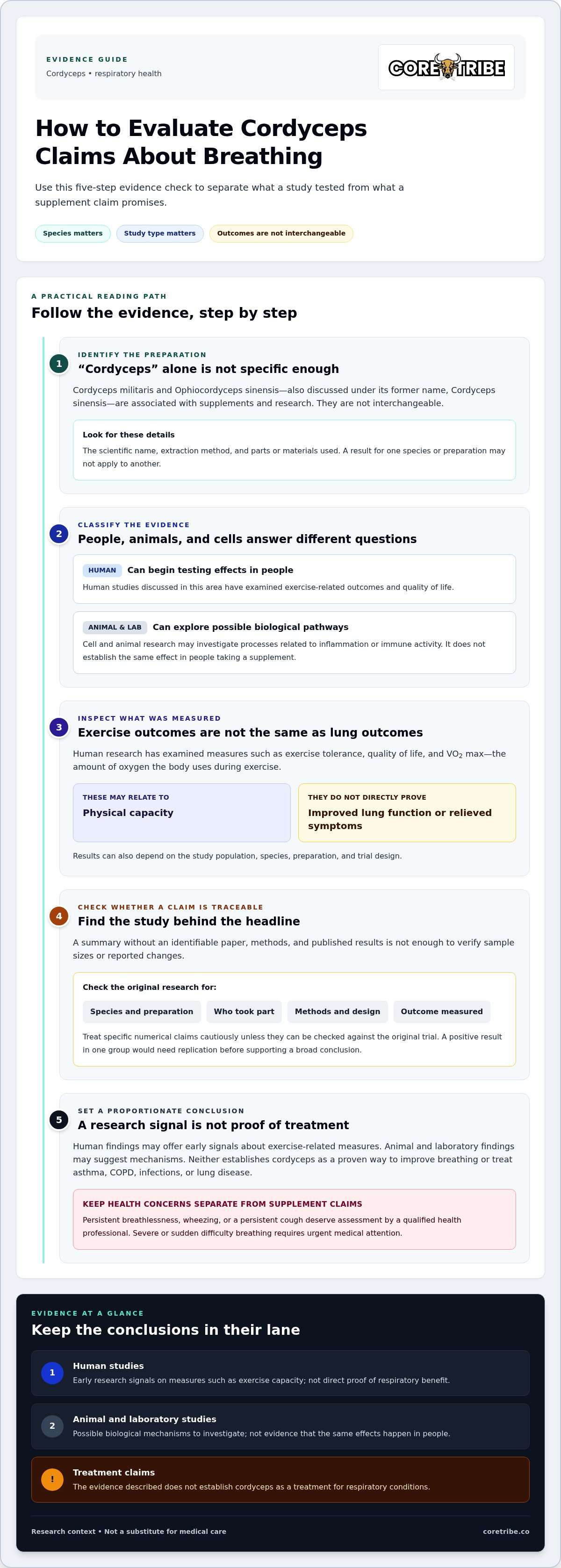
Cordyceps militaris and Ophiocordyceps sinensis, also often discussed under its former name, Cordyceps sinensis, are two species associated with supplements and research. They are not interchangeable. Species, extraction methods, and the parts or materials used can differ. When reviewing a study or product label, look for the scientific name and preparation rather than relying on “cordyceps” alone. A finding for one preparation may not apply to another.
What Does Respiratory Health Include?
Respiratory health includes the lungs and airways’ work of moving air and exchanging oxygen and carbon dioxide. General interest in supporting this function is different from trying to address ongoing breathlessness, wheezing, or a persistent cough, or managing a diagnosed condition. Persistent symptoms deserve assessment by a qualified health professional. Severe or sudden difficulty breathing requires urgent medical attention.
Keeping these distinctions clear helps put the evidence in perspective. Traditional use can explain why cordyceps attracts interest, while research must establish whether a specific preparation offers a measurable benefit. The sections ahead examine what studies have found and what their limits mean if you’re considering a supplement.
What Does Research Say About Cordyceps and Breathing?
Research on cordyceps and breathing includes human studies, animal experiments, and laboratory work. These types of evidence answer different questions. Human trials can begin to test whether a preparation affects people. Animal and cell studies can explore possible biological pathways. A mechanism that looks promising in a lab does not show that a supplement improves breathing or lung function in everyday use.
What Have Human Studies Tested?
Human research discussed in relation to cordyceps has examined outcomes such as exercise tolerance, quality of life, and VO2 max, a measure of how much oxygen the body uses during exercise. These measures may relate to physical capacity, but they aren’t direct proof that a supplement improves lung function or relieves respiratory symptoms. Results also depend on the study population, cordyceps species, preparation, and trial design.
Summaries that don’t identify a traceable paper, its methods, and published results aren’t enough to verify sample sizes or reported changes. Treat specific numerical claims cautiously unless they can be checked against the original trial. Even a positive result in one group would need replication before it could support a broad conclusion about cordyceps for respiratory health.
How Do Laboratory and Animal Findings Fit?
Cell and animal research can help scientists investigate how cordyceps compounds interact with biological processes, including pathways related to inflammation or immune activity. Such findings can guide future questions, but they don’t establish that the same effects happen in humans after taking a supplement. Species, doses, and experimental conditions may differ substantially from real-world use.
These studies can offer a reason to keep researching, not a basis for promising relief from asthma, infections, or lung disease. The next step is well-designed human research that tests a clearly identified preparation and measures meaningful respiratory outcomes.
Evidence in brief: Human studies may offer early signals about exercise-related measures, while animal and laboratory findings suggest possible mechanisms. Neither establishes cordyceps as a proven way to improve breathing or treat respiratory conditions.
When you read a claim, look for the original study, the species and preparation tested, who took part, and what outcome researchers measured. If those details aren’t clear, the claim may go beyond what the evidence supports. Readers exploring supplements can also browse Coretribe’s supplement collection while keeping research findings separate from product-specific claims.
Cordyceps for Respiratory Health: Claims, Evidence, and Limits
Claims about cordyceps can sound more certain than the evidence behind them. To assess a claim, ask what kind of research supports it and whether researchers measured breathing itself, exercise performance, or only a biological process in a lab. These outcomes may be related, but they aren’t interchangeable.
| Claim | Evidence type | What it may suggest | What remains unknown |
|---|---|---|---|
| Cordyceps may support oxygen use or exercise capacity. | Some human research has examined exercise-related measures such as oxygen use or stamina. | There may be a research signal worth investigating for physical performance. | Whether any effect is reliable, applies to healthy people generally, or reflects improved lung function. |
| Cordyceps may influence inflammation or immune activity. | Laboratory and animal research. | Researchers can explore possible biological pathways. | Whether these mechanisms produce meaningful respiratory benefits in people. |
| Traditional use demonstrates respiratory effectiveness. | Historical or traditional use, not clinical testing by itself. | It can explain why cordyceps has attracted scientific interest. | Whether it safely and consistently improves a specific health outcome. |
| Cordyceps treats asthma, COPD, or respiratory infections. | Not established by the evidence summarized here. | No treatment conclusion can be drawn. | Clinical effectiveness and safety for these conditions. |
Can Cordyceps Improve Oxygen Use or Breathing Capacity?
Oxygen use during exercise and stamina are performance measures, not direct measurements of lung function or relief from breathing symptoms. A change in exercise performance alone can’t show that airways work better or that a respiratory condition improves. The evidence described here is preliminary. Without a verifiable study citation and details about its design and population, reported results shouldn’t be treated as established clinical conclusions.
Why Study Results May Not Apply to Every Supplement
Research findings apply to the specific species, preparation, and population studied. Species and extracts can differ, and a commercial supplement may not match the preparation used in a trial. If a study or product label leaves these details unclear, it’s difficult to judge whether the findings apply. That uncertainty doesn’t mean the preparations are equivalent.
Evidence summary: Human research has explored exercise-related outcomes, but the evidence available here does not establish that cordyceps improves lung function, relieves respiratory symptoms, or treats disease.
Traditional use and proposed mechanisms can guide research, but neither proves effectiveness. For cordyceps for respiratory health, distinguish early signals from demonstrated clinical benefits, and don’t treat a supplement as a substitute for medical care.
How to Evaluate Cordyceps Supplements and Respiratory Health Claims
A careful review starts with two separate questions: What does the product contain, and what does the evidence actually show? A clear label can help you understand a supplement, but it can’t prove a respiratory benefit. Promising research also doesn’t show that every product sold as cordyceps matches the preparation studied.
What to Look for on a Cordyceps Label
Review the label for the stated species, ingredient form, serving information, and other listed ingredients. Compare those details with a study only if its methods clearly identify the species and preparation used. If a research paper or label leaves important information unclear, don’t assume the supplement is equivalent to the study material.
Look for quality or testing statements only when they’re specific and verifiable. A quality measure addresses what is in a product, not whether it improves breathing. Be cautious of language that promises to treat, cure, or prevent a respiratory disease. A confident claim isn’t the same as clinical evidence.
Safety, Medications, and When to Seek Guidance
Whether a supplement is suitable can depend on your health and circumstances. Ask a qualified healthcare professional about possible interactions and whether a supplement is appropriate for you, especially if you take medication, have a chronic condition, are pregnant, or are breastfeeding. They can also advise on dose-related questions. There isn’t enough information here to recommend a dose.
Don’t use a supplement to delay care for breathing problems. New or worsening symptoms should be assessed by a healthcare professional, and severe or sudden difficulty breathing calls for urgent medical care.
Use this checklist to assess cordyceps for respiratory health claims:
- Identify the ingredient: Check the species and form named on the label.
- Read the full label: Review serving information and all listed ingredients.
- Check the claim: Does it describe a measured study outcome, or promise treatment for a condition?
- Compare carefully: Match the product with a study only when reliable details about both preparations are available.
- Consider your health: Get professional guidance about medications, conditions, pregnancy, breastfeeding, and dosing.
Coretribe offers Cordyceps as part of its supplement range. Explore the supplement collection, and assess any product by its label rather than assuming a particular respiratory outcome.
A Balanced Next Step for Cordyceps and Respiratory Wellness
The evidence supports curiosity, not certainty. Cordyceps has a history of traditional use, and researchers continue to explore its possible effects. But current findings don’t establish that it improves lung function, eases breathing symptoms, or prevents respiratory illness. It isn’t necessary for respiratory wellness, and it shouldn’t replace medical care.
A balanced view includes both potential interest and important limits:
- Potential interest: Research offers questions worth exploring, including whether particular preparations affect exercise-related measures.
- Important limits: Study results may not apply to different species or products, and early findings don’t confirm a clinical benefit.
- Practical priority: Everyday health foundations and appropriate care matter whether or not you choose to use a supplement.
The U.S. Centers for Disease Control and Prevention identifies avoiding tobacco smoke as one way to protect respiratory health. If breathing symptoms are persistent, new, or worsening, seek qualified medical advice. Severe or sudden difficulty breathing needs urgent attention.
Who May Want to Learn More About Cordyceps?
Cordyceps may interest people exploring supplements as part of a broader wellness routine, provided expectations remain measured. Consider the quality and limits of the evidence alongside your own health circumstances, rather than viewing the supplement as treatment or disease prevention. For a wider perspective on wellbeing, explore the holistic mind-body balance guide.
What to Do Before Trying a Supplement
Read the label and compare it with research only when reliable details about the study preparation are available. A supplement’s quality and the strength of evidence for a health benefit are separate questions; neither guarantees an outcome. If you take medication, have a chronic condition, are pregnant or breastfeeding, or have breathing symptoms, discuss personal risks and suitability with a qualified healthcare professional.
If you’re interested after weighing the evidence and your own needs, explore Coretribe’s supplement collection as one option in your personal wellness routine. Keep expectations realistic, and make sure breathing symptoms receive appropriate care.
Make Your Next Wellness Choice With Clarity
The research on cordyceps for respiratory health offers reasons for continued study, but it hasn’t established that supplements improve lung function or treat respiratory conditions. Human findings on exercise-related measures are not the same as proof of better breathing, and laboratory or animal research can’t confirm benefits in people. Species, preparation, and individual health context also matter.
A thoughtful choice means weighing those limits, reading the product label carefully, and discussing personal suitability or medication questions with a qualified healthcare professional. Cordyceps isn’t essential for respiratory wellness, and it shouldn’t replace medical care or everyday habits that support health.
Coretribe offers Cordyceps among its supplement categories. Explore Coretribe’s wellness supplement collection and choose with an informed perspective and realistic expectations.
Frequently Asked Questions
Can cordyceps help with respiratory health?
It’s possible that cordyceps may have effects worth studying, but current evidence doesn’t establish that it improves breathing or prevents respiratory problems. Research varies by species and preparation, and findings from cells or animals can’t confirm benefits in people. If you’re considering cordyceps for respiratory health, treat it as a supplement of uncertain benefit, not a substitute for medical assessment or treatment.
What does research say about cordyceps and lung function?
Research has explored cordyceps in relation to exercise measures such as oxygen use and stamina, but these aren’t the same as direct measurements of lung function. Laboratory and animal studies may suggest pathways for further study, yet they can’t show that people breathe better after taking a supplement. The available evidence doesn’t establish a reliable improvement in lung function, symptoms, or respiratory capacity.
Is cordyceps safe to take every day?
There isn’t enough information here to say that daily cordyceps use is safe for everyone. Safety may depend on the product, amount, health conditions, and other supplements or medicines you use. Follow the product label, and discuss regular use with a qualified healthcare professional, especially if you’re pregnant, breastfeeding, managing a chronic condition, or unsure whether it’s appropriate for you.
Can cordyceps interact with medications?
It may be possible for a supplement to interact with medication or affect whether it’s suitable for your health situation. The risk can depend on the specific cordyceps product and your medicines, so don’t assume a natural ingredient is interaction-free. Before taking it, show the label to a qualified healthcare professional or pharmacist and ask about potential interactions. Don’t stop or change prescribed medication without medical guidance.
Which type of cordyceps is used in supplements?
Supplements may use different species, including Cordyceps militaris and Ophiocordyceps sinensis, sometimes called Cordyceps sinensis in older references. Products may also differ in ingredient form and preparation. Check the scientific name and other details on the label, then compare them with research only when the study clearly identifies what it tested. Evidence for one preparation may not apply to another.
Does cordyceps help with asthma or COPD?
Cordyceps hasn’t been established as a treatment for asthma or chronic obstructive pulmonary disease (COPD). Early research or proposed biological mechanisms don’t prove that it relieves symptoms, prevents flare-ups, or changes the course of either condition. If you have asthma or COPD, follow your care plan and speak with a qualified healthcare professional before considering a supplement. Don’t delay prescribed treatment or urgent care to try cordyceps.
How long does cordyceps take to affect breathing?
There’s no established timeline for cordyceps to affect breathing, and current evidence doesn’t show that it reliably improves respiratory symptoms. Study duration alone can’t predict how quickly a person might respond, or whether they would respond at all. Don’t increase the amount or continue taking a supplement in expectation of relief. If breathing symptoms are new, persistent, or worsening, seek medical advice. Severe or sudden difficulty breathing needs urgent care.

