


Could cordyceps support sexual wellness without being a proven libido booster? It’s understandable to feel hopeful when claims about cordyceps for libido increase appear alongside traditional uses and promising-sounding research. But human evidence is limited, and findings from animal studies can’t tell us whether people will experience the same effects.
Libido changes can feel personal, and they don’t always have a simple explanation. Desire is different from arousal, erectile function, or energy, even though these experiences can influence one another. That distinction matters when judging claims about any supplement.
This guide looks at what research on cordyceps and sexual desire can, and can’t, show. You’ll learn how to interpret early findings, distinguish libido from related aspects of sexual function, and consider safety before trying a supplement. The aim isn’t to promise a quick fix, but to help you make a careful, informed choice.
Key Takeaways
- Libido means sexual desire. It isn’t the same as arousal, erectile function, or fertility.
- Evidence for cordyceps for libido increase in humans is limited. Traditional use and animal findings shouldn’t be treated as proof.
- Distinguish research on sexual desire from claims about testosterone, erectile function, or general energy.
- Compare cordyceps supplements carefully: species, preparation, serving information, and quality testing can differ.
- Consider supplements an optional part of wellness, not a substitute for looking into persistent changes in libido.
Cordyceps for libido increase: what does libido mean, and what can supplements affect?
Can cordyceps increase libido? The clearest answer is that human evidence remains limited. Cordyceps has a history of traditional use, but that history doesn’t establish that a supplement reliably increases sexual desire. Claims about vitality or sexual wellness may sound persuasive, but they don’t prove one causes the other.
Libido is a person’s interest in or desire for sexual activity. It can vary over time and may be influenced by health, stress, sleep, relationships, medications, and life stage. A change in desire isn’t automatically a sign that something is wrong, and it doesn’t have one universal cause.
The term Cordyceps refers to a group of fungi with different species and preparations. Some have also featured in traditional Chinese medicine. That background helps explain why people explore the mushroom for sexual wellness, but tradition is context, not clinical proof. To assess claims about cordyceps for libido increase, look for human research that directly measured desire.
Is libido the same as sexual performance?
No. Desire is interest or motivation for sexual activity. Arousal describes the body’s response to sexual stimulation; erection, orgasm, and fertility are distinct outcomes as well. These experiences may overlap, but a finding about one doesn’t establish an effect on the others. For example, research measuring exercise capacity or perceived energy cannot, by itself, show that participants felt more sexual desire.
Keeping these outcomes separate also avoids assumptions about gender, relationship status, or why desire changes. Someone may want intimacy without experiencing a particular physical response, or have a physical response without feeling much desire. Neither pattern alone defines a person’s libido.
Why might someone consider cordyceps for sexual wellness?
Traditional use and modern wellness marketing often associate cordyceps with vitality. Because energy and sexual well-being can feel connected, a broad vitality claim can easily become a more specific promise about libido. But a plausible connection isn’t proof of cause and effect. Supporting a claim that cordyceps increases libido requires relevant human research that measures sexual desire.
Questions about desire can feel private or difficult to raise. There’s no need to treat a change as a personal failing or assume a supplement is the answer. A thoughtful starting point is to notice what has changed and consider the wider context, including stress, sleep, health, and life circumstances. Persistent or concerning changes may warrant discussion with a qualified healthcare professional.
Cordyceps and libido research: mechanisms, human evidence, and important limits
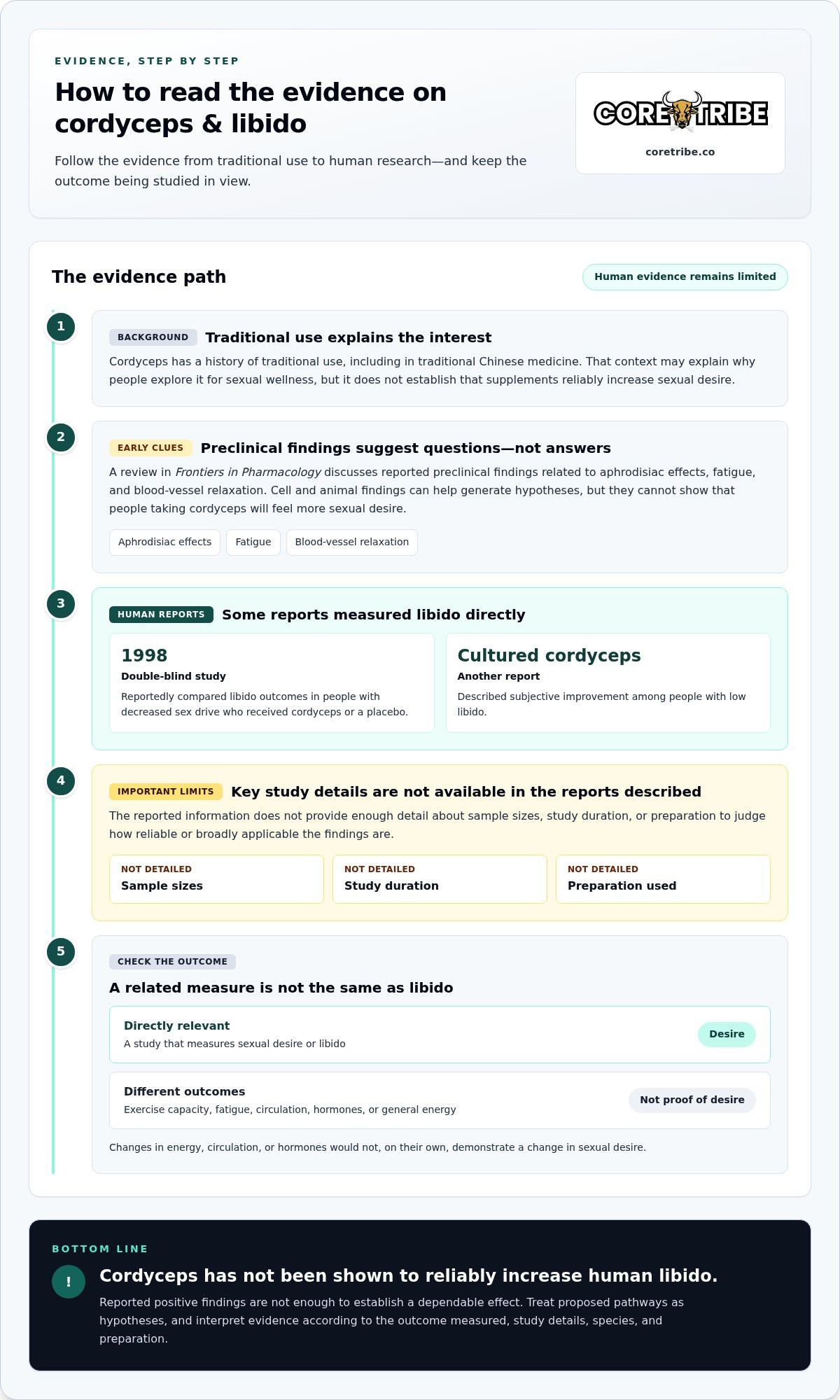
To judge claims about cordyceps for libido increase, separate the evidence by type. Traditional use can explain why an ingredient attracts interest, while laboratory and animal studies can suggest questions for researchers. Neither establishes that people taking a supplement will feel more sexual desire. Human studies that directly measure libido are most relevant, but the available evidence remains limited.
What mechanisms are proposed for cordyceps?
Researchers have explored a range of potential biological effects. A review in Frontiers in Pharmacology discusses reported pharmacological activities, including preclinical findings related to aphrodisiac effects, fatigue, and blood vessel relaxation. These findings can help generate hypotheses, but they don’t show that cordyceps increases human libido. Changes in circulation, hormones, or energy would not, on their own, demonstrate a change in sexual desire.
What do human studies actually measure?
Some reported human research has assessed libido directly, but the findings need careful interpretation. A 1998 double-blind study is reported to have compared libido outcomes in people with decreased sex drive who received cordyceps or a placebo. Another report describes subjective improvement among people with low libido after cultured cordyceps. The reported information doesn’t provide enough detail about sample sizes, study duration, or preparation to judge how reliable or broadly applicable these results are.
That distinction matters. A study about libido asks whether participants’ sexual desire changed. Research measuring exercise capacity or fatigue asks a different question, even if improved energy could plausibly affect someone’s well-being. One outcome can’t stand in for another.
Evidence summary: Human research directly addressing cordyceps and libido is limited, and reported positive findings aren’t enough to establish that cordyceps reliably increases sexual desire. Study design, participant numbers, the exact species and preparation, and the outcome measured all affect how much confidence to place in a result. Findings from cell or animal research are early clues, not proof of a benefit in people.
For now, view proposed pathways as hypotheses and libido claims as unproven, not guaranteed. Coretribe’s supplement range includes Cordyceps as one optional part of a considered wellness approach.
Cordyceps for libido vs. other claims: how to separate desire from energy and hormones
Supplement claims may place libido alongside energy, testosterone, and sexual performance as though they’re interchangeable. They aren’t. To assess a claim, look at the specific outcome a study measured and whether it involved people using the same species and preparation as the supplement being discussed.
| Outcome | What direct evidence would measure | How to interpret cordyceps claims |
|---|---|---|
| Libido | Sexual desire or interest, assessed directly in people | Some human libido research has been reported, but the evidence is limited and doesn’t establish a reliable effect. |
| Erectile function | Ability to achieve or maintain an erection | Findings in diabetic rats are not proof of benefit in people, or evidence of increased desire. |
| Testosterone | Hormone levels measured in human participants | Testosterone-related findings in mice don’t establish a human hormone effect or a libido benefit. |
| General energy | Measures of fatigue, stamina, or exercise capacity | These outcomes may relate to overall well-being, but they don’t directly measure sexual desire. |
Evidence for one outcome cannot confirm another: a change in energy, hormone levels, or erectile function does not by itself prove that sexual desire increases.
Does cordyceps increase testosterone or improve erectile function?
There isn’t enough verified human evidence to conclude that cordyceps reliably increases testosterone or improves erectile function. Memorial Sloan Kettering Cancer Center notes that cordyceps stimulated testosterone production in mice, while whether this happens in humans is unknown, as described in its Cordyceps evidence from MSKCC. A hormone marker also isn’t the same as a meaningful change in desire or sexual function. Treat these findings as research leads, not a basis for self-diagnosis.
What else can influence sexual desire?
Desire can shift with stress, sleep, mood, relationship context, health conditions, medications, and changes in life circumstances. These factors may overlap, and the same change in libido can have different explanations for different people. Lower desire doesn’t automatically mean something is wrong or needs treatment.
If a change is persistent, distressing, or accompanied by other symptoms, consider discussing it with a qualified healthcare professional. That can help clarify possible contributors rather than relying on a supplement claim to explain what’s happening.
How to evaluate cordyceps supplements and use a cautious, evidence-aware approach
If you’re considering a supplement after reading claims about cordyceps for libido increase, start with the label, not the promise. Species and preparations can differ, so don’t assume products match one another or the preparations used in research. A clear label helps you understand what you’re considering, though it can’t guarantee a particular effect.
What should a cordyceps label make clear?
Use this checklist to assess whether product information is specific enough to support an informed choice:
- Species: Look for the Cordyceps species, rather than a label that names only the genus.
- Serving information: Check the amount per serving and the suggested serving directions. This is label information, not a personalized dose recommendation.
- Preparation: See whether the label explains if the ingredient is a whole mushroom, mycelium, or extract, and provides details about the extract where applicable.
- Other ingredients: Review the full ingredient list, especially if the product combines Cordyceps with other active ingredients.
- Quality information: Look for clear information about quality testing and what it covers. Don’t assume a broad “quality” or “purity” statement means a particular certification or independent test.
These details matter because different species, mushroom parts, and extraction methods may produce preparations that aren’t interchangeable. If a label leaves key details unclear, it’s harder to compare the product with research or understand what you’re taking.
Who should take extra care before using a supplement?
Supplements can be relevant to medication use and health circumstances. If you take medication, have an ongoing condition, or have a planned procedure, ask a qualified healthcare professional or pharmacist whether Cordyceps is appropriate for you. If you’re pregnant or breastfeeding, seek individualized professional guidance before using a supplement.
There isn’t a single dose that can be recommended here for libido, and this information can’t replace personal medical advice. If you decide to try Cordyceps, follow the product label and avoid treating a change in desire as proof that the supplement is working or addressing its cause.
Coretribe offers Cordyceps as part of its supplement range. The supplement collection presents it as an optional wellness choice, not a guaranteed solution for libido.
A balanced next step: consider cordyceps as one part of sexual wellness
The evidence around cordyceps for libido increase remains limited, so keep expectations measured. Traditional use and early findings may prompt interest, but they don’t establish that Cordyceps reliably increases sexual desire. A supplement can be an optional wellness choice, not a substitute for investigating a persistent change or getting care when you need it.
How can readers make an informed decision?
Start by being clear about what you hope to support. Are you noticing a change in sexual desire, low energy, or a physical aspect of sexual function? These are different goals, and evidence for one doesn’t prove an effect on another. Consider the research, product label, and your personal circumstances together rather than relying on a single benefit claim.
- Check whether research measures the outcome you care about, rather than a related but different result.
- Review the label for species, preparation, serving information, and other ingredients.
- Consider medication use and health circumstances; seek professional guidance if you’re unsure whether a supplement is appropriate.
If you choose to try a supplement, follow its label and pay attention to how you feel. Stop using it and seek advice if you experience a concerning reaction. For ongoing or distressing changes in desire or sexual function, a qualified healthcare professional can help explore possible contributors. You don’t have to assume that a supplement is the answer, or that a change in libido automatically needs treatment.
Where does Coretribe fit into the next step?
Coretribe offers Cordyceps within its broader supplement range. It’s an option for people interested in this ingredient, but the offering shouldn’t be read as a clinically proven way to increase libido. Base your decision on what you’re looking for, the evidence available, transparent product information, and any guidance relevant to your health.
There’s no need to rush. Coretribe’s supplement collection includes Cordyceps for those considering it as part of a personal wellness approach.
Choose your next step with clarity and care
The evidence for cordyceps for libido increase in humans remains limited, and claims about energy, testosterone, or erectile function don’t automatically demonstrate a change in sexual desire. Libido can shift for many reasons, so consider your own health and circumstances rather than expecting one supplement to provide a guaranteed answer.
If changes in desire or sexual function persist or cause concern, consider discussing them with a qualified healthcare professional. If you’re curious about Cordyceps, review the product details and treat it as an optional wellness choice, not a replacement for care or further investigation.
Coretribe offers Cordyceps as part of its natural supplement range. Explore Coretribe’s supplement collection to review the available options and make an informed choice at your own pace.
Frequently Asked Questions
Can cordyceps increase libido in men or women?
It’s not established that cordyceps reliably increases libido in men or women. Limited human research has reported changes in libido, but the available evidence doesn’t provide enough detail to determine how dependable the findings are or whether they apply across different people and preparations. Claims about cordyceps for libido increase should be considered cautiously, not as a guaranteed outcome. Desire can also vary with health, stress, sleep, relationships, medications, and life stage.
How long does cordyceps take to affect libido?
There’s no established timeline for cordyceps to affect libido. Current evidence doesn’t identify a proven time frame or show that a particular duration of use reliably increases sexual desire. Be wary of claims promising results within a specific number of days or weeks unless they’re supported by relevant human research. If you choose to use a supplement, follow its label, and don’t delay seeking advice about persistent or concerning changes in desire.
What is the difference between cordyceps for libido and cordyceps for energy?
Cordyceps for libido refers to a claim about sexual desire, while cordyceps for energy refers to claims about fatigue, stamina, or exercise capacity. Those outcomes require different evidence. Feeling more energetic could support general well-being, but it doesn’t prove that sexual desire has changed. When assessing a product claim or study, check what was actually measured, who participated, and whether the research examined libido directly.
Is cordyceps safe to take every day?
Daily use can’t be assumed safe for everyone, and the evidence provided here doesn’t establish a universally safe duration or dose. Follow the product label, and don’t exceed its directions. If you notice a concerning reaction, stop taking the supplement and seek professional advice. Ask a qualified healthcare professional or pharmacist before use if you take medication, have an ongoing health condition, are pregnant or breastfeeding, or have a planned procedure.
Can cordyceps interact with medications or health conditions?
Whether cordyceps is appropriate can depend on your medications and health circumstances, so don’t assume a supplement is interaction-free because it’s natural. Research may not answer every question about a specific product or combination. If you take medication, have an ongoing condition, or have a planned procedure, ask a qualified healthcare professional or pharmacist before using it. People who are pregnant or breastfeeding should seek individualized professional guidance before taking supplements.
What should I look for in a cordyceps supplement?
Look for a label that identifies the Cordyceps species, amount per serving, preparation or extract details, and all other ingredients. Transparent information about quality testing can also help you assess what the product contains; don’t assume a general quality statement means it has a particular certification. Species and preparations can differ, so products aren’t automatically interchangeable. Compare the label with your needs, follow its directions, and seek professional guidance if safety is uncertain.

