


What if the generic multivitamin on your kitchen counter is passing right through you without replenishing your baseline vitality? It's deeply frustrating to take daily supplements and still struggle with persistent fatigue, especially when you find yourself wondering what minerals are in shilajit and whether those bold claims of 84 plus trace elements are genuinely backed by science.
You aren't alone in questioning the difference between beneficial earth minerals and unwanted heavy metal contaminants. Authentic Himalayan shilajit delivers a rich spectrum of essential macrominerals and microscopic trace elements, but its true strength lies in its fulvic acid content. Fulvic acid bonds to these minerals in an ionic state, dramatically enhancing cellular bioavailability so your body can actually absorb and put them to work. In this complete guide, you'll explore the documented mineral breakdown of pure shilajit, discover how rigorous third-party lab testing ensures absolute safety, and gain the clarity you need to restore your elemental balance with confidence.
Key Takeaways
- Uncover exactly what minerals are in shilajit, exploring how centuries of compressed high-altitude flora concentrate 84 plus ionic trace elements into a living phytocomplex.
- Identify essential macrominerals like iron and magnesium that naturally replenish depleted reserves to sustain steady, day-long physical stamina.
- Understand why fulvic acid acts as nature's ultimate cellular carrier, transporting microscopic nutrients directly through cell membranes for superior bioavailability.
- See how balanced trace elements and natural electrolytes spark mitochondrial ATP synthesis to help lift persistent, everyday fatigue.
- Learn how to verify third-party lab reports so you can choose purified, heavy-metal-cleared formulations that support long-term elemental vitality.
The Mineral Profile of Shilajit: What Are the 84+ Trace Elements?
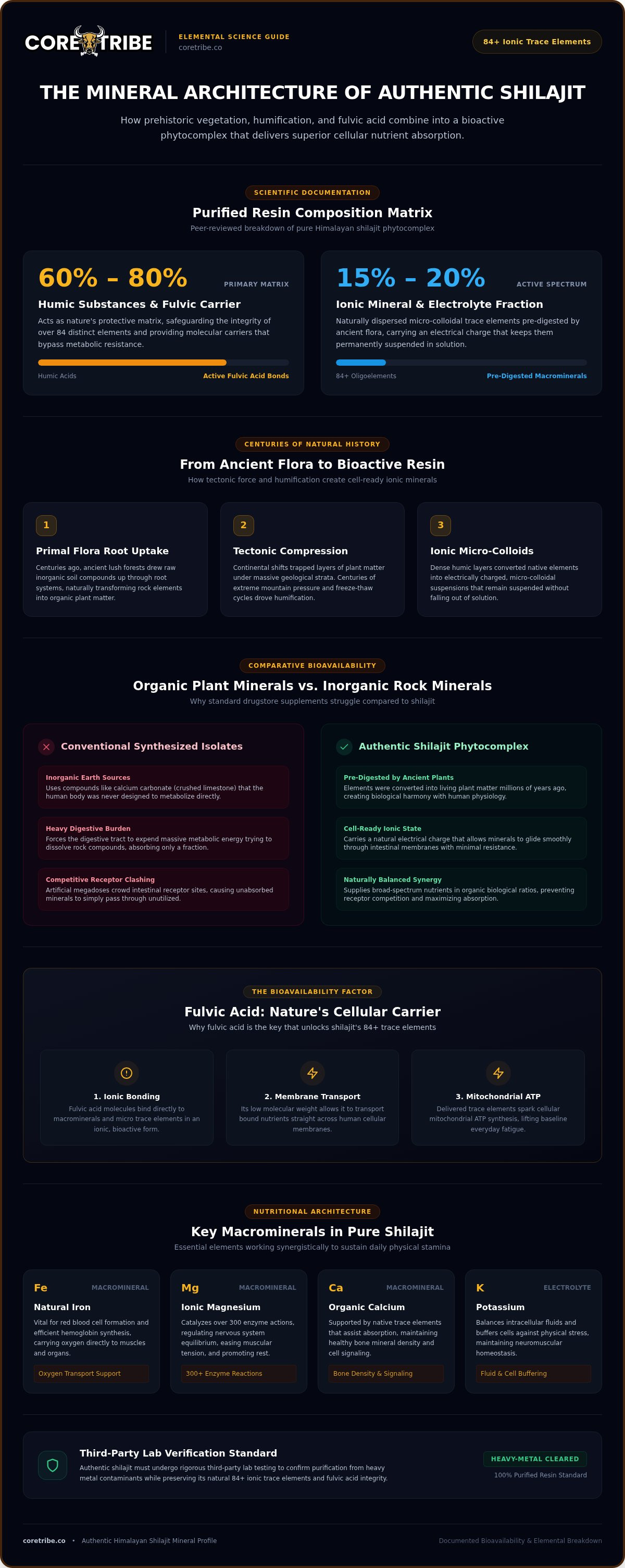
To truly understand what minerals are in shilajit, one must look deep into natural history. Shilajit isn't a simple mineral deposit scraped off a rock face. Rather, it is a dense phytocomplex created over centuries as lush prehistoric vegetation gradually decomposed under massive geological forces. As tectonic collisions thrust ancient ocean floors and primal forests skyward to form high mountain ridges, layers of lush plant matter became trapped beneath towering strata. Over hundreds of years, this organic material underwent a slow, natural transformation known as humification.
Scientific documentation of shilajit composition shows that purified resin consists of 60% to 80% humic substances, alongside a balanced mineral fraction of roughly 15% to 20%. These enduring humic substances act as nature's protective matrix, safeguarding the integrity of over 84 distinct elements. Unlike conventional, lab-made multivitamin tablets that rely on isolated, synthesized compounds, shilajit delivers a harmonious collective of nutrients bound naturally together just as nature designed.
How Centuries of Geological Pressure Create Ionic Minerals
Intense mountain weight combined with seasonal freeze-thaw cycles compresses these ancient humic layers into a potent resin. This process converts native elements into micro-colloidal suspensions. Because these particles carry a natural electrical charge, they remain permanently dispersed in fluid rather than falling out of solution, making them remarkably gentle on human physiology.
Organic Plant-Derived Minerals vs. Inorganic Rock Minerals
Most drugstore supplements supply inorganic minerals. Calcium carbonate, for instance, is essentially crushed limestone; your digestive tract must expend massive digestive resources trying to dissolve it, often absorbing only a fraction before eliminating the rest.
Shilajit operates on an entirely different biological principle:
- Pre-digested by primal flora: Ancient plants drew raw soil compounds up through their root networks, converting inorganic earth into organic plant matter.
- Cell-ready ionic structure: When these plants broke down, they released trace elements in an ionic state that glides through intestinal membranes with minimal metabolic resistance.
- Naturally balanced ratios: Instead of artificial megadoses that compete for the same receptor sites, these trace elements exist in balanced, biological proportions.
By understanding what minerals are in shilajit through this geological lens, it becomes clear why this ancient mountain resin offers a degree of cellular harmony that standard mineral isolates simply cannot match.
Key Macrominerals and Essential Trace Elements in Authentic Shilajit
When wellness seekers ask what minerals are in shilajit, generic answers often gloss over the precise nutritional architecture. Shilajit's composition divides cleanly into two functional categories: macrominerals required in larger quantities for daily physiological maintenance, and micro trace elements that ignite cellular enzymatic reactions. Together, they create a balanced baseline that helps replenish what modern, depleted soils often leave out of our daily food supply.
Peer-reviewed literature examining the bioavailability of minerals in Shilajit highlights how these organic compounds and oligoelements act collectively at molecular and cellular levels. Rather than overwhelming your system with an isolated megadose of a single nutrient, pure resin delivers broad-spectrum synergy.
Essential Macrominerals: Iron, Magnesium, and Calcium
The primary macrominerals in shilajit provide the physical bedrock for daily endurance and skeletal strength:
- Natural Iron: Crucial for red blood cell formation and efficient hemoglobin synthesis, bioavailable iron transports oxygen directly to hard-working muscles and organs.
- Ionic Magnesium: Catalyzes over 300 enzyme actions, regulating nervous system equilibrium, easing muscular tension, and promoting restorative rest.
- Organic Calcium: Supported by native trace elements that assist absorption, this plant-derived calcium works to maintain bone mineral density and healthy cellular signaling.
- Potassium: Balances intracellular fluids, buffering cells against physical stress and sustaining healthy cardiovascular rhythm.
Vital Trace Elements: Zinc, Selenium, and Copper
While macrominerals handle broad structural demands, microscopic trace elements serve as spark plugs for human biochemistry. Even tiny amounts yield profound systemic effects:
- Zinc: Promotes cellular repair, supports hormonal harmony, and reinforces front-line immune defenses.
- Selenium: Functions as a premier cellular antioxidant, protecting delicate cell walls from everyday oxidative stress.
- Copper and Manganese: Collaborate to synthesize collagen, preserve connective tissue elasticity, and support mitochondrial energy generation.
Understanding what minerals are in shilajit reveals why this ancient phytocomplex delivers such a dependable lift in daily stamina. If you are looking to support your body's elemental reserves naturally, exploring carefully purified shilajit supplements can provide a clean, earth-grown foundation for enduring vitality.
The Bioavailability Factor: Why Fulvic Acid Changes How You Absorb Minerals
Knowing what minerals are in shilajit only tells half the story; the true secret lies in how your cells receive them. You could consume the most nutrient-dense substance on earth, yet if those compounds cannot pass through the intestinal wall and enter individual cells, their vitality is lost. This is where fulvic acid steps in as nature's most sophisticated organic chelator.
Fulvic acid features an exceptionally low molecular weight. Because of its tiny physical footprint, it slips effortlessly through semi-permeable cell membranes where bulkier synthetic compounds stall. As it travels, it neutralizes rogue free radicals, releasing attached mineral ions directly into cellular fluid while carrying out accumulated metabolic waste. This two-way transport system bridges the gap between simple digestive ingestion and true cellular nourishment.
Nature's Cellular Carrier: How Fulvic Acid Works
Fulvic acid acts as an organic cellular transporter, creating microscopic bonds with elemental ions. Thanks to its active electrical charge, it balances cell membrane potential. This electrochemical transfer mechanism allows cells to absorb incoming minerals rapidly, optimizing intracellular hydration while ushering toxic residues out through normal elimination channels.
Chelated vs. Non-Chelated Minerals: What the Science Shows
Standard mineral supplements often arrive in cheap chemical forms like magnesium oxide, zinc sulfate, or calcium carbonate. These non-chelated, inorganic salts routinely trigger gut distress, nausea, and poor uptake because the digestive tract struggles to break their rigid molecular bonds. Unabsorbed, they pass right through the body or stress sensitive elimination organs.
Shilajit provides naturally pre-chelated minerals. The differences in real-world assimilation are stark:
- Natural protection: Fulvic bonds wrap around mineral ions, shielding them from reactive stomach acid and preventing gut lining irritation.
- Superior intestinal passage: The intestinal mucosa recognizes fulvic complexes as organic food rather than inert rock, permitting prompt uptake into the bloodstream.
- Reduced internal burden: Efficient delivery leaves fewer unabsorbed residues behind, working harmoniously with shilajit for liver health by preventing sluggish metabolic waste accumulation.
When you evaluate what minerals are in shilajit, it becomes clear that nature solved the problem of nutrient delivery long before modern chemistry intervened. The fulvic complex transforms raw earth elements into bio-ready fuel that your cells instantly welcome.
How the Minerals in Shilajit Support Daily Energy and Vitality
Persistent physical fatigue often persists even after a full night of sleep. When you evaluate what minerals are in shilajit from a functional perspective, the root cause becomes clearer: your mitochondria cannot produce cellular energy without adequate elemental spark plugs. The human body generates energy through adenosine triphosphate (ATP), and every step of that energetic cycle relies on ionic minerals working in tandem.
Rather than providing an artificial spike like synthetic stimulants, shilajit works at the foundational cellular level. It delivers micro-nutrients directly where metabolic conversion happens, supporting physical stamina, mental clarity, and post-exertion recovery throughout demanding days.
Mitochondrial Support and Cellular Energy Production
Inside each mitochondrion, the electron transport chain converts dietary fuel into usable ATP. Iron acts as a vital electron shuttle, while trace copper helps drive the terminal steps of oxygen utilization. Paired with fulvic carriers, these minerals reach the inner mitochondrial matrix without metabolic delay. This steady conversion process builds durable physical endurance without nervous jitters, rapid heart flutters, or afternoon energy crashes.
Restoring Electrolyte Balance and Deep Cellular Hydration
Many people drink liters of filtered water daily yet remain fundamentally dehydrated at the cellular level. Pure water lacks the mineral charge needed to pass through cell walls against osmotic pressure. Shilajit supplies a balanced trio of essential electrolytes:
- Intracellular potassium: Maintains healthy fluid volume inside cell walls, preventing cramping and supporting muscle contraction.
- Enzymatic magnesium: Regulates the sodium-potassium pump, calming the autonomic nervous system and aiding rapid recovery.
- Natural sodium traces: Balances blood pressure and fluid distribution across tissues without the bloat of refined table salt.
Integrating these natural electrolytes into your morning routine fosters lasting resilience. Pairing a mineral-rich start with mindful lifestyle rituals nurtures true mind-body balance, grounding both mental focus and physical resilience against everyday stress.
When you replace synthetic multi-mineral isolate tablets with a complete phytocomplex, your cells stop struggling to scavenge scarce cofactors. If you want to experience sustained vitality powered by authentic Himalayan earth minerals, take the next step and explore pure shilajit formulations that align with your daily routine.
Maximizing Mineral Synergy: Purity Standards and Botanical Blends
Investigating what minerals are in shilajit inevitably brings you to a pivotal question: how do you ensure that what goes into your body is entirely safe and potent? In its raw state, shilajit is a crude geological pitch exuding from rocky cliff faces. It contains natural mountain grit, microbial debris, and soil sediments that must undergo meticulous filtration before consumption. True wellness begins with rigorous purification, separating beneficial ionic trace elements from unwanted environmental contaminants.
Achieving total-body balance also involves looking beyond single ingredients. Modern herbalism pairs the dense elemental makeup of the earth with oceanic botanicals and adaptogens, building a multi-nutrient synergy that supports resilience across every physical system.
The Critical Importance of Purification and Heavy Metal Testing
Authentic Himalayan resin requires standardized low-temperature extraction to remove impurities while preserving delicate fulvic acid chains. Reliable formulas verify safety through third-party Inductively Coupled Plasma Mass Spectrometry (ICP-MS) testing. This advanced testing ensures heavy metals remain well within strict health limits: lead below 10 ppm, arsenic under 10 ppm, cadmium under 3 ppm, and mercury below 1 ppm. Reputable suppliers also test for obscure toxic metals like thallium and verify that fulvic acid content reaches verified industry benchmarks.
Synergistic Nutrition: Shilajit, Sea Moss, and Ashwagandha
While terrestrial shilajit provides over 84 trace minerals, wildcrafted marine sea moss contributes 92 ocean-derived minerals, including natural iodine, sulfur, and folate. Combining the two creates an unparalleled full-spectrum mineral profile that bridges land and sea.
Adding organic ashwagandha elevates the blend even further:
- Targeted stress modulation: Ashwagandha helps soothe the adrenal glands, moderating cortisol spikes that otherwise burn through essential minerals.
- Enhanced cellular uptake: Shilajit's fulvic acid shuttles sea moss nutrients directly across cell walls with remarkable efficiency.
- Modern daily convenience: Formulations like Coretribe Pure Shilajit Capsules with Sea Moss and Ashwagandha eliminate messy resin spoons, providing consistent, lab-cleared potency.
You can discover how these ancient allies combine to support endurance in our comprehensive shilajit, ashwagandha & sea moss synergy guide.
Understanding what minerals are in shilajit empowers you to look for third-party Certificates of Analysis (CoAs) from ISO-accredited laboratories. When clean geological minerals merge with restorative adaptogens, your daily routine becomes an intentional act of cellular renewal.
Reclaim Your Elemental Vitality from Within
Discovering what minerals are in shilajit transforms how you approach daily physical nourishment. Rather than relying on synthetic multi-mineral isolate tablets that pass through the body unabsorbed, authentic high-altitude resin delivers 84 plus ionic trace elements naturally bound to organic fulvic acid. This ancient phytocomplex supplies the precise elemental spark plugs your mitochondria require to generate clean cellular energy and maintain deep intracellular hydration.
Elevating your daily routine becomes effortless when wildcrafted Himalayan shilajit is paired with mineral-rich marine sea moss and restorative ashwagandha. Backed by rigorous third-party lab testing that verifies elemental safety and purity, you can nourish your cells without messy measuring spoons or bitter resin pastes. Take the first step toward grounded, sustainable endurance and experience pure Himalayan vitality with Coretribe Shilajit Capsules. True balance begins when you restore the elemental foundation your body was built to thrive on.
Frequently Asked Questions
What specific minerals are found in highest amounts in shilajit?
Natural iron, magnesium, calcium, and potassium make up the highest concentrations among the macrominerals in shilajit. Alongside these essential drivers, bioavailable trace elements such as zinc, selenium, copper, and manganese appear in balanced quantities. Rather than flooding your system with unbalanced megadoses, these elements exist in harmonious biological ratios that mirror living plant tissue, providing foundational support for cellular health and enzymatic performance.
Can you get all your daily minerals from taking shilajit alone?
Shilajit serves as a broad-spectrum trace element catalyst rather than a complete replacement for dietary macrominerals. While it supplies over 84 ionic elements, your body requires bulk macrominerals like calcium and magnesium in gram quantities that a modest daily dose cannot fully satisfy. Shilajit works best alongside a nutrient-dense whole-food diet, ensuring that the trace cofactors you need for enzyme activation and metabolic balance are steadily available.
Is there a difference between the minerals in shilajit and a multivitamin?
Yes, there is a fundamental biological difference between the two forms. Multivitamins typically use synthesized, non-chelated mineral salts like calcium carbonate or magnesium oxide, which often pass through the gut unabsorbed. In contrast, examining what minerals are in shilajit shows they are plant-derived and naturally bound to fulvic acid. This ionic structure allows them to bypass digestive resistance and enter cells with minimal metabolic friction.
Does shilajit contain dangerous heavy metals like lead or mercury?
Raw, unrefined shilajit naturally contains heavy metals from surrounding mountain rocks, which is why standardized purification is essential. High-grade supplements undergo careful low-temperature filtration and third-party laboratory testing to clear contaminants. Look for products verified via ICP-MS testing that meet strict safety standards: lead under 10 ppm, arsenic under 10 ppm, cadmium under 3 ppm, and mercury under 1 ppm. A transparent lab report guarantees daily peace of mind.
How does fulvic acid help your body absorb shilajit minerals?
Fulvic acid acts as a natural chelating agent, binding directly to microscopic mineral ions. Because fulvic acid has an exceptionally small molecular weight, it easily penetrates cellular walls where larger synthetic compounds stall. It delivers attached minerals straight into the cell's interior while assisting in the removal of metabolic cellular waste. This dynamic electrochemical exchange dramatically increases bioavailability, allowing your tissues to actually utilize the nutrients you consume.
What happens if you take shilajit supplements every single day?
Taking purified shilajit consistently helps establish a steady baseline of cellular stamina and restorative balance. Over several weeks, daily mineral replenishment supports mitochondrial ATP generation, sustains healthy electrolyte hydration, and aids faster post-exertion recovery. Many people notice a gradual reduction in mid-afternoon slumps and improved mental clarity. For optimal results, choose a standardized, filler-free formula and maintain consistent daily intake alongside plenty of water.
Can combining shilajit with sea moss increase overall mineral intake?
Combining shilajit with wildcrafted sea moss creates an exceptional, full-spectrum botanical synergy. While understanding what minerals are in shilajit reveals over 84 terrestrial elements, marine sea moss contributes 92 ocean-derived minerals, including natural iodine, sulfur, and folate. Shilajit's fulvic acid acts as an organic cellular transporter for these marine nutrients, enhancing systemic uptake. Blends like Coretribe Pure Shilajit Capsules with Sea Moss and Ashwagandha deliver comprehensive land-and-sea nourishment in one simple serving.

