


A better-known supplement brand doesn’t automatically provide clearer proof of purity. In the thorne research vs coretribe for purity comparison, the key question is whether you can review current, product-specific evidence, not which name sounds more established. That distinction matters because Thorne’s shilajit is included in Advanced Testosterone Support, while Coretribe’s listed shilajit capsules also contain sea moss and ashwagandha. These aren’t identical formulas, so a simple brand-versus-brand verdict could mislead.
It’s reasonable to want clear answers about testing, contaminants, and what a purity claim actually means. This guide explains how to assess those details, compare the closest available products, and distinguish a branded ingredient or “lab-tested” statement from a batch-specific certificate of analysis. You’ll learn what to check on each label, what a useful test report should show, and what to ask when documentation isn’t easy to find. The goal is a grounded choice based on evidence you can verify, rather than reputation or a product name alone.
Key Takeaways
- In the thorne research vs coretribe for purity comparison, assess evidence for the specific product and batch rather than relying on brand reputation or a product name.
- Check whether the formulas are genuinely comparable: Coretribe’s listed shilajit capsules also contain sea moss and ashwagandha, while Thorne’s shilajit is included in a multi-ingredient formula.
- Look for a current certificate of analysis that matches the product and lot, and check which contaminants and quality measures the report covers.
- Separate manufacturing standards and ingredient-sourcing claims from test results for the finished product. Each answers a different question about quality.
- Before choosing, verify current labels, serving details, testing scope, laboratory identity, and batch traceability so your decision reflects evidence you can review.
Thorne Research vs. Coretribe for Purity: What Does Purity Actually Mean?
Purity isn’t a single quality stamp. It involves several questions: what a supplement contains, whether it matches its label, and whether unwanted contaminants are controlled. For a meaningful thorne research vs coretribe for purity comparison, look for current records tied to each specific product. Don’t treat a brand’s reputation or a reassuring phrase as proof.
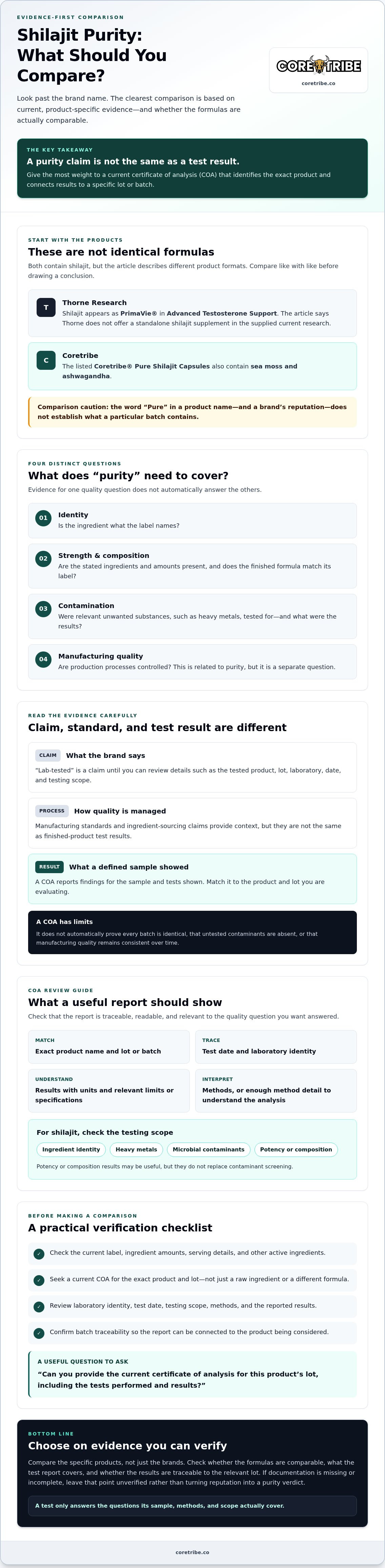
A purity claim describes what a brand says about a product; documented test results show what a defined sample was tested for and what the analysis found. A test report also has limits. It applies to the sample and test parameters shown, not every quality question or every batch unless it can be matched to that batch.
What does supplement purity mean on a product label?
Separate four questions. Identity: is the ingredient what the label names? Strength and composition: are the stated ingredients and amounts present, and does the finished formula match its label? Contamination: were relevant unwanted substances, such as heavy metals, tested for, and what were the results? Manufacturing quality: are production processes controlled? These questions are related, but evidence for one doesn’t answer them all.
A label can list ingredients and make quality claims, but it isn’t a laboratory report. “Lab-tested,” for example, is a claim until you can review details such as the tested product, lot, laboratory, date, and testing scope. For background on supplements and their U.S. regulatory context, see the Dietary Supplement Health and Education Act (DSHEA) overview. It doesn’t replace product-specific evidence.
Why compare products rather than brand reputations?
A company may use different ingredients, formulas, suppliers, and testing approaches across its products. Thorne Research does not offer a standalone shilajit supplement in the supplied current research; shilajit appears as PrimaVie® in Advanced Testosterone Support. Coretribe’s listed product, Coretribe ® Pure Shilajit Capsules - Mixed Sea Moss & Ashwagandha, combines shilajit with sea moss and ashwagandha. They aren’t direct equivalents simply because both contain shilajit.
Before drawing a conclusion, check each current label for ingredient amounts, serving details, and other active ingredients. Then seek records that apply to those exact products. Natural origin doesn’t establish that an ingredient is free from contaminants, and a premium reputation doesn’t prove that a particular batch passed specific tests. The word “Pure” in a product name isn’t a substitute for results. Compare evidence on equal terms, and leave unverified points open rather than turning a brand impression into a purity verdict.
How to Judge Shilajit Purity Evidence from Thorne Research and Coretribe
A brand-wide statement can describe an approach to quality, but it doesn’t show what was found in the product you’re considering. For thorne research vs coretribe for purity, give the most weight to records that identify the product and connect results to a specific lot. A useful question to ask is: “Can you provide the current certificate of analysis for this product’s lot, including the tests performed and results?”
A certificate of analysis (COA) can report findings for the sample tested, such as ingredient identity or measured contaminants. It can’t automatically prove that every batch is identical, that untested contaminants are absent, or that manufacturing quality is consistent over time. The report’s scope matters as much as the claim of testing: a test that doesn’t cover the contaminant you’re concerned about can’t answer that question.
What should a certificate of analysis include?
Check that the COA identifies the product and its lot or batch, gives a test date, names the laboratory, and presents results with units and relevant limits or specifications. Look for methods, or enough method detail to understand how the analysis was conducted. For shilajit, ask whether testing covers heavy metals, microbial contaminants, and ingredient identity. A potency or composition result may also be useful, but it doesn’t replace contaminant screening.
Match the report to the exact product label. A COA for a raw ingredient, a different formula, or a different lot may offer context, but it isn’t direct evidence for the finished supplement you’re considering. If a result is marked “pass” without showing what was tested or the criteria used, ask for those details.
How do third-party testing and certification differ?
Testing means a sample was analyzed. Certification generally involves a defined standard and a certifying organization’s process, so the terms aren’t interchangeable. Verify any seal or standard with its issuer, and confirm it applies to the exact product, not simply the brand or facility. Manufacturing requirements, including the Current Good Manufacturing Practice (cGMP) regulations, concern production controls; they don’t replace a batch-specific COA.
As of September 2026, the available research indicates that a Thorne-specific, lot-level COA for its product containing PrimaVie® isn’t publicly available. COAs for PrimaVie® from another vendor can’t establish results for Thorne’s finished product. Coretribe states that its shilajit is lab-tested, but a third-party COA wasn’t publicly available in the reviewed materials. Treat both points as documentation gaps to check, not proof of failure or purity. Don’t assume USP or NSF certification without current confirmation for the specific product. You can review Coretribe’s current product listings and seek supporting records for the exact item and lot before deciding.
Thorne Research vs. Coretribe: Compare the Products and Their Purity Claims
A fair comparison starts with the actual products, not the names on their labels. As of September 2026, the closest identified Thorne option is Thorne Advanced Testosterone Support, which contains PrimaVie® shilajit extract alongside other ingredients. Coretribe’s listed shilajit capsule formula combines shilajit with sea moss and ashwagandha. Since neither is a standalone shilajit product, compare the full formulas and their documentation rather than assuming they’re equivalent.
Are the Thorne Research and Coretribe products comparable?
They share a shilajit ingredient, but their blends and purposes differ. Check current product labels for each ingredient, serving details, and amounts before comparing strength. Don’t infer equivalent shilajit doses from capsule counts or product names. If your priority is shilajit alone, note that the identified Thorne product is a multi-ingredient formula and consider whether that fits your comparison.
What can the available purity documentation establish?
The table separates reported information from details that remain unverified. “Not publicly available” means the reviewed materials didn’t provide the record; it doesn’t mean a product failed a test.
| Comparison point | Thorne Advanced Testosterone Support | Coretribe shilajit capsules |
|---|---|---|
| Ingredient blend | Includes PrimaVie® shilajit extract with other ingredients. Check the current label for the complete formula. | Shilajit with sea moss and ashwagandha, according to the listed product name. |
| Available testing records | No publicly available COA for a specific lot of Thorne’s finished product was identified in the reviewed research. | Coretribe states its shilajit is lab-tested for purity and quality; a public third-party COA was not identified in the reviewed materials. |
| Testing scope | PrimaVie® COAs from another vendor report testing of that ingredient, but don’t establish results for Thorne’s finished product. Confirm current product-specific scope directly. | Specific tests, laboratory identity, methods, and results remain unverified without a report. |
| Traceability | Finished-product lot-level documentation was not publicly identified. | Public batch-linked testing documentation was not identified. |
Use the same standard for both brands: seek a current report tied to the finished product and its lot, then check the laboratory, methods, and contaminant panel. The available information doesn’t support declaring either product purer. For product details to review alongside any documents you request, see Coretribe supplements.
A Practical Checklist for Verifying Supplement Purity Before You Buy
Use the same review process for either brand, and keep a short record of what you can confirm. For a fair thorne research vs coretribe for purity decision, connect the product label to the test report and the specific batch you’re considering. If those details don’t line up, note the gap rather than assuming the claim applies.
Which questions should you ask the supplement brand?
Check the label and product page, then ask for any details that aren’t available. Keep your questions specific:
- Does the current COA apply to this exact finished product and lot? Ask how to match its batch identifier to the package.
- Which contaminants and identity tests were included? Ask whether the analysis covers relevant heavy metals and microbial contaminants, and who performed it.
- Does the tested formula match the current label? Confirm that the report relates to the finished blend, not only one ingredient or a different product version.
- Can I review the results and test date? If the response is a general statement such as “tested for quality,” ask for the report or a clear description of the testing scope.
Write down the product name, label version, lot number, document date, laboratory, tests covered, and any unanswered questions. This makes it easier to compare records later and helps prevent a report for one ingredient or batch from being mistaken for evidence about another.
How can you assess purity claims without overreading them?
Read broad terms such as “pure,” “clean,” or “lab-tested” as claims to investigate, not as results. Check whether the document is current, identifies the relevant batch, and reports the measurements or findings you care about. A missing public report is an information gap, not proof that a product failed testing. Similarly, a passing result only speaks to the sample and tests listed.
Reviews may describe a shopper’s experience, and an origin story may offer sourcing context, but neither can show laboratory results for contaminants. Treat them as separate kinds of information. Manufacturing or certification statements also need checking to see what they cover and whether they apply to the specific product.
Purity evidence doesn’t determine whether a supplement is suitable for you. If you have a health condition, take medication, or are unsure about possible interactions, ask a qualified healthcare professional before use.
Use this checklist as you review Coretribe supplement offerings, and verify product-specific documentation before relying on a purity claim.
Choosing Between Thorne Research and Coretribe with Clearer Expectations
There isn’t a responsible brand-wide winner in the thorne research vs coretribe for purity comparison unless the products are assessed using current, comparable evidence. Choose the product that best fits your ingredient preferences and whose documentation answers your questions. If one brand provides a current, batch-specific report for its finished product and the other does not, the first may be easier to evaluate. That difference in accessible evidence isn’t, by itself, proof that the other product is poor quality.
When is one brand easier to evaluate than the other?
As of September 2026, the identified Thorne product containing shilajit is Advanced Testosterone Support, a multi-ingredient formula with PrimaVie®. A lot-specific COA for Thorne’s finished product wasn’t publicly available in the reviewed research. Coretribe lists shilajit capsules with sea moss and ashwagandha, and states that its shilajit is lab-tested, but a public third-party COA wasn’t identified in those materials. These findings describe what was publicly accessible, not what either company may provide upon request.
Thorne’s use of a branded ingredient, or a quality statement from either brand, doesn’t replace a report for the product and batch being considered. COAs for PrimaVie® from another vendor also can’t confirm results for Thorne’s finished formula. If either brand supplies more current records, compare them on equal terms: product identity, batch match, laboratory, test date, methods, and relevant results. If key details are missing, keep the comparison open rather than filling gaps with assumptions.
What should shoppers review before making a final choice?
Before deciding, revisit the current label and confirm the complete ingredient list, serving information, and amount of shilajit if stated. Then check whether available tests relate to the finished product and the lot you’re considering. Note unresolved points, such as unreported testing scope or a certificate that doesn’t match the batch. Those are useful questions to ask, not automatic reasons to conclude that a product is unsafe or pure.
Coretribe’s listed formulation combines shilajit with sea moss and ashwagandha. If you’re weighing how those ingredients fit together, read the Shilajit, Ashwagandha, and Sea Moss synergy guide for ingredient context, not proof of purity or a promised health outcome. For personal suitability, including possible interactions with medicines or health conditions, consult a qualified healthcare professional rather than relying on marketing language.
Take the time to review the label and request product-specific records that matter to you. When you’re ready, you can explore Coretribe’s current collection and assess each product using the same careful standards.
Make Your Choice with Evidence in Hand
The clearest takeaway from the thorne research vs coretribe for purity comparison is to judge the specific formula and its supporting records, not the brand name or the word “pure.” Check the current label, then look for test documentation that identifies the product, batch, laboratory, and relevant testing scope. If information is missing, treat it as something to verify, not as proof of either purity or poor quality.
Coretribe’s listed offering includes Pure Shilajit Capsules mixed with sea moss and ashwagandha. Product certifications and batch-specific purity testing aren’t established by a product name or general claim, so review current product details and ask for applicable documentation before drawing conclusions. Use the same evidence standard for any Thorne product you’re considering, while remembering that the formulas may not be direct equivalents.
Thoughtful comparison takes patience, but it helps you choose with clearer expectations. Explore Coretribe’s current supplement collection and review the product information as you continue your research.
Frequently Asked Questions
Is Thorne Research or Coretribe purer?
There isn’t enough comparable, product-specific evidence to declare either brand purer. The identified Thorne product, Advanced Testosterone Support, contains PrimaVie® shilajit in a multi-ingredient formula. Coretribe’s listed capsules combine shilajit with sea moss and ashwagandha. The reviewed materials didn’t include current batch-specific certificates of analysis for either finished product. Missing public documents don’t prove a product is poor quality, but they limit what shoppers can independently verify.
What does a certificate of analysis prove for a supplement?
A certificate of analysis (COA) reports results for a particular sample and the tests listed on that document. It may show ingredient identity or measured contaminants if those were included in the analysis. Check the product name, lot or batch, test date, laboratory, methods, and results. A COA can’t automatically establish that every batch has the same results or prove that substances outside its testing scope are absent.
Can you compare Thorne Research and Coretribe directly?
You can compare them carefully, but they aren’t necessarily like-for-like products. The identified Thorne option with shilajit is Advanced Testosterone Support, which includes other ingredients. Coretribe’s listed shilajit capsules also contain sea moss and ashwagandha. For a fair thorne research vs coretribe for purity comparison, check current labels, serving details, and batch-specific records for both finished formulas. Don’t assume ingredient amounts or testing are equivalent.
How do I know if shilajit has been tested for heavy metals?
Look for a current COA tied to the exact finished product and its lot or batch. Confirm that the report specifically lists heavy-metal testing, identifies the laboratory, and provides results for the contaminants tested, such as lead, arsenic, cadmium, or mercury. A general “lab-tested” statement doesn’t identify the test panel or findings. If the report is unavailable, ask the brand whether it can provide product-specific results.
Does the word pure on a supplement label guarantee purity?
No. “Pure” in a product name or marketing statement isn’t a laboratory result and doesn’t show which contaminants were tested. Treat it as a claim to verify. Look for documentation that identifies the exact product and batch, names the laboratory, and reports relevant test results. The same standard applies to natural-origin or premium-quality language: it may describe a product, but it doesn’t replace evidence about its composition or testing.
Is third-party tested the same as third-party certified?
No. Third-party testing means an outside laboratory or organization analyzed a sample; the phrase alone doesn’t reveal what was tested or the results. Certification involves a defined program or standard, so verify the certifying organization, the scope, and whether the specific product is covered. Don’t assume a brand-wide seal applies to every formula. For either term, seek current documentation and confirm it relates to the product you’re considering.
What should I compare before buying a shilajit supplement?
Start with the current label: check the full ingredient list, serving information, and whether shilajit is a standalone ingredient or part of a blend. Then look for product- and batch-specific testing, including the laboratory, date, methods, and relevant contaminant results. Compare documents using the same criteria, and note unanswered questions rather than guessing. For personal suitability or possible interactions with medicines or health conditions, consult a qualified healthcare professional.

