


What if lasting mental clarity begins not with another caffeine hit, but with supporting the cells that power your brain? Brain fog and midday fatigue can make focus feel fragile, while concerns about memory may leave you searching for a steadier approach. Interest in shilajit for cognitive function is growing, but can it sharpen thinking or help preserve memory? The honest answer is that early research is promising but limited. Shilajit isn’t a proven cognitive treatment.
This guide looks at how this mineral-rich substance, traditionally gathered in the Himalayas, may relate to brain health, and where the science still has questions. We’ll cover fulvic acid and antioxidant properties, what early studies suggest about attention and memory, and why purification and product quality matter. You’ll also find practical ways to assess a supplement and consider how it fits into a balanced routine. Stress and everyday habits can influence brain fog, too, so no supplement works in isolation. If you’re looking beyond repeated caffeine spikes for a more considered approach to focus and healthy aging, this guide separates established facts from hopeful claims.
Key Takeaways
- Learn how Shilajit’s traditional use has prompted interest in nootropic support, and what the term “nootropic” means.
- Explore how researchers are studying shilajit for cognitive function, including possible links to cellular energy and oxidative stress.
- Compare a whole-ingredient approach with synthetic nootropics, while weighing the evidence and avoiding promises of effortless focus or guaranteed results.
- Find out how to approach Shilajit consistently, and why capsules may be more convenient for daily use than resin.
- See how Coretribe ® Pure Shilajit Capsules - Mixed Sea Moss & Ashwagandha combine Shilajit with Sea Moss and Ashwagandha as part of a broader wellness routine.
What is Shilajit, the Ultimate Ancient Nootropic?
Shilajit is a dark, resin-like substance found in mountainous regions, including the Himalayas. It forms over long periods as plant-derived material breaks down and interacts with rock, creating a complex mixture of organic compounds and minerals. Its composition can vary by source and processing, so no single mineral profile applies to every form. For an overview of its history and traditional uses, see this Shilajit reference.
A nootropic is a substance intended to support aspects of mental performance, such as attention or memory. Shilajit is sometimes discussed in this context because it contains fulvic acid and other compounds with antioxidant properties. That makes it a subject of scientific interest, not a proven brain enhancer. Research into shilajit for cognitive function is limited, and traditional use is not clinical proof that it improves memory or prevents cognitive decline.
From High Altitudes to High Performance
Himalayan Shilajit is associated with high-altitude rock formations and a slow natural formation process. Its mountain origins are part of its history, but they don’t guarantee a particular potency or purity. Source, purification, and testing matter, too. In Ayurveda, Shilajit has been used as a Rasayana, a category associated with rejuvenation and vitality. Modern research asks a different question: could its components support processes involved in healthy brain function?
Stories may describe Shilajit as “the conqueror of mountains,” reflecting its traditional reputation for vitality. That phrase is cultural imagery, not evidence that it reliably produces mental clarity. A natural resin isn’t automatically better than a synthetic ingredient, either. A more useful comparison considers the ingredients, available evidence, product quality, and how each option fits a person’s needs.
The Core Components: Fulvic Acid and Minerals
Fulvic acid is one of Shilajit’s best-known components. It can bind to minerals and other substances, which is why it’s sometimes described as a delivery vehicle for nutrients. That description doesn’t mean it delivers cognitive benefits in people. The effects of a particular supplement depend on its composition and the evidence available for it.
Shilajit may contain a range of minerals, but quantities vary. A number such as “84+” isn’t a universal guarantee for every source or product. Minerals play roles in normal bodily processes, including nerve signaling, but their presence in Shilajit doesn’t show that supplementation improves neural communication. Calling Shilajit a “biomolecular catalyst” for the brain is a metaphor for how its complex compounds may interact with biological processes, not a proven mechanism for boosting cognition.
For readers drawn to natural approaches, the distinction matters: Shilajit has a long traditional history and promising lines of study, but it isn’t a shortcut to sharper thinking. Careful sourcing and realistic expectations are essential when considering it.
The Science of Clarity: What We Know About Shilajit for Cognitive Function
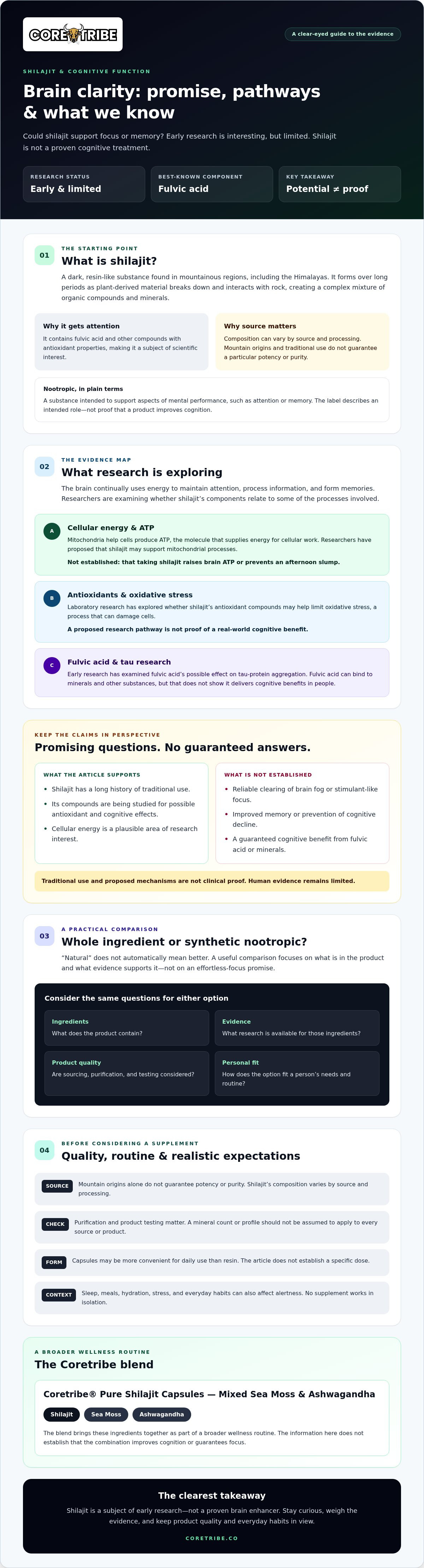
The brain uses energy continuously to maintain attention, process information, and form memories. That makes cellular energy production a plausible area of interest in research on Shilajit. Its compounds have been studied for possible antioxidant and cognitive effects, but proposed mechanisms aren’t proof of real-world results. This review of Shilajit’s potential procognitive activity offers background, while human evidence remains limited.
ATP Production and Brain Fog
Mitochondria help cells produce adenosine triphosphate, or ATP, the molecule that supplies energy for cellular work. Neurons have ongoing energy demands, so healthy mitochondrial function is important to normal brain activity. Researchers have proposed that Shilajit may support mitochondrial processes, but it hasn’t been established that taking it raises brain ATP or prevents an afternoon slump. Sleep, meals, hydration, stress, and other factors can also affect alertness.
Think of cellular energy as a research pathway, not a guaranteed outcome. Shilajit for cognitive function is a topic worth following, but current evidence doesn’t show that it reliably clears brain fog or provides stimulant-like focus.
Neuroprotection and Cognitive Longevity
Shilajit contains antioxidant compounds, and laboratory research has explored whether they may help limit oxidative stress, a process that can damage cells. Other early research has examined fulvic acid’s possible effect on tau-protein aggregation. These findings are relevant to brain-health research, but they don’t establish that Shilajit prevents cognitive decline or treats a neurological condition.
Learning and memory also depend on synaptic plasticity, the brain’s ability to adjust connections between neurons. This concept helps explain cognition, but there isn’t enough human evidence to conclude that Shilajit improves plasticity or learning capacity. A plausible biological mechanism can guide further study without confirming a benefit in everyday life.
Claims about the blood-brain barrier and neurotransmitters need similar care. Fulvic acid may interact with minerals and other compounds, but that alone doesn’t prove Shilajit transports nutrients across the barrier. Nor is there strong clinical evidence that it regulates neurotransmitters to create steady focus or a balanced mood. Research continues to explore these questions.
For a measured approach, review ingredient information and available quality-testing details, and treat supplements as one part of a broader wellbeing routine. You can also review Coretribe’s Shilajit supplement options while keeping expectations grounded in the evidence.
Shilajit vs. Synthetic Nootropics: A Holistic Comparison
“Nootropics” covers a wide range of substances, from caffeine to prescription medicines and supplements. Their effects and risks aren’t interchangeable. Some stimulants can temporarily increase alertness, but they don’t replace sleep or address the reason you feel tired. Depending on the substance and how it’s used, unwanted effects can include jitters or disrupted sleep. Frequent caffeine use may also lead to tolerance or withdrawal symptoms. Shilajit has a different composition, but “natural” doesn’t automatically mean more effective, better absorbed, or free of risks.
The science around shilajit for cognitive function is still developing. For a balanced overview of proposed benefits and limitations, see this review of Shilajit’s Health Benefits, Risks, and Clinical Evidence. Current evidence doesn’t establish that Shilajit provides clean energy, prevents a crash, or avoids dependency. Those outcomes shouldn’t be promised simply because it’s a natural resin.
Avoiding the Nootropic Crash
A stimulant may make fatigue feel less noticeable for a while, but masking tiredness isn’t the same as restoring mental stamina. If your focus fades, consider the basics: sleep quality, food, hydration, stress, and workload can all influence alertness. Shilajit is sometimes described as an adaptogen, but it shouldn’t be presented as a proven way to regulate the nervous system or maintain a stable cognitive baseline. A measured approach prioritizes sustainable habits over trying to override the body’s signals.
Minerals and Mind-Body Balance
Minerals have important roles in normal bodily functions, including nerve signaling. An inadequacy can affect health, but brain fog alone doesn’t confirm a mineral deficiency, and a broad-spectrum supplement isn’t a substitute for identifying the cause. Shilajit’s mineral content varies, while targeted supplements provide specific nutrients. Neither approach is automatically preferable. What’s appropriate depends on individual needs, product quality, and evidence.
Coretribe’s product information describes Coretribe ® Pure Shilajit Capsules - Mixed Sea Moss & Ashwagandha as a blend providing 92+ minerals. That figure is a product-specific claim, not a guarantee that every mineral is present in a meaningful amount or that the blend corrects a deficiency. Capsules offer a convenient format, but they don’t make effects on focus or energy certain. For a broader perspective on wellbeing, read this guide to mind-body balance and holistic vitality.
How to Use Shilajit for Peak Mental Performance
A thoughtful routine starts with realistic expectations. Shilajit isn’t a guaranteed fix for brain fog, and research hasn’t established an ideal schedule for sharper focus. If you’re exploring shilajit for cognitive function, prioritize product quality, follow the label, and consider how it fits with your wider habits, including sleep, meals, hydration, and stress management.
Dosage and Timing for Brain Health
There’s no universal dose or proven best time of day for cognitive support. Rather than adopting a dose from a study or online post, follow the directions on your chosen product. A morning routine may make a daily supplement easier to remember, but morning use hasn’t been shown to set a “cognitive tone” or prevent an afternoon slump.
Use a measured, consistent approach:
- Check the label: Review the serving directions and ingredients, and don’t exceed the recommended use.
- Choose a routine you can maintain: Taking capsules at the same time each day can make use more consistent, though consistency doesn’t guarantee a cognitive effect.
- Pay attention to your response: Keep track of changes in focus, sleep, or how you feel. Stop using the supplement if you experience an unwanted reaction, and seek appropriate medical advice.
Capsules can be simpler to measure and carry than resin, which may suit a busy workday. For example, Coretribe ® Pure Shilajit Capsules - Mixed Sea Moss & Ashwagandha offer a capsule format for daily use. Follow the product’s directions rather than guessing at a serving size.
Building a Cognitive Supplement Stack
Keep the rest of your routine steady while assessing a new supplement. Drink fluids regularly, especially if you’re thirsty or active. Hydration supports normal body function, but there’s no established “fulvic acid transport system” that you need to activate. A balanced diet supports general wellbeing, too. Although dietary fat helps absorb certain nutrients, evidence hasn’t established that pairing Shilajit with healthy fats improves its absorption, so there’s no need to add fat solely for that purpose.
Avoid introducing several new supplements at once. A simpler routine makes it easier to identify what agrees with you and reduces the temptation to stack products for a quick boost. For practical guidance on taking capsules, read how to take Shilajit capsules.
To compare capsule and other Shilajit options, review Coretribe’s supplement selection and check each product’s ingredients and directions.
The Coretribe Blend: Shilajit, Sea Moss, and Ashwagandha
A blend can bring different ingredients together, but that doesn’t automatically mean their effects are amplified or proven to work in synergy. Coretribe ® Pure Shilajit Capsules - Mixed Sea Moss & Ashwagandha combines Shilajit with Sea Moss and Ashwagandha as part of a broader approach to everyday wellbeing. The ingredients may appeal to people thinking about nutritional adequacy and stress, two common concerns behind brain fog. The product isn’t a treatment for cognitive symptoms, and research hasn’t established that this specific combination improves memory or focus.
When considering shilajit for cognitive function, assess each ingredient separately and keep expectations grounded. Shilajit is being studied for possible cognitive effects, while Ashwagandha and Sea Moss have their own research and limitations. A combination product can be convenient, but check its label and consider whether each ingredient suits your needs.
Ashwagandha and the Stress-Focus Connection
Stress can make it harder to concentrate, recall information, or settle into a task. Research has linked prolonged stress with changes in brain systems involved in memory, but saying cortisol simply “shrinks” memory centers oversimplifies a complex process. Ashwagandha is studied for potential effects on stress, though results vary. It shouldn’t be described as clearing a path for Shilajit or guaranteeing sharper focus. Its role in the blend is better understood as a complementary ingredient, not a proven cognitive enhancer.
For more on the ingredients and the thinking behind their combination, see this Shilajit, Ashwagandha, and Sea Moss synergy guide.
Sea Moss and the Mineral Foundation
The brain relies on minerals and electrolytes for normal functions, including nerve signaling, but it isn’t accurate to call it the body’s most mineral-hungry organ. Iodine supports thyroid hormone production, and potassium is essential for normal cellular and nerve function. Those roles don’t mean Sea Moss will improve mental health or focus, or that everyone needs extra minerals. Sea Moss composition can vary, so review the product label rather than assuming a supplement provides a specific amount of each nutrient.
Coretribe describes its blend as providing 92+ minerals. Treat that as a product formulation claim, not proof that every mineral is present in a meaningful amount or that the capsules correct a deficiency. A daily routine may help with consistency, but cognitive health also rests on foundations such as sleep, balanced nutrition, and stress care. The blend offers a convenient way to combine Shilajit, Sea Moss, and Ashwagandha, while its specific cognitive effects remain an open question for research.
Build a Steadier Foundation for Cognitive Wellness
Shilajit has a long history of traditional use and is now being studied for possible cognitive effects, but the science is still developing. It isn’t a proven way to sharpen memory, prevent cognitive decline, or replace sleep and other foundations of wellbeing. A thoughtful approach to shilajit for cognitive function means keeping expectations realistic, comparing supplements carefully, and noticing how they fit into your routine.
Coretribe ® Pure Shilajit Capsules - Mixed Sea Moss & Ashwagandha bring together Shilajit, Sea Moss described as providing 92+ minerals, and Ashwagandha. The capsule format offers a straightforward way to include the blend in a broader wellness routine, though individual results aren’t guaranteed.
For ingredient details and product information, explore Coretribe’s Shilajit supplements. Pair any supplement choice with balanced daily habits, and take an informed, steady approach to wellbeing.
Frequently Asked Questions
Does Shilajit help with brain fog immediately?
There’s no reliable evidence that Shilajit clears brain fog immediately. Research into cognitive effects is still limited, and responses may vary. Brain fog can have many possible contributors, including poor sleep, stress, nutrition, medications, or an underlying health concern. Rather than expecting a quick effect from a supplement, consider these factors too. If brain fog is persistent, worsening, or affecting daily life, speak with a healthcare professional.
Can I take Shilajit for cognitive function every day?
Daily use depends on the product directions, your health, and any medicines or supplements you take. Evidence on long-term use specifically for cognitive support is limited, so daily use shouldn’t be treated as proven brain-health protection. Follow the label and avoid taking more than directed. If you have a health condition, take medication, or are unsure whether it’s suitable for you, ask a qualified healthcare professional or pharmacist first.
Is Shilajit better than caffeine for focus?
Neither is universally better. They’re different substances, and evidence for their effects differs. Caffeine can increase alertness for some people, but it may also cause jitters or interfere with sleep. Shilajit hasn’t been established as a reliable replacement for caffeine, nor is it proven to provide focus without a crash. Consider your own response and habits, especially sleep, and don’t use supplements to mask persistent fatigue.
How does Shilajit interact with memory recall?
It’s not yet clear whether Shilajit improves memory recall in everyday life. Researchers are studying possible cognitive effects, but current human evidence is early and limited. You shouldn’t count on it to make it easier to remember names, details, or new information. Memory is also influenced by sleep, stress, attention, and health. If you notice persistent or concerning memory changes, seek advice from a healthcare professional.
Are there any side effects when taking Shilajit for the brain?
Shilajit may not suit everyone, and its safety depends partly on the product’s ingredients, quality, and your individual circumstances. A key concern is contamination, including heavy metals, which makes purification and testing important. Look for clear ingredient details and, where available, a batch-specific Certificate of Analysis. Stop taking it if you experience an unwanted reaction, and ask a healthcare professional or pharmacist about possible interactions with medicines.
Can Shilajit help with anxiety-related focus issues?
Shilajit hasn’t been shown to treat anxiety or reliably resolve focus problems linked to stress. Ashwagandha, an ingredient in Coretribe ® Pure Shilajit Capsules - Mixed Sea Moss & Ashwagandha, is studied for stress-related effects, but that doesn’t guarantee relief or improved concentration. If anxiety is persistent or interfering with daily life, consider speaking with a healthcare professional. Supplements shouldn’t replace appropriate care or coping strategies that work for you.
Is Himalayan Shilajit the best type for cognitive health?
A Himalayan origin alone doesn’t prove a Shilajit product is more effective or safer for cognitive health. Composition can vary, and quality also depends on purification and testing. When comparing products, review the full ingredient information and look for credible testing details, particularly for potential contaminants. Current research doesn’t establish one geographic source as best for memory or focus, so prioritize product quality over origin claims alone.
What is the best time of day to take Shilajit for mental clarity?
No time of day has been established as best for mental clarity. Follow the directions on your specific product, and choose a time that’s easy to remember and fits your routine. Taking it in the morning may be convenient, but that doesn’t mean it will improve workday focus or prevent an afternoon slump. Keep track of how you respond, and check with a healthcare professional if you have questions about timing.

