


Moringa contains a range of nutrients, but it does not replace a multivitamin. Using moringa as a natural multivitamin can add nutrients such as vitamins A, C, and E to your diet. However, its effects in people aren’t well defined, so don’t treat it as a guaranteed substitute for a supplement designed to provide essential nutrients.
Moringa’s appeal is easy to understand: its leaves are used in foods and supplements, and the powder offers a plant-based way to add them to everyday meals. But the nutrient content alone doesn’t tell the whole story. The amount you get can depend on the form and processing, and some people should weigh possible risks before taking it.
Here, you’ll learn what moringa is used for, which vitamins and minerals its leaves contain, and how powder and capsules differ. We’ll also cover how processing can affect nutrients and what to consider before choosing a form, helping you decide whether moringa fits your routine or a conventional multivitamin better meets your needs.
Key Takeaways
- Moringa leaves contain several vitamins and minerals, but their nutrient range doesn’t make them a complete replacement for a multivitamin.
- Powder and capsules differ in how they’re used and how much control you have over adding moringa to food or drinks.
- Drying and processing can affect nutrient retention, so the form and handling of moringa matter when considering its nutritional value.
- Medication use and certain health circumstances can affect whether moringa is a suitable addition to your routine.
- Learn what to look for when comparing moringa products and when another approach may better meet your nutritional needs.
Does moringa powder contain B vitamins?
Yes. Moringa leaves contain several B vitamins, as well as vitamins A and C and various minerals. Nutrient amounts vary by form, so don’t assume dried powder, fresh leaves, and capsules are nutritionally identical.
Moringa Leaf Vitamins and Minerals
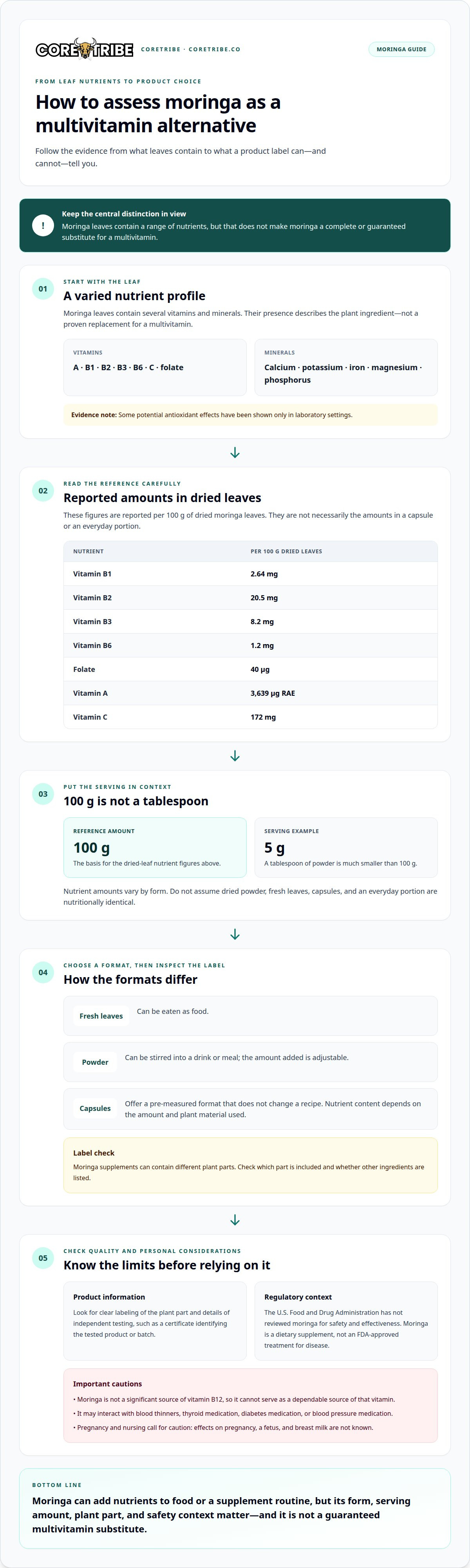
Moringa leaves provide vitamins A, B1, B2, B3, B6, C, and folate, plus calcium, potassium, iron, magnesium, and phosphorus. These nutrients make leaves a varied plant ingredient, but don’t establish that a serving replaces a multivitamin. Moringa also contains compounds described as antioxidants; some potential antioxidant effects have been shown only in laboratory settings.
Vitamin Content in Dried Leaves
Dried leaves contain measurable B vitamins: approximately 2.64 mg of B1, 20.5 mg of B2, and 8.2 mg of B3 per 100 g. They also contain 1.2 mg of B6 and 40 µg of folate per 100 g. These figures describe dried leaves, not necessarily the amount in a capsule or an everyday portion.
Dried moringa leaves contain approximately 3,639 µg RAE of vitamin A and 172 mg of vitamin C per 100 g. The serving amount matters: a 5 g tablespoon of powder is much smaller than 100 g. Moringa isn’t a significant source of vitamin B12, so it cannot serve as a dependable source of that vitamin.
Fresh leaves, ground powder, and capsules offer different ways to consume moringa. You can eat fresh leaves as food, stir powder into a drink or meal, or use capsules for a measured format. Capsule nutrient content depends on the amount and plant material used. Since moringa supplements can contain different plant parts, check the label to see which part is included.
Research on health uses has mainly examined leaves or seeds, rather than proving that every form works alike. In a Tanzanian study lasting 3 months, researchers assessed moringa leaf powder in a nutrition intervention. Authors of the Tanzanian study reported mean Hb of 10.9 g/dl (95% CI: 10.2-11.4) for intervention and 9.4 g/dl (95% 7.8-10.1) for control (p-value = 0.002). These findings describe that study, not a general treatment claim.
When choosing a quality-tested supplement in the United States, look for clear labeling of the plant part and details of independent testing, such as a certificate identifying the tested product or batch. The U.S. Food and Drug Administration has not reviewed moringa for safety and effectiveness. Moringa is a dietary supplement, not an FDA-approved treatment for disease.
What are the most common side effects of moringa?
Moringa’s possible effects depend on its form, amount, and the person taking it. Digestive discomfort is one practical consideration with powder, while medication interactions and pregnancy call for particular care. Evidence for many claimed health benefits remains limited.
Consider digestion first. A large amount of powder may cause discomfort, so introduce it gradually instead of starting with a generous scoop. Powder can be mixed into food, while capsules offer a pre-measured format. Follow the product label and pay attention to how your body responds.
Blood pressure findings deserve careful context. In a study, healthy participants who ate 120 grams of cooked moringa leaves had lower blood pressure two hours later than participants who didn’t eat the leaves, according to the Authors of the moringa blood-pressure study. That short-term result doesn’t establish a lasting effect from supplements.
Moringa is also used with the aim of lowering blood sugar and cholesterol, but benefits for those purposes aren’t well defined. A study of 40 people with type 2 diabetes found only minimal changes in blood sugar, blood pressure, and cholesterol after consuming moringa leaves. People taking diabetes medicine face a particular concern because moringa may interact with treatment.
Read other claims just as carefully. Some chemicals in moringa may have antioxidant or anti-inflammatory effects, but these have only been shown in laboratory research. The nickname “miracle tree” and an organic label don’t establish clinical benefits. More clinical research is needed to assess safety and effectiveness for many uses in people.
Claims about eye health and anemia should also be distinguished from nutrient content. Moringa leaves contain vitamin A and iron, but that alone doesn’t show that moringa prevents or treats vision problems or anemia. Results for hemoglobin in a Tanzanian nutrition study apply to that study’s intervention, not automatically to every person or supplement.
Medication use changes the risk picture. Moringa may interact with blood thinners, thyroid medication, diabetes medication, or blood pressure medication. These potential interactions matter whether someone takes moringa as food or as a plant-based supplement, rather than as a treatment.
Pregnancy and nursing also call for caution. It isn’t known whether moringa could affect pregnancy or harm a fetus, or whether it passes into breast milk. Because of these uncertainties, starting a supplement on your own during these periods is not advisable. A natural or organic label doesn’t remove those concerns.
For a broader wellness routine beyond moringa, explore wellness options with your goals in mind. Keep health claims in proportion to the evidence, especially when blood pressure, blood sugar, anemia, or medication use is part of the picture.
Differences between moringa powder and capsules
Powder and capsules provide moringa in different formats, affecting how you use and portion them. Mix powder into meals or drinks; capsules offer a pre-portioned option that doesn’t change a recipe. Both may be made from moringa leaves, so check the label for the plant part and any other ingredients.
Choose a format based on how you want moringa to fit into your routine. Powder lets you control how much you add, but its earthy taste and texture may stand out in water. Capsules avoid the flavor and need no mixing. Neither format guarantees a standard nutrient amount, since serving sizes and product composition vary.
To try moringa powder in food, start with a small amount and increase it gradually to help limit digestive discomfort. Blend a teaspoon into a smoothie or juice, stir it into porridge, or mix it into a sauce. Start with a familiar recipe and adjust the flavor before adding more.
For a warm drink, use 1 teaspoon of powder in 1 cup of hot water. Stir well to disperse it, since leaf powder may settle. A smoothie can mask its grassy taste with fruit, while porridge offers a thicker texture. Follow the label’s serving directions, especially if combining moringa with other supplements.
Capsules make portioning simpler, but follow the serving instructions. Read the ingredients panel to see whether the capsule contains moringa leaf alone or other components. Check how many capsules make up a serving, and don’t assume one capsule equals a teaspoon of powder. Moringa products also come as tablets, liquid extracts, and dried, ground leaf.
Children’s diets call for a distinction between research and everyday use. In a Tanzanian study, malnourished children aged 6 to 24 months received 25 g of moringa leaf powder daily in maize porridge. That study amount describes a research intervention, not a general serving recommendation for children. A child’s age, diet, and health needs matter when considering supplements.
Moringa leaf powder contributes protein, but a food’s nutrient content doesn’t make it a complete meal. Adding powder to oats, for example, changes the ingredients without replacing the meal’s other sources of energy and nourishment. Capsules are even less suited to that role because they don’t function as a food ingredient.
For either format, compare the stated plant part, serving size, and full ingredient list. Store opened powder in an airtight container in a cool, dry place; it can last up to 12 months under those conditions. These details help you choose a form that suits your meals and use it consistently.
Effects of drying and processing on vitamin retention
Drying removes water from moringa oleifera leaves, changing how nutrients appear by weight. A 100 g portion of dried leaf powder represents a more concentrated material than the same weight of fresh leaves. That comparison doesn’t show how much of each vitamin survived processing. It does explain why dried-leaf figures shouldn’t be applied directly to fresh leaves or every capsule.
Dried moringa leaves contain vitamin E, calcium, iron, potassium, and protein. Reported amounts per 100 g include 56-113 mg of vitamin E, approximately 2,000 mg of calcium, 28 mg of iron, and 1,300 mg of potassium. The same amount contains approximately 25 g of protein. These figures describe dried leaves, not the nutrients in an individual serving.
Can moringa provide enough vitamin A, iron, calcium, or other key nutrients? Dried leaves contain these nutrients, but whether they meet someone’s needs depends on the amount consumed and the rest of their diet. A serving is much smaller than 100 g, so per-100 g values alone can’t establish how much a person gets.
Processing also matters for vitamins. Moringa leaves contain B vitamins, including B1, B2, and B3, while moringa isn’t a significant source of B12. Dried-leaf nutrient figures don’t mean every powder or capsule contains identical amounts. The plant part, processing, serving size, and product ingredients all shape what the label describes.
Compare the ingredient list and serving information together. A label that identifies moringa leaf powder tells you more than a broad reference to the plant alone. Capsules and powders may use different plant materials or amounts. Don’t treat a capsule serving as equivalent to a spoonful of powder unless the labels support that comparison.
Moringa leaves contain vitamins A and C, as well as minerals such as magnesium and phosphorus. These nutrients don’t make moringa a treatment for disease. Claims about anti-inflammatory properties also need care: laboratory effects don’t establish health outcomes in people. Likewise, low fat content and an absence of harmful cholesterol don’t show that processing preserves every vitamin.
Think of moringa as a nutrient-containing food or supplement, not a fixed-dose multivitamin. Drying changes nutrient concentration by weight, while the plant part and serving size determine what reaches your cup or capsule. This distinction matters when considering moringa as a natural multivitamin, especially when comparing dried powder with fresh leaves or another supplement.
Moringa as a multivitamin alternative
Moringa offers a range of nutrients, but that doesn’t make it interchangeable with a multivitamin. Moringa leaf powder contains over 90 nutrients, while a multivitamin is designed as one pill that can provide many essential nutrients. The practical difference is consistency: a pill gives a measured blend, while moringa’s nutrient contribution depends on its form and serving.
For example, a serving of moringa can provide up to 57% of the daily value for vitamin C and 42% for vitamin A. Dried leaf powder also contains vitamin E, minerals, and protein. These figures can help explain its appeal, but they don’t describe every product or serving. Compare the serving size on a label with the amount you actually use.
The broader question is whether those nutrients lead to the health effects people want. Studies haven’t clearly established moringa’s effects in humans, including its potential effects on blood sugar and cholesterol. Some compounds show antioxidant or anti-inflammatory properties in laboratory research, but those findings don’t establish a treatment effect in people. Nutrient content and proven outcomes are different measures.
How do moringa supplements compare in cost with multivitamins? Compare the cost per serving using each label’s serving size and number of servings per container. Powder, capsules, and multivitamin formulas can differ in serving amounts, ingredients, and frequency of use. Compare those details rather than assuming different products provide equivalent nutrients.
Moringa as a natural multivitamin may suit someone who wants to add a plant ingredient to food or drinks. It’s less direct for someone seeking a measured combination of essential nutrients in one pill. Consider your diet, the nutrient you want to add, and the product’s listed serving before deciding. A supplement doesn’t replace varied meals or treat disease.
Keep the goal specific: use moringa for its plant-based nutrient contribution, not as proof that every nutritional need is covered. If you’re exploring other botanical supplements for a broader wellness routine, browse the available supplement options and compare each product’s ingredients with your priorities.
Coretribe: Coretribe ® Pure Shilajit Capsules - Mixed Sea Moss & Ashwagandha
Coretribe ® Pure Shilajit Capsules - Mixed Sea Moss & Ashwagandha are another botanical supplement option for readers exploring wellness products beyond moringa. They aren’t moringa capsules or a multivitamin, so consider them only if shilajit, sea moss, and ashwagandha align with your interests.
Choose supplements based on their ingredients and purpose, rather than assuming one product can replace another. When comparing options, review the product information and consider how it fits alongside your existing routine.
For a broader look at Coretribe’s wellness offerings, visit coretribe.co.
Choose a wellness routine that fits your needs
Start with a clear priority: adding a whole-leaf ingredient to meals, choosing a measured multivitamin, or exploring a different kind of wellness product. Moringa as a natural multivitamin may sound appealing, but the right choice depends on what you want from your routine and how it fits with your diet and medications.
Coretribe offers Coretribe ® Pure Shilajit Capsules - Mixed Sea Moss & Ashwagandha, Coretribe®Shilajit Honey Sticks, and Revive Dress. Each suits different interests, so consider its listed ingredients and purpose rather than treating it as a substitute for moringa or a multivitamin.
Take a considered approach: identify your goal, compare product information, and make room for choices that suit your everyday habits. Explore Coretribe’s wellness offerings as you shape a routine that feels right for you.
Frequently Asked Questions
What is moringa used for?
Moringa is used as a food ingredient and dietary supplement, commonly made from its leaves or seeds. Stir powder into porridge or blend it into a smoothie, or choose capsules as another format. Some people use it hoping to support blood sugar or cholesterol levels, but evidence for these purposes remains limited. Culinary use and treatment claims are different, so don’t assume that eating moringa treats a health condition.
Does moringa interact with foods or drinks?
No known interactions between moringa and foods or drinks have been reported. People add its powder to smoothies, juice, or porridge, though taste and texture may affect how they prefer to use it. In a mixed drink or recipe, consider every ingredient, not just moringa. Other herbs or supplement ingredients in the same blend may have separate considerations, particularly if you take medication.
Does moringa interact with medicines (drug interactions)?
Moringa may interact with blood thinners, thyroid medicines, diabetes medicines, and blood pressure medicines. If you take any of these, discuss moringa before adding powder or capsules, and share the product label and your medication list. This is particularly important for medicines that affect blood sugar or blood pressure, since some people use moringa in the hope of influencing those levels.
How does moringa work (mechanism of action)?
No single established mechanism explains all of moringa’s proposed effects. Its leaves contain nutrients and plant compounds, some of which show antioxidant or anti-inflammatory effects in laboratory studies. Those findings don’t demonstrate the same effects in people. Proposed effects on blood sugar, cholesterol, or blood pressure involve different outcomes, so evidence for one shouldn’t be treated as proof of another.
Nutritional Powerhouse: What’s Inside Moringa?
Moringa leaves contain vitamins A, C, and E, several B vitamins, and minerals such as calcium, iron, potassium, and magnesium. They also provide protein. Seeds differ from leaves: they contain fatty acids and can be eaten or used to make oil. This distinction matters when reading a product label, because a supplement may use different parts of the plant.
What are the benefits?
Moringa can add plant-derived nutrients to meals, and its leaves can be used in foods or supplements. Possible effects on blood sugar, cholesterol, and inflammation are still being studied, so don’t confuse nutrient content with proven health outcomes. The U.S. Food and Drug Administration hasn’t reviewed moringa for safety and effectiveness. Treat it as a dietary supplement, not as a way to treat or cure disease.
What vitamins and minerals are in moringa leaf powder per serving?
A 5 g tablespoon of dried moringa leaf powder can provide 24-86% of daily needs for vitamins A, C, and E. It also contains B vitamins and minerals, including calcium, iron, and potassium. The precise amount in a product serving depends on its label and serving size. Compare the stated amount with your usual portion rather than assuming all powders or capsules are equivalent.
How does moringa’s nutrient content compare with a daily multivitamin?
A multivitamin is designed to provide many essential nutrients in one pill, while moringa is a plant ingredient whose nutrient contribution depends on its serving and form. Moringa provides several vitamins and minerals, but it isn’t a significant source of vitamin B12. Compare labels for nutrients you specifically need, and don’t assume moringa powder or capsules match a multivitamin’s nutrient amounts.

