


The more potent-sounding Cordyceps may not be the one with stronger human evidence. That’s the key nuance behind cordyceps militaris vs sinensis benefits: species can differ in their compounds, but those differences alone don’t show which supplement works better for people.
If the names on labels feel confusing, or marketing claims seem more certain than the science, you’re not alone. Wild Cordyceps sinensis is rare, while Cordyceps militaris is commonly cultivated. Some products labeled as C. sinensis use cultivated CS-4 mycelium, a preparation studied in human trials. These forms aren’t automatically interchangeable, and findings from one preparation don’t necessarily apply to another.
This guide explains how the species and common preparations differ, what research can and can’t tell us about proposed benefits, and how to read labels carefully. We’ll look at human evidence and the questions worth discussing with a healthcare professional, so you can set realistic expectations and make a more informed choice.
Key Takeaways
- Learn why the familiar name Cordyceps sinensis can refer to a different fungus under current taxonomy.
- See how cordycepin and adenosine are discussed in research, without mistaking compound levels for proven supplement effects.
- Explore what research says about cordyceps militaris vs sinensis benefits, distinguishing findings by species, preparation, and study type.
- Use a practical label checklist to compare the named species, ingredient form, serving directions, and testing transparency.
- Follow a thoughtful decision path based on evidence and personal context, while recognizing that research may not establish one species as best for everyone.
Cordyceps militaris vs. sinensis: what are the two species?
Cordyceps militaris and Ophiocordyceps sinensis are distinct fungi, not two names for the same organism. The latter is often still called Cordyceps sinensis, its familiar historical scientific name, especially in traditional and supplement contexts. Current taxonomy places it in the genus Ophiocordyceps, while C. militaris remains in the genus Cordyceps.
Quotable distinction: Cordyceps militaris is a fungus known for its orange fruiting bodies and commercial cultivation; Ophiocordyceps sinensis is a different fungus historically named Cordyceps sinensis, associated in the wild with caterpillar hosts.
Why do Cordyceps militaris and sinensis have different names?
Common names are everyday labels; scientific names identify organisms more precisely and can change as classification improves. The name Cordyceps sinensis remains widely recognized, but the updated name for that species is Ophiocordyceps sinensis. Since supplement labels may use the familiar older name, read the full ingredient description rather than relying on the word “Cordyceps” alone. This Cordyceps militaris overview also outlines its classification and distinguishes it from O. sinensis.
Wild Cordyceps, cultivated fungi, and supplements
In its natural life cycle, O. sinensis infects a caterpillar larva, and the fungus grows from the host. This wild fungus-host material differs from cultivated fungal ingredients. C. militaris can be grown commercially on a substrate such as rice, while some products identified with C. sinensis use cultivated mycelium, including the CS-4 strain. These are different sources and preparations, not automatically equivalent versions of the wild organism.
Supplement ingredients may include fruiting bodies, mycelium, fermented fungal material, or extracts. The species name alone doesn’t tell you which part was used, how it was prepared, or whether the product resembles material used in a particular study. To compare cordyceps militaris vs sinensis benefits, read the ingredient description and serving information together. Don’t assume that a shared traditional name means the same fungal material, preparation, or evidence applies.
How do their compounds and supplement preparations compare?
Both fungi contain compounds studied for their biological activity, but their chemical profiles can differ. Cordycepin is especially discussed in research on Cordyceps militaris; adenosine is also examined in Cordyceps research. This review of Properties of Cordyceps Sinensis provides background on research into O. sinensis and its constituents. These findings describe materials studied, not a guaranteed effect from taking a supplement.
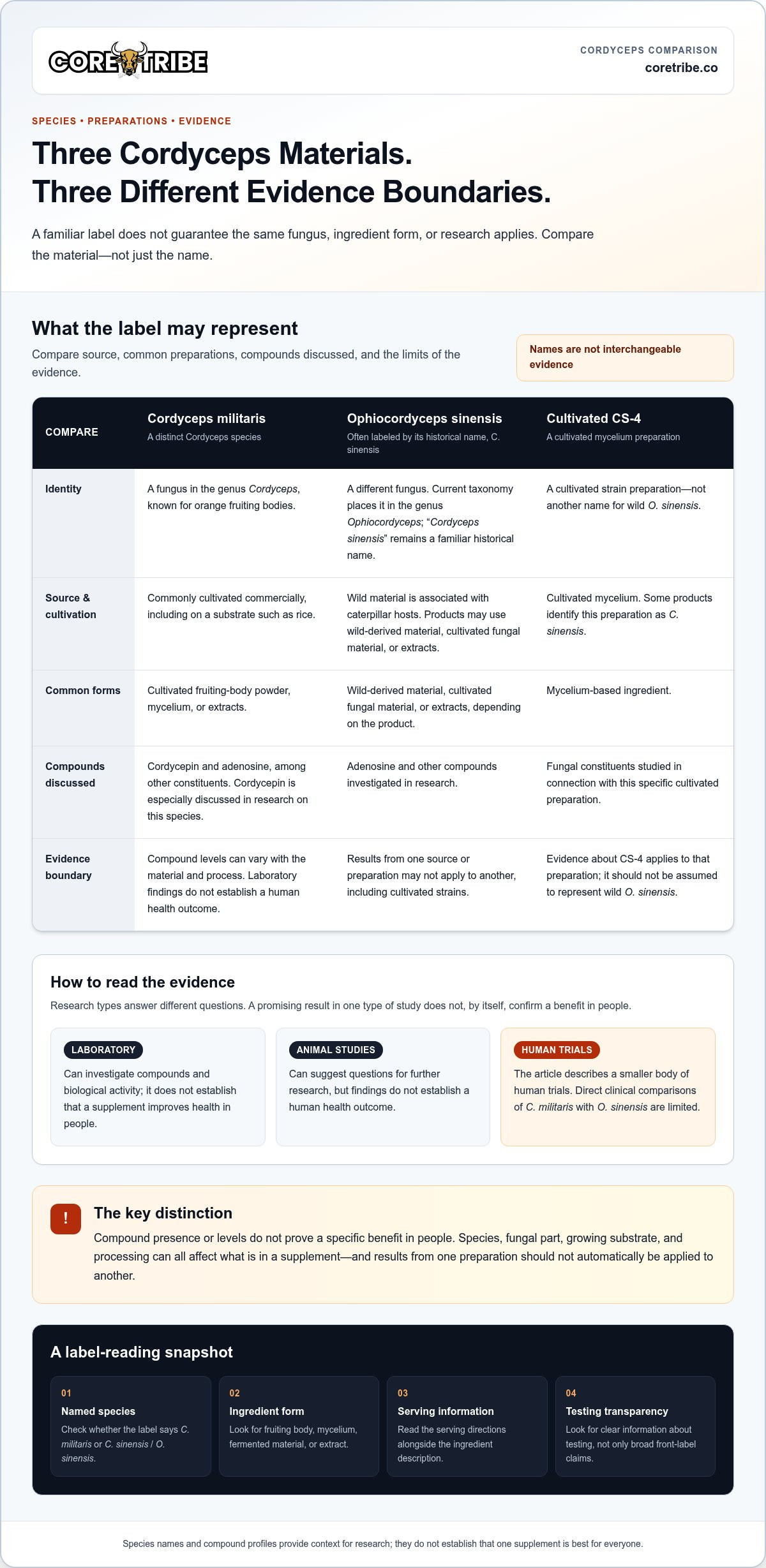
| Species or material | Compounds discussed | Common supplement preparations | Evidence limits |
|---|---|---|---|
| Cordyceps militaris | Cordycepin and adenosine, among other constituents | Cultivated fruiting-body powder, mycelium, or extracts | Compound levels can vary by material and process; laboratory findings don’t establish a human health outcome. |
| Ophiocordyceps sinensis, often labeled by its historical name, Cordyceps sinensis | Adenosine and other compounds investigated in research | Wild-derived material, cultivated fungal material, or extracts, depending on the product | Results from one source or preparation may not apply to another, including cultivated strains. |
| Cultivated CS-4 mycelium | Fungal constituents studied in connection with this cultivated preparation | Mycelium-based ingredients, sometimes labeled as C. sinensis | Evidence about CS-4 applies to that preparation and shouldn’t be assumed to represent wild O. sinensis. |
Cordycepin, adenosine, and other compounds under study
Cordycepin is a compound found in C. militaris and studied extensively in laboratory settings. Some analyses report higher cordycepin in certain C. militaris materials than in some O. sinensis materials, but the comparison depends on the samples tested. Adenosine is a separate compound found in Cordyceps materials and also studied for its biological activity. Neither compound’s presence, by itself, proves a specific benefit in people.
Why extract and cultivation details matter
Powder and extract describe different forms, not a universal quality ranking. A powder may contain ground fungal material, while an extract is processed to concentrate or draw out constituents. The species, growing substrate, fungal part, and processing can all affect what ends up in the ingredient. A species name alone cannot establish a supplement’s potency. Look for a clear ingredient description and transparent information about testing rather than relying only on broad front-label claims.
These distinctions put cordyceps militaris vs sinensis benefits into context: composition can guide what researchers investigate, but it can’t predict an individual product’s effects. Coretribe offers Cordyceps supplements, and the supplement collection is one place to review product ingredient details as part of your comparison.
Cordyceps militaris vs. sinensis benefits: what does the evidence show?
Research on Cordyceps spans laboratory experiments, animal studies, and a smaller body of human trials. These types of evidence answer different questions. A change in cells or animals can suggest what to investigate, but it doesn’t establish that a supplement improves energy, immunity, or health in people. Direct clinical comparisons of C. militaris with O. sinensis are limited, so the evidence doesn’t support a simple species-versus-species winner.
Energy, exercise, and stamina claims
One often-cited human study examined cultivated CS-4, a mycelium preparation associated with the historical name Cordyceps sinensis, in a small group of healthy older adults over 12 weeks. Researchers reported an improvement in ventilatory threshold, a measure related to exercise capacity, but not a clear improvement in maximum oxygen uptake. This result applies to that preparation and study population, not to wild O. sinensis or every product using its name.
For C. militaris, research into exercise-related effects includes laboratory and animal work, while human evidence is less established. This review of the pharmacological properties of Cordyceps militaris describes biological findings that help guide research, but those findings aren’t proof of improved athletic performance. Differences in products, participants, study length, and outcome measures make results difficult to compare directly.
Immune and general wellness claims
Compounds from both species have been investigated for effects on immune-related processes, particularly in cell and animal models. Such studies can show biological activity under specific experimental conditions. They don’t necessarily show that taking a Cordyceps supplement prevents illness, meaningfully strengthens immune function, or improves general wellness in people. Traditional use offers historical context, but it isn’t a substitute for clinical evidence.
Human trials of cultivated CS-4 and other preparations don’t automatically establish effects for C. militaris, wild fungal material, or a differently processed extract. Small samples and limited follow-up can also make it hard to determine whether a reported change is reliable or lasting. Read each finding alongside the species, preparation, participants, and outcome actually studied.
Current human evidence offers preliminary, preparation-specific clues, but it can’t establish that one Cordyceps species is broadly more beneficial or that either reliably delivers a particular health outcome. That’s the most useful perspective on cordyceps militaris vs sinensis benefits: promising mechanisms may warrant more research, while practical claims should stay within the limits of human trials.
How to compare Cordyceps supplements and consider safety
A careful label check helps connect the species and preparation to what’s actually in the product. Front-label phrases such as “energy support” don’t tell you which fungal material was used or establish that the claimed effect is proven. Start with the Supplement Facts panel and full ingredient list, then look for details that make the product easier to assess.
What should a Cordyceps supplement label tell you?
- Species: Look for a specific name, such as Cordyceps militaris or Ophiocordyceps sinensis. A familiar or historical name may appear, so read the complete description.
- Ingredient form: Check whether it’s a powder, extract, mycelium, fruiting-body material, or blend. If the label uses a blend, see whether it identifies the component ingredients.
- Serving directions: Follow the product’s stated directions, and compare serving information consistently across products. Don’t infer that a larger serving or a concentrated-sounding extract is more effective.
- Other ingredients and testing: Review the full ingredient list for added ingredients, allergens, or fillers. Look for clear information about quality or contaminant testing, such as what was tested and whether results are available.
Clear labeling supports comparison, but it isn’t proof of effectiveness. A claim about cordycepin content, for example, doesn’t by itself show that a product will produce a particular outcome. For cordyceps militaris vs sinensis benefits, the preparation and evidence behind a claim matter as much as the species name.
Who should use extra caution with Cordyceps?
Safety information for supplements can be incomplete, and possible effects may depend on the ingredient, preparation, and person. Cordyceps may affect blood sugar or blood clotting, so people taking glucose-lowering medicines or anticoagulant or antiplatelet medicines should discuss use with a qualified healthcare professional. Those taking immune-suppressing medicines should also seek guidance before adding a supplement that may influence immune activity.
If you’re pregnant or breastfeeding, have a chronic health condition, or take prescription or over-the-counter medicines, speak with a clinician or pharmacist before use. They can consider your health history and the specific product rather than treating all Cordyceps preparations as identical. Don’t use a supplement in place of prescribed treatment or delay medical care because of a wellness claim. Stop using it and seek professional advice if you experience a concerning reaction.
Use these checks to compare labels at your own pace, then browse Coretribe’s Cordyceps supplements as part of an informed review.
Which Cordyceps species makes sense for your goals?
There isn’t a universal winner. The research discussed so far doesn’t establish that Cordyceps militaris or Ophiocordyceps sinensis is best for everyone, or that a supplement will reliably deliver a particular result. A more useful choice starts with the outcome you’re interested in, then checks whether the available human evidence studied a matching species and preparation.
A simple decision path for comparing the two species
- Define your goal. Be specific, such as interest in exercise capacity rather than a general promise of “more energy.” This makes it easier to judge whether a study measured an outcome that matters to you.
- Look for relevant human evidence. Check the species, preparation, participants, and outcome in the study. Cell or animal findings can help explain why researchers are interested in a fungus, but they don’t confirm a benefit in people.
- Match the evidence to the label. Compare the product’s named species and ingredient form with what was tested. A result involving cultivated mycelium, for example, shouldn’t automatically be applied to a different fungal material or extract.
- Consider transparency and personal context. Look for a complete ingredient list, clear serving directions, and available testing information. If you take medication, have a health condition, or are unsure whether a supplement is appropriate for you, discuss the specific product with a qualified healthcare professional.
This approach keeps the cordyceps militaris vs sinensis benefits comparison grounded in what evidence can support, rather than assuming a species name or compound claim predicts how a product will affect you. Personal preferences matter too, but they’re best considered alongside evidence, preparation details, and safety guidance.
Coretribe offers Cordyceps and other wellness supplements for readers who want to browse products after considering these factors. Use the label and evidence questions in this guide to inform your review.
Explore Coretribe’s supplement collection and compare product details with the evidence and label questions in this guide.
Choose Cordyceps with clearer expectations
Cordyceps militaris and Ophiocordyceps sinensis are distinct fungi, and supplement labels may use historical names or describe different fungal materials. Their compounds are studied in different settings, but promising laboratory findings and early human research don’t prove a supplement will deliver a specific result.
The practical lesson in comparing cordyceps militaris vs sinensis benefits is to look beyond the species name. Match claims to the preparation and human evidence, read the Supplement Facts panel and full ingredient list, and consider testing transparency. If you take medication, have a health condition, or are pregnant or breastfeeding, discuss use with a qualified healthcare professional.
Coretribe offers Cordyceps supplements for those exploring wellness products. Browse Coretribe’s supplement collection and use the label and evidence questions in this guide to make an informed comparison.
Frequently Asked Questions
What is the difference between Cordyceps militaris and Cordyceps sinensis?
Cordyceps militaris and the fungus commonly called Cordyceps sinensis are different species. Under current taxonomy, the latter is named Ophiocordyceps sinensis, though its historical name remains common on supplement labels. C. militaris is often cultivated commercially, while wild O. sinensis has a distinctive relationship with caterpillar hosts. Supplements may use cultivated mycelium or other fungal material, so the name alone doesn’t identify the preparation.
Which has more cordycepin, Cordyceps militaris or Cordyceps sinensis?
Cordyceps militaris is often associated with higher cordycepin content, but amounts vary with the sample and how it was grown and processed. Comparisons of fungal materials don’t establish the cordycepin level in every supplement. Check whether a product identifies the ingredient source and provides clear compound testing information. Cordycepin is a compound studied for biological activity, not proof that a supplement will produce a particular health effect.
Is Cordyceps militaris better than Cordyceps sinensis for energy?
Current evidence doesn’t establish C. militaris as better for energy. Human studies have examined specific preparations, including cultivated CS-4 associated with O. sinensis, but results from one preparation can’t be assumed to apply to another species or product. When comparing cordyceps militaris vs sinensis benefits, distinguish subjective energy claims from measured outcomes, such as exercise capacity, and consider whether human research supports the specific claim.
Can Cordyceps militaris and sinensis provide the same benefits?
They may share some compounds and are both investigated in wellness research, but that doesn’t mean they provide identical effects. Species, fungal material, cultivation, and processing can change a supplement’s composition. Research on a particular extract or cultivated mycelium applies most directly to that preparation, not automatically to another species or product. Available evidence doesn’t establish that the two fungi are interchangeable or that they produce the same benefits in people.
What does research say about Cordyceps and exercise performance?
Research is still developing, and findings aren’t settled. A small human study of cultivated CS-4 in healthy older adults reported a change in ventilatory threshold, an exercise-capacity measure, but didn’t show a clear improvement in maximum oxygen uptake. Other findings, especially from cell and animal studies, are preliminary. Differences in participants, preparations, study length, and measured outcomes make it difficult to generalize results to all Cordyceps supplements or athletes.
Are Cordyceps supplements safe to take every day?
Daily use hasn’t been established as appropriate for everyone, and long-term safety evidence is limited. Supplement ingredients and individual health circumstances can differ. If you take medication, have a chronic condition, or are pregnant or breastfeeding, talk with a qualified healthcare professional before use. Follow the product’s serving directions, don’t replace prescribed care with a supplement, and stop using it and seek professional advice if you experience a concerning reaction.
How do I choose between Cordyceps militaris and sinensis supplements?
Start with your goal, then look for human evidence on that outcome and check which species and preparation researchers studied. Compare those details with the supplement’s ingredient description rather than choosing by species name alone. Review serving directions, the full ingredient list, and available testing information. There’s no established best choice for everyone. If you take medication or have a health condition, discuss the specific product with a qualified clinician.
What should I check on a Cordyceps supplement label?
Check for the full species name, ingredient form, serving directions, and complete ingredient list. Note whether the product describes powder, extract, mycelium, fruiting-body material, or a blend. Look for transparent quality or contaminant-testing information, including what was tested where available. Marketing terms and claims about a compound don’t independently prove effectiveness or tell you how the supplement may affect you. Match the label details to the evidence you’re using to compare products.

