


What if a supplement associated with energy and exercise isn’t necessarily a proven focus aid? If you’re considering cordyceps for focus and concentration, that distinction matters. It’s understandable to be curious about a natural supplement promoted for mental clarity, especially when busy days make steady attention feel hard to come by. But claims about energy, exercise performance, and concentration aren’t interchangeable.
This article looks at what research can and can’t tell us about cordyceps and cognitive performance. Human studies have focused more on areas such as physical performance and immune response than on directly measuring focus, so proposed mechanisms alone can’t confirm a benefit. We’ll separate early clues from demonstrated outcomes, then cover practical questions about species, ingredients, testing, and label transparency.
You’ll also find safety considerations to keep in mind before trying a supplement, including when it’s wise to ask a healthcare professional about your circumstances. The goal isn’t to promise a quick switch for sharper attention, but to help you weigh the evidence and make an informed choice.
Key Takeaways
- Understand why cordyceps for focus and concentration remains a research question, not a guaranteed outcome.
- Learn to distinguish proposed biological explanations from human studies that directly measure attention.
- Compare focus, alertness, energy, and stamina as separate outcomes rather than treating them as interchangeable.
- Use a practical checklist to review species, ingredient form, serving directions, and manufacturer disclosures.
- Explore Coretribe’s cordyceps offering with a clear view of what product details to verify on its label.
Cordyceps for Focus and Concentration: What Are People Hoping It Will Do?
Wanting steadier concentration is understandable, especially when a long workday or demanding routine leaves your attention feeling scattered. Cordyceps is sometimes promoted for mental clarity, but a promising story or traditional reputation isn’t the same as proof. It helps to look at what people hope it will do without treating it as a quick fix or overlooking the limits of the evidence.
Cordyceps refers to a group of fungi, some of which have a history of use in traditional practices and are now used in supplements. The name on a supplement label matters because products can differ by species, fungal material, and preparation. Don’t assume that products labeled “cordyceps” contain the same ingredients or have the same effects.
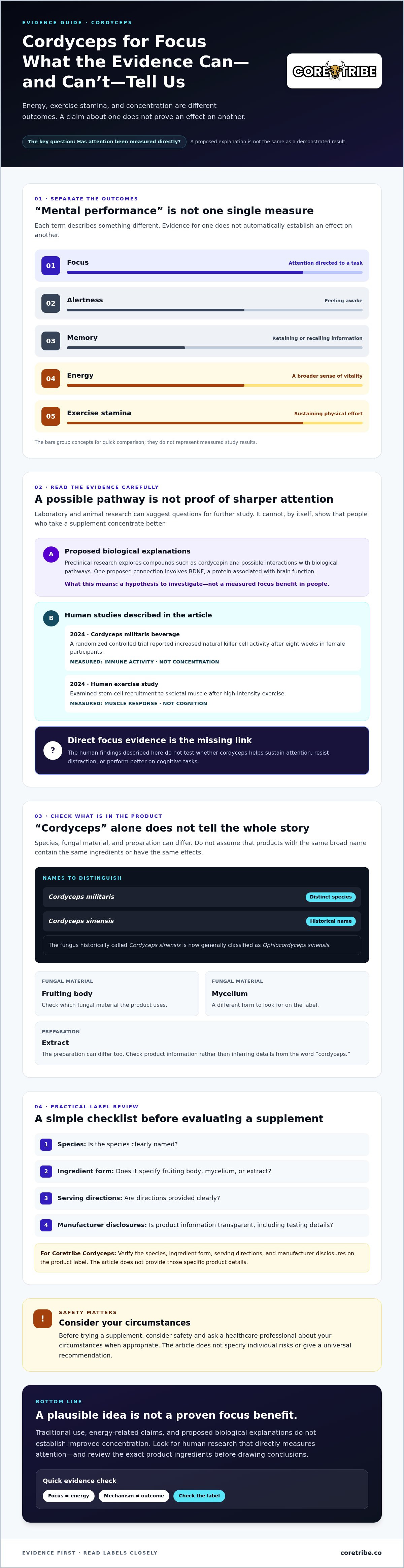
It also helps to separate the outcomes often grouped under “mental performance.” Focus means directing attention to a task; alertness is feeling awake; memory concerns retaining or recalling information. Energy is a broader sense of vitality, while exercise stamina relates to sustaining physical effort. Evidence for one outcome can’t automatically establish an effect on another.
What does cordyceps mean on a supplement label?
Cordyceps militaris and the fungus historically called Cordyceps sinensis are distinct species, not interchangeable names for the same ingredient. The latter is now generally classified as Ophiocordyceps sinensis. Supplements may also differ in whether they use fruiting bodies, mycelium, or an extract. Check the label and product information for the species and form; don’t infer them from the word “cordyceps” alone.
Why do people connect cordyceps with concentration?
Traditional use provides cultural and historical context, while current wellness interest often links cordyceps with energy or stamina. That overlap can make a concentration benefit sound plausible, but it doesn’t demonstrate one. Feeling more energetic, if someone experiences it, isn’t the same as measurable improvement in attention or task performance. Consumer interest and proposed biological explanations aren’t proof of better concentration in people.
In brief: Cordyceps is proposed as a possible way to support focus, but traditional use, energy-related claims, and scientific hypotheses don’t establish that it improves concentration. Direct evidence in people is needed to answer that question.
How Might Cordyceps Affect Focus, and What Has Human Research Tested?
The idea that cordyceps could influence concentration often rests on proposed biological explanations. Those ideas can guide research, but they don’t show that people will focus better after taking a supplement. To assess the claim, look for human studies that measure attention or cognition directly, not just energy, exercise capacity, or another body response.
What do laboratory and animal studies tell us, and not tell us?
Preclinical research explores how cordyceps compounds, including cordycepin, may interact with biological pathways. One proposed connection involves brain-derived neurotrophic factor (BDNF), a protein associated with brain function. Findings involving cells or animals can suggest questions for further study, but they can’t establish that a supplement improves concentration in people. A possible pathway also doesn’t prove that taking cordyceps changes that pathway in a meaningful way in humans.
That distinction matters: a mechanism is a possible explanation, not a measured outcome. A finding related to fatigue or a brain-associated pathway shouldn’t be presented as evidence of sharper attention, better memory, or improved performance on a task.
Have human studies measured concentration directly?
The human research summarized to date includes studies of outcomes other than focus. For example, a 2024 randomized controlled trial of a Cordyceps militaris beverage reported increased natural killer cell activity after eight weeks in female participants. That’s an immune measure, not a test of concentration. Another 2024 human study examined stem-cell recruitment to skeletal muscle after high-intensity exercise, an outcome related to muscle response rather than cognition.
These findings may be relevant to other research questions, but they can’t answer whether cordyceps helps someone sustain attention, resist distraction, or perform better on cognitive tasks. Research also varies by preparation, so studies using different ingredients or formats may not apply to one another. Small samples and short study periods, where present, further limit conclusions. Memorial Sloan Kettering Cancer Center’s summary of evidence for its utility provides additional context on the range and limitations of cordyceps research.
Bottom line: Direct human evidence that cordyceps improves focus or concentration is currently limited; the cited human findings don’t establish a cognitive benefit. Larger, well-designed trials using a clearly described preparation and directly measuring attention are needed.
If you’re considering a supplement, start by reviewing what the label identifies and what evidence supports its claims. You can also explore Coretribe’s supplement range and assess the cordyceps listing using the same questions.
Cordyceps for Focus Versus Energy: What Should You Realistically Expect?
Focus, alertness, energy, and stamina are related in everyday life, but they’re not interchangeable research outcomes. A supplement claim about one doesn’t automatically support a claim about the others. This distinction is especially useful when evaluating cordyceps for focus and concentration, since much of the human research discussed so far examines outcomes other than attention.
| Outcome | What it means | What evidence should measure |
|---|---|---|
| Focus | Directing attention and staying on task | Attention or task-performance tests |
| Alertness | Feeling awake and responsive | Measures of wakefulness or alertness |
| Energy | A person’s sense of vitality | Clearly defined self-reports or relevant physical measures |
| Stamina | Sustaining physical effort | Exercise or endurance measures |
Research on physical performance or exercise-related outcomes may help address questions about stamina, but it can’t substitute for a controlled test of concentration. An animal study available through the National Center for Biotechnology Information investigated cognitive effects such as learning and memory. That kind of preclinical work can inform future research, but it doesn’t establish that people will focus better.
Does feeling energized mean you are concentrating better?
Not necessarily. Subjective energy is how awake or lively someone feels; attention is whether they can stay with a task and perform it accurately. A person might feel alert after a good night’s sleep yet still make errors while reviewing a report. Feeling energized, if reported, doesn’t by itself show improved concentration, and there’s no basis here to promise a predictable effect or onset time from cordyceps.
How should readers interpret testimonials and wellness claims?
Personal accounts can describe someone’s experience, but they can’t show what caused it or rule out expectation, sleep, stress, or other changes. Look for controlled human research using a clearly identified preparation and outcomes that directly match the claim. Everyday habits matter too: sleep, movement, nutrition, and stress management can all shape how focused we feel.
Cordyceps shouldn’t be described as a guaranteed stimulant or focus aid. If you’re weighing an option, you can explore Coretribe’s supplement range while checking the specific listing and its label details. A claim about energy or stamina alone isn’t evidence of better attention.
How to Evaluate Cordyceps Supplements and Use Them Thoughtfully
A clear label helps you understand what a supplement contains, but it can’t establish that the product improves focus. Use this checklist to assess the information available before deciding whether cordyceps belongs in your routine.
- Check the species. Look for a scientific name, such as Cordyceps militaris, rather than relying on “cordyceps” alone. Don’t assume different species are interchangeable.
- Identify the ingredient form. See whether the label specifies the fungal material used, such as fruiting body or mycelium, and whether the ingredient is described as a powder or extract. If details are missing, don’t guess.
- Read the serving directions and amounts. Check what the label says about serving size and ingredient quantity. Follow product directions, and don’t infer a dose or duration from another product or study.
- Review manufacturer disclosures. Look for clear ingredient information and any quality or testing claims. If a company mentions independent testing, check whether it provides details about what was tested and what the results cover.
These steps can help you judge transparency and compare products. They don’t prove a focus benefit, and a polished label or quality statement isn’t a substitute for human research that measures attention directly.
Which label details deserve a closer look?
Compare the label with the full product description, including ingredient identity, amounts, directions, and warnings. Be cautious about broad claims that don’t explain what outcome was studied or what the product contains. If the species, material, or testing information isn’t provided, treat it as unknown rather than filling in the gaps yourself. Claims about cordyceps for focus and concentration still require evidence that directly supports that outcome.
Who should seek professional advice before use?
Ask a qualified healthcare professional before using a supplement if you take medication, manage a health condition, are pregnant, or are nursing. Natural origin doesn’t guarantee that an ingredient is suitable for every person or free from interactions. Share the exact product label so they can consider its ingredients and directions in context.
If you develop concerning symptoms after taking a supplement, stop using it and seek medical advice. For severe or urgent symptoms, seek emergency care. Avoid adding other supplements or changing medication without appropriate professional guidance.
If you’d like to review Coretribe’s offerings, explore the supplement range and check the current cordyceps listing for its specific ingredient details, directions, and warnings.
Exploring Coretribe Cordyceps After Reviewing the Evidence
Once you’ve considered what research can and can’t establish, evaluate any product by its own details. Coretribe offers cordyceps as part of its supplement range. That’s a starting point for exploring the ingredient, not evidence that it improves focus or concentration. Check product information against the current listing and label rather than assuming it applies from general descriptions of cordyceps.
What should readers confirm on a Coretribe cordyceps listing?
Before making a decision, look for clear answers to practical questions. Is the exact product name shown? Does the listing identify the species and ingredient form? Are serving directions and ingredient amounts stated on the label? If it makes claims about sourcing, testing, or purity, can you find supporting details? Availability and product information can change, so review the live listing and packaging rather than relying on older descriptions.
These checks help you understand what’s being offered, but they don’t prove a cognitive benefit. Keep product attributes separate from health outcomes: a stated ingredient or quality practice isn’t the same as clinical evidence that cordyceps for focus and concentration works. If key information is missing or unclear, treat it as unknown rather than filling in the gaps.
What is a sensible next step if you are still considering cordyceps?
Take your time comparing labels and the evidence behind the specific claim you care about. If your goal is steadier attention, look for research that measures attention rather than relying on claims about energy, exercise, or general wellness. Concentration is shaped by more than supplements, too. Sleep, nutrition, stress, and the conditions in which you work can all influence how easy it feels to stay on task.
If you’re unsure whether a supplement suits your circumstances, especially if you take medication, manage a health condition, are pregnant, or are nursing, discuss it with a qualified healthcare professional. A measured decision can include choosing not to use a supplement if the evidence or product details don’t answer your questions.
Make Your Next Step an Informed One
The evidence for cordyceps for focus and concentration remains limited: research on energy, exercise, or other outcomes doesn’t prove sharper attention. Keep those outcomes distinct, and look for human studies that directly measure focus before treating a claim as established.
If you’re considering a supplement, check the species, ingredient form, serving directions, and any quality claims against the current label. A transparent product description can help you understand what’s offered, but it can’t guarantee a focus benefit. If you take medication, manage a health condition, are pregnant, or are nursing, ask a qualified healthcare professional whether it’s appropriate for you.
Coretribe lists cordyceps among its supplement offerings. Confirm the current product details before deciding whether it fits your needs. You can explore Coretribe supplements with these evidence and label questions in mind.
Steady concentration is shaped by many parts of daily life. Take a thoughtful approach, and choose the next step that feels right for you.
Frequently Asked Questions
Can cordyceps help with focus and concentration?
It hasn’t been established that cordyceps improves focus or concentration in people. Research has explored other outcomes, including exercise performance and immune response, but those results don’t demonstrate sharper attention. To support the claim, human studies need to measure focus or cognitive performance directly. Traditional use and proposed biological mechanisms may inform research, but they aren’t proof of a cognitive benefit.
Is cordyceps a stimulant like caffeine?
Cordyceps shouldn’t be assumed to act like caffeine. Caffeine is a familiar stimulant, while cordyceps isn’t established as a predictable stimulant or quick-acting focus aid. Some supplement claims connect it with energy or stamina, but those are different outcomes from attention. If you’re sensitive to stimulants or take medication, check the full ingredient list and ask a qualified healthcare professional about suitability.
How long does cordyceps take to improve focus?
There isn’t an established timeline because a focus benefit hasn’t been demonstrated in human research. Don’t assume it should work immediately or that taking it for a particular duration will sharpen concentration. Studies on other outcomes, preparations, or populations can’t establish when a focus effect might occur. Follow the product label, and speak with a qualified healthcare professional if you have questions about use.
Does cordyceps improve energy more than concentration?
Current human research has examined physical performance and other outcomes more than direct measures of concentration, so it doesn’t establish that cordyceps reliably improves either energy or focus. Feeling more energetic, if someone reports it, doesn’t necessarily mean they can sustain attention or complete tasks more accurately. Assess claims according to what a study actually measured, rather than treating energy, stamina, and concentration as equivalent.
Is cordyceps safe to take every day?
Available information doesn’t establish that daily use is safe for everyone or for every duration. Safety can depend on the product, its ingredients, your health, and other substances you take. Check the label for serving directions and warnings, and don’t exceed them. Ask a qualified healthcare professional before use if you’re pregnant, nursing, managing a health condition, or taking medication.
What should I look for in a cordyceps supplement?
Look for a clearly identified species and ingredient form, disclosed ingredient amounts, serving directions, and warnings. Review any testing or purity statements for details you can verify, rather than relying on broad marketing language. A transparent label helps you understand the product, but it doesn’t prove that it improves focus. Check the current listing and packaging because product details can vary or change.
Can I take cordyceps with medication or other supplements?
Ask a qualified healthcare professional or pharmacist before combining cordyceps with medication or other supplements. Interactions and suitability can depend on your health and the specific products involved, so don’t assume a natural ingredient is automatically risk-free. Share the full product label and your current supplement and medication list. If you develop concerning symptoms after taking a supplement, stop using it and seek medical advice.

