


What if the most confident claim about ashwagandha for mood support is the one worth questioning? Online, it’s often described as a dopamine booster, but current human research doesn’t show that it directly raises dopamine. That doesn’t settle every question about its potential role in mood, but it does make careful interpretation important.
If you’ve found conflicting claims about brain chemistry, stress, and emotional wellbeing, you’re not alone. Research suggests possible benefits in some areas, but it doesn’t establish that ashwagandha treats a mood condition or works the same way for everyone. A supplement’s ingredients and quality matter, too.
This guide explains what the evidence does and doesn’t say, how ashwagandha compares with other approaches to mood support, and what to check before choosing or using a supplement. You’ll learn how to assess research findings, review label details such as plant part and extract information, and consider key safety points. These practical checks can help you make a more informed choice without relying on bold promises.
Key Takeaways
- Separate traditional use and general wellbeing language from evidence that a supplement treats a mental health condition.
- Assess research by what it measured, how long it ran, and whether its findings relate to stress or mood outcomes.
- Compare ashwagandha for mood support with everyday wellbeing habits and other supplement options by purpose, evidence limits, and safety.
- Before choosing a product, check its ingredient identity, clearly stated amounts, directions, cautions, and available independent quality information.
- For combination capsules, review the full label and decide whether each ingredient and the format suit your needs.
Ashwagandha for Mood Support: What People Mean and What It Can’t Promise
“Mood support” is broad wellness language, not a clinical promise. It may refer to interest in feeling more balanced or coping with everyday stress, but it doesn’t mean a supplement can treat depression, anxiety, or another mental health condition. That distinction helps set realistic expectations for ashwagandha for mood support: it’s a possible area of study, not a guaranteed outcome.
Ashwagandha is a traditional botanical, but mood-support claims should be understood as general wellbeing language, not proof that it changes a specific brain chemical or treats a mental health condition. To assess those claims, start by understanding what the plant is and what research can show.
What is ashwagandha, and why is it discussed for mood?
Ashwagandha, or Withania somnifera, is a plant with a history of use in traditional wellness practices. That background offers context, but tradition alone doesn’t establish a specific effect on mood. For a general overview of the plant and its uses, see Ashwagandha (Withania somnifera).
Products may use different parts of the plant, such as root or leaf, and may contain powders or extracts made in different ways. These differences matter because findings from research on one preparation can’t automatically be applied to every supplement. Human studies are needed to assess outcomes in people, and results depend on the product tested and what researchers measured.
Does ashwagandha directly boost dopamine?
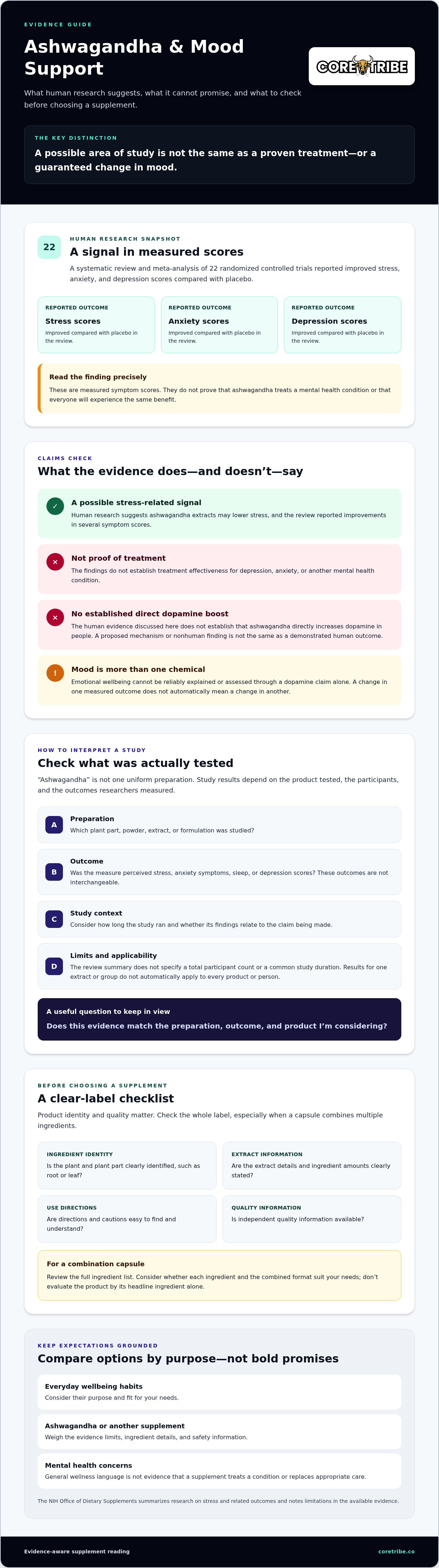
The human evidence discussed here doesn’t establish that ashwagandha directly increases dopamine in people. A proposed mechanism, or an effect observed in early or nonhuman research, isn’t the same as a demonstrated human outcome. Treat claims that an herb “boosts dopamine” cautiously unless relevant human evidence supports them.
Dopamine is one neurotransmitter involved in several brain processes, but mood is more complex than a single chemical level. A person’s emotional wellbeing can’t be reliably explained or assessed through a dopamine claim alone. Even when research explores biological pathways, that doesn’t by itself prove a meaningful or predictable change in how people feel.
Keep the question practical: What preparation was studied? What outcome did researchers measure? Does that evidence apply to the product you’re considering? The next step is to look at human research without confusing stress-related findings with proof of treatment or a guaranteed mood benefit.
What Research Says About Ashwagandha and Emotional Wellbeing
Human research offers some encouraging signals, but the findings need careful interpretation. A 2026 systematic review and meta-analysis of 22 randomized controlled trials reported improved stress, anxiety, and depression scores compared with placebo. These are measured symptom scores, not proof that ashwagandha treats a mental health condition or produces the same benefit for everyone.
What outcomes have human studies actually measured?
Researchers have examined distinct outcomes, including perceived stress, anxiety symptoms, sleep, and depression scores. These measures aren’t interchangeable. For example, a change in perceived stress doesn’t automatically show a direct improvement in mood or better sleep. The NIH Office of Dietary Supplements summarizes evidence on stress and related outcomes while emphasizing limitations in the available research. Its review notes that research suggests that ashwagandha extracts may lower stress.
The most relevant signal is a potential reduction in stress-related measures. A 2026 review of 22 randomized trials also reported improved anxiety and depression scores, but these findings don’t establish treatment effectiveness or apply to every preparation. The research summary available here doesn’t specify the review’s total participant count or a common study duration, so those details shouldn’t be assumed. A change in a questionnaire score also doesn’t establish a clinical diagnosis or its treatment.
Why results may differ from person to person
“Ashwagandha” doesn’t describe one uniform intervention. Studies may use different plant parts, extracts, formulations, and study lengths, and participants may differ in their health circumstances and starting symptoms. A result for a particular extract in a particular group can’t automatically be transferred to every capsule or blended supplement. The product label is important, but even a label that resembles a study preparation can’t guarantee a similar response.
Individual results vary, and a supplement shouldn’t replace appropriate care for persistent or concerning symptoms. Before trying one, consider the full ingredient list, directions, and cautions. Ask a qualified health professional whether it’s suitable for you, especially if you have a health condition or take medication. For broader ingredient context, see ashwagandha blend benefits and side effects.
When comparing ashwagandha for mood support, keep both the research and the specific product in view. If you’re also comparing combination supplement formats, browse Coretribe’s supplement options and assess each by its label and suitability rather than assuming a mood outcome.
Comparing Natural Mood Support Options Without Overstating Dopamine Claims
There isn’t one natural option that suits everyone, and a “dopamine support” label doesn’t tell you whether a product can improve mood. Sleep, regular movement, balanced eating, and social connection can be useful foundations for general wellbeing. Supplements have a different role: they add ingredients to consider, but they aren’t interchangeable with these habits or a substitute for care when symptoms persist.
Lifestyle foundations and supplement options serve different roles
Compare options by purpose, evidence, and suitability rather than by promises to “balance” brain chemistry. Ashwagandha research has focused on specific outcomes such as stress and anxiety. Harvard Health discusses the evidence and safety considerations behind claims that it may reduce feelings of stress and anxiety. That doesn’t establish a direct dopamine effect or guarantee a change in mood.
| Approach | Intended purpose | Evidence caveat | Key safety consideration |
|---|---|---|---|
| Sleep routine | Support regular rest and daily wellbeing | A helpful foundation, not a guaranteed mood treatment | Persistent sleep difficulties may need professional attention |
| Regular movement | Build activity into a wellbeing routine | Individual experiences vary; it doesn’t promise a specific emotional outcome | Choose activity suited to your abilities and health |
| Balanced eating and social connection | Support overall health and connection | Neither is a stand-alone treatment for ongoing symptoms | Needs and circumstances differ from person to person |
| Ashwagandha supplement | Often considered for stress-related support | Evidence depends on the preparation and measured outcome; it doesn’t prove a dopamine boost | Review cautions and check suitability with a qualified health professional |
| Combination capsule with ashwagandha | Provide multiple ingredients in one format | Evidence for one ingredient or extract may not apply to the full blend | Review every ingredient, amount, direction, and caution |
How to compare ashwagandha with other supplement choices
“Natural dopamine supplements” is a search phrase, not a scientifically established category. Instead of comparing products by that label, identify the exact ingredients and the outcome each is intended to support. Then check whether human evidence relates to that ingredient and outcome, and whether the preparation used in research matches the product. Broad claims such as “mood balance” don’t provide those details.
One combination option is Coretribe ® Pure Shilajit Capsules - Mixed Sea Moss & Ashwagandha. Assess it by reviewing its current full label and deciding whether a multi-ingredient capsule suits your needs. The information available here doesn’t establish its ingredient amounts, extract type, or mood effects. For a broader lifestyle perspective, read mind-body balance and holistic vitality. If you’re comparing supplement formats, browse Coretribe’s supplement options and assess each product by its ingredients and label, not by a dopamine promise.
How to Choose Ashwagandha for Mood Support More Carefully
A clear label can help you judge what a supplement contains, though it can’t guarantee a particular effect. Use this checklist to compare products and decide whether an option fits your needs. For ashwagandha for mood support, look beyond broad promises and check the details you can verify.
- 1. Confirm the ingredient identity. Look for the botanical name, Withania somnifera, and check which plant part is listed, such as root or leaf. Products may use different parts, so don’t assume evidence for one preparation applies to another.
- 2. Review extract details. If the label identifies an extract, check whether it explains the form or standardization. If those details aren’t provided, don’t guess what was used or treat the product as equivalent to a preparation described in a study.
- 3. Check the amount per serving. Look for a clear quantity for each ingredient. In a combination product, confirm whether the label gives separate amounts for ashwagandha and the other ingredients. Don’t fill in missing information using general dosage claims online.
- 4. Read the whole label. Review every ingredient, serving directions, warnings, and the manufacturer’s contact information. Consider whether you’re comfortable with a multi-ingredient formula, since it can be harder to tell which ingredient may be associated with an effect or side effect.
- 5. Look for quality information you can assess. Check whether the manufacturer provides accessible information about identity or independent testing, including what was tested and how. A testing statement alone doesn’t tell you its scope, and don’t assume a product has a certification unless you can verify it.
Safety questions to discuss with a qualified clinician
Your health history and medications can affect whether a supplement is suitable. Before use, ask a qualified clinician or pharmacist about possible interactions and your individual circumstances. This is especially important if you’re pregnant or breastfeeding, have thyroid or autoimmune concerns, or have a history of liver problems. Ashwagandha has been linked to rare reports of liver injury, and its long-term safety isn’t well established.
Stop and seek medical advice if you develop concerning symptoms after starting a supplement. If mood symptoms persist, worsen, or disrupt daily life, speak with a qualified health professional rather than relying on a supplement as a substitute for care.
Once you’ve reviewed the evidence and know what label details matter, explore Coretribe’s supplement collection and assess each option by its ingredients, directions, and suitability for you.
Considering Coretribe’s Ashwagandha Blend as One Product Option
If you’re comparing formats, Coretribe ® Pure Shilajit Capsules - Mixed Sea Moss & Ashwagandha is a combination capsule containing shilajit, sea moss, and ashwagandha. That description identifies the ingredients, not a proven mood effect. The information available here doesn’t confirm ingredient amounts, the ashwagandha plant part or extract, or an outcome for mood. Check the current label before deciding whether it fits your needs.
How to assess a multi-ingredient capsule
Start with the full label, not just the featured botanical. Check whether it lists each ingredient and its amount, serving directions, and any warnings. If an amount or extract detail isn’t stated, don’t assume it or infer that the formula matches a preparation used in a study.
A combination product may suit someone who prefers multiple ingredients in one capsule, but it may be less straightforward to assess than a single-ingredient product. Consider whether every listed ingredient is appropriate for you, including in light of medications and health conditions. For general context on combining these ingredients, see the Shilajit, Ashwagandha, and Sea Moss synergy guide. A discussion of ingredient combinations doesn’t establish that a blend produces a particular effect.
If you’re uncertain about suitability, these are useful questions to bring to a qualified health professional or pharmacist. The aim is to make an informed choice, not to treat ashwagandha for mood support as a guaranteed result.
When a supplement is not the right next step
A supplement shouldn’t replace a mental health assessment or prescribed care. If symptoms are severe, affect daily life, or are getting worse, seek support from a qualified health professional. The same applies if you have a safety concern or notice a troubling reaction after taking a supplement. A product label can help you understand what you’re considering, but it can’t determine what care you need.
Taking time to review the ingredients, amounts, directions, and cautions is a worthwhile first step. If this combination format interests you, check the current product label and assess it against your own needs. You can explore Coretribe’s supplement collection at your own pace.
Make Your Next Supplement Choice with Care
A thoughtful approach to ashwagandha for mood support starts with realistic expectations. Research offers signals around stress-related outcomes, but it doesn’t establish a guaranteed mood effect or prove that ashwagandha directly boosts dopamine. Product details matter, too. Check the plant part, extract information, ingredient amounts, and cautions before deciding whether a supplement suits you.
Coretribe’s Coretribe ® Pure Shilajit Capsules - Mixed Sea Moss & Ashwagandha combines shilajit, sea moss, and ashwagandha. The information available here doesn’t establish product-specific clinical evidence for a mood outcome, so review the current label and consider your own health circumstances. For persistent or disruptive symptoms, seek support from a qualified health professional rather than relying on a supplement.
If you’d like to compare supplement options, explore Coretribe’s supplement collection. Review the labels and choose an option that fits your needs.
Frequently Asked Questions
Can ashwagandha support mood?
It may support some aspects of emotional wellbeing, but it’s not a proven treatment for a mental health condition. A 2026 systematic review of 22 randomized controlled trials reported improved stress, anxiety, and depression scores compared with placebo. These findings don’t guarantee an individual benefit or show that every supplement has the same effect. When considering ashwagandha for mood support, look at the specific evidence, product, and your health circumstances.
Does ashwagandha increase dopamine?
The human evidence discussed here doesn’t establish that ashwagandha directly increases dopamine. Proposed biological mechanisms aren’t proof of an effect in people, and mood can’t be explained by one neurotransmitter alone. Be cautious of products or articles that promise a dopamine boost without relevant human evidence. Check what a study actually measured, such as stress or anxiety scores, and don’t treat those outcomes as proof of a direct dopamine effect.
How long does ashwagandha take to affect mood?
There isn’t a reliable timeline that applies to everyone. Studies vary in their preparations, participants, length, and measured outcomes, so their results can’t establish exactly when an individual might notice a change. Don’t increase the amount or continue taking a product just because you haven’t noticed an effect. Follow the label directions and ask a qualified health professional about suitability and next steps, particularly if symptoms persist or worsen.
Is ashwagandha safe to take every day?
Daily use isn’t automatically safe for everyone. Ashwagandha is generally considered safe for short-term use, up to three months, but long-term safety isn’t well established. Stomach upset and drowsiness are among the reported mild side effects, and rare cases of liver injury have been reported. It’s generally not recommended during pregnancy or breastfeeding or for people with certain thyroid or autoimmune disorders. Check with a qualified health professional before use if any concern applies to you.
Can I take ashwagandha with antidepressants or other medication?
Check with your prescriber or pharmacist before combining ashwagandha with antidepressants or other medication. Whether a supplement is suitable can depend on the specific medicine, dose, health conditions, and other ingredients in the product. Don’t stop or change prescribed treatment to try a supplement without guidance. Bring the full product label, including the ingredient list and serving directions, so a health professional can help assess possible interactions and advise you on safer next steps.
What should I look for in an ashwagandha supplement?
Choose a product with a clear label that identifies the botanical, plant part, extract details where provided, and amount per serving. Review all ingredients, directions, warnings, and manufacturer contact information, and look for accessible independent quality information without assuming a certification. Combination formulas need extra attention: check the amount of each ingredient and whether the full blend suits you. Products labeled “ashwagandha” aren’t necessarily equivalent, so don’t assume their evidence or effects are interchangeable.

